

Daily Workout Routine for Weight Loss: A Practical Guide to Quick Results
When you're trying to lose weight, it's easy to think you need punishing, hours-long workouts a few times a week. That approach often leads to burnout.
The real secret weapon for sustainable weight loss is building a consistent, daily habit of movement that fits into your life, not takes it over.
Why A Daily Routine Is Your Best Bet For Weight Loss

It’s that classic "all or nothing" trap. You start a plan, go hard for a week, miss one day, and feel like a failure. But lasting success isn't about perfection—it’s about consistency.
Every time you move, you're nudging your metabolism to work a little harder. When you do this daily, your body becomes more efficient at burning calories all day long.
Finding a Rhythm That Actually Works
Forget the idea that you need to spend hours at the gym. A smart, daily workout can be incredibly effective in just 30 minutes.
The World Health Organization suggests 150–300 minutes of moderate-intensity activity each week. That's a manageable 21–43 minutes per day—a sweet spot for weight management. You can learn more about WHO's physical activity guidelines on their site.
This daily commitment isn't just about the scale. It builds a powerful foundation for your health by:
- Improving insulin sensitivity, which helps your body manage blood sugar and store less fat.
- Boosting your mood and energy with a nice hit of endorphins.
- Strengthening your heart and improving cardiovascular fitness.
A daily workout habit is like making small, daily deposits into your health account. Over time, they compound into significant wellness and weight loss.
The Essential Parts of Every Single Workout
To get the most out of your daily routine, you need a complete session. It’s a balanced approach that gets your body ready, pushes it, and helps it recover properly.
First, a warm-up is non-negotiable. It gently gets your heart rate up, sends blood to your muscles, and seriously cuts down your risk of injury.
Next is the main event: a mix of cardio and strength training. Cardio burns calories, while strength training builds lean muscle. More muscle boosts your resting metabolism, so you burn calories even at rest.
Finally, always finish with a cool-down. A few minutes of gentle stretching helps your heart rate return to normal, improves flexibility, and reduces soreness.
The 4 Pillars of a Truly Effective Workout
Putting together a daily workout for weight loss is simple. Build your routine around four core pillars: warm-up, cardio, strength, and cool-down.
This structure gets your body ready, torches calories, builds metabolism-boosting muscle, and helps you recover so you can do it all again tomorrow.
First, The Non-Negotiable Warm-Up
Jumping straight into a tough workout is a recipe for disaster. A good warm-up gradually raises your heart rate and gets blood flowing to your muscles, which loosens up your joints.
You need dynamic stretching. This means using active movements that take your joints and muscles through their full range of motion.
A few great dynamic warm-ups include:
- Leg Swings: Grab a wall for support. Swing one leg forward and back 10-15 times, then repeat side-to-side. Switch legs.
- Torso Twists: Stand with feet shoulder-width apart, arms out. Gently twist your upper body left and right.
- Arm Circles: Make big, controlled circles with your arms—first forward, then backward.
Next, Burn Calories With Cardiovascular Exercise
Cardio is any activity that gets your heart rate up. It’s a champion at burning calories and boosting heart health.
The best part is how adaptable it is. A brisk walk, jogging in place, or finding a fun workout on our Diet & Exercise YouTube channel are all great options.
For a time-efficient calorie burn, High-Intensity Interval Training (HIIT) is your best friend. HIIT involves short, explosive bursts of effort followed by brief rest. Check out this quick and effective HIIT workout on our YouTube channel.
Then, Build a Faster Metabolism With Strength Training
Cardio burns calories during the workout, but strength training turns your body into a fat-burning machine 24/7. Building lean muscle is the key.
You can start with just your body weight. Master the form before adding weights.
- Squats: Stand with feet shoulder-width apart, chest up. Lower your hips back and down.
- Push-ups: Do them on your toes or modify on your knees. Keep your body in a straight line.
- Planks: Hold a push-up position, resting on your forearms. Squeeze your core and keep your back flat.
To level up, our Durable Resistance Bands Set is the perfect next step. Wrap a band around your thighs for squats to seriously amp up your muscle building. Finding the right mix is a game-changer; learn how to balance cardio and strength training in our guide.
Finally, The Essential Cool-Down and Recovery
Now it's time to help your body wind down. The cool-down gradually brings your heart rate back to normal and improves flexibility.
This is where static stretching comes in. Hold each stretch for 20-30 seconds, focusing on the muscles you just trained. Think of a quad stretch or a hamstring stretch.
Recovery isn't a sign of weakness; it’s where you actually get stronger. Skipping it is missing a critical step for your long-term health.
Beyond stretching, learning how to recover faster from workouts is what makes a routine sustainable. Prioritize recovery to feel strong, energized, and injury-free.
Your Weekly Workout Schedule For Any Fitness Level
Consistency is key, but having a clear daily plan gets results. I’ve mapped out a few weekly schedules by fitness level—beginner, intermediate, and advanced.
Be honest with yourself. Pick the plan that matches where you are right now. This builds momentum and helps you avoid injuries.
H3: The Beginner's Blueprint
Just starting? Your goal is to get in the habit of moving. This plan uses shorter, low-impact workouts that are easy on your joints but still effective.
Forget speed or intensity for now. Concentrate on learning proper form and getting comfortable with a regular routine. Just completing each day’s workout is a huge win.
H3: The Intermediate Accelerator
Ready to dial things up? The intermediate schedule alternates dedicated strength days with more intense cardio sessions. You'll build more lean muscle while burning more calories.
Our Adjustable Dumbbell Set is perfect for your strength days. It lets you progressively add weight to exercises like lunges and presses without needing a garage full of gear. For inspiration, check out a great total-body dumbbell workout on our YouTube channel.
H3: The Advanced Performance Plan
For those itching for a real challenge, this one’s for you. The advanced plan uses complex exercises, higher volume, and strategic workout splits to push you past plateaus.
You’ll hit different muscle groups on different days (a "split"), which allows for more focused training and proper recovery.
This diagram breaks down the four pillars that every workout in these schedules is built on.
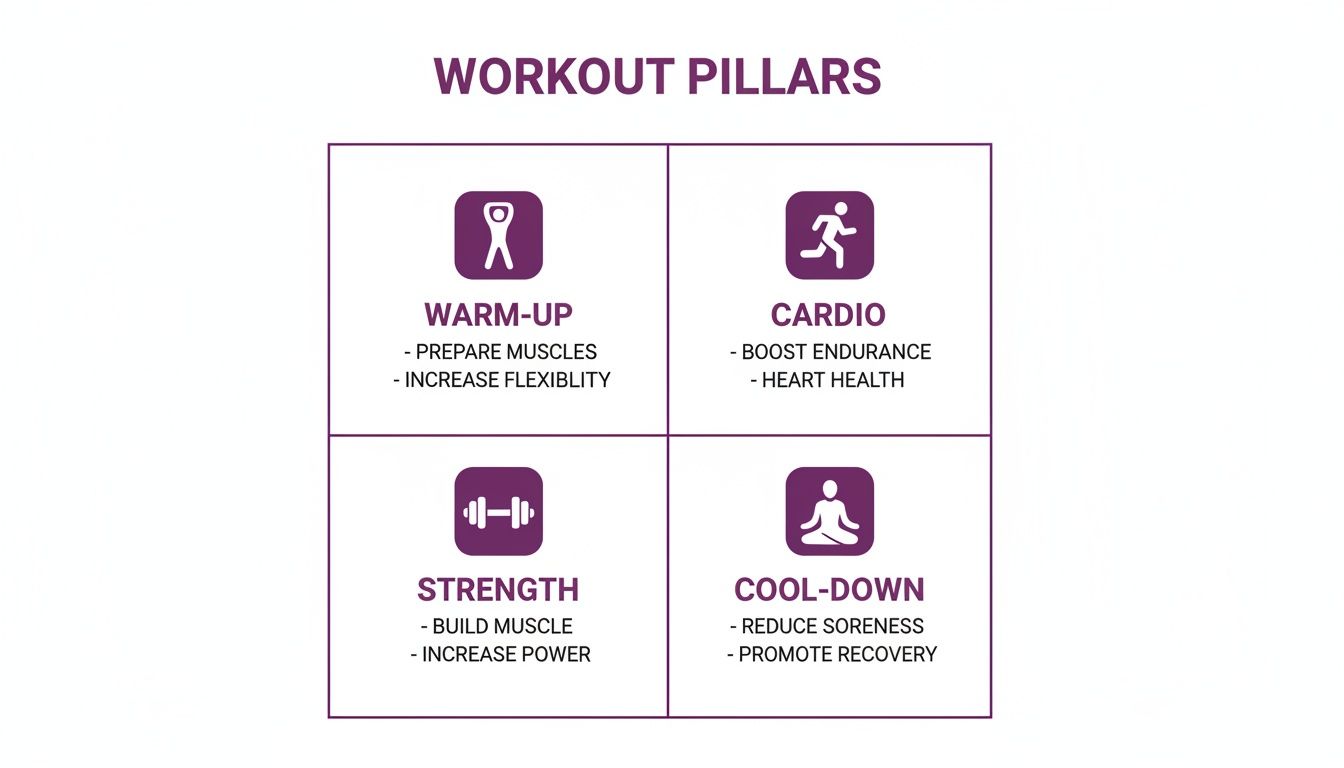
A successful session isn't just about the hard part in the middle. It's a full cycle that prepares your body, challenges it, and helps it recover.
H3: Sample Weekly Workout Schedule
Below is a table to structure your week. "Active Recovery" days are just as important as training days. Listen to your body and move days around to fit your life.
| Day | Beginner Focus (30 mins) | Intermediate Focus (45 mins) | Advanced Focus (60 mins) |
|---|---|---|---|
| Monday | Full Body Strength (Bodyweight) | Upper Body Strength (Dumbbells) | Chest & Triceps Strength |
| Tuesday | Brisk Walk or Light Jog | HIIT Cardio (Intervals) | HIIT & Core Workout |
| Wednesday | Full Body Strength (Bodyweight) | Lower Body Strength (Dumbbells) | Back & Biceps Strength |
| Thursday | Active Recovery (Stretching) | Steady-State Cardio (30-40 mins) | Legs & Shoulders Strength |
| Friday | Full Body Strength (Bodyweight) | Full Body Strength (Dumbbells) | Full Body Metabolic Conditioning |
| Saturday | Active Recovery (Long Walk) | Active Recovery (Yoga/Mobility) | Active Recovery or Skill Work (e.g., Sprints) |
| Sunday | Rest Day | Rest Day | Rest Day |
This schedule provides a balanced approach, hitting different energy systems while building in crucial rest time.
Key Takeaway: The best workout plan is the one you can actually stick with. Real progress comes from mastering your current stage and leveling up when you feel confident.
Fueling Your Body to Amplify Results
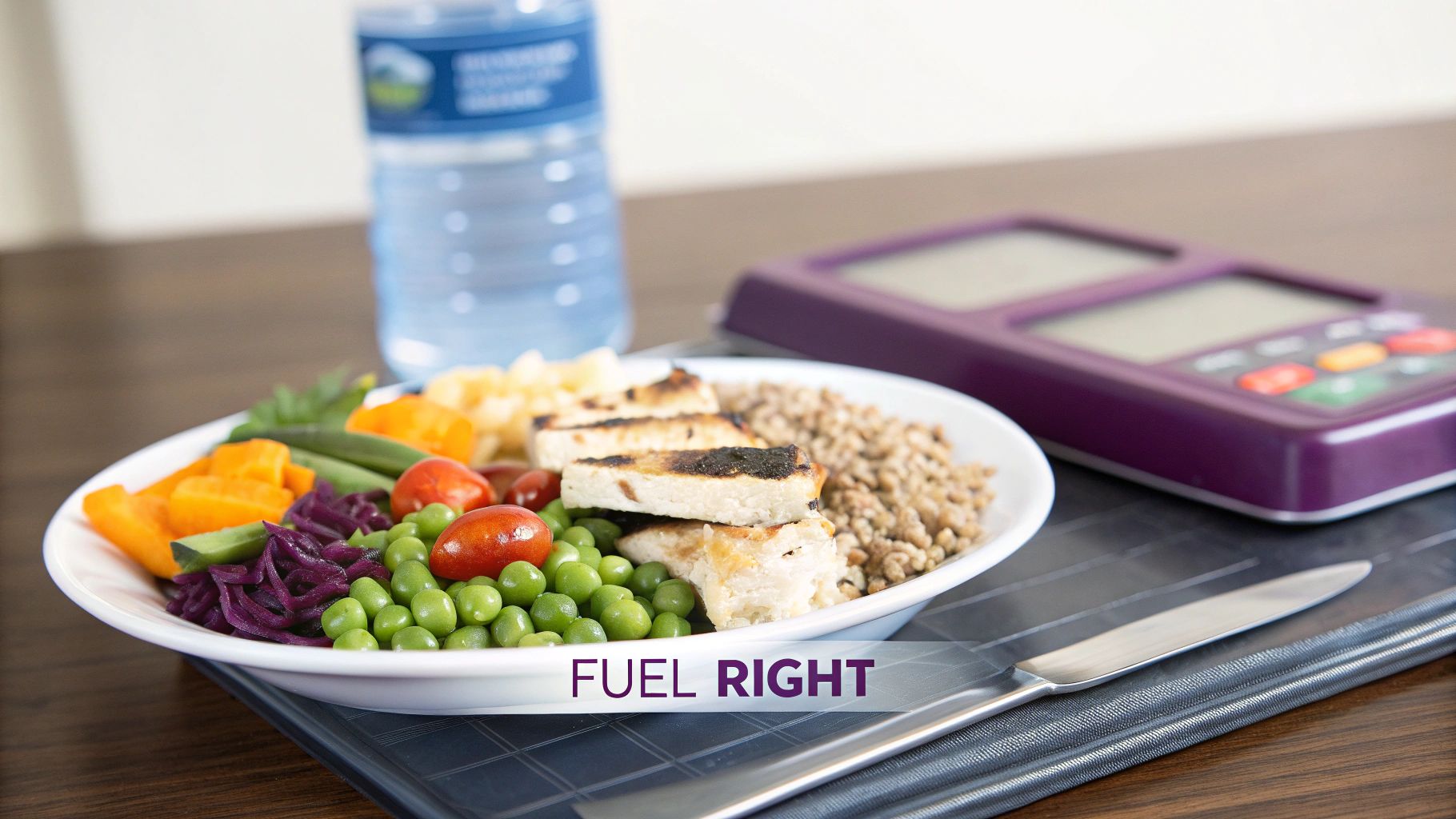
You simply cannot out-train a poor diet. While your workout routine is essential, what you eat is the force multiplier that truly determines your success.
You don't need a restrictive meal plan. Focus on adding in high-quality fuel to power your workouts, repair your muscles, and keep your metabolism fired up.
The Power Trio: Protein, Whole Foods, and Water
The foundation of a weight loss diet is simple.
First, prioritize protein. It's the building block for muscle. After a workout, protein helps repair muscle fibers, making them stronger and boosting your resting metabolism.
Next, fill your plate with whole foods like fruits, vegetables, and lean meats. They give you sustained energy without the sugar crash from processed junk.
Finally, make hydration a non-negotiable. Water is essential for countless metabolic processes, including burning fat for energy.
Smart Snacking and Post-Workout Recovery
Timing your nutrition can give you a serious edge.
- Pre-Workout Snack (30-60 minutes before): A banana or a handful of almonds is perfect for a quick energy boost.
- Post-Workout Meal (within 1-2 hours after): Aim for lean protein and complex carbs to replenish energy and kickstart muscle repair.
Think of nutrition as part of the workout. Your pre-workout snack is the warm-up, and your post-workout meal is the cool-down.
The Importance of Mindful Eating and Portion Awareness
How you eat is just as important as what you eat. Mindful eating means paying attention to your food and your body's hunger cues.
Understanding portion sizes is another game-changer. It’s easy to misjudge how much you're eating.
Using a Smart Digital Food Scale takes all the guesswork out of portion control. It gives you precise data, turning a confusing task into a simple habit. You'll quickly learn what a real serving size looks like.
Ultimately, exercise and diet work together. To really make progress, you must understand the concept of a caloric deficit. Our guide on what is a calorie deficit breaks it down perfectly.
How To Track Progress And Stay Motivated
Starting a new routine is a huge step, but the journey isn't always a straight line. Some days you'll feel great; others will be a struggle. That’s normal.
Lasting success is built on solid habits, smart tracking, and knowing why you started. When you track your progress, you prove your effort is paying off, and that's the best fuel for consistency.
Using Technology To Your Advantage
Amazing tools make tracking almost effortless. It's no surprise that Wearable Technology is a top fitness trend. You can read more about these fitness trends to see how much technology is changing the game.
Our Advanced Smart Fitness Watch takes the guesswork out of it. It automatically logs your steps, monitors heart rate, and tracks calories burned. Seeing those numbers add up is tangible proof your hard work is making a difference.
Beyond The Scale: Celebrating Non-Scale Victories
The number on the scale is just one piece of the puzzle. To stay motivated, celebrate non-scale victories (NSVs).
These are the real-world signs you’re getting healthier: having more energy, sleeping better, or noticing your clothes fit better. These are the wins that really matter.
A few NSVs to pay attention to:
- More Energy: Are you hitting that 3 PM slump?
- Better Mood: Do you feel happier and more positive?
- Clothes Fit Differently: Is that shirt a little looser?
- Getting Stronger: Can you hold that plank 10 seconds longer?
"The moments you feel your body getting stronger are the truest measures of your success. These are the victories that build unstoppable momentum."
Beyond workouts, proper diet and lifestyle tracking is a huge factor. Combining exercise data with nutrition gives you the full picture.
Overcoming The Inevitable Plateau
Sooner or later, almost everyone hits a weight loss plateau. Your progress just... stops. This is normal; it means your body has adapted.
See it as a signal to switch things up. A few small tweaks are all it takes to get things moving again.
Here are a few ways to break through a plateau:
- Turn Up the Intensity: Add jogging intervals to your walk or grab a dumbbell for your squats.
- Try Something New: Shock your system. Find a new workout on the Diet & Exercise YouTube channel, try a dance class, or go for a hike.
- Revisit Your Nutrition: As you lose weight, your calorie needs change. Check your intake to ensure you’re still in a healthy deficit.
- Get Serious About Sleep: A lack of sleep can spike cortisol, a stress hormone that tells your body to store fat. Aim for 7-9 hours of quality rest.
Staying motivated is an active process. Celebrate small wins, use tools to see your progress, and have a plan for bumps in the road.
Got Questions About Your Daily Workout? Let's Clear Things Up.
Jumping into a new routine always brings up questions. Getting solid answers is the best way to build confidence and stick with it.
How Long Do I Really Need to Work Out Each Day?
Aim for 30-60 minutes of moderate-intensity exercise most days. If you're just starting, even a consistent 20 or 30 minutes a day is a massive win.
Consistency is more important than duration. A daily 30-minute session is far better than a single, grueling two-hour gym session on a Saturday.
Should I Do Cardio or Strength Training First?
Alternating days works incredibly well. This gives your muscles time to recover while keeping your metabolism firing.
A simple schedule might look like this:
- Monday, Wednesday, Friday: Focus on strength training.
- Tuesday and Thursday: Make these your dedicated cardio or HIIT days.
This approach gives you the maximum benefit from both. For more, check out the videos on combining cardio and strength for fat loss on our YouTube channel.
What Happens If I Miss a Day?
Absolutely nothing. One missed workout won't undo your progress. The real danger is letting one missed day turn into a week. Don't fall into the "all-or-nothing" trap.
Life is messy. The goal is long-term consistency, not daily perfection. A quick 15-minute walk is a thousand times better than skipping it altogether.
Do I Need a Bunch of Equipment to Work Out at Home?
Not at all. Your own body is the most effective piece of equipment you'll ever own. Exercises like squats, lunges, push-ups, and planks are the bedrock of any solid home fitness plan.
Down the road, you can add simple tools to keep challenging yourself. But motivation and commitment are the only things you truly need.
At Diet and Exercise, our goal is to make fitness work for everyone. When you're ready to make those bodyweight exercises a bit more comfortable and effective, our Yoga Mat is a great starting point. It gives you a non-slip surface for planks, push-ups, and core work, so you can focus on your form with stability.