

Fitness Tips and Motivation: 10 Quick Wins for 2026
Welcome to your go-to guide for actionable fitness tips and motivation. If you're tired of starting and stopping, or feeling lost in a sea of conflicting advice, you've come to the right place.
We're cutting through the noise to bring you powerful, science-backed strategies that combine diet, exercise, and mindset. Whether your goal is to build strength, lose weight, or simply feel more energetic, these tips are designed to create lasting change.
This guide is your blueprint for success. We will explore ten fundamental pillars of a successful fitness journey, from setting goals that actually work to designing an environment that makes healthy choices effortless.
Each point is crafted to be immediately useful, whether you're a seasoned athlete or just beginning. These concepts work together to build momentum and ensure long-term commitment.
To kickstart your journey, why not do it in style? Our ‘Workout Motivation’ T-shirt is the perfect reminder of your commitment. Wear your goals, and let's get started.
1. SMART Goal Setting
Vague goals like "get in shape" often lead to frustration because they lack a clear roadmap. The SMART goal-setting framework transforms these wishes into concrete, actionable targets.
SMART stands for Specific, Measurable, Achievable, Relevant, and Time-bound. This method provides structure and clarity, eliminating guesswork and building a direct path to your desired outcome.
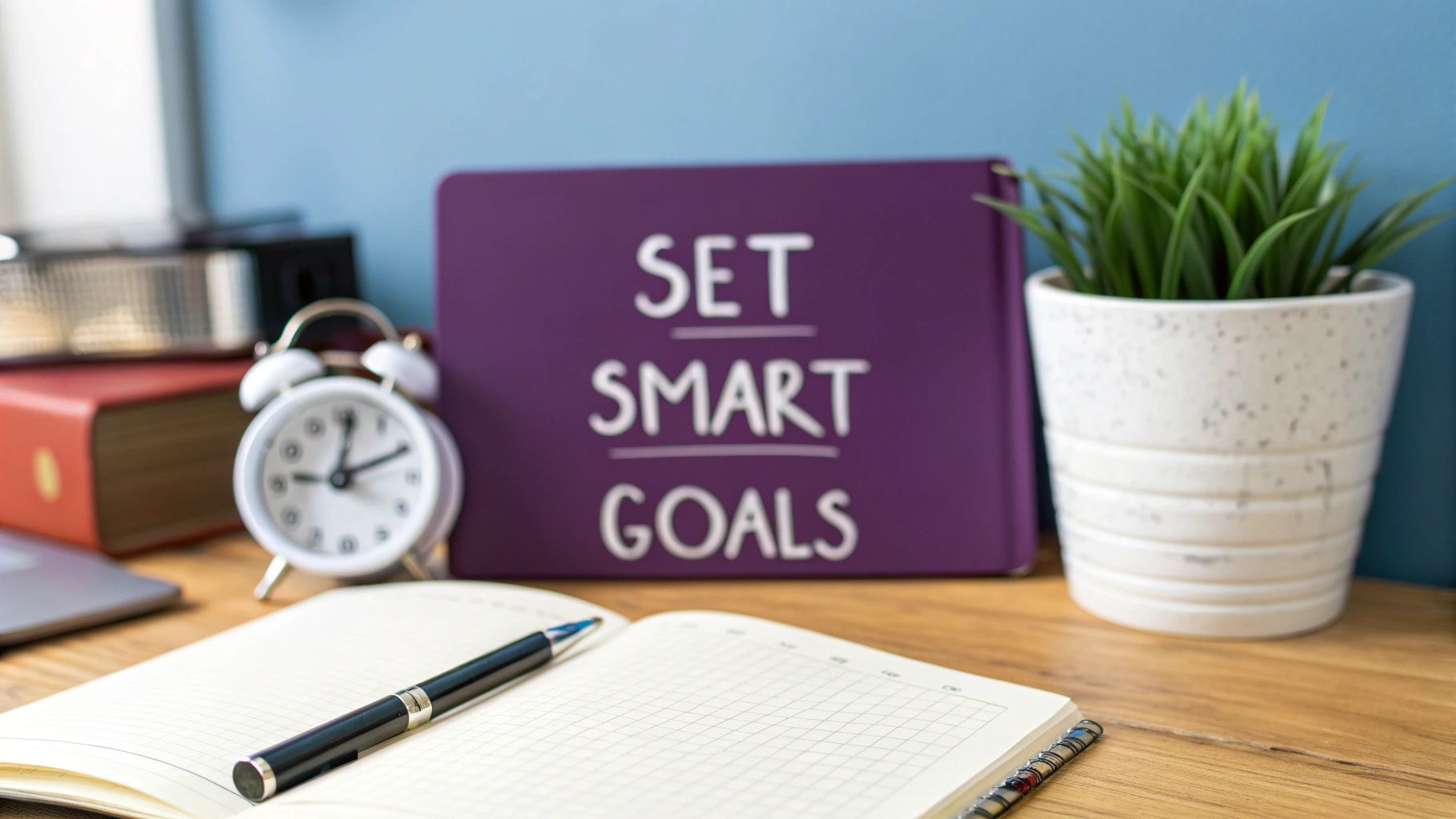
Combining Diet and Exercise for SMART Goals
To apply this method, break down your objective using each letter. Instead of "I want to get stronger," a SMART goal would combine diet and exercise: "I will increase my bench press by 20 lbs in 12 weeks by following a structured lifting program and consuming 150g of protein daily."
This integrated approach ensures both your training and nutrition support your goal, accelerating your progress. A great way to hit your protein target is with a quality supplement, like the 100% Whey Protein Powder available at our shop, which helps with muscle repair and growth.
Actionable Tips for Success
Write your goals down and post them where you’ll see them daily. Break larger goals into smaller weekly milestones, like adding 5 pounds to your lift each week.
Celebrate these small wins to maintain momentum. This structured approach makes your fitness journey feel manageable and rewarding.
2. Accountability Partners and Support Groups
Embarking on a fitness journey alone can be challenging. Accountability partners and support groups provide a powerful solution by creating a sense of shared responsibility and community.
The principle is simple: you are more likely to stick to your commitments when you know someone else is counting on you. This shared journey transforms fitness from a solitary chore into a collaborative activity.
Combining Diet and Exercise with Accountability
Implement this strategy by finding a person or group to share your integrated goals. Instead of just tracking your progress privately, you actively report it.
For example, you and a partner could commit to a "clean eating" challenge for a month while also hitting the gym three times a week. You can share meal prep photos and gym selfies to keep each other motivated. Our stylish ‘Eat Clean Train Dirty’ T-Shirt is a great way to show your shared commitment.
Actionable Tips for Success
Find someone with a similar commitment level and schedule. Establish clear expectations for communication and support.
Schedule regular check-ins, whether in person or via text. Most importantly, be honest about your challenges and celebrate each other's achievements.
3. Habit Stacking and Routine Building
Relying solely on willpower to establish new habits is often a recipe for failure. A more effective approach is habit stacking, which links a new desired behavior to an existing routine.
Habit stacking works by using a current habit as a trigger for a new one. The formula is: "After [Current Habit], I will [New Habit]." This makes it easier to stay on track without draining your motivation.
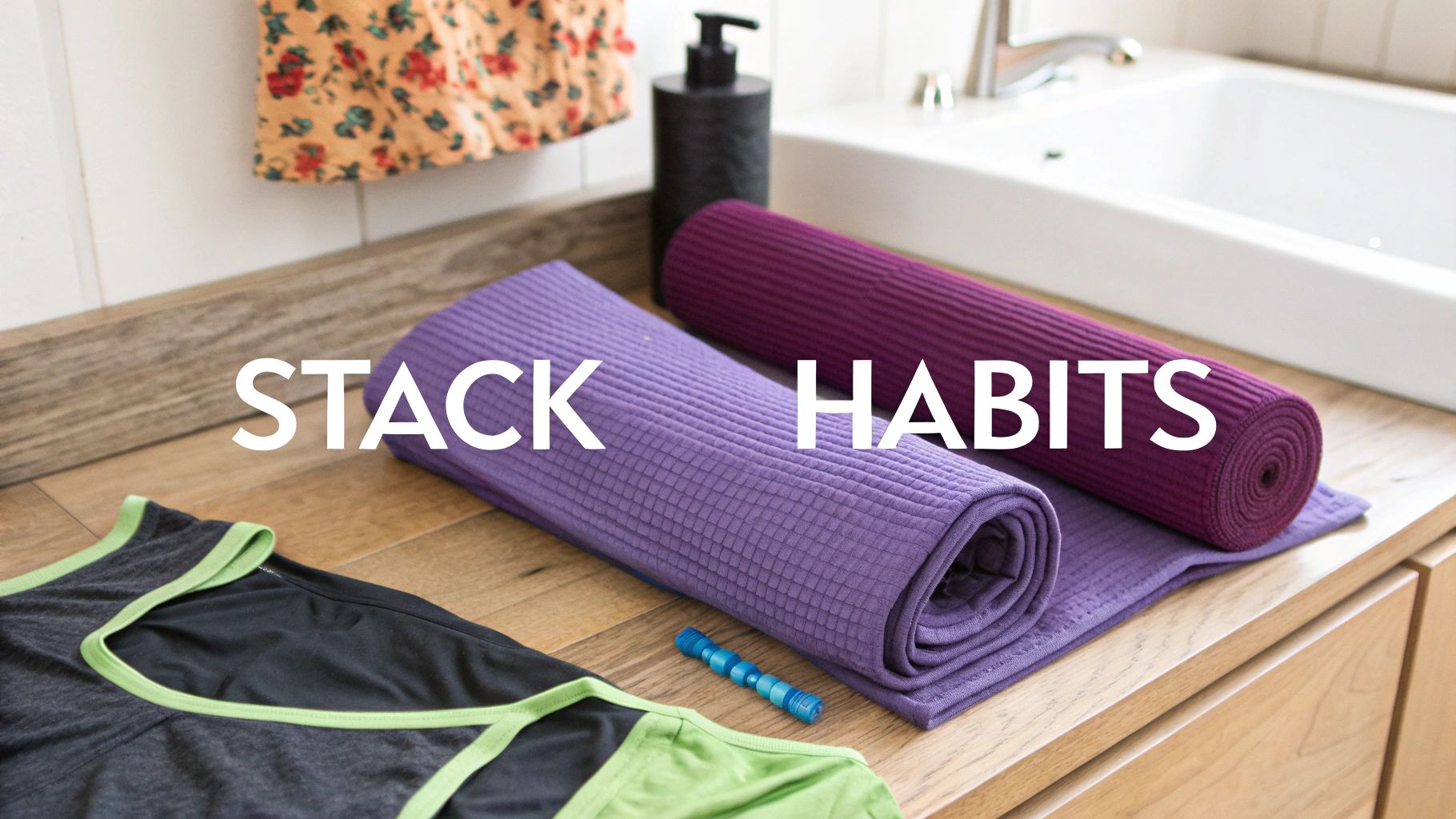
Combining Diet and Exercise Habits
To implement this technique, link your nutrition and fitness actions. For instance, you can use our Shaker Bottle to make habit stacking for post-workout nutrition seamless.
Here are a few practical examples:
- After I finish my workout, I will immediately mix my protein shake.
- After I pack my lunch for work, I will also pack my gym clothes.
- After I pour my morning coffee, I will take my daily supplements.
Actionable Tips for Success
Start with one small habit and master it before adding another. Make your new habit obvious; for instance, place your yoga mat next to your coffee machine.
Tracking your new habit on a calendar can also provide a visual sense of accomplishment, reinforcing the behavior. By anchoring your fitness goals to existing routines, you build a sustainable system.
4. Progress Tracking and Data Monitoring
Relying on how you feel can be misleading. Systematically tracking your fitness journey provides objective data that reveals true progress and keeps you accountable.
The core idea is to move beyond just the number on the scale and monitor a variety of metrics. This data-driven approach allows you to make informed decisions about your training and nutrition.
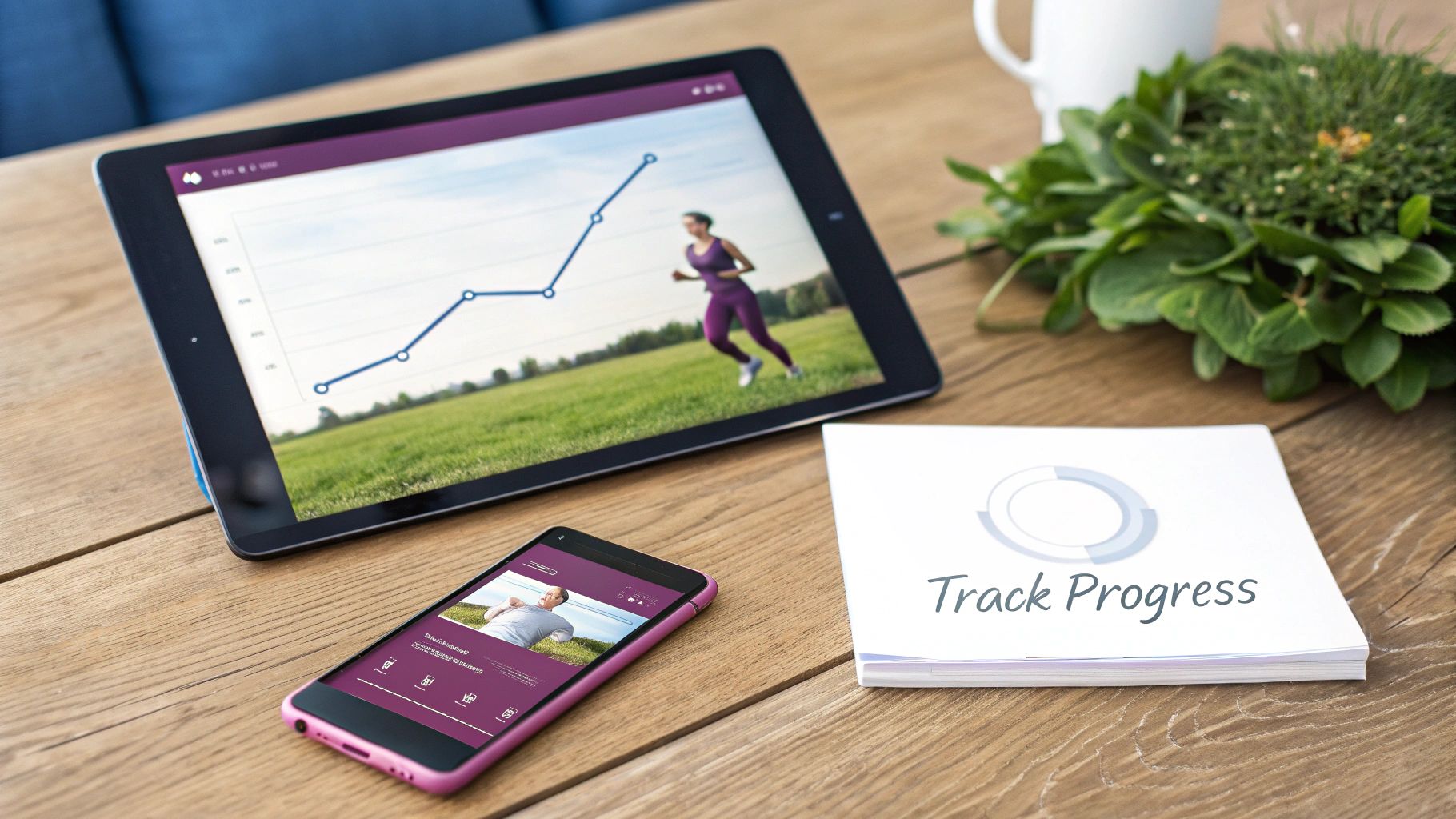
Combining Diet and Exercise Tracking
Effective tracking involves collecting consistent data on both your workouts and your meals. Use an app to log your food intake alongside your gym sessions to see how your nutrition impacts performance.
To make tracking easier, use tools that simplify the process. A Digital Food Scale is essential for accurately measuring portions and tracking calories, ensuring your diet aligns perfectly with your exercise output.
Actionable Tips for Success
Be consistent. Log your workout details and meals immediately. Focus on multiple data points beyond body weight, such as how your clothes fit or hitting a new personal record.
Review your data weekly for short-term patterns and monthly for a bigger picture of your progress. Celebrating these "non-scale victories" is crucial for maintaining long-term motivation.
5. Intrinsic vs. Extrinsic Motivation Balance
Understanding what drives you is a cornerstone of long-term success. Motivation is either extrinsic (external rewards) or intrinsic (internal satisfaction). Lasting commitment is built on intrinsic drivers.
The goal is to shift your focus from external validation to enjoying the process, feeling energized, and appreciating what your body can do. This internal drive keeps you going long after external rewards fade.
Finding Internal Drive in Diet and Exercise
Use external goals as a starting point while cultivating internal rewards. Instead of focusing solely on losing 20 pounds (extrinsic), pair it with noticing how much better you sleep after a workout (intrinsic).
A crucial part of feeling good internally is proper nutrition. Using a high-quality supplement like our Creatine Monohydrate can enhance performance, leading to a greater sense of accomplishment and fueling that intrinsic motivation.
Actionable Tips for Success
Find an activity you genuinely enjoy, whether it’s dancing, hiking, or lifting. Focus on performance-based goals, like mastering a new yoga pose, rather than just aesthetic ones.
Practice gratitude for your body's capabilities. By celebrating these internal benefits, you build a resilient and deeply personal connection to your fitness journey.
6. Visualization and Mental Rehearsal
The power of the mind is an underutilized tool in physical training. Visualization involves creating a detailed mental image of yourself successfully completing a workout or reaching a goal.
This mental practice bridges the gap between intention and action. By repeatedly imagining a successful outcome, you pre-program your body for success, reducing anxiety and reinforcing proper technique.
Visualizing Integrated Success
To implement this technique, experience your success with all your senses. Visualize not only lifting a new personal record but also the satisfaction of fueling your body correctly to achieve it.
Imagine the taste of your healthy post-workout meal and how it helps your muscles recover. This connects the dots between your diet and exercise efforts, making them feel like a unified process.
Actionable Tips for Success
Dedicate 5-10 minutes each day to visualization, ideally in a quiet space or before your workout. Create a detailed mental "script" for specific goals.
Focus on including sensory details like the clank of weights, the smell of the gym, and the feeling of your muscles contracting. Always visualize a smooth, powerful, and successful performance.
7. Variety and Progressive Overload
Hitting a fitness plateau is a common source of frustration. The principles of variety and progressive overload are your best tools to break through these barriers and maintain long-term gains.
Progressive overload is gradually increasing the demands on your body. Combining this with exercise variety prevents your body from becoming too efficient at one movement, reducing boredom and injury risk.
Integrating Diet with Progressive Overload
As you progressively overload your muscles, your nutritional needs change. To support increased training intensity, you need to adjust your diet accordingly. This might mean increasing your protein intake for muscle repair or your carbohydrates for energy.
For a simple way to boost your energy for tougher workouts, consider a pre-workout supplement. Our Pre-Workout Powder is formulated to give you the energy and focus needed to push your limits and achieve progressive overload.
Actionable Tips for Success
Change only one variable at a time, such as weight, reps, or rest time. Aim for a modest increase of 5-10% to ensure your form remains perfect.
Track your workouts in a journal to ensure you are actually progressing. Incorporate planned "deload" or recovery weeks to prevent overtraining and allow your body to fully adapt.
8. Identity-Based Motivation
Identity-based motivation reframes your fitness journey by focusing on becoming the type of person who naturally reaches your goals. This makes healthy behaviors an automatic extension of your self-image.
The goal isn't just to exercise; it's to become an active person. This transforms your mindset from "I have to work out" to "I am the kind of person who works out."
Living a Healthy Identity
To implement this method, you choose an identity and then prove it to yourself with small wins. The focus is on casting votes for your new self-image through daily diet and exercise actions.
For example, a "healthy person" doesn't just work out; they also make conscious food choices. Every time you opt for a healthy meal or a workout, you reinforce this identity. Wearing gear like our ‘Stronger Than Yesterday’ Hoodie can also serve as a powerful external reminder of your chosen identity.
Actionable Tips for Success
Start small. An "active person" might take the stairs instead of the elevator. Each decision reinforces the new belief.
Use affirming self-talk like, "I am a healthy person who makes good food choices." Surround yourself with people who already embody the identity you're building.
9. Recovery and Rest Day Prioritization
Physiological adaptations like muscle growth and strength gains happen during recovery, not during the workout itself. Prioritizing rest is a crucial fitness tip.
Treating recovery with the same seriousness as your training prevents burnout, reduces injury risk, and ensures long-term progress. True fitness is a balance of stress and recovery.
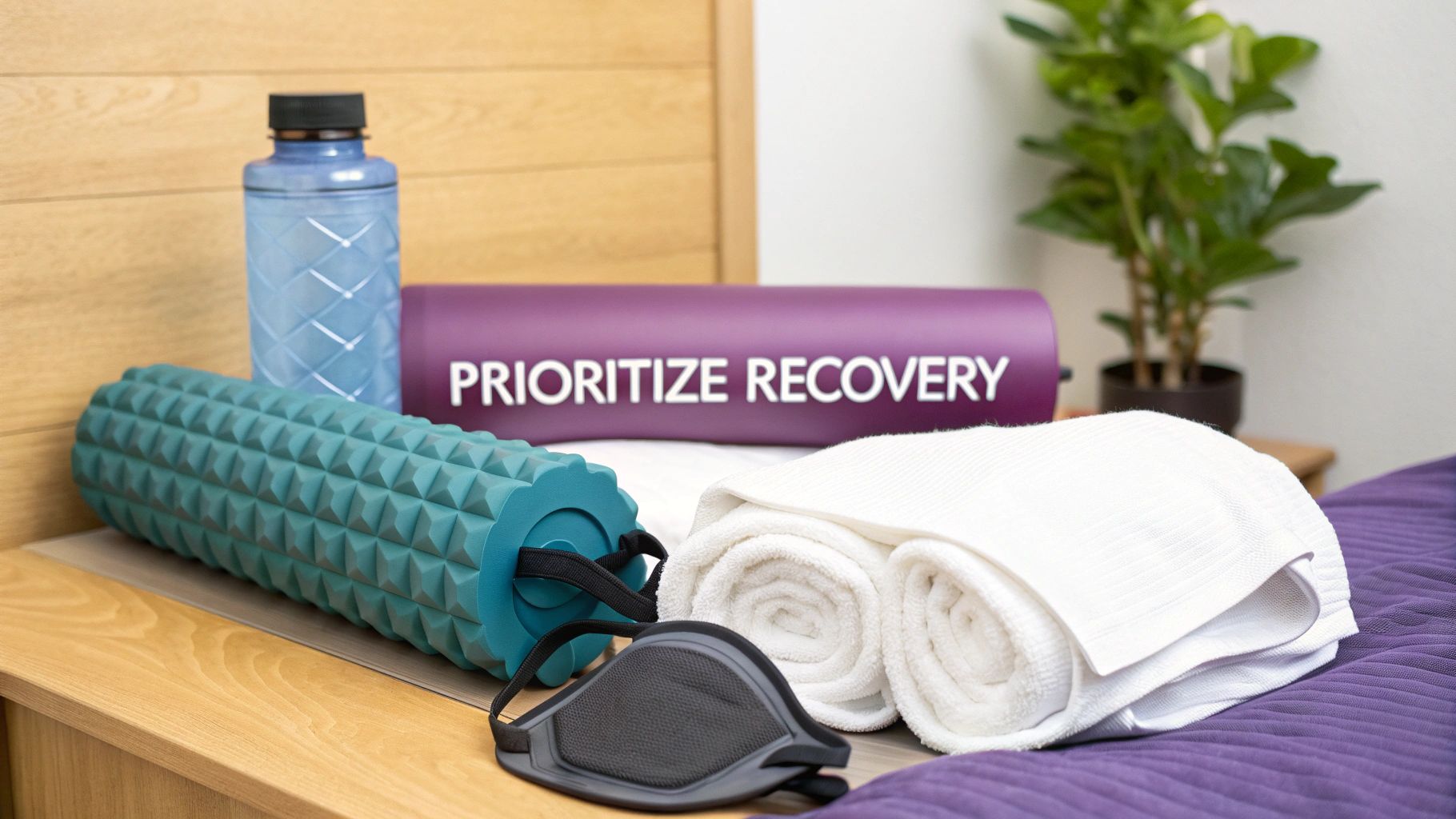
Combining Nutrition with Recovery
Recovery isn't just about rest; it's also about refueling. Consuming the right nutrients post-workout is essential for muscle repair and replenishing energy stores.
A balanced meal with protein and carbohydrates is key. For enhanced recovery, especially after intense training, our BCAA Powder can help reduce muscle soreness and support the rebuilding process, making your rest days even more effective.
Actionable Tips for Success
Schedule your recovery days in your calendar just as you would a workout. Aim for a consistent 7-9 hours of quality sleep per night.
On rest days, focus on active recovery like gentle walking or stretching. Listen to your body’s signals of overtraining and take an unscheduled day off when needed.
10. Environment Design and Friction Reduction
Relying on willpower to make healthy choices is a battle you don't need to fight. Instead, architect your surroundings to make good habits effortless and bad habits difficult.
This strategy, known as environment design, focuses on reducing the "friction" associated with positive actions. It guides your behavior with minimal mental effort.
Designing Your Diet and Exercise Environment
To implement this method, identify the steps between you and your desired behavior, then remove the barriers. This applies to both your fitness routine and your diet.
For your diet, keep healthy snacks visible and accessible. Having our Meal Prep Containers filled with nutritious meals in the fridge reduces the friction of healthy eating and makes it the easiest choice when you're hungry.
Actionable Tips for Success
Start small. Identify one friction point and solve it this week. For example, lay out your gym clothes the night before.
Use technology to your advantage by setting alarms for workouts. By consciously designing an environment that supports your goals, you make healthy choices the path of least resistance.
10-Point Fitness Motivation Comparison
| Strategy | Implementation Complexity 🔄 | Resource Requirements ⚡ | Expected Outcomes 📊 ⭐ | Ideal Use Cases 💡 | Key Advantages ⭐ |
|---|---|---|---|---|---|
| SMART Goal Setting | Medium 🔄 — requires planning and periodic review | Low ⚡ — time to set and track goals | Clear measurable progress; higher success rates 📊 ⭐⭐⭐ | Time-bound targets, training cycles, measurable goals | Clarity, accountability, objective milestones |
| Accountability Partners & Support Groups | Medium 🔄 — coordination and group dynamics | Medium ⚡ — people, regular check-ins, apps | Greatly increased adherence and consistency 📊 ⭐⭐⭐ | Those needing social support or motivation | Social reinforcement, accountability, motivation |
| Habit Stacking & Routine Building | Low-Medium 🔄 — identify anchors and build gradually | Low ⚡ — minimal tools, time for cues | High long-term adherence once automatic 📊 ⭐⭐⭐ | Daily routines, busy schedules, behavior automation | Automaticity, reduced decision fatigue, sustainable |
| Progress Tracking & Data Monitoring | Medium 🔄 — consistent logging and review | Medium ⚡ — apps, wearables, time to record | Objective trends and informed adjustments 📊 ⭐⭐⭐ | Data-driven training, plateau troubleshooting | Evidence-based decisions, motivation from visible gains |
| Intrinsic vs Extrinsic Motivation Balance | High 🔄 — requires self-reflection and gradual shift | Low ⚡ — introspection, possible coaching | Long-term sustainability when intrinsic dominates 📊 ⭐⭐⭐ | Long-term behavior change, avoiding burnout | Sustainable enjoyment, resilience, internal drive |
| Visualization & Mental Rehearsal | Low 🔄 — learn techniques and practice regularly | Low ⚡ — short daily sessions, quiet space | Moderate performance and confidence gains when paired with practice 📊 ⭐⭐ | Competition prep, technical skill rehearsal | Boosts confidence, primes motor patterns, low cost |
| Variety & Progressive Overload | High 🔄 — structured periodization and progression | Medium-High ⚡ — knowledge, equipment, planning | Continued physical adaptation and fewer plateaus 📊 ⭐⭐⭐ | Strength/endurance progression, intermediate+ trainees | Ongoing progress, injury risk reduction, engagement |
| Identity-Based Motivation | High 🔄 — sustained identity change and reinforcement | Low ⚡ — consistent actions, community or cues | Very high adherence if identity is internalized 📊 ⭐⭐⭐ | Lifelong lifestyle shifts, habit permanence | Automatic choices, reduced willpower, robust persistence |
| Recovery & Rest Day Prioritization | Medium 🔄 — scheduling and lifestyle adjustments | Medium ⚡ — sleep hygiene, recovery modalities | Improved performance, reduced injury and burnout 📊 ⭐⭐⭐ | High-volume programs, long-term consistency | Enhances adaptation, longevity, mental recovery |
| Environment Design & Friction Reduction | Medium 🔄 — initial setup and cue design | Low-Medium ⚡ — rearranging space, apps, planning | Greater consistency by making healthy choices default 📊 ⭐⭐⭐ | Beginners, busy people, initial habit formation | Lowers willpower needs, increases default healthy behavior |
Your Journey Continues: Putting Motivation into Motion
You now have a roadmap of powerful fitness tips and motivation strategies. We've moved beyond generic advice to explore the frameworks that create lasting change.
The journey ahead is about integration and consistent application. True transformation happens when you begin weaving these concepts together into a cohesive personal system.
Synthesizing Your Strategy for Lasting Success
Think of each tip as a building block. Your task is to construct a fitness routine and mindset that is uniquely yours.
- Combine Structure with Flexibility: Use SMART Goal Setting to define your destination but lean on Variety and Progressive Overload to make the journey engaging.
- Link Actions to Identity: The most powerful shift occurs when "I need to work out" becomes "I am a person who stays active."
- Balance Effort with Recovery: Pushing your limits is crucial, but true strength is built during rest. For a guided approach to active recovery, check out our "Mindful Movement" series on the Diet & Exercise YouTube channel.
Making Motivation Your Default Setting
The ultimate goal is to make healthy choices feel like an automatic reflex. This is where Environment Design becomes your greatest ally.
Consider this practical application: place your workout clothes right by your bed. This simple act makes your morning workout an easier choice. You are programming your environment to give your motivation a constant boost.
Your mindset is the other half of this equation. Techniques like Visualization prepare you mentally for challenges. When you combine this with an optimized environment, you create a powerful synergy that makes consistent action almost inevitable. The power is now in your hands to build, adapt, and conquer your goals.
Ready to wear your motivation and surround yourself with reminders of your commitment? The curated collections at Diet and Exercise are designed to fuel your fitness journey. Find everything from performance gear to motivational accessories that keep your goals front and center at Diet and Exercise.