

How to Measure Body Fat Percentage at Home
Stepping on the scale only gives you a single number. It doesn't tell the whole story about your health. The real key is understanding how to measure body fat percentage.
This one metric offers far more insight than weight alone. It reveals the crucial ratio of fat to lean mass, which is a much better indicator of your fitness progress and overall well-being.
Why Body Fat Matters More Than Your Weight
Have you ever started a new diet and workout plan, felt great, but the number on the scale refused to budge? This is a common frustration, but it often signals a positive change your scale can't see.
You could be losing fat while building lean muscle. Muscle is much denser than fat and takes up less space. This is exactly why focusing only on pounds or kilograms can be so misleading.
Someone with a "healthy" weight might still have a high body fat percentage. On the flip side, an athlete with a lot of muscle might be flagged as "overweight" by old-school measures like BMI, even though they're in peak shape. To dig deeper, read our guide on what is body composition.
Beyond the Scale a Truer Picture of Health
Knowing your body fat percentage empowers you to make smarter decisions about your health. It helps you set meaningful goals that go way beyond just "losing weight."
Instead, you can focus on fat loss and muscle gain. This directly impacts your metabolism, your strength, and even how your clothes fit.
The rise of obesity as a global issue has pushed for better ways to measure our health. Back in the early 1960s, only about 13% of Americans were classified as obese. By 2023, that number had skyrocketed to nearly 40%.
Tracking body composition gives you a much clearer picture of your progress. It helps you distinguish between losing fat and losing muscle, ensuring your hard work is actually paying off the right way.
To understand what a healthy body fat percentage is for you, it helps to see how your numbers stack up. Comparing your results to normative data in sports science gives your numbers context based on age and gender. This guide will walk you through the different methods available.
Your Guide to At-Home Body Fat Measurement
Knowing you need to track your body fat is the first step, but how do you actually do it? The good news is you don't need a fancy lab or expensive equipment to get a solid estimate.
Several reliable methods let you measure body fat percentage right from home. Some methods are quick but less precise. Others take more practice but can yield accurate results. Let’s break down the most popular options.
The Skinfold Caliper Approach
One of the oldest and most trusted at-home methods involves using skinfold calipers. You gently pinch the skin and the fat underneath it at specific spots on your body.
You use the caliper tool to measure the thickness of that fold. Then you plug those numbers into a formula to get your body fat estimate. The go-to formula is usually the 3-site Jackson/Pollock method.
For men, this means measuring the chest, abdomen, and thigh. For women, the sites are the triceps, the suprailiac (right above your hip bone), and the thigh. Consistency is key—always measure on the same side of your body. For a great deep dive, check out this guide on using calipers for body fat measurement.
My Pro Tip: Don't just take one measurement and call it a day. Pinch and measure each site three times, then use the average of the three. This simple extra step smooths out any small errors and gives you a much more reliable number to work with.
When done right, calipers can be surprisingly accurate, often getting you within 3-5% of what a high-tech clinical test would show. Just be patient—there's a bit of a learning curve.
Bioelectrical Impedance (BIA) and Smart Scales
If the idea of pinching yourself doesn't sound great, a smart scale that uses Bioelectrical Impedance Analysis (BIA) is a fantastic, zero-effort alternative.
These scales work by sending a tiny, completely safe electrical current up one leg and down the other. Muscle, fat, and water all conduct electricity differently. The scale measures the speed of the current (its impedance) to estimate your body composition.
Modern scales make it simple. You just step on the scale, and within seconds, it calculates your stats and syncs everything to an app on your phone. To get the most out of a BIA scale, consistency is everything.
- Measure at the same time. The best time is right after you wake up and use the restroom, before you’ve had anything to eat or drink.
- Keep your hydration levels steady. Being dehydrated can falsely inflate your body fat number, while being over-hydrated can make it look lower than it is.
- Don't measure right after a workout. Exercise messes with your body's fluid balance and will definitely skew the results.
This infographic shows why tracking body fat is such a crucial step up from just looking at the number on the scale.
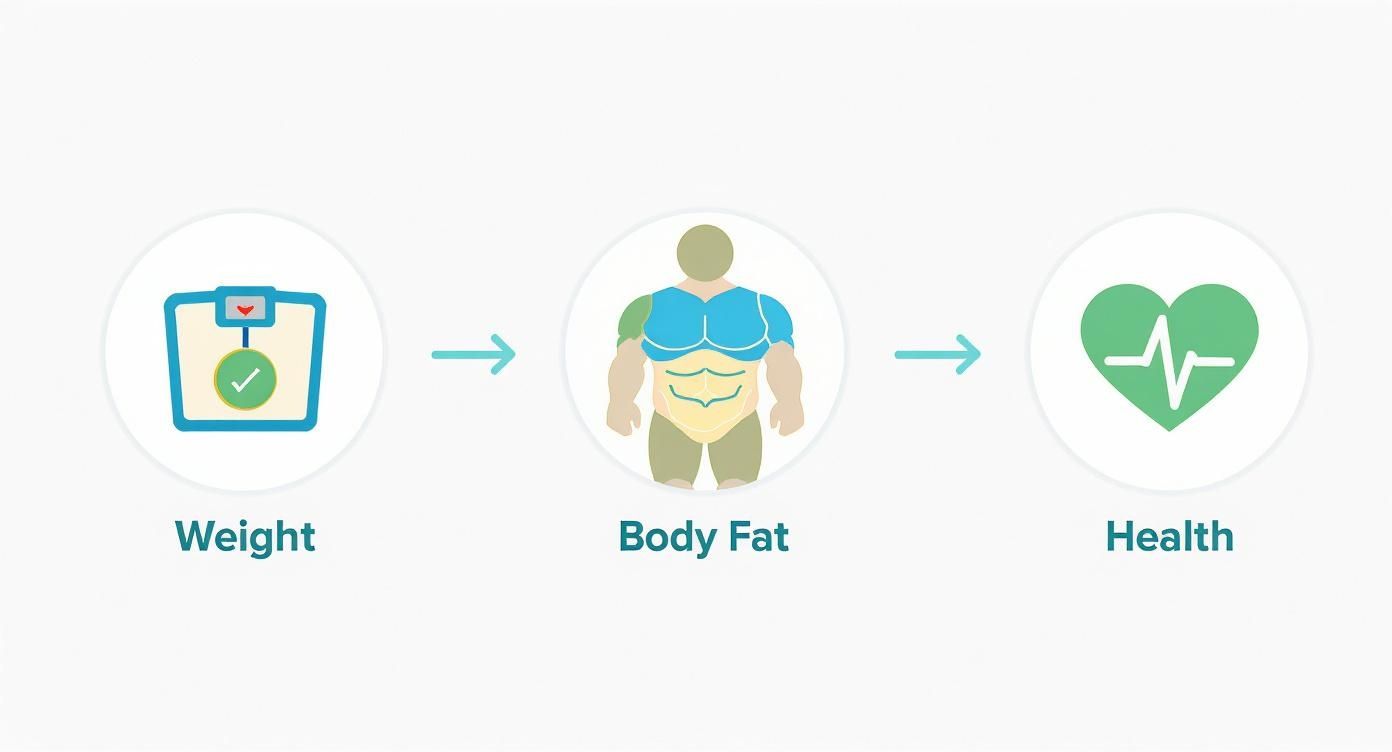
It’s a clear visual reminder that understanding your body composition is the key link between simply weighing yourself and truly improving your overall health.
The U.S. Navy Circumference Method
Looking for something even simpler? The U.S. Navy circumference method has you covered. All you need is a flexible tape measure.
This technique uses your height, neck, and waist measurements (plus hips for women) to calculate your estimated body fat percentage. Developed back in the 1980s, this method was validated against gold-standard techniques and found to have an average error of about 3-4%.
The formulas look a bit intimidating, but you don't need to do the math yourself:
- For Men: %Fat = 86.010 * log10(waist - neck) - 70.041 * log10(height in inches) + 36.76
- For Women: %Fat = 163.205 * log10(waist + hips - neck) - 97.684 * log10(height in inches) - 78.387
Just plug your measurements into any online "Navy Body Fat Calculator" and it will do the work for you. Make sure the tape is snug against your skin but not digging in.
Comparing At-Home Body Fat Measurement Methods
This quick table breaks down the most common at-home methods, highlighting their differences in accuracy, cost, and ease of use.
| Method | Typical Accuracy Range | Cost | Ease of Use |
|---|---|---|---|
| Skinfold Calipers | ±3.5% | Low | Moderate (Requires practice) |
| BIA Smart Scales | ±3-5% | Moderate | Very Easy |
| Navy Tape Measure | ±3-4% | Very Low | Easy |
So, which one should you choose? Calipers are cheap but take skill. Smart scales are incredibly convenient. The tape measure method is the most accessible.
The best method is the one you'll actually use consistently. Pick one, stick with it, and focus on the trend over time, not the single-day number.
When to Consider Professional Body Fat Testing
While at-home methods provide fantastic data, sometimes you might want higher precision. Competitive athletes or anyone serious about a major transformation can get invaluable insight from a professional test.
Clinical-grade testing removes the guesswork and user error. These advanced methods are often called the "gold standard" because they measure your body directly. If you've hit a plateau, a professional test provides the data to fine-tune your approach.
DEXA Scans: The Gold Standard
For pure accuracy, the Dual-Energy X-ray Absorptiometry (DEXA) scan is top-tier. It was originally developed to measure bone density but is now the go-to for body composition analysis.
During a DEXA scan, you lie still on a table as a scanning arm passes over you. It uses two low-dose X-ray beams to differentiate between bone mass, fat mass, and lean muscle mass. The result is a precise map of your entire body.
The real power of a DEXA scan is its ability to see beyond just the total numbers. It can reveal muscle imbalances between your left and right sides, which is incredibly useful for tailoring your strength training program.
Because its accuracy is so high (often within a 1-2% margin of error), a DEXA scan is the best way to get a definitive measurement.
Hydrostatic (Underwater) Weighing
Before DEXA, hydrostatic weighing was the benchmark for accuracy. This method works on Archimedes' principle: fat is less dense than muscle, so it floats more easily.
The process involves being lowered into a large tank of water after you’ve exhaled as much air as possible. Your underwater weight is then compared to your weight on dry land. You can learn more about the history of body fat percentage charts and how our understanding has evolved.
While highly accurate, the experience can be intense for some people. It’s become less common now that more convenient technologies are available.
Air Displacement Plethysmography: The Bod Pod
Want the accuracy of a density-based measurement without getting wet? Air Displacement Plethysmography (ADP) is the answer. The most well-known device is the Bod Pod.
Much like underwater weighing, the Bod Pod measures your body density, but it uses air instead of water. You sit inside the sealed chamber for a few minutes while it measures the volume of air you displace.
The Bod Pod offers accuracy that’s right up there with hydrostatic weighing, typically within a ±2-3% margin of error. It’s a fast, comfortable, and highly reliable alternative.
Professional testing gives you pinpoint precision, but consistent tracking with reliable at-home tools, like those from the Diet and Exercise Shop, is crucial for monitoring day-to-day progress.
Common Mistakes That Skew Your Results
Getting a reliable body fat reading isn't about chasing a single number. It's about tracking a consistent trend over time. But if your daily habits are all over the map, your data will be, too.
Let’s dig into the common mistakes that can throw off your results and how to sidestep them.
The single biggest culprit that messes with at-home measurements, especially from BIA scales, is your hydration level. Muscle holds a lot of water, which conducts electricity well. Fat tissue contains very little. This means small shifts in fluid balance can send your results on a wild ride.
The Problem with Timing and Prep
Many people measure their body fat whenever they think about it. This is a surefire way to get inconsistent data.
Measuring right after a tough workout, for instance, is a classic mistake. You've lost water through sweat, which can make your body fat percentage temporarily read higher on a BIA scale.
What you consume has a huge impact, too:
- A big meal or a lot of water: This adds temporary weight and fluid, which can easily interfere with an electrical current and skew the reading.
- Caffeine or alcohol: Both act as diuretics, making you lose water. This can lead to mild dehydration that might artificially inflate your body fat reading.
The real key is to build a consistent, repeatable routine for your measurements. You have to treat it like a mini science experiment—to get reliable data, you need to control the variables as much as possible.
Technique and Tool Errors
Even if your timing is perfect, small errors in how you physically take the measurement can throw everything off.
When using skinfold calipers, the most common issue is pinching the wrong spot. The popular Jackson/Pollock method has very specific sites. Being off by even an inch can significantly alter the result.
With a tape measure, the main offender is an unlevel tape. It's surprisingly difficult to keep it perfectly horizontal all the way around your waist or hips.
Building a Reliable Measurement Routine
To get data you can trust, you need a simple, consistent process. The goal is to measure under the exact same conditions every single time.
Here’s a simple checklist to get it right:
- Measure first thing in the morning. The best time is right after you wake up and use the restroom, before you’ve had anything to eat or drink.
- Hold off on that morning coffee. Don't have any food or even a glass of water until after you've taken your measurement.
- Don't work out beforehand. Save your exercise for later in the day.
- Use the same device every time. Stick with the same scale, calipers, or tape measure.
Consistency is your absolute best friend when learning how to measure body fat percentage. By creating this simple ritual, you’ll be able to confidently track your progress.
How to Improve Your Body Composition
Alright, so you've figured out how to measure your body fat percentage. That number is your starting line. The real work begins now, with a smart plan to improve it.
When we improve body composition, we’re chasing two goals: dropping body fat while building or holding onto lean muscle.
This isn't about crash dieting. The secret is weaving together smart nutrition and effective exercise into a routine you can stick with. Let's map out how to do it.
Fueling for Fat Loss The Right Way
Fat loss always comes down to one core principle: creating a calorie deficit. You have to burn more calories than you take in.
A smart approach is to aim for a modest deficit of about 300-500 calories a day. This is the sweet spot for sustainable fat loss. Load up on whole, nutrient-dense foods like lean proteins, complex carbs, and a ton of vegetables.
Remember, the goal isn't just weight loss; it's fat loss. Prioritizing protein is non-negotiable. It helps ensure that the pounds you're shedding are coming from fat stores, not your hard-earned muscle.
This is where a quality whey protein supplement can be a game-changer. A quick scoop of Premium Whey Protein after a workout helps kickstart muscle repair and makes hitting your daily protein goal so much easier.
Building Muscle to Boost Your Metabolism
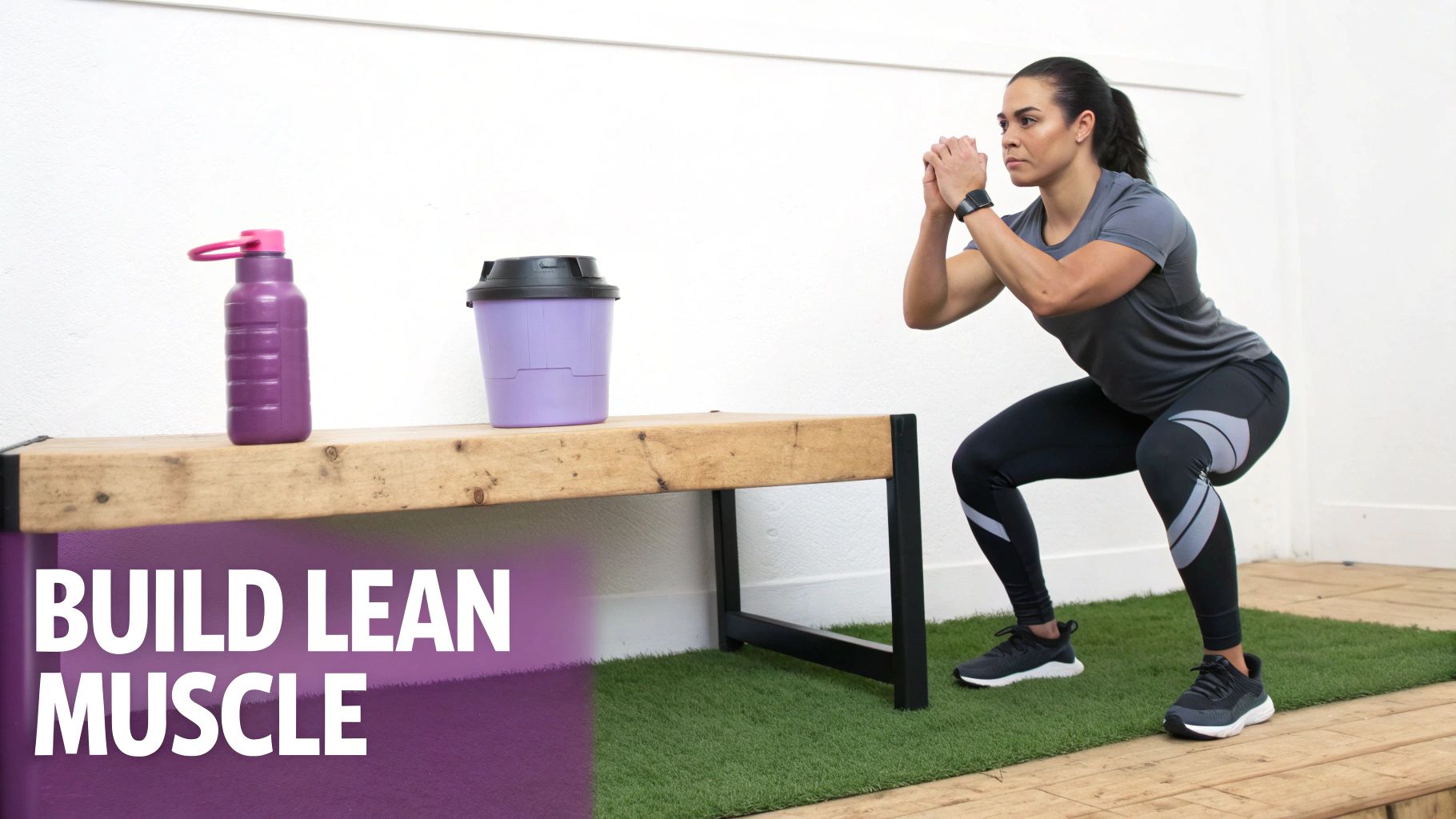
While diet creates the deficit, resistance training sculpts your physique. Building muscle turns your body into a more efficient fat-burning furnace. Muscle is metabolically active, which means it burns calories around the clock.
Focus on big, compound movements—squats, deadlifts, push-ups, and rows. These are the heavy hitters that stimulate serious muscle growth and torch calories. For more, check out our guide on how to build muscle mass.
You don’t need a fancy gym membership. A versatile tool like a set of resistance bands can deliver a killer workout anywhere.
- Bicep Curls: Stand on the band, grab the ends, and curl up toward your shoulders.
- Squats: Loop the band under your feet and hold the ends at shoulder height for constant tension.
- Glute Bridges: Wrap a band around your thighs (just above the knees) to really fire up your glutes.
Our Resistance Band Sets are perfect for adding that extra challenge to your home workouts, making it easy to progressively overload your muscles and spark new growth.
The Cardio and Recovery Connection
Cardio is a fantastic tool for torching extra calories. A blend of both steady-state cardio (like a brisk walk) and high-intensity interval training (HIIT) works best.
But don’t forget: the magic happens outside the gym. Your muscles grow while you're resting. Make sleep a top priority and give your body enough time to repair itself between workouts.
Looking for a routine that pulls all of this together? Check out this full-body workout from the Diet & Exercise channel. It’s a perfect showcase of how to blend strength and conditioning.
Answering Your Top Body Fat Questions
So, you’re diving into the world of body fat measurement. It's natural to have questions. Getting a handle on these details is the key to tracking your progress without driving yourself crazy.
Let's cut through the confusion. Here are straightforward answers to the questions I hear most often.
How Often Should I Measure My Body Fat Percentage?
Measuring your body fat every single day is a surefire way to get frustrated. Your body’s hydration and glycogen stores fluctuate constantly, causing daily readings to bounce around.
For a much clearer picture of your real progress, I always recommend measuring every 2 to 4 weeks. This gives your body enough time to make genuine changes. The golden rule is consistency—always test under the exact same conditions.
What Is a Healthy Body Fat Percentage?
This is a big one, and the honest answer is: there's no single magic number. What's "healthy" really depends on your age, gender, and activity level. Still, it helps to have a general ballpark to aim for.
These are the widely accepted ranges that support good overall health for most people:
- For Women: A healthy range typically falls between 21-33%.
- For Men: The ideal range is generally considered to be 8-20%.
Keep in mind that dedicated athletes will often have percentages well below these ranges. The real goal isn't just to hit a number on a chart, but to find a percentage where you feel strong, healthy, and full of energy.
Why Does My Smart Scale Reading Change So Much?
If you've ever stepped on a smart scale and seen your body fat percentage jump five points overnight, you're not alone. This is a classic quirk of bioelectrical impedance analysis (BIA).
BIA scales are extremely sensitive to your hydration levels. The tiny electrical current they send through your body travels differently through water than it does through muscle or fat. So, anything that shifts your body's fluid balance—a sweaty workout, a carb-heavy meal, or being a little dehydrated—can throw off the reading.
To get the most reliable trend from your scale, be disciplined about weighing yourself at the same time and under the same circumstances every time. First thing in the morning is usually best.
Ready to start your own fitness journey with the right gear? At Diet and Exercise, we've got everything from effective workout equipment to fun, motivating apparel. Check out our Resistance Band Sets to take your home workouts to the next level.