

How to Prevent Muscle Soreness: A Quick Recovery Guide
Preventing muscle soreness isn’t about some magic bullet. It's about a smart, consistent approach.
You need a good mix of proper warm-ups, sensible workout progression, and a real focus on recovery. This combination gets your muscles ready for work and helps them repair efficiently.
Understanding Muscle Soreness And How To Prevent It
We’ve all been there. That deep, familiar ache that settles in a day or two after a tough workout is Delayed Onset Muscle Soreness, or DOMS.
DOMS is caused by microscopic tears in your muscle fibers—the direct result of pushing your body past its usual limits.
While it’s a normal sign that your muscles are adapting, too much soreness can slow your progress. The goal is to give your body the right tools to recover and come back stronger.

Learning how to prevent muscle soreness means building a routine that supports your body before, during, and after you train. This involves weaving smart exercise habits into your life alongside supportive lifestyle choices, especially when it comes to diet and rest.
The Role Of Diet And Exercise Together
You can't out-train a bad recovery plan. Your physical effort in the gym is only half the battle.
Pairing your workouts with the right nutritional strategy is where the magic happens. Good nutrition provides the literal building blocks for muscle repair, while smart workout programming ensures you're not causing more damage than your body can handle.
A solid nutritional plan makes a world of difference. For example, nutrition impacts muscle soreness recovery by providing the fuel for tissue healing and topping off energy stores.
Think of your workout as the construction crew, but your diet is the truck delivering high-quality bricks and mortar. Without the right materials, the structure you're trying to build will always be weak.
Quick Guide To Soreness Prevention
| Phase | Strategy | Key Benefit |
|---|---|---|
| Before Workout | Dynamic Warm-Up | Increases blood flow and muscle elasticity, reducing injury risk. |
| During Workout | Gradual Progression | Allows muscles to adapt over time, preventing system shock. |
| During Workout | Stay Hydrated | Proper hydration supports muscle function and nutrient transport. |
| After Workout | Cool-Down & Stretch | Helps muscles relax and begins the recovery process. |
| After Workout | Protein & Carbs | Provides essential nutrients for muscle repair and energy replenishment. |
| Rest Days | Active Recovery | Light movement improves circulation and eases stiffness. |
Sticking to these fundamentals consistently separates those who are constantly sidelined by soreness from those who use it as a signal of progress.
Key Strategies For Soreness Prevention
To effectively manage soreness, focus on a few core areas that deliver real results.
- Warm-Up and Cool-Down: A dynamic warm-up gets your body ready for action, while a static cool-down helps it shift into recovery mode.
- Progressive Overload: Slowly increasing the weight, reps, or intensity gives your body time to adapt, which prevents severe soreness.
- Nutrition and Hydration: Fueling up with protein, carbs, and water is non-negotiable for muscle repair.
- Active Recovery: On rest days, light movement like walking or stretching boosts blood flow and reduces stiffness.
By paying attention to these simple but powerful elements, you create an environment where your muscles can bounce back faster and grow stronger.
Build A Foundation With Smart Warm-Ups And Cooldowns
Diving into a workout without any prep is an easy way to guarantee you'll be in pain the next day. Think of your warm-up and cooldown as non-negotiable parts of your routine.
They are your first and best defense against serious muscle soreness.
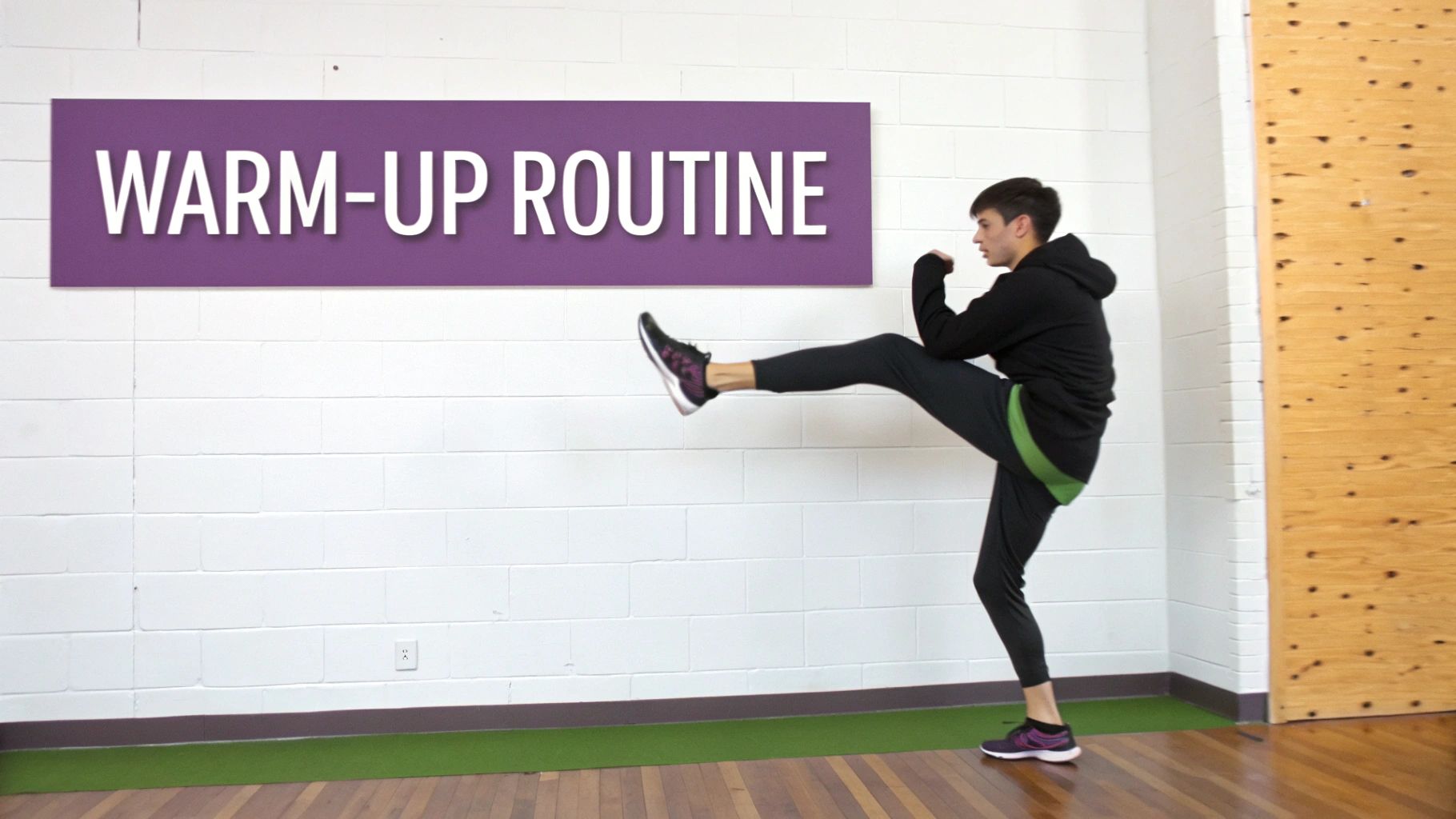
Imagine your muscles are like a cold rubber band; if you yank it, it snaps. But if you gently warm it up, it becomes flexible. A proper warm-up does exactly that for your body.
Why Dynamic Warm-Ups Are Your Best Friend
It's time to ditch old-school static stretching before you move. Dynamic stretching—actively moving your body through its full range of motion—is far superior for getting ready to exercise.
These fluid movements get your heart rate up, raise your core temperature, and pump blood to the muscles you're about to use. This process "wakes up" the connection between your brain and muscles, protecting them from micro-tears.
Here’s a simple 10-minute dynamic routine. Perform each movement for about 30-45 seconds.
- Leg Swings (Forward and Sideways): Loosen up your hips, hamstrings, and glutes.
- Arm Circles (Forward and Backward): Get the shoulders ready with controlled circles.
- Torso Twists: Gently twist your upper body to mobilize your spine.
- High Knees and Butt Kicks: These light drills fire up your quads and hamstrings.
A good warm-up is a deliberate signal to your body that it's time to perform. Just 5-10 minutes of focused, dynamic movement can make a world of difference.
If you’re a visual learner, watch a demo to lock in the proper form.
The Overlooked Power of a Good Cooldown
What you do after your workout is just as important. A dedicated cooldown helps your body transition from an all-out effort back to a state of rest.
This is where static stretching shines. With your muscles warm, holding stretches for 20-30 seconds can help lengthen muscle fibers and restore flexibility.
A few minutes of light cardio is also a fantastic cooldown tool. A slow 5-minute walk on the treadmill keeps the blood circulating, helping flush out waste products that cause soreness.
Fuel Your Muscles For Faster Recovery
What you do in the kitchen is just as important as what you do in the gym. Your nutrition provides the raw materials your body needs to repair muscle tears, rebuild stronger, and control inflammation.
Your workout is the demolition phase. Afterward, you need high-quality building materials—protein, carbs, and micronutrients—to rebuild.
The Power Duo: Protein And Carbohydrates
Protein and carbs are a non-negotiable team for muscle repair. Protein delivers amino acids for patching up muscle fibers. Carbs refuel the glycogen stores you used during your workout.
Many people mistakenly skimp on carbs post-workout. This is a huge miss, as your body may break down muscle tissue for energy, undoing your hard work.
A post-workout smoothie is one of the easiest ways to get this power duo working for you. Try blending a scoop of our Premium Whey Protein Isolate with a banana, spinach, and almond milk for a perfect recovery kickstart.
Hydration Is More Than Just Water
When you sweat, you lose critical electrolytes like sodium, potassium, and magnesium. These are essential for everything from nerve signals to muscle contractions.
If your electrolytes are out of whack, you're setting yourself up for cramps, fatigue, and worse muscle soreness. Dehydration also thickens your blood, making your heart work harder to deliver nutrients.
Pro Tip: By the time you feel thirsty, you’re already dehydrated. Sip water all day, and for intense sessions, add an electrolyte tablet to your bottle.
The Role Of Key Supplements
A solid diet is your foundation, but certain supplements can give you an edge in beating soreness.
Magnesium is getting a lot of attention for good reason. Research found taking magnesium before a workout significantly reduced soreness. You can read the full research on magnesium and muscle soreness to learn more.
Timing Your Nutrition For Maximum Impact
When you eat can be as crucial as what you eat. Your body is primed to soak up nutrients right after a workout.
Aim to get a mix of protein and carbs within 30-60 minutes after you finish to dramatically improve glycogen replenishment and kickstart muscle repair.
Fight Soreness With Anti-Inflammatory Foods
You can actively combat soreness by loading your plate with anti-inflammatory foods.
- Fatty Fish: Salmon and mackerel are loaded with omega-3s.
- Berries: Blueberries and strawberries are antioxidant powerhouses.
- Leafy Greens: Spinach and kale are excellent choices.
- Nuts and Seeds: Almonds and walnuts provide healthy fats.
- Turmeric and Ginger: These spices pack a potent anti-inflammatory punch.
When you fuel your body this thoughtfully, nutrition becomes your most powerful tool for preventing muscle soreness.
Master Active Recovery And Hands-On Therapies
When your muscles are screaming, the impulse is to become a couch potato. While rest is important, gentle movement and targeted therapies can actively help your body heal.
Instead of just waiting for the pain to fade, you can speed up the process.
The "Active" Part of Active Recovery
One of the best things for sore muscles is light movement. This is called active recovery—low-intensity exercise performed on the days after a hard session.
It boosts circulation, which helps clear out metabolic waste and delivers fresh, oxygen-rich blood to your muscle tissues. The goal isn't to break a sweat, but to get blood flowing.
- A leisurely walk
- Gentle yoga or stretching
- A casual swim
Just 15-20 minutes can make a world of difference. Heat therapies also work wonders. Many find success by using a sauna for sore muscles to soothe their body.
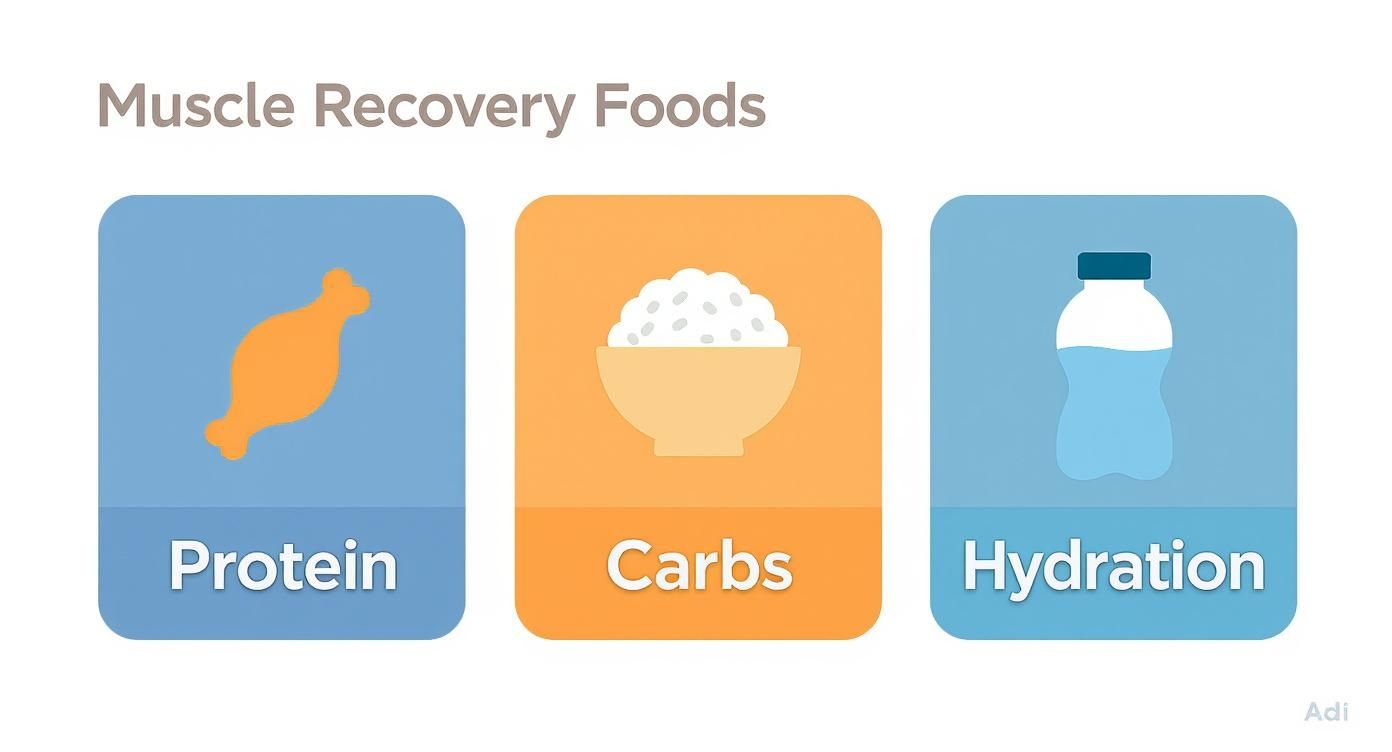
Recovery methods work best when combined with proper fuel. Providing your body with protein, carbs, and water gives it the raw materials it needs to repair.
Get Your Hands on Recovery
Sometimes, you need a direct approach for stubborn tightness. This is where tools like massage, foam rollers, and percussion massagers come in. They physically break up muscle knots and drive blood flow where you need it most.
Science backs this up. A massive review confirmed that massage is incredibly effective at fighting DOMS.
Of course, a massage therapist can't live in your gym bag. That’s why at-home tools from dietexerciseshop.com are so valuable. They put the power of recovery in your hands.
Choosing the right tool can make all the difference. Our products are designed to support your fitness journey by targeting soreness and promoting faster healing.
Recovery Tools Comparison
| Recovery Tool | Best For | Key Benefit | Product Link |
|---|---|---|---|
| Foam Roller | General muscle tightness, large muscle groups (quads, back) | Improves flexibility and circulation through self-myofascial release. | Eco-Friendly Foam Roller |
| Massage Ball | Pinpointing small, hard-to-reach knots (shoulders, feet, glutes) | Provides targeted, intense pressure to release deep trigger points. | Trigger Point Massage Ball |
| Percussion Massager | Deep-tissue relief, pre-workout activation, stubborn soreness | Delivers rapid percussive force to break up adhesions and increase blood flow. | Deep Tissue Percussion Massager |
| Compression Sleeves | Reducing swelling, post-workout soreness in limbs | Enhances blood flow and provides support to reduce inflammation. | Compression Recovery Sleeves |
Each tool offers a unique way to tackle muscle soreness. A great recovery toolkit might include several of these products, depending on your training style and needs. These items from dietexerciseshop.com are essential for anyone serious about their fitness goals.
By combining gentle active recovery with our targeted recovery tools, you create a powerful system for managing muscle soreness. This is about recovering smarter so you can train more consistently.
Improve Recovery With Better Sleep And Smart Training
If your sleep is a mess and you're not training intelligently, you're constantly fighting an uphill battle against soreness.
Think of it this way: a tough workout is like placing an order for muscle growth. Sleep is the overnight crew that shows up to do the actual construction.
The Critical Role Of Deep Sleep
When you're in deep sleep, your body is actively rebuilding. Your pituitary gland releases Human Growth Hormone (HGH), which is essential for repairing the microscopic tears in your muscles.
Skimping on deep sleep short-changes this process, leading to more intense soreness and stalled progress.
- Stick to a Schedule: Go to bed and wake up around the same time every day.
- Create the Right Environment: A cool, dark, and quiet room is non-negotiable. Understanding how breathable fabrics can improve sleep quality can be a huge help.
- Power Down Before Bed: Blue light from phones can mess with melatonin production.
These simple habits make a night-and-day difference in how you feel.
Training Smarter, Not Just Harder
How you structure your training is a massive piece of the puzzle. One of the most common mistakes is the "too much, too soon" trap.
Smart workout programming is about being strategic with your effort.
Intelligent training isn't about avoiding hard work. It's about applying it in a way that allows your body to adapt. Pushing to failure every session is a recipe for burnout.
For a deeper dive, check out our guide on how to recover faster.
The Principle Of Progressive Overload
The foundation of long-term progress is progressive overload. To get stronger, you have to challenge your muscles with more than they're used to.
The key word is progressive—a gradual increase over time.
Instead of a huge jump in weight, you slowly add a little more weight, one more rep, or an extra set. This controlled approach gives your muscles time to adapt, reducing the shock that leads to severe soreness.
Structuring Your Week For Success
A smart training week balances work with rest. Planned rest days aren't a sign of weakness; they're a non-negotiable part of any successful fitness journey.
Scheduling a "deload" week every 4-8 weeks can be a game-changer. During a deload, you pull back on volume and intensity. This gives your system a chance to fully recover and sets you up to smash new personal records.
Got Questions About Muscle Soreness? We've Got Answers.
Even when you do everything right, questions about muscle soreness are normal. Let’s clear up some of the most common ones.
This is your personal cheat sheet for those "is this normal?" moments.
Is It Okay To Work Out If I'm Already Sore?
It depends on how sore you are.
If you have mild, general achiness, light active recovery is one of the best things for you. A gentle walk or easy yoga can get blood flowing and ease discomfort. For visual guides, the Diet & Exercise youtube channel has some excellent videos.
If you're so sore that it's painful to move, that's your body screaming for a break. Pushing through severe pain is a surefire way to get injured. Listen to your body and take a full rest day.
How Long Does This Soreness Actually Last?
Delayed Onset Muscle Soreness (DOMS) follows a predictable timeline. You'll feel it creeping in about 12 to 24 hours after your workout.
It typically peaks between 24 and 48 hours later. After that, the soreness should fade, and most people feel much better after 72 hours.
A quick heads-up: If you're dealing with sharp, stabbing pain or soreness that doesn't improve after a week, it might be more than DOMS. Chat with a doctor to make sure you haven't picked up an injury.
Are Ice Baths Actually Worth the Hype?
Ice baths can work. Dunking yourself in cold water is great for taming inflammation and soreness after a brutal workout. The cold constricts blood vessels, helping flush out metabolic waste.
But it’s not something for every day. Some research suggests overdoing ice baths might blunt muscle-building signals. Save it for when you really need it, not as a daily routine.
What's The Difference Between "Good Pain" and "Bad Pain"?
Learning to tell these two apart is a critical skill.
- Good Pain (DOMS): A dull, generalized ache in the muscles you worked. It's that "I worked hard" feeling that fades in a few days.
- Bad Pain (Injury): Often sharp, sudden, and pinpointed to a specific spot, especially near a joint. Pain that worsens with movement or comes with swelling is a red flag. Never push through sharp pain.
At Diet & Exercise, we know that smart recovery is what turns effort into results. To help you on your way, we've curated a collection of top-notch fitness apparel and recovery tools. Check out our latest arrivals over at dietexerciseshop.com and find what you need to feel and perform your best.