

How to Train Like a Bodybuilder: A Practical Guide
Training like a bodybuilder is a whole different ball game. It’s a disciplined art, meticulously focused on one primary goal: muscle hypertrophy.
The idea is to create microscopic tears in your muscle fibers through intense, focused resistance training. Your body then overcompensates, repairing those fibers to be bigger and stronger than before. It’s a demanding process that hinges on a smart combination of strategic exercise, precision nutrition, and dedicated recovery.
The Bodybuilding Mindset and Core Principles
To get results like a bodybuilder, you have to think like one. This goes way beyond just mindlessly lifting heavy weights.
It's about developing a deep understanding of your own body—learning how it responds to stress, fuel, and rest. The entire journey is built on a few core principles that all work in sync. Before we dive into the workouts, it's crucial to grasp these foundational concepts.
Foundational Pillars of Bodybuilding Training
| Pillar | Description |
|---|---|
| Strategic Training | Every single exercise, set, and rep is chosen for a specific reason: to stimulate muscle growth. There's no "junk volume" here. |
| Precision Nutrition | Think of your diet as the raw material. It provides the protein and energy needed to repair and build new muscle. |
| Deliberate Recovery | Muscle growth happens when you're resting. This makes sleep and recovery time absolutely non-negotiable. |
| Unyielding Consistency | The real magic is just showing up, day after day. This is what truly separates the amateurs from the pros. |
Think of it like a four-legged stool. If any one of these pillars is weak, the entire structure wobbles. You can't out-train a bad diet, and you can't grow without proper rest.
Embracing the Mind-Muscle Connection
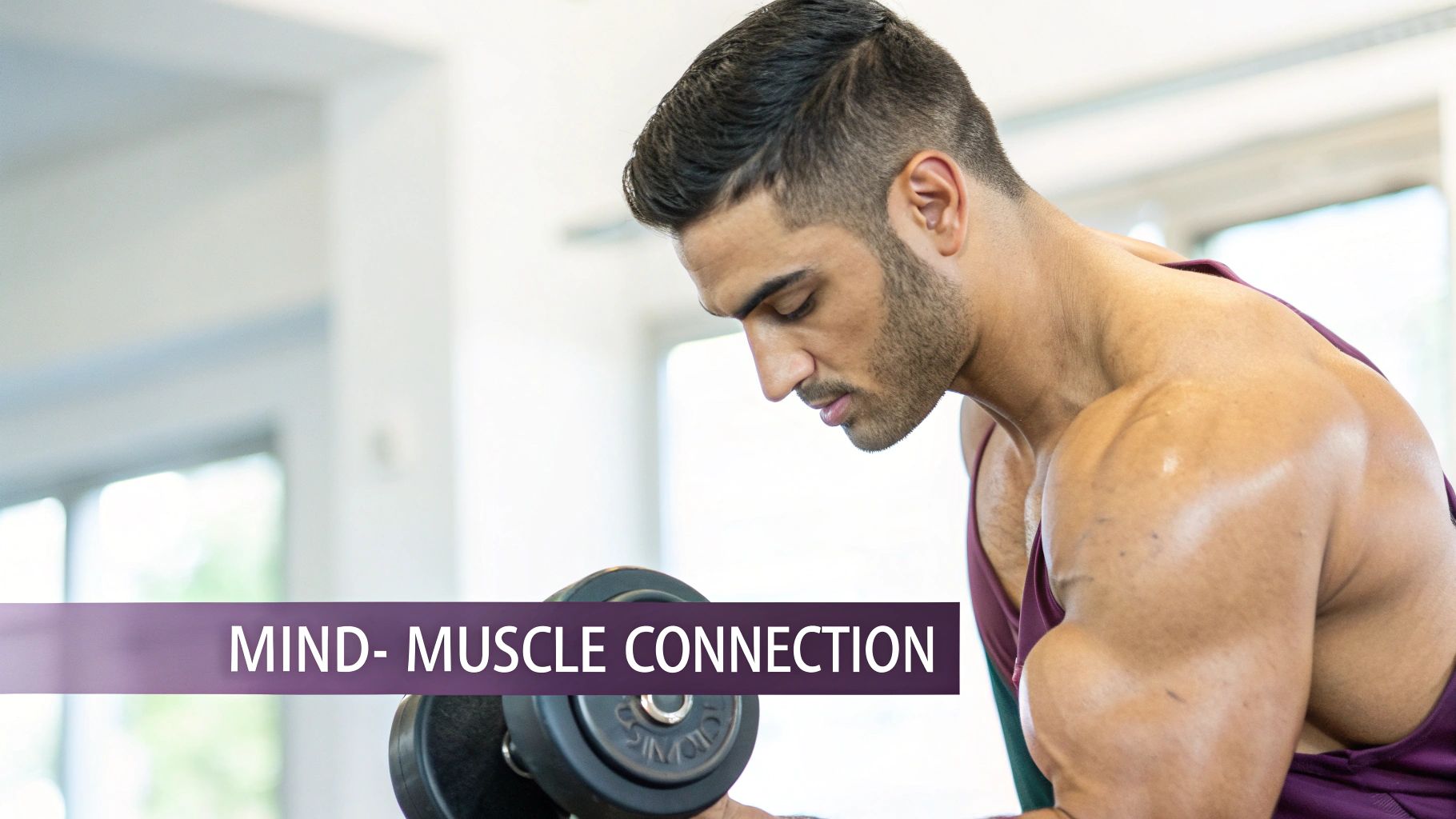
One of the most critical skills you'll develop is the mind-muscle connection. This is the conscious practice of focusing your thoughts on the specific muscle you're working.
When you're doing a bicep curl, for instance, don't just move the weight. Actually feel the bicep contract, squeeze at the top, and stretch on the way down. This focus improves muscle fiber activation, leading to better growth.
The level of commitment needed is intense. A new lifter might gain 8 to 15 pounds of muscle in their first year. But progress slows. An advanced lifter might only gain 5 to 15 pounds annually. For a deeper dive, you can find more details on bodybuilding progress online.
The Reality of Muscle Growth
Patience is a bodybuilder's greatest virtue. "Newbie gains" are fantastic, but progress will inevitably slow down. This is where your mental fortitude is truly tested.
To keep your head in the game, find tools that support your journey. Something as simple as a motivational mug from the Diet & Exercise Shop can be a powerful daily reminder of your commitment. The real secret is staying dedicated through plateaus.
Designing Your Bodybuilding Training Split
Walking into the gym without a plan is like trying to build a house without a blueprint. You might get some work done, but you won't get the results you're after. A solid training split is your road map for building muscle.
A training split organizes your workouts, dictating which muscle groups you'll hit on which days. The point is to give each muscle enough attention to trigger growth and enough time to recover and rebuild before you train it again.
Understanding Common Training Splits
The "best" split is the one that fits your life and your current fitness level. There’s no one-size-fits-all answer, but a few tried-and-true methods have stood the test of time.
- Push-Pull-Legs (PPL): This is highly efficient. You group muscles based on how they move. One day is for "pushing" (chest, shoulders, triceps), the next for "pulling" (back, biceps), and the third for your lower body.
- Upper/Lower Split: You have upper body days and lower body days. This is great for beginners as it's straightforward and lets you hit every muscle group twice a week.
- The 'Bro Split': The classic approach. Monday is chest day, Tuesday is back day, and so on. It dedicates an entire workout to one major muscle group per day, allowing for insane volume.
A quick word on muscle soreness: that feeling a day or two after a workout is called Delayed Onset Muscle Soreness (DOMS). It usually kicks in 12 to 48 hours post-training. It's a sign that you’ve created the stimulus for your muscles to grow back stronger.
Training is only half the battle. Your diet provides the raw materials for rebuilding. A post-workout meal high in protein is non-negotiable, and carbs restock your energy. For a visual breakdown of syncing meals with workouts, the Diet & Exercise YouTube channel has excellent content.
Sample Push-Pull-Legs (PPL) Split
The PPL split is a powerhouse because it's so well-balanced. You typically run a three-day cycle, which you can do twice for a six-day training week, leaving one day for total rest.
Here’s what a typical PPL week could look like:
| Day | Workout Focus | Primary Muscles Worked |
|---|---|---|
| Day 1 | Push | Chest, Shoulders, Triceps |
| Day 2 | Pull | Back (Lats, Traps, Rhomboids), Biceps |
| Day 3 | Legs | Quadriceps, Hamstrings, Glutes, Calves |
| Day 4 | Rest | Active Recovery or Full Rest |
| Day 5 | Push | Repeat Cycle |
| Day 6 | Pull | Repeat Cycle |
| Day 7 | Legs | Repeat Cycle |
See the logic? The muscles you use to push get plenty of time to recover before they assist on your next pull day. It’s an intelligent way to manage fatigue.
Combining Diet and Training for Optimal Results
Your training split and your diet need to work together. A brutal leg day burns a massive amount of calories. It only makes sense to fuel up with more carbohydrates on those days to power through and kickstart recovery.
Conversely, a day hitting smaller muscles won't be as demanding, so you might not need as many calories. Matching your fuel to your workload is a game-changer for building a lean, muscular physique.
This lifestyle is built on discipline. Sometimes, the little things keep you going. Small reminders of your commitment, like a custom fitness-themed mug from Diet & Exercise Shop, can be the daily nudge you need to get your workout in or prep your meals.
Choosing The Right Exercises For Muscle Growth
You’ve picked your split. Now for the fun part: picking the exercises. A solid bodybuilding program is built on two types of movements: compound and isolation lifts. Getting the balance right is everything.
Compound exercises are your foundation builders—squats, deadlifts, and bench presses. These big, multi-joint movements let you move serious weight, building raw strength and overall mass.
Isolation exercises are your sculpting tools. Bicep curls, lateral raises, and leg extensions let you zoom in on a specific muscle. This is how you add detail and bring up lagging body parts.
The infographic here breaks down how different splits organize these exercises across a training week.
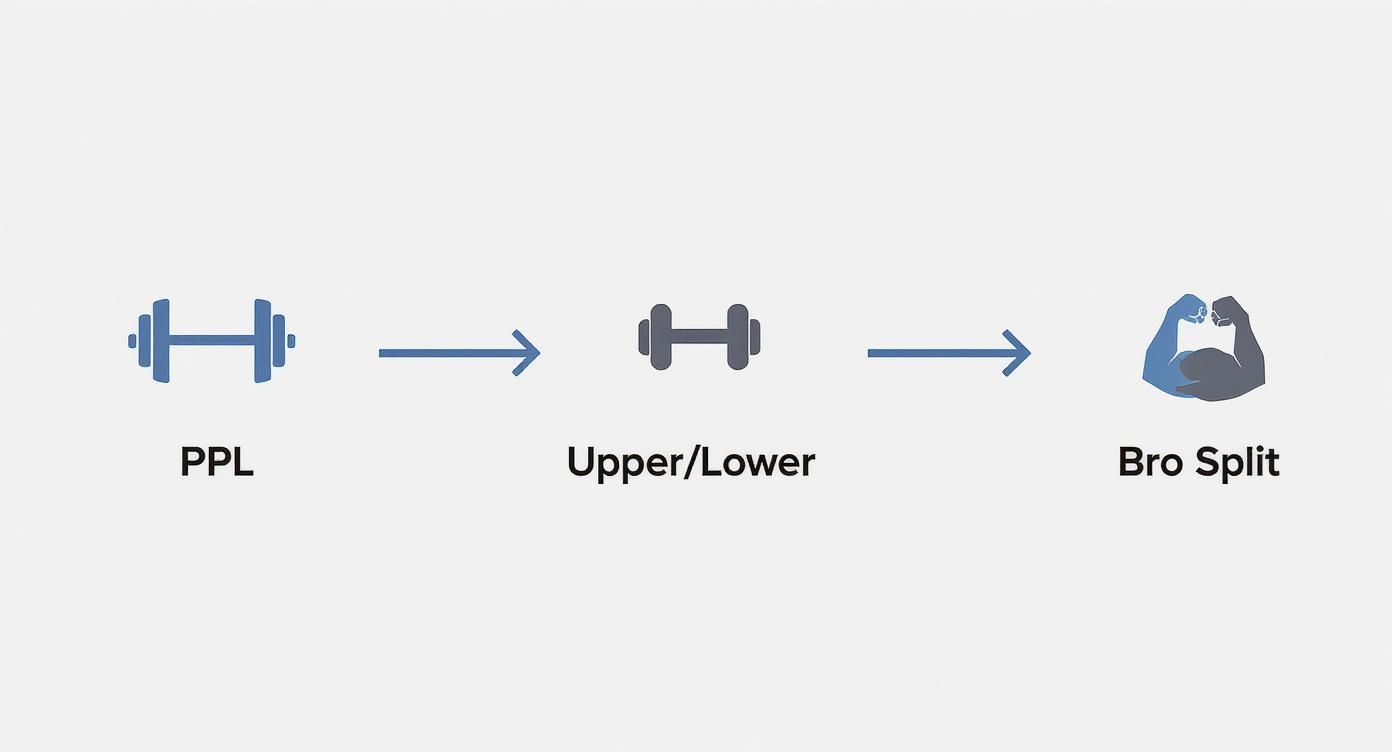
Whether you're running a PPL or a classic "Bro Split," the strategy is the same. Use a smart mix of big compound movements and targeted isolation work to build and then refine your physique.
Balancing Compound And Isolation Lifts
Many people get this wrong. Some live in the squat rack but have no detail, while others only do curls and never build a solid base of strength. You need both.
A simple rule is to lead every workout with your big compound lifts. That’s when you’re fresh. After the heavy lifting, shift to isolation work to burn out the target muscle.
A chest day could start with barbell bench press, move to incline dumbbell presses, and finish with cable flyes. It’s a one-two punch: build the mass, then carve in the detail. For more detail, there are great scientific strategies to build lean muscle available on the internet.
Determining Your Training Volume
Training volume—sets x reps x weight—tells your muscles to grow. You have to do enough work to create a stimulus, but not so much that you can't recover.
Most competitive bodybuilders use multiple exercises per muscle group. Research shows that nearly 95% of them perform 4–5 exercises for each muscle. They’ll typically stick to 3–6 sets per exercise in the classic 4 to 12 rep range for hypertrophy.
The real secret is finding your Minimum Effective Dose (MED). That's the smallest amount of volume you need to trigger growth. Piling on "junk volume" just digs a deeper recovery hole. Start with less and earn your way to more.
Getting a handle on exercise selection is a huge part of the puzzle. Check out our complete guide on how to build muscle mass.
Go-To Exercises For Each Muscle Group
Here’s a list of go-to compound and isolation movements for each major muscle group.
-
Chest
- Compound: Barbell Bench Press, Incline Dumbbell Press, Dips
- Isolation: Cable Crossovers, Dumbbell Flyes, Pec Deck Machine
-
Back
- Compound: Deadlifts, Pull-Ups, Barbell Rows, T-Bar Rows
- Isolation: Straight Arm Pulldowns, Dumbbell Pullovers, Face Pulls
-
Legs
- Compound: Squats, Leg Press, Romanian Deadlifts, Lunges
- Isolation: Leg Extensions, Hamstring Curls, Calf Raises
-
Shoulders
- Compound: Overhead Press (Barbell or Dumbbell), Arnold Press
- Isolation: Lateral Raises, Front Raises, Reverse Pec Deck
-
Arms
- Biceps: Barbell Curls, Dumbbell Hammer Curls, Preacher Curls
- Triceps: Close-Grip Bench Press, Skull Crushers, Tricep Pushdowns
Remember: form trumps weight. Always. Master the movement and feel the right muscles working before you load up the bar.
Fueling Your Body for Peak Performance and Growth
All the intense training in the world is just a signal for growth; the food you eat provides the actual building blocks. You simply cannot out-train a bad diet. Nutrition is the engine that drives muscle repair and gives you the energy to smash your next workout.
The game boils down to mastering your macronutrients. These are the three pillars of your diet—protein, carbohydrates, and fats—and each plays a non-negotiable role.
The Role of Macronutrients
Protein is the king of muscle growth. It provides the essential amino acids your body uses to repair muscle tears. Without enough protein, your body just can't rebuild itself bigger and stronger.
Carbohydrates are your body's number one energy source. Stored in your muscles as glycogen, they fuel high-intensity exercise. Cutting carbs too low will kill your performance in the gym.
Healthy fats are crucial for producing hormones like testosterone, which is vital for building muscle. Eliminating fats from your diet is a rookie move you can't afford.
Tailoring Your Diet to Your Goals
A bodybuilder's diet must adapt based on whether you're in a "bulking" phase to build mass or a "cutting" phase to lose fat. When bulking, you need a caloric surplus. During a cut, you'll shift to a caloric deficit to shed body fat while holding onto muscle.
To do this, you need to know exactly how many calories and macros your body needs. For a step-by-step guide, check out our article on how to calculate your macros.
Aiming for 1.6 to 2.2 grams of protein per kilogram of body weight (about 0.7 to 1.0 grams per pound) is the sweet spot for maximizing muscle growth.
This precision ensures that every single meal serves a purpose, pushing you one step closer to your goals.
The Power of Strategic Supplementation
While whole foods should always be your foundation, smart supplementation can fill gaps and give you a performance edge. Think of them as tools to optimize your hard work.
Take whey protein, for example. Your muscles are primed to soak up nutrients right after a workout. A fast-digesting Whey Protein Isolate shake delivers essential amino acids exactly when you need them most, kickstarting recovery much faster than a whole food meal. This is a lifesaver when you're busy.
Fueling Your Workouts Effectively
What you eat before you train is just as important. A pre-workout supplement can dramatically improve performance by boosting energy, sharpening focus, and improving blood flow.
Our Energy & Focus Pre-Workout is engineered to deliver a clean, sustained energy boost without the dreaded crash. This allows you to push harder for longer and squeeze out those extra growth-inducing reps.
Here’s a simple way to structure your nutrition around your workout:
- 1-2 hours pre-workout: A balanced meal with complex carbs and lean protein.
- 30 minutes pre-workout: Take your pre-workout for a mental and physical kick.
- Immediately post-workout: A whey protein shake to get amino acids to your muscles fast.
- 1-2 hours post-workout: A solid food meal to continue the recovery process.
By combining a precise diet with targeted supplements from the Diet & Exercise Shop, you create the perfect environment for building a powerful physique.
Optimizing Recovery With Rest and Essential Gear
You don't build muscle in the gym; that’s where you break it down. The real magic happens when you're resting. Pushing your body to its limits is only half the battle; the other half is smart, dedicated recovery.
This starts with making sleep a priority. Aim for 7-9 hours of quality sleep a night. It's a biological requirement for repairing muscle, regulating hormones, and staying mentally sharp. If you skimp on sleep, your gains will flatline.
The Role of Active Recovery
Recovery isn’t just about being a couch potato. Active recovery methods are key for managing muscle soreness and improving mobility. Mastering strategies to speed up muscle recovery is just as important as the training itself.
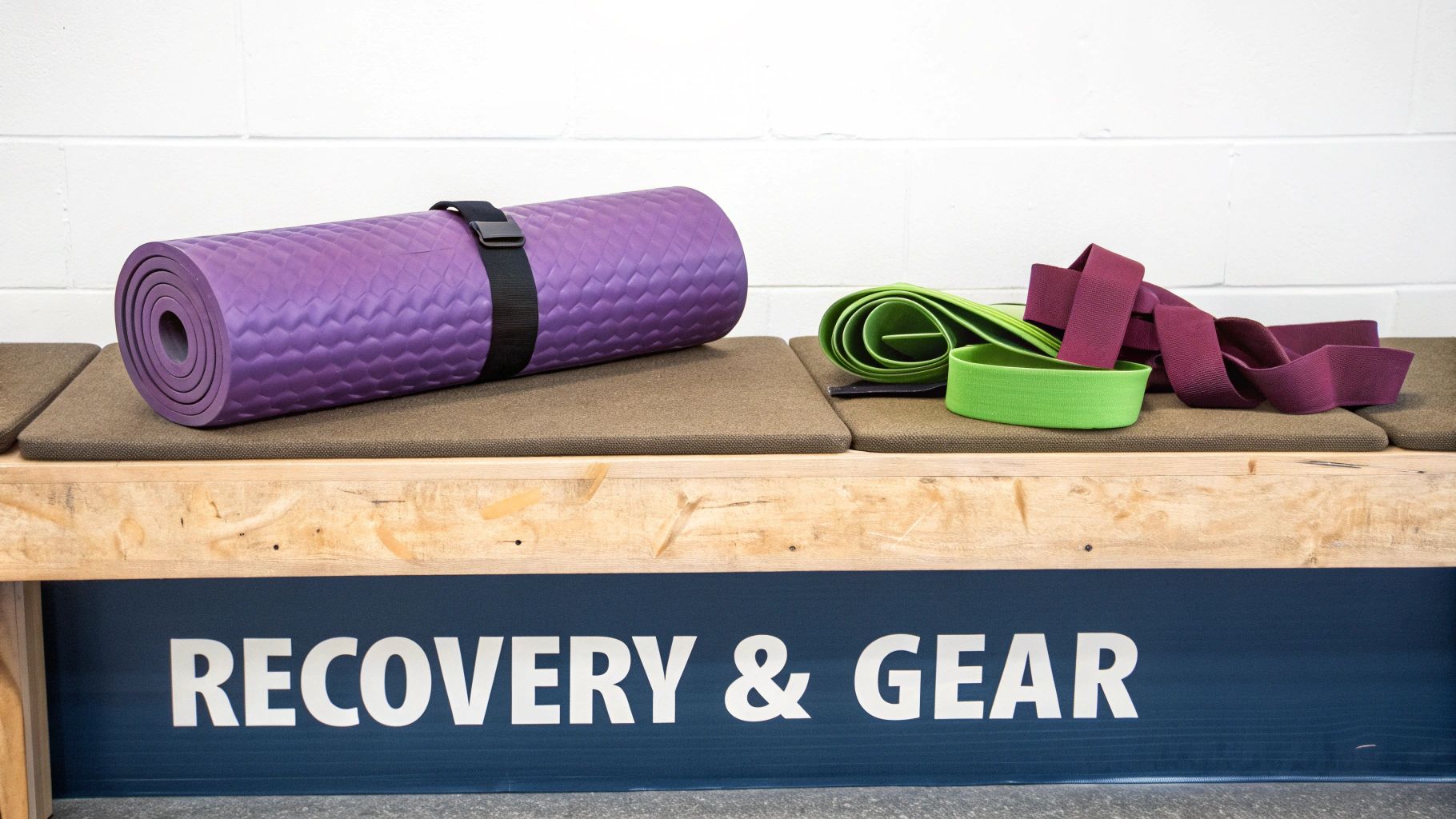
Light activities like a brisk walk, gentle stretching, or foam rolling get the blood flowing to your muscles. This helps flush out metabolic waste and delivers fresh oxygen to kickstart the repair process.
Investing In Smart Training Gear
Using the right equipment to train safely and effectively is vital. Good gear is a smart investment in your performance and longevity. It gives you the confidence to push harder while minimizing the risk of a setback.
The weight training equipment market is projected to hit USD 16.26 billion by 2035, which shows how seriously people are taking their lifting. Certain pieces of equipment from the Diet & Exercise Shop can make all the difference.
Essential Bodybuilding Gear Checklist
A breakdown of recommended equipment to support your training, available at dietexerciseshop.com.
| Gear Item | Primary Use | When to Use It |
|---|---|---|
| Lifting Belt | Supports the core and lower back by increasing intra-abdominal pressure. | During your heaviest sets of squats, deadlifts, and overhead presses. |
| Wrist Wraps | Stabilize the wrist joint to prevent hyperextension. | Heavy pressing movements like bench press, shoulder press, or even low-bar squats. |
| Lifting Straps | Secure your grip on the bar when it becomes the limiting factor. | Heavy pulling movements like deadlifts, rows, and shrugs. |
| Knee Sleeves | Provide warmth and compression to the knee joints for stability and comfort. | During heavy squats, leg presses, and lunges. |
All of this gear is designed to support proper mechanics, not replace them.
A common mistake is using gear as a crutch for bad form. A lifting belt helps brace a strong core; it can't create one for you. Always own the movement with lighter weight before relying on supportive equipment.
The Mental Side of Recovery
Finally, you can’t ignore stress management. Chronic stress pumps your body full of cortisol, a hormone that breaks down muscle tissue—the exact opposite of what you’re working for.
Find healthy ways to manage your mental load, whether it’s meditation or just unplugging from your phone. Your central nervous system takes just as much of a beating from intense training as your muscles do. It needs to recover, too.
Clearing Up Common Bodybuilding Questions
The more you learn, the more questions you have. It's totally normal. Let's tackle some of the most common questions to give you clarity and get you on the right track.
"How Much Protein Do I Really Need?"
This is the number one question. Protein is the building block of muscle. Without enough of it, your hard work won't pay off.
The sweet spot for building muscle is 1.6 to 2.2 grams of protein per kilogram of body weight (about 0.7 to 1.0 grams per pound). For an 82 kg (180-pound) lifter, that's a daily target of around 126 to 180 grams. A quality Whey Protein Isolate is a convenient way to meet this goal.
"Should I Train to Failure on Every Set?"
This is a classic rookie mistake. Taking every set to absolute failure is a fast track to burnout. It taxes your central nervous system too much and can stall your progress.
Think of training to failure as a tool, not the whole toolbox. Save it for the last set of an isolation exercise. On big compound lifts like squats? Leave one or two good reps in the tank. This is safer and more sustainable for long-term growth.
"How Much Cardio Should I Do?"
Cardio is a balancing act. It’s fantastic for heart health and fat loss, but too much can eat into your recovery and the energy needed to build muscle.
For most people, 2-3 sessions of low-to-moderate intensity cardio per week is a solid baseline. Think incline walking or a steady pace on the elliptical. This keeps your conditioning up without sabotaging your gains.
"How Important Is Nutrient Timing?"
Diet and training are two sides of the same coin. Your workouts create the stimulus, but your food provides the raw materials.
To get the most out of your efforts, be strategic with your nutrition:
- Before Your Workout: Fuel up with carbs and protein. An Energy & Focus Pre-Workout about 30 minutes before your session gives you the sustained energy to push hard.
- After Your Workout: This is your prime recovery window. A fast-acting protein shake and simple carbs will kickstart repair.
- All Day Long: Consistency is king. Hitting your daily macro goals, day in and day out, is what truly builds an impressive physique.
For a deeper dive into crafting the perfect nutrition plan, the Diet & Exercise YouTube channel has fantastic, no-nonsense videos on fueling for performance.
At Diet & Exercise, we know that sometimes, a small thing can be a big motivator. The right gear can be a daily reminder of the work you're putting in and the goals you're chasing. Stay focused with our collection of apparel and accessories made for people who are serious about their fitness.
Shop our full collection of fitness apparel and accessories at dietexerciseshop.com