
Is Diet More Important Than Exercise for Weight Loss
When it comes to the classic “diet vs. exercise” debate, especially for weight loss, the answer is pretty straightforward: diet holds the most power.
There’s a reason the old saying, "you can't outrun a bad diet," has stuck around. It’s simply far more efficient to create a calorie deficit—the non-negotiable first step to losing weight—by managing what you eat than by trying to burn off every extra calorie on the treadmill.
The Final Verdict on Diet vs Exercise
To really get a handle on any fitness goal, you have to start with the fundamental principle of energy balance. We often boil it down to "calories in versus calories out."
While both your nutrition and your workouts are absolutely essential for good health, they play very different roles in changing your body. Your diet is the primary tool for controlling the "calories in" side of the equation, giving you direct influence over the number on the scale.
Exercise, on the other hand, is all about the "calories out" side of the formula. But its real magic isn't just about burning calories during a workout. The true impact of exercise lies in its ability to improve your body composition, rev up your metabolism, and supercharge your cardiovascular health.
Understanding the Core Differences
Here’s a simple way to think about it: diet determines your weight, but exercise determines the shape and function of that weight.
You can absolutely lose pounds by focusing on nutrition alone. However, it’s the addition of exercise that builds a strong, lean physique and improves how you move and feel every day.
This isn't just theory; we see it reflected in global health trends. Over the last 30 years, obesity rates have climbed dramatically, and the evidence points more to a massive increase in calorie consumption than a significant drop in physical activity.
The real variable is what—and how much—we’re eating, especially the ultra-processed foods engineered for overconsumption30248-7).
A good rule of thumb for pure weight loss is the 80/20 principle: about 80% of your results will come from your diet, while exercise contributes the other 20%. This really drives home why getting your nutrition in order is the most effective place to start.
Diet vs Exercise At a Glance
This table offers a snapshot of how diet and exercise each play their unique, critical roles in helping you achieve your health and fitness goals.
| Aspect | Primary Role of Diet | Primary Role of Exercise |
|---|---|---|
| Weight Loss | Directly creates a calorie deficit, making it the most efficient tool for losing pounds. | Contributes to the calorie deficit and helps maintain metabolism, but is less efficient than diet for shedding weight. |
| Body Composition | Provides the building blocks (protein) for muscle growth and repair. | Stimulates muscle growth (resistance training) and improves cardiovascular health (cardio), shaping the body. |
| Overall Health | Supplies essential vitamins, minerals, and macronutrients for bodily functions, energy, and disease prevention. | Strengthens the heart, improves circulation, reduces stress, and increases longevity. |
| Practicality | Relatively easy to control intake; for example, skipping a 500-calorie snack is simpler than running for 45 minutes to burn it off. | Requires significant time, effort, and consistency to burn a meaningful number of calories. |
Ultimately, thinking of it as "diet versus exercise" misses the point. The real magic happens when they work together. Diet lays the foundation for weight control, and exercise builds a stronger, healthier, and more resilient body on top of it.
Why Your Plate Has the Power in Weight Loss
When it comes to shedding pounds, the straightest line between two points is simple math. At its core, weight loss happens when you create a consistent calorie deficit—burning more calories than you eat.
While your workouts definitely help burn calories, your diet gives you the most direct and powerful control over how many you take in. To take control, a simple tool like a Digital Kitchen Food Scale can be invaluable. It removes guesswork, ensuring you know exactly how many calories you're consuming to maintain that deficit.
Let's put it in real-world terms. To burn 500 calories, you might have to grind through a 45-minute run. On the flip side, you could cut those same 500 calories just by skipping a sugary latte and a pastry.
It’s a lot easier—and takes far less time—to manage what’s on your plate than to try and out-train a poor diet.
The Math of a Calorie Deficit
The cornerstone of any weight loss discussion is understanding a calorie deficit. Creating this energy gap is the only way to get your body to tap into its fat stores for fuel.
For anyone serious about this, our guide on what a calorie deficit truly means can give you a deeper look.
That's not to say exercise doesn't help—it absolutely does. A large meta-analysis showed that aerobic exercise is effective at reducing body weight. But the study also found that these results were generally more modest than what people achieved through diet alone.
The takeaway is clear: Diet holds the steering wheel for weight loss, while exercise acts as the turbocharger. You can reach your destination with diet alone, but adding exercise gets you there in better shape and with a stronger engine.
How Food Quality Amplifies Your Results
It’s not just about the number of calories. The quality of those calories makes a world of difference. Eating 1,500 calories from junk food feels completely different than eating 1,500 calories from whole, nutrient-packed foods.
This is where protein and fiber become your best friends. Protein keeps you full, and fiber adds bulk to meals without extra calories.
When you prioritize these, you naturally eat fewer calories without feeling like you’re starving. That’s what makes a diet sustainable for the long haul. A great way to ensure you're getting enough protein is with a high-quality Shaker Bottle for your post-workout or meal-replacement shakes.
How Exercise Sculpts Your Body
While your diet has the final say on the number you see on the scale, exercise is what truly determines the quality of that weight. It’s the difference between just being smaller versus being strong, toned, and genuinely fit.
This is where body composition comes into play. It’s the ratio of fat to lean mass—your muscles, bones, and organs. For a deeper dive, check out our guide on what is body composition.
When you drop pounds through diet alone, you often lose precious muscle, too. This is how people end up with a "skinny-fat" look. Exercise, especially resistance training, is the non-negotiable tool to stop that from happening.
The Critical Role of Resistance Training
Lifting weights, using bands, or doing bodyweight exercises sends a powerful signal to your body: "Hold onto this muscle!" When you’re eating in a calorie deficit to lose fat, resistance training tells your body to preserve—and even build—lean tissue.
This is a game-changer. Muscle is metabolically active, which means it torches calories even when you’re relaxing. By keeping your muscle mass, you keep your metabolism firing on all cylinders, making it far easier to lose fat and keep it off.
Think of it this way: Your diet clears away the excess marble, but resistance training is the chisel that carves out the details and reveals the masterpiece.
Building Your Body at Home
You don't need an expensive gym membership to start sculpting your body. The right tools can bring the full power of resistance training right into your living room. One of the most effective options is a quality set of resistance bands.
For an all-in-one home solution, our Adjustable Resistance Band Set is the perfect partner for your body composition goals. It’s designed to hit every major muscle group, letting you perform hundreds of exercises without needing clunky equipment.
- Versatility: From bicep curls to squats, you can replicate almost any gym exercise.
- Progressive Overload: Easily ramp up the challenge as you get stronger—a core principle for building muscle.
- Convenience: The set is lightweight and portable, so you can get a killer workout anywhere.
By making this set part of your routine, you're directly investing in building lean muscle. This ensures that as the number on the scale goes down, you're revealing a toned, strong physique underneath.
To see just how powerful this tool can be, check out this Full Body Resistance Band Workout for Toning from our Diet & Exercise YouTube channel. It's a great starting point for anyone looking to reshape their body.
Balancing Diet and Exercise for Your Goals
So, what's more important: diet or exercise? The truth is, your goal determines the answer.
The best way to think about it is to stop pitting diet and exercise against each other. They aren't competitors; they're partners. This decision tree gives you a visual of the two main paths: losing fat or building muscle.
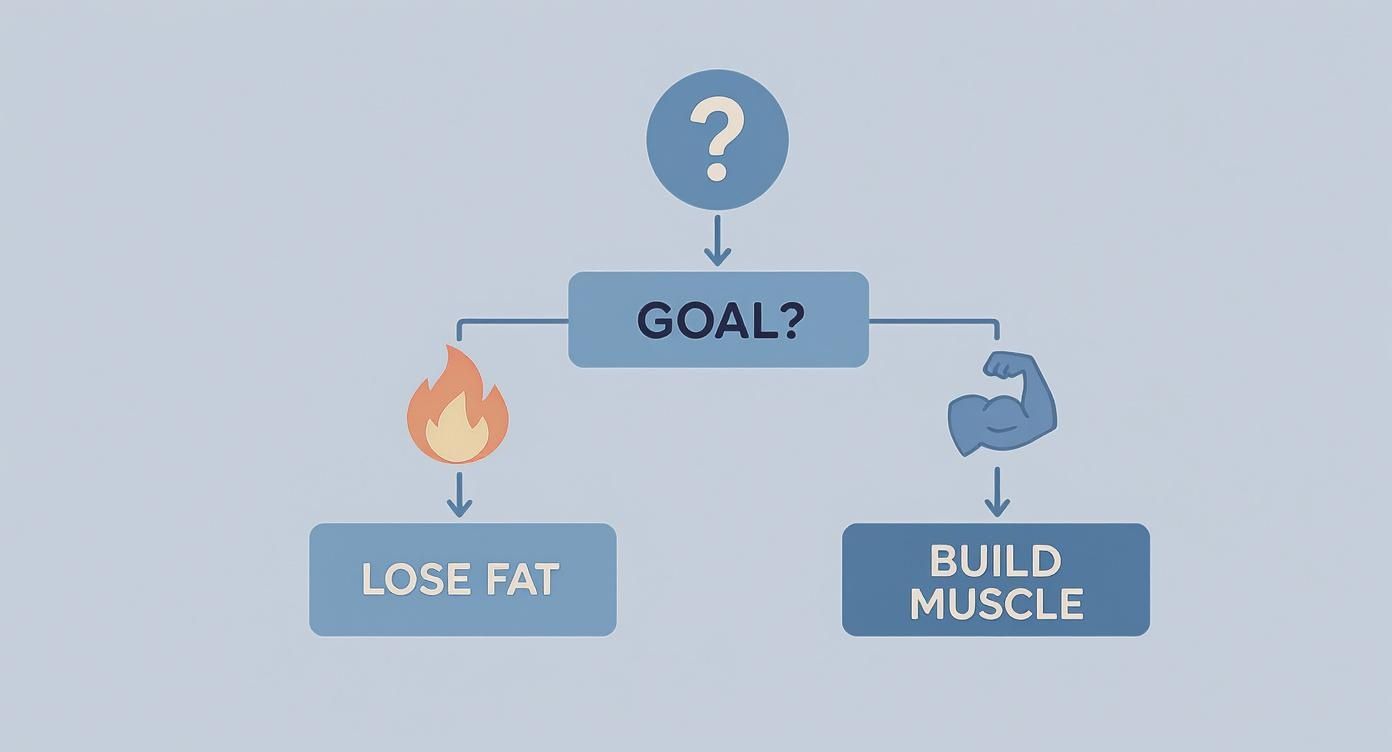
As you can see, the first step is always getting crystal clear on your primary objective. That single choice dictates your entire game plan for nutrition and training. Let's break down the playbooks.
The Playbook for Accelerated Fat Loss
If your main mission is to lose fat, your diet is the undisputed MVP. The bedrock of all fat loss is creating a consistent calorie deficit.
That said, exercise plays a crucial supporting role. It helps you hold onto precious muscle while you're in a deficit and gives your metabolism a nice boost. For women focusing on toning the lower body during fat loss, Fabric Booty Resistance Bands are an excellent tool to target the glutes and thighs.
Here’s a solid framework to follow:
- Diet Priority: Aim for a daily calorie deficit of 300-500 calories. Fill your plate with high-protein and high-fiber foods to keep you full.
- Exercise Priority: Mix 2-3 days of full-body resistance training with 2-3 days of moderate-intensity cardio.
Research shows that combining diet and exercise leads to far better improvements in body composition. You can read the full research about these findings for a deeper dive.
The Strategy for Sustainable Muscle Gain
When you shift gears to building muscle, the relationship between diet and exercise becomes a true 50/50 split. Neither is more important.
To grow, you have to challenge your muscles with resistance training—that's the signal that tells them to get bigger. But that signal is useless if your body doesn't have the raw materials (calories and protein) to repair and build new tissue. This requires eating in a slight calorie surplus.
Your workouts place an order for new muscle. Your diet delivers the bricks and mortar. If the delivery never shows up, nothing gets built.
Here's your muscle-building framework:
- Diet Priority: Eat in a slight calorie surplus of 250-400 calories above maintenance. Aim for 1.6-2.2 grams of protein per kilogram of body weight daily.
- Exercise Priority: Focus on progressive resistance training 3-5 times per week, using tools like Lifting Straps to help you lift heavier and maximize muscle stimulus.
Maintaining Health for the Long Haul
What if your main goal is simply long-term health? The focus shifts toward balance, consistency, and sustainability. In this scenario, diet and exercise are equal partners.
The key here is finding what you can stick with. The best diet is one you don't feel like you're "on," and the best exercise is something you actually enjoy. For general fitness and mobility, incorporating a Non-Slip Yoga Mat into your routine for stretching and bodyweight exercises is a fantastic habit.
Optimizing Recovery to Amplify Your Results
When we debate "is diet more important than exercise?", it's easy to forget the third critical piece: recovery. Your results are forged during the downtime between workouts, when your body repairs and gets stronger.
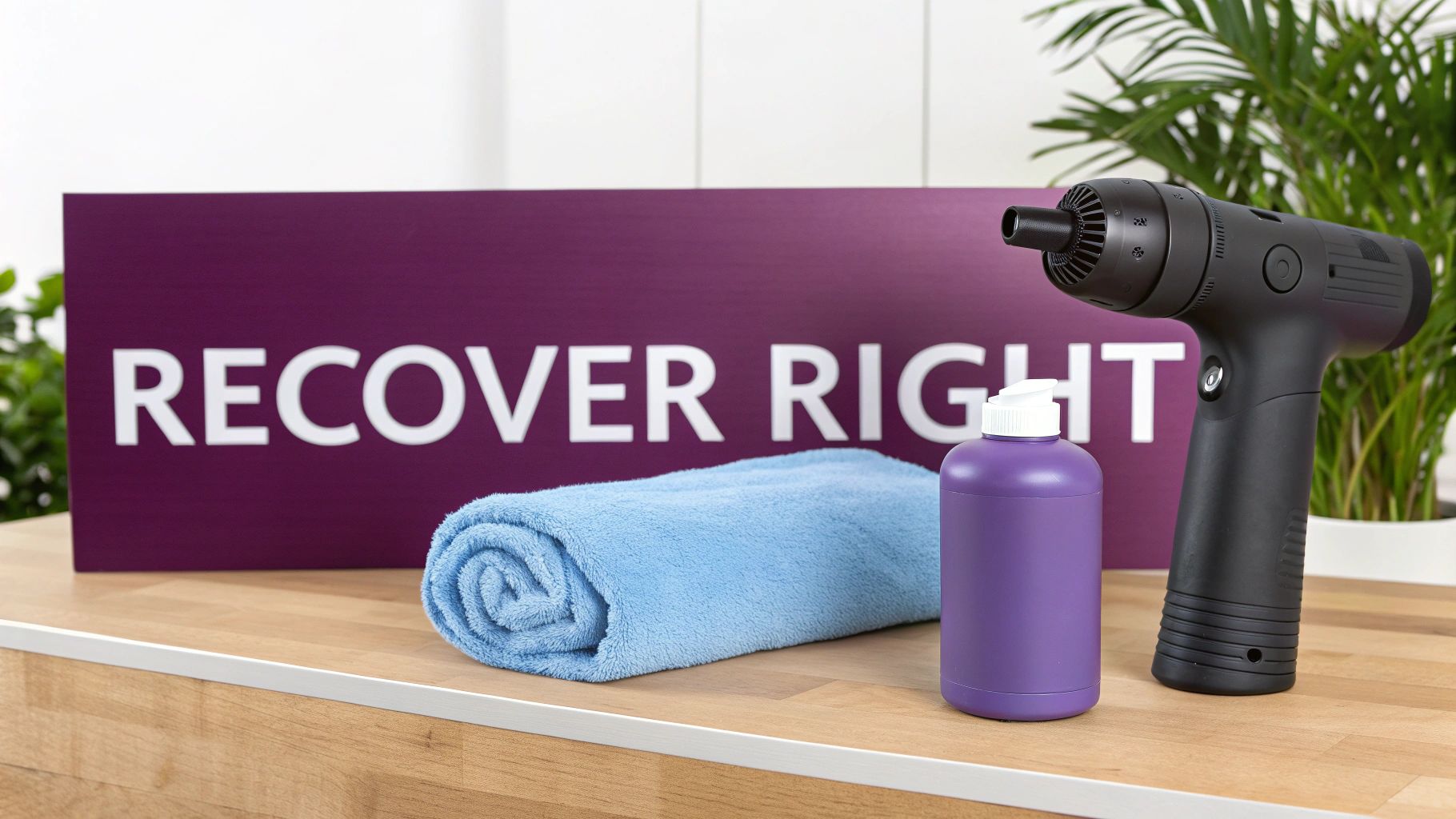
Think of recovery as the essential link connecting your efforts in the kitchen with your hard work in the gym. Without it, even the best plan will fall flat. Proper recovery boils down to sleep, hydration, and targeted nutrition.
The Power of Post-Workout Nutrition
What you eat after a workout is just as important as the workout itself. During exercise, you break down muscle protein and drain your muscle glycogen (fuel). Your post-workout meal kickstarts the repair and refueling process.
Your focus should be on two key macronutrients: carbohydrates and protein. Carbs restore glycogen stores, while protein provides the amino acids needed for muscle repair.
A simple rule of thumb for effective post-workout nutrition is a 3-to-1 ratio of carbohydrates to protein. This combination ensures you’re both refueling and rebuilding.
Speeding Up Muscle Repair and Reducing Soreness
Beyond what you eat, physical recovery techniques can make a huge difference. One of the most effective ways to tackle muscle soreness is percussive therapy from a massage gun.
This technology uses rapid pulses that get deep into muscle tissue, helping release knots and boost circulation. Better blood flow delivers more oxygen and nutrients to sore muscles while flushing out metabolic waste.
For anyone who trains consistently, managing soreness is key. Our Deep Tissue Massage Gun is designed specifically for this. It offers a professional-grade recovery experience at home.
- Targeted Relief: With multiple attachments, you can zero in on specific muscle groups.
- Improved Circulation: The powerful percussive action accelerates your body’s natural recovery process.
- Enhanced Flexibility: Regular use can help improve your range of motion and reduce injury risk.
By making a massage gun part of your post-workout routine, you’re actively helping your body repair itself. For more tips, check out our video on 5 Science-Backed Recovery Tips to Boost Your Results.
Hydration: The Overlooked Key to Performance
Hydration is fundamental, yet often neglected. Water is essential for nearly every bodily function. Even slight dehydration can tank your strength, endurance, and focus.
When you exercise, you lose a lot of water through sweat. It’s crucial to replace those lost fluids. A simple trick is to weigh yourself before and after a workout; for every pound lost, drink 2 to 3 cups of water.
To make this a no-brainer, the Smart Water Bottle with Hydration Reminder from our shop is a perfect companion. It glows to remind you when it's time to drink, taking the guesswork out of staying hydrated.
Got Questions About Diet and Exercise? Let's Clear Things Up.
Diving into fitness can feel overwhelming. Let's tackle some of the most common questions head-on to make your journey clearer and more effective.
Can I Just Exercise to Lose Weight and Not Change My Diet?
Technically, yes, but it's an uphill battle. Losing a single pound of fat requires burning 3,500 more calories than you consume.
Trying to achieve that with exercise alone is a massive undertaking. You’d have to run a marathon to burn off one pound. It's much easier to create a sustainable 500-calorie deficit each day by making smarter food choices.
What’s More Important for Gaining Muscle?
When building muscle, diet and exercise are a true 50/50 partnership. You cannot have one without the other. Resistance training signals your muscles to grow.
But that signal is just a request. Your diet delivers the supplies. Without enough protein and calories, your body can't build new muscle tissue. The gym is where you place the order; the kitchen is where you pick up the materials.
If I Only Have Time for One, Which Should I Pick?
This comes down to your primary goal. If dropping pounds is your priority, focus on your diet. Controlling calorie intake gives the fastest results on the scale.
But if you're aiming for overall health and a mental boost, exercise is non-negotiable. Start with your diet to get the weight moving, then layer in whatever exercise you can realistically fit into your life.
At Diet & Exercise, we're all about giving you the tools and knowledge you need to hit your goals.
Check out our collection of fitness equipment and apparel to find the right gear for your balanced lifestyle at dietexerciseshop.com.