
4 Essentials and Fit Checks for What to Wear to the Gym
Wear shoes matched to your workout, a moisture-wicking top, bottoms that let you move freely, and a sports bra with the right support level for the activity. Get those four right, and everything else—socks, layers, accessories—falls into place. The goal is simple: clothes that disappear so you can focus on the workout, not your waistband.
TL;DR:
- Choosing moisture-wicking fabrics such as polyester, nylon, or spandex blends ensures better sweat management and greater comfort during workouts.
- Proper fit testing involves raising your arms, squatting, and lunging to confirm that garments stay in place and do not restrict movement before gym sessions.
- Matching shoes to specific activities—running shoes for cardio, flat shoes for lifting, and cross-trainers for multi-directional movement—significantly reduces injury risk.
- Supportive sports bras should be chosen based on impact level, with band fit being more critical than cup size to prevent bounce and discomfort.
- Avoid common mistakes like wearing heavy cotton clothing, open-toed shoes, and loose-fitting clothes that can snag or reduce stability during exercise.
Table of Contents
- What Should You Wear to the Gym? A 60-Second Checklist
- Which Fabrics and Fits Actually Perform Better?
- How Do You Choose Gym Shoes and Socks?
- How Do You Pick the Right Sports Bra?
- What to Wear for Each Type of Workout
- How Should You Layer for Commuting and Weather?
- Common Beginner Mistakes and Easy Fixes
- Mark’s Packing List and Practical Gym Bag Tips
- What Beginners Get Wrong About Gym Clothes
- Gear Up: Apparel and Guides That Match This Advice
- Sources
- FAQ
What Should You Wear to the Gym? A 60-Second Checklist
Before you head out the door, run through this. It covers the essentials for nearly any session, whether you’re lifting, running, or trying your first HIIT class.
- Shoes: Running shoes for cardio, flat stable shoes for heavy lifting, cross-trainers if your workout mixes both, according to Nike’s outfit guidance.
- Top: A moisture-wicking shirt or tank that fits close enough to move with you but doesn’t restrict your arms overhead.
- Bottoms: Leggings or shorts with a secure waistband that won’t slide during a squat or a burpee.
- Sports bra: Match the support level to the impact of the workout (more on this below).
- Socks: Moisture-wicking, cushioned where you need it most.
- Extras: A towel, a water bottle, and a spare top if you sweat heavily or plan to run errands afterward.
Beginner-focused guides consistently point to the same short list, breathable fabric, activity-matched shoes, and a couple of basic accessories, as the foundation of an appropriate gym outfit. Nail this checklist and you’re covered for most situations in a typical gym.
Which Fabrics and Fits Actually Perform Better?
Fabric choice matters more than most beginners realize. Moisture-wicking synthetics, polyester, nylon, and spandex blends, pull sweat away from your skin and let it evaporate, which keeps you cooler and drier through a long session. Cotton does the opposite: it absorbs sweat and holds onto it, so a cotton shirt that felt fine at minute five feels like a wet towel by minute thirty. Under Armour’s breakdown of workout fabrics makes this same point, and it’s backed by basic physiology: synthetic blends manage moisture and heat far more efficiently once you’re sweating for real, a mechanism clinical research on exercise thermoregulation also touches on.
Fit is the other half of the equation, and it’s where most beginners guess wrong. You want snug, not tight. A shirt that’s too loose will bunch under a barbell or catch on gym equipment; one that’s too tight will restrict your shoulders on an overhead press. The same logic applies to bottoms: check the waistband, check the seams, and make sure nothing digs in when you bend.
Here’s a three-step fit test you can run in the dressing room or your bedroom before you ever set foot in a gym:
- Raise your arms straight overhead. If your shirt rides up past your belly button or your shoulders feel pinched, size up or pick a different cut.
- Drop into a deep squat. Leggings or shorts should stay put at the waist and knee, no rolling down, no riding up.
- Step into a lunge. Check that the fabric stretches with your hips instead of pulling tight across the thigh.
If a garment passes all three, it’ll survive most workouts. For a deeper look at which materials hold up best over repeated washes and sweat sessions, Diet Exercise Shop’s guide to workout clothes material breaks down the tradeoffs by fabric blend.
Pro Tip: Do the squat test with your hands empty first. If the fabric pulls or the waistband slips without any added weight, it’s going to fail the moment you load a barbell.
How Do You Choose Gym Shoes and Socks?
Your shoes do more work than any other item on your body, and picking the wrong pair is the fastest way to end up with sore knees or a rolled ankle. The core rule, backed by Nike’s gym outfit guidance, is to match the shoe to the movement:
- Running shoes have more cushioning and a build designed for repeated forward motion, ideal for treadmill work or outdoor runs.
- Lifting shoes are flat and stable with minimal cushioning, which keeps your feet planted and your force transfer efficient during squats and deadlifts.
- Cross-trainers offer multi-directional support for HIIT classes, agility drills, or any session that mixes lateral movement with straight-line cardio.
Beyond the category, look at heel-to-toe drop, stability through the midfoot, grip on the outsole, and breathability in the upper. A shoe that’s cushioned for running but worn for heavy squats can actually make your lifts less stable, since the extra foam compresses unevenly under load.
Socks matter more than beginners expect. Moisture-wicking material prevents blisters, and cushioned zones at the heel and ball of the foot absorb impact during running or jumping. Crew socks give extra ankle coverage for outdoor runs or turf work; low-cut socks work fine for most indoor lifting and cardio sessions. One detail worth knowing: Men’s Health’s testing of workout gear found that gear fit and comfort directly affect how focused people stay mid workout, and that starts from the feet up.
How Do You Pick the Right Sports Bra?
Sports bras aren’t one-size-fits-all, and the biggest mistake beginners make is grabbing whatever’s on sale instead of matching support to activity. Nike’s guidance on impact levels breaks support into three tiers:
- Low impact: Yoga, Pilates, walking, or light stretching. Compression-style bras with minimal structure work fine here.
- Medium impact: Strength training, cycling, or moderate-intensity cardio. Look for a wider band and adjustable straps.
- High impact: Running, HIIT, or jump-heavy classes. Encapsulation bras (which support each breast separately, rather than just compressing) reduce bounce and discomfort far better than compression alone.
When shopping, prioritize band fit first, since a loose band is the most common cause of bounce, not cup size. Adjustable straps let you fine-tune support as fabric stretches with wear, and a racerback or crossback style tends to hold up better during overhead movement than a simple T-back.
If you can’t find your exact size in a store, don’t panic. A slightly larger band with a bra extender, or layering a lighter compression tank underneath a medium-support bra, buys you real support until you find your correct fit. Readers looking for a broader rundown of what to prioritize in women’s activewear can check Diet Exercise Shop’s guide to workout clothes for women.
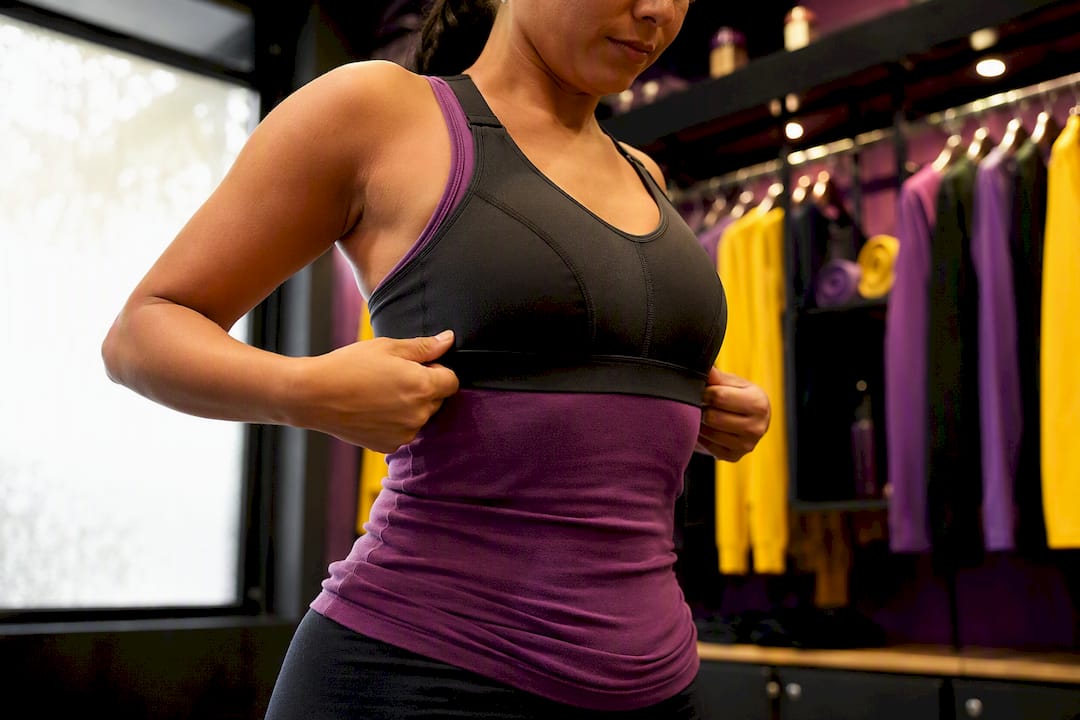
Pro Tip: If you can slide more than two fingers under the band while standing straight, it’s too loose. Go down a band size before you go up a cup size.
What to Wear for Each Type of Workout
The outfit that works for a lifting session isn’t necessarily the one you want for a HIIT class or a yoga flow. Matching your clothes to the specific demands of the workout is the difference between gear that helps you and gear that just gets in the way.
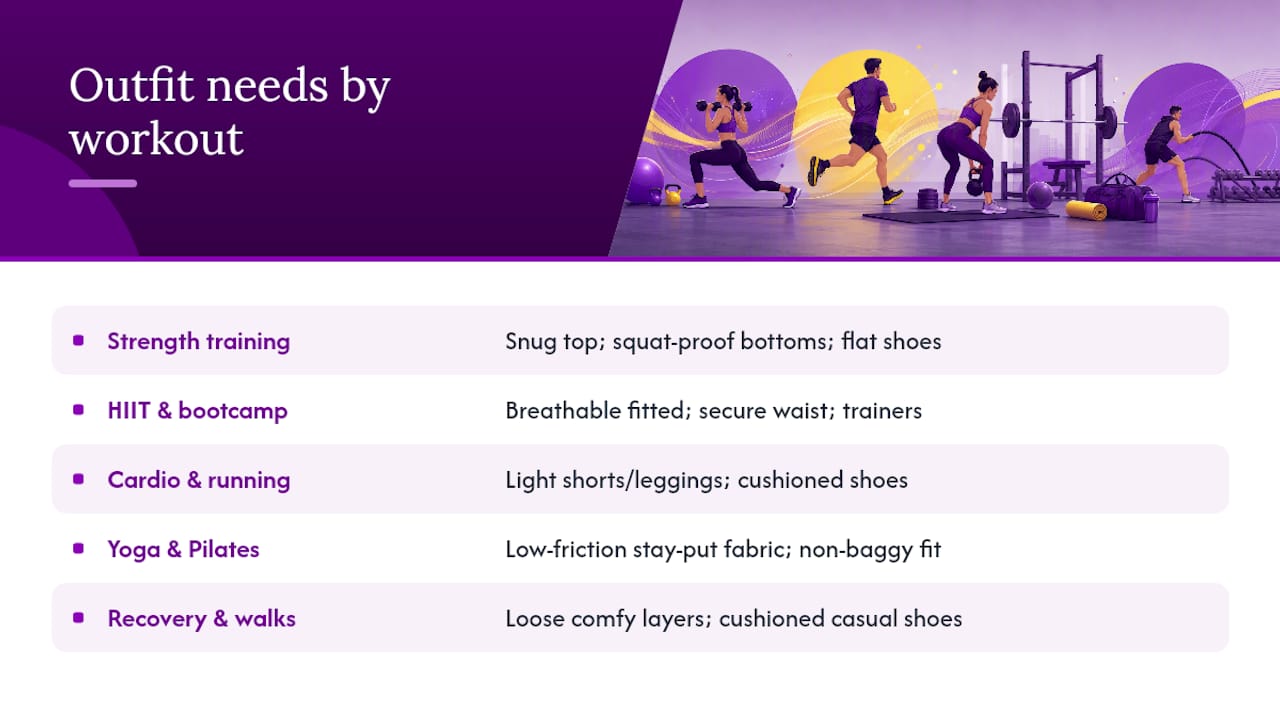
Strength training calls for a snug top that won’t slide during overhead presses, squat-proof bottoms with a locked waistband, and flat, stable shoes that keep your feet planted through heavy lifts. Loose shorts that ride up mid-squat are one of the most common complaints from new lifters, and it’s an easy fix with the right cut.
HIIT and bootcamp classes move fast and change direction constantly, so breathable, fitted layers that won’t flap around matter here. Shorts or leggings need a secure waistband since you’ll be jumping, lunging, and sprinting in the same 45 minutes. Cross-trainers are the right shoe choice for this kind of multi-directional load.
Cardio and running sessions favor lighter leggings or shorts and running shoes with real cushioning underfoot, since repeated impact adds up over a 5K or a long treadmill session.
Yoga and Pilates need garments that stay put through inversions and stretches without bunching, low-friction fabric that moves with your body rather than against it. This is one place where a slightly looser fit, as long as it’s not baggy, actually helps rather than hurts.
Recovery days and walks are the exception to the snug-fit rule. Looser layers and comfortable, well-cushioned shoes make more sense than performance gear when the goal is low-intensity movement or just getting your steps in.
Activewear styling has also loosened up. Harper’s Bazaar’s coverage of gym outfit trends notes that bike shorts, track shorts, and other silhouettes beyond leggings are increasingly common, as long as they still function for the movement at hand. For anyone building a strength routine specifically, Diet Exercise Shop’s beginner workout routine guide pairs well with this outfit breakdown since the two decisions, what you’re doing and what you’re wearing, go hand in hand.
How Should You Layer for Commuting and Weather?
If you’re heading to the gym straight from work or braving cold weather, layering solves most of the friction. Wear a lightweight, removable layer for your warm-up or commute, something you can strip off once your body heat rises, rather than starting your workout already overheated.
Pack a spare top or a compact towel if you sweat heavily on the way there, especially if you’re walking or biking in. Nobody wants to start a lifting session already soaked through.
Cold weather adds a couple of extra steps: a warm-up jacket or hoodie for the walk in and out, thermal socks if you’re commuting on foot, and an insulated layer you can throw back on the second your session ends. A hoodie built for exactly this purpose, insulated enough for a chilly commute but light enough not to overheat mid warm-up, earns its spot in any beginner’s gym bag.
Common Beginner Mistakes and Easy Fixes
A few wardrobe missteps show up again and again with new gym-goers, and all of them have simple fixes.
- Wearing heavy cotton for long, sweaty sessions. It holds moisture instead of wicking it away, leaving you soaked and chafed by the halfway mark.
- Open-toed shoes or sandals. They offer zero stability and no protection if you drop a weight.
- Baggy clothes that can snag on machines. Loose drawstrings or oversized sleeves catch on cable pulleys and resistance bands more often than beginners expect.
- Skipping a towel. Wipe down shared equipment after use, both for hygiene and gym etiquette.
- Ignoring a slipping waistband. An anti-chafe balm and a properly fitted waistband solve most of the mid-workout adjustments people make.
Small fixes, big difference. Pack a spare top, tighten your waistband before you start, and skip the cotton on cardio day.
Mark’s Packing List and Practical Gym Bag Tips
Here’s what actually goes in my gym bag: a moisture-wicking top, activity-matched shoes, a spare pair of socks, a small towel, and a water bottle that doesn’t leak. That’s the whole ritual, and it takes under two minutes to pack once you’ve got the right gear on hand.
Confidence matters more than people give it credit for. Editors and trainers who’ve tested workout gear extensively consistently note that feeling prepared cuts down on distraction mid-session, so the right outfit isn’t vanity, it’s focus. Pairing the right clothes with the right fuel matters too; Diet Exercise Shop’s guide to eating around workouts covers the other half of showing up ready.
What Beginners Get Wrong About Gym Clothes
Most advice on this topic treats outfit choice like an afterthought, buy whatever’s cheap, worry about it later. That’s backwards. The clothes you choose directly shape how a workout feels, and getting the basics wrong (a slipping waistband mid-squat, a soaked cotton shirt by minute twenty) is often what makes beginners quit a routine they’d otherwise stick with.
The conventional wisdom oversells brand names and undersells fit testing. Nobody needs premium gear to have a good first month at the gym. What they need is shoes matched to the actual movement, a top that survives a raised-arms test, and a bra sized to the band, not just the cup. Get those right and the rest is preference.
If there’s one thing to prioritize first, it’s shoes. Bad footwear affects your joints and your balance in ways a shirt never will. Everything else, fabric, layering, accessories, can be adjusted after the fact. Your shoes can’t.
— Mark
Gear Up: Apparel and Guides That Match This Advice
Dietexerciseshop built its apparel line around exactly the fit and fabric principles covered above: moisture-wicking materials, honest sizing, and designs that move with you instead of against you. If you’re assembling a first gym wardrobe, the TRUST THE PROCESS T-Shirt and the SQUATS? I THOUGHT YOU SAID SQUASH? T-Shirt both pass the raised-arms and squat tests described earlier, at a price that makes sense for someone still figuring out what works.
For colder commutes, the MEAL PREP & MUSCLE REPS Hoodie and the RUNNING ON COFFEE AND PROTEIN SHAKES Hoodie work exactly the way the layering section describes: warm enough for the walk in, light enough to strip off mid warm-up. And if you want to pair your outfit choices with real programming, the FUNCTIONAL FITNESS eBook and the HIIT IT HARD Training Guide both build workouts around the exact movement patterns this article uses to explain outfit choice. Browse the full T-shirt collection to find your first gym-ready top today.
Sources
- What to Wear to the Gym: Guide to Women’s Workout Clothes — Under Armour
- Best workout clothes for men, tested by editors and trainers — Men’s Health
- PubMed study (ID 27096286)
FAQ
What Should a Beginner Wear to the Gym?
Start with moisture-wicking top and bottoms, shoes matched to your planned activity, and a sports bra sized to the workout’s impact level. Skip anything baggy enough to snag on equipment.
What’s the Best Outfit to Wear to the Gym?
There’s no single best outfit, since running, lifting, and HIIT each call for different shoes and fits, but a moisture-wicking top paired with squat-proof bottoms and activity-appropriate shoes covers most sessions.
What Is the 3-3-3 Rule at the Gym?
Definitions vary depending on the source, and it’s not a standard fitness or apparel guideline this article’s research supports, so treat any specific claim about it with caution.
Can You Wear a Regular T-Shirt to the Gym?
A regular cotton T-shirt works fine for light activity or a beginner’s first few sessions, but it holds sweat during longer or high-intensity workouts, so a moisture-wicking shirt performs better once you’re training regularly.