

Do Workout Hoodies Actually Help Your Training?
Yes, but only in specific situations. A hoodie helps you warm up faster in a cold gym, keeps your muscles loose before heavy lifts, and can shut out enough distraction to help you focus on a hard set. What it will not do is burn more fat. That extra sweat pouring off you by rep three is water leaving your body, not extra calories being torched.
The real answer is conditional, so here is the quick version before the deeper dive:
- Helps with: warm-up quality, cold-weather sessions, and mental focus during heavy lifts
- Hurts with: high-intensity cardio, hot rooms, and anything requiring a full overhead range of motion
- Rule of thumb: layer up for the warm-up, strip down for the work, and never mistake sweat for progress
If you remember one thing, make it this: hoodies change comfort and warm-up quality, not your metabolism.
Key Takeaways
A workout hoodie improves warm-up quality, comfort, and focus, but it has no effect on fat loss and can hurt performance if worn too long into intense training.
| Point | Details |
|---|---|
| Warm-up window is short | Hoodies help most in the first 10 to 15 minutes before your body generates its own heat. |
| Sweat is not fat loss | Extra sweating in a hoodie is water and electrolyte loss, not additional calories burned. |
| Watch for overheating signs | Dizziness, nausea, or confusion mean it is time to remove the hoodie and rehydrate immediately. |
| Match fabric to intensity | Choose moisture-wicking synthetics for active sessions and midweight cotton blends for warm-up or casual wear. |
| Dietexerciseshop fits the use case | The MEAL PREP & MUSCLE REPS Hoodie and CARDIO AND CARBS Hoodie are built for warm-up and casual training, not high-intensity work. |
Table of Contents
- Workout Hoodie Benefits for Warm-Up, Focus, and Comfort
- The Overheating, Dehydration, and Mobility Tradeoffs
- Fabric, Fit, and Hoodie Types That Actually Work
- Matching Hoodies to the Right Workout
- Why Trust This Guide
- What Happens to Your Muscles After the Workout
- How Your Body Regulates Heat Mid-Workout
- Getting the Most Life Out of Your Training Hoodie
- How I Actually Use a Hoodie in My Own Training
- Gear That Matches This Approach
- Sources
- FAQ
Workout Hoodie Benefits for Warm-Up, Focus, and Comfort
The biggest, most defensible benefit of training in a hoodie comes down to muscle temperature. Warmer muscles have better elasticity and blood flow, and exercise physiology research ties that improved elasticity to reduced strain risk during exercise. A cold muscle is a stiffer muscle. Ask anyone who has pulled a hamstring on a chilly morning run without warming up properly. Trapping body heat with a hoodie during your first sets of squats, or during a slow mobility flow, gets your tissue ready to work sooner than a t-shirt does in a 60 degree gym.
That thermal advantage fades fast once you are a few sets deep and your core temperature climbs on its own. This is why the hoodie’s real value window is narrow: the first 10 to 15 minutes of a session, not the whole workout.
Psychological benefits are underrated and worth taking seriously. Pulling the hood up is a real behavioral cue for a lot of lifters. It narrows your visual field, muffles gym noise, and signals to everyone around you that you are not looking for conversation. Fitness commentary on gym culture points to privacy and confidence as genuine, non-trivial reasons people wear hoodies at the gym, especially for lifters who get self-conscious about their bodies or just need to lock in before a heavy attempt. This is not a placebo effect you should dismiss. A pre-lift ritual, even one as simple as putting a hood up, primes focus the same way a boxer’s walkout song does.
There are practical, almost mundane benefits too:
- Kangaroo pockets hold your phone, keys, or a pre-workout shaker without a bulky gym bag nearby
- A layer of fabric between your arms and shared equipment acts as a light hygiene buffer on padded benches and mats
- Extra warmth makes slower, lower-heart-rate sessions (mobility work, light technique days) noticeably more comfortable
- A familiar hoodie can make an unfamiliar gym feel less exposed on your first few visits
Now for the part that trips up a lot of well-meaning lifters. Sweating heavily in a hoodie feels productive. It is not. Sweat is a cooling mechanism, not a fat-burning one. Michigan State University Extension research is direct about this: sweat is mostly water and electrolytes leaving your body, and losing more of it does not equal losing more fat. The scale drop you see after a hoodie session is water weight that comes right back once you rehydrate.
Quick reality check: the number on the scale after a sweaty hoodie workout reflects fluid loss, not fat loss. You will regain that weight the moment you drink water.
Working out in a hoodie can genuinely improve how your first few sets feel, but it changes nothing about the energy math behind fat loss. Burning more calories still requires more output, whether that is heavier weight, more reps, or a faster pace. No amount of insulation substitutes for that.
The Overheating, Dehydration, and Mobility Tradeoffs
Everything that makes a hoodie useful for warm-up becomes a liability once your session picks up intensity. Trapped heat that felt good at minute five starts fighting against you at minute twenty. Your body has to work harder to dissipate heat through a layer of fabric, and that added thermal load raises your perceived exertion. A set that should feel like a 7 out of 10 starts feeling like a 9, and your endurance on longer efforts drops as a result. This is exactly the mechanism behind why heavy insulating layers during high-intensity interval training increase overheating risk and can actively hurt your output.
Dehydration is the more serious concern hiding behind that “good sweat.” Excess fluid loss without matching water intake shifts your electrolyte balance, and that is when things go from uncomfortable to genuinely risky. MedlinePlus guidance on heat-related illness lists dizziness, nausea, confusion, and excessive fatigue as warning signs that your body is struggling to regulate temperature, and insulating clothing that increases sweat rate is a documented risk factor.
Fit matters just as much as fabric here. A bulky hood or a hoodie cut too generously through the shoulders will bunch up during overhead presses, pull-ups, or any exercise requiring a full range of motion at the shoulder joint. That is not just annoying. Restricted movement changes your form, and bad form under load is how strains happen.
Here is a simple checklist for knowing when to stop or shed the hoodie:
- You feel dizzy or lightheaded between sets, even briefly
- You stop sweating despite still working hard, a sign your cooling system is overwhelmed
- You feel nauseated or unusually fatigued compared to a normal session
- Your form breaks down on overhead or rotational movements because the fabric is restricting you
- Your heart rate feels disproportionately high for the effort you are putting in
Pro Tip: Keep water within arm’s reach during any hoodie warm-up and take a real drink, not a sip, every time you strip the hoodie off between blocks. That habit alone catches most early dehydration before it becomes a problem.
Fabric, Fit, and Hoodie Types That Actually Work
Not every hoodie belongs in a gym bag, and the material makes a bigger difference than most lifters assume. Cotton feels comfortable at rest but holds onto sweat once you start working, which means it gets heavy, clings, and takes forever to dry between sets. Moisture-wicking synthetic blends pull sweat away from your skin and let it evaporate, which keeps you lighter and helps manage odor over a long session. If you train hard more than twice a week, that difference compounds fast. Guidance on choosing breathable, moisture-wicking fabrics backs this up directly for anyone shopping for active gear.
Weight class matters too, and it is worth matching to the job:
- Lightweight technical hoodies for active sessions where you will be moving the whole time, like circuit training or a warm-weather run
- Midweight cotton or blend hoodies for warm-up, cool-down, and casual wear around the gym floor
- Heavyweight fleece hoodies for outdoor training in genuinely cold conditions, or for lounging post-workout
Fit follows a similar logic to weight class. Go looser through the torso for warm-up sets where mobility is not maximally demanded, and switch to a slimmer, more fitted cut once you are lifting heavy and need the fabric to stay out of the bar path. Skip hoodies with long drawstrings around equipment with moving parts, cables, or pulleys. It is a small detail that avoids a real snag hazard.
One more category worth a mention: weighted hoodies. Added load can genuinely raise workout intensity, but it also shifts your center of gravity and changes how your shoulders and spine load during movement. Guidance on weighted training gear is consistent on this point: it is not something a beginner should reach for without coaching. Build a base with standard resistance training first.
For side-by-side comparisons of fabric options across your whole wardrobe, this guide to workout clothing materials covers the same wicking-versus-cotton tradeoffs in more depth.
Matching Hoodies to the Right Workout
The clearest way to think about this is by workout type, not by preference. A hoodie earns its place in some sessions and actively works against you in others.
Good fits for a hoodie:
- Cold indoor gyms where the thermostat runs low and your muscles take longer to warm up
- Outdoor runs or walks in cool weather, especially the first mile before your body generates its own heat
- Warm-up sets before heavy lifts, when you want joint and muscle temperature up before loading the bar
- Low-intensity circuits or mobility days where comfort matters more than heat dissipation
Poor fits for a hoodie:
- High-intensity interval training, where your body is already generating maximum heat
- Long steady-state cardio in a warm room or outdoors in summer
- Technical mobility or flexibility sessions that need full, unrestricted range of motion
A simple routine solves most of the guesswork: start layered during your warm-up, strip the hoodie off once you move into your main working sets, and pull it back on during cool-down if the room has gone cold while you trained. This three-phase approach captures the warm-up benefit and the post-workout comfort without dragging the overheating risk into the middle of your hardest work.
Why Trust This Guide
This guide comes from Dietexerciseshop, a retailer built specifically around helping people train and eat better, with apparel, supplements, and educational content designed to work together rather than as unrelated add-ons.
Choosing the right layer for the right phase of your workout is a small decision that adds up over months of training. Get it wrong consistently and you either fight your own gear or leave warm-up quality on the table.
The products referenced throughout this guide are not arbitrary picks. The MEAL PREP & MUSCLE REPS Hoodie suits the warm-up and casual-wear use case described above: a midweight layer built for comfort before and after training, not for grinding through a HIIT circuit in. Dietexerciseshop’s broader hoodie collection is organized around that same principle: match the fabric and cut to the actual training phase, not just the look.
What Happens to Your Muscles After the Workout
The warm-up benefit gets most of the attention, but a hoodie’s value does not disappear once your session ends. Muscle temperature that helped you move well going into a workout plays a role coming out of it too. Keeping muscles warm during your cool-down phase helps maintain the blood flow that clears metabolic byproducts and starts the recovery process, rather than letting your body cool rapidly and tighten up while you are still stretching or foam rolling.

A lot of lifters skip this entirely. They finish their last set, strip off every layer immediately, and let sweat evaporate off cold skin in an air-conditioned gym. That rapid cooling can leave muscles feeling stiffer walking out the door than they would if you had kept a light layer on through your stretching routine.
Throwing a hoodie back on for the last ten minutes of a session, during static stretching or a slow walk on the treadmill, keeps that muscle temperature elevated a little longer. It is a small habit, but it costs nothing and there is no real downside once you are past the point of generating your own heat through hard effort. Pair it with your usual post-workout routine, protein intake, hydration, sleep, and the hoodie becomes one more small lever rather than the whole recovery strategy. Nobody recovers faster purely because of a garment, but comfort during the wind-down phase does make people more likely to actually complete their stretching routine instead of rushing out the door.
How Your Body Regulates Heat Mid-Workout
Your body is constantly balancing heat production against heat loss, and that balance is what a hoodie interferes with, for better or worse depending on timing. At rest and in the opening minutes of a workout, you are not generating much heat yet, so an added layer helps you reach a productive working temperature faster. Once you are several sets or several minutes into sustained effort, your body is producing far more heat internally, and now that same layer is working against your ability to shed it.
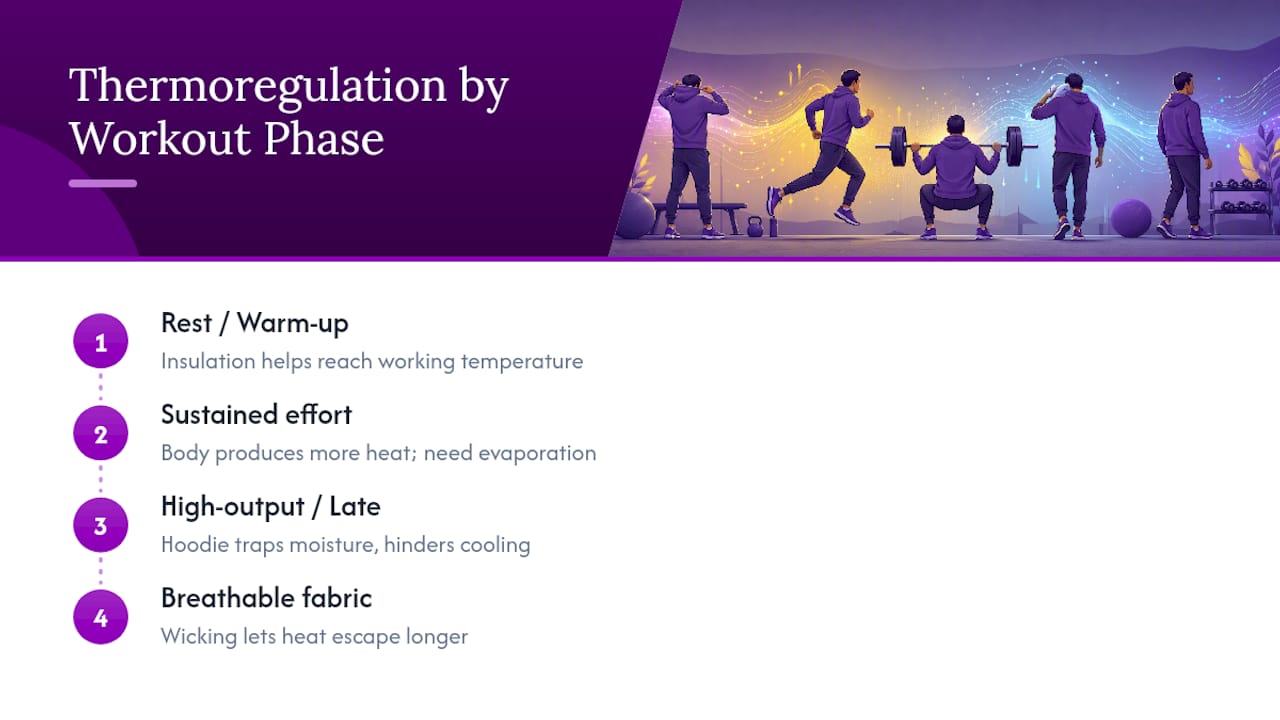
This is thermoregulation in a nutshell: a constant push and pull between insulation and evaporation. Sweating is your primary cooling tool, and it only works efficiently when sweat can evaporate off your skin. Trap that moisture under thick or non-breathable fabric during high-output work and you undermine your own cooling system right when you need it most. That is the direct mechanical link between overheating and the reduced endurance covered earlier in this guide.
The practical takeaway is timing, not avoidance. Wearing a hoodie is not inherently good or bad for thermoregulation. It depends entirely on where you are in the heat curve of your session. Early, when your body wants help warming up, the hoodie assists. Late, when your body is already fighting to cool itself, the same hoodie becomes a hurdle. Fabric choice shifts this curve too. A breathable, moisture-wicking hoodie lets more heat escape than a heavy cotton one, which buys you a slightly longer window before overheating becomes a real issue.
Getting the Most Life Out of Your Training Hoodie
A hoodie that gets washed after every sweaty session and dried properly will outlast one thrown in a gym bag for days at a time by a wide margin. Sweat contains salt and oils that break down fabric fibers and elastic over repeated exposure, especially around the cuffs and waistband where stretch matters most for fit.
Wash training hoodies in cold or warm water rather than hot, since high heat degrades synthetic wicking fibers faster and can shrink cotton blends unevenly. Skip fabric softener on technical fabrics. It coats the fibers and blocks the moisture-wicking properties that made the hoodie useful in the first place. Air drying preserves elastic and print quality far better than a high-heat dryer cycle, particularly for hoodies with graphic prints or embroidered logos, which crack and peel faster under repeated heat exposure.
Rotating between two or three training hoodies rather than relying on a single one also extends the useful life of each piece, since fabric gets a full day to recover its shape and wicking capacity between wears. Check drawstrings periodically for fraying, since that is usually the first component to wear out, and replace or remove one that is starting to unravel before it becomes a snag risk near equipment. A well-maintained midweight hoodie can realistically serve two or three full training seasons before the fabric starts losing its wicking performance or shape.
How I Actually Use a Hoodie in My Own Training
My routine is simple: hoodie on for the first ten minutes of any cold-gym session, off the second I start my heavy working sets. I learned this the hard way after fighting a bunched-up sleeve mid-set on an overhead press, which is a fast way to lose focus on a heavy lift. The caution I would pass on is not to trust how warm you feel as your only signal. I have caught myself dehydrated on days I felt perfectly comfortable simply because the hoodie masked how much I was actually sweating. Drink water on a schedule, not just when you feel thirsty.
— Mark
Gear That Matches This Approach
If you want a hoodie built around the warm-up-then-strip-down approach this guide recommends, Dietexerciseshop’s lineup is designed with exactly that use case in mind, not as generic streetwear repurposed for the gym.

The MEAL PREP & MUSCLE REPS Hoodie works well as your go-to warm-up and casual layer, midweight enough for a cold gym floor without becoming a liability once you start sweating. The CARDIO AND CARBS, THE PERFECT PAIRING Hoodie fits the same casual, low-intensity role for lighter training days or a chilly walk to the gym.
If you want to pair your gear with actual training knowledge, the MUSCLE GAIN SECRETS eBook covers programming and progression strategy that goes well beyond what any garment can offer. Wash your hoodie after every use, skip the fabric softener, and air dry when possible. It will hold its shape and wicking performance far longer. Browse the full hoodie collection or check out the TRUST THE PROCESS T-Shirt for your lighter training days, and place your order before your next cold-gym session.
Sources
- Working Out in a Hoodie: Pros & Cons — The Manual
- PubMed: Effects of muscle temperature on exercise (example source)
- Heat-related illness: prevention and safety — MedlinePlus
- Is sweating good for you? — Michigan State University Extension
FAQ
Is it beneficial to work out in a hoodie?
It helps during warm-up and in cold environments by keeping muscles warmer, which supports flexibility, but it offers no benefit for calorie burn or fat loss.
Why do people wear hoodies in the gym?
Beyond warmth, many lifters use a hoodie for privacy, focus, and a mental cue to lock into a heavy set, along with the practical convenience of built-in pockets.
Does working out in a hoodie burn fat?
No. The extra sweat you produce is water and electrolyte loss, not additional fat burned, and the weight drop you see afterward returns once you rehydrate.
Why do bodybuilders always wear hoodies?
Bodybuilders often favor hoodies for the combination of muscle warmth during warm-up sets and the psychological focus that comes with reduced visual distraction during heavy lifts.