

Training Load Carb Cycling for Trainees: 4–6 g/kg on Hard Days
Carb cycling can help you lose fat while keeping muscle, but only when it’s built on top of a real calorie deficit and a firm protein floor. It’s not a metabolic shortcut. It works best for people who train hard on some days and lighter on others and want their carbohydrate intake to match that effort. The rule to remember: protein stays at a target range supported by research, typically between roughly 1.6 and 2.2 grams per kilogram every single day, and carbs rise or fall depending on whether you’re lifting heavy, doing light cardio, or resting.
TL;DR:
- Carb cycling aligns carbohydrate intake with training intensity, but fat loss depends solely on being in a calorie deficit supported by sufficient protein.
- It helps maintain workout performance and lean mass during fat loss, especially when carbs are increased on heavy training days and decreased on rest days.
- Proper planning requires setting a calorie deficit of about 500 kcal and maintaining protein at 1.6 to 2.2 grams per kilogram daily, with carb targets based on activity level.
- Fluctuations in scale weight on low-carb days often reflect water shifts, not actual fat loss, emphasizing the importance of tracking long-term trends.
- The approach works best for trained athletes, those who prefer structured routines, and individuals without health issues like diabetes or disordered eating.
Table of Contents
- What Carb Cycling Is and the Physiology That Actually Matters
- Benefits, Realistic Limits, and Who Should Try It
- How to Build a Carb-Cycling Plan for Fat Loss
- A Sample 7-Day Carb Cycling Meal Plan
- Common Mistakes and Safety Checks
- Mark’s Take on Practical Carb Cycling
- Customizing Carb Cycling for Your Body and Life Stage
- Comparing Carb Cycling Patterns: Which Split Fits You
- Fitting Carb Cycling Around Strength Training, Cardio, and HIIT
- Managing Hunger and Energy Dips While Cycling Carbs
- The Mental Side of Carb Cycling and How to Stick With It
- How to Transition Off Carb Cycling for the Long Haul
- Start Simple, Then Adjust
- Optional Support From Dietexerciseshop While You Cut
- Sources
- FAQ
What Carb Cycling Is and the Physiology That Actually Matters
Carb cycling means alternating your daily carbohydrate intake based on activity level, usually across three tiers: high, moderate, and low, sometimes with a scheduled refeed day thrown in for a mental and physical reset. Most versions keep protein steady and let carbs (and sometimes fat) shift around depending on the day.
Here’s the mechanism worth understanding. Carbohydrates get stored as glycogen in your muscles and liver, and glycogen is the fuel your body prefers for anything intense, like heavy squats or sprint intervals. Run low on glycogen for too many hard sessions in a row, and your lifts stall, your reps drop, and workouts start to feel like wading through mud. That’s the practical case for cycling carbs upward on your toughest training days.
What carb cycling does not do is override energy balance. A systematic review on weight loss strategies confirms that calorie deficit drives fat loss, and no single macronutrient pattern beats another once calories and protein are matched. The short-term water weight swings people notice on low-carb days, along with shifts in leptin and fullness signals, feel dramatic on the scale but don’t represent actual fat loss.
A few things separate carb cycling from just eating the same carbs every day:
- Carbs get assigned by training load, not by mood or convenience
- Protein and fiber-rich vegetables typically stay constant across all day types
- Refeed days are planned in advance, not used as an excuse to binge
One randomized trial comparing calorie-restricted diets found that certain calorie-restricted approaches produced somewhat greater short-term weight loss than a calorie-matched Mediterranean diet in some arms over a few months, though long-term differences are unclear, though the researchers noted the long-term picture stays murky. Translation: macro patterns can nudge short-term results, but they’re not the main lever.
Benefits, Realistic Limits, and Who Should Try It
Carb cycling earns its keep in three specific ways: it protects performance on your hardest training days, it gives you a scheduled break from restriction that makes dieting mentally easier to sustain, and it helps preserve lean mass when protein stays high throughout. That’s the honest list. No version of carb cycling burns fat faster than an equivalent calorie deficit on a fixed-carb diet, and research reviewing carb cycling specifically confirms there’s no independent fat-loss advantage once calories are matched.
Good candidates for this approach:
- Trained lifters or athletes with clearly defined hard and easy training days
- Anyone who finds a strict daily calorie target mentally exhausting and needs structured variety
- People who want a framework that protects strength while cutting
Skip it, or check with a doctor first, if you have a history of disordered eating, Type 1 diabetes, or you’re pregnant. The daily fluctuation in carbs and the tracking demands can trigger unhealthy patterns in people prone to them, and blood sugar management in Type 1 diabetes requires far more careful, individualized planning than a generic cycling template provides.
How to Build a Carb-Cycling Plan for Fat Loss
Building your own plan takes five steps, and none of them require guesswork once you have your numbers.
-
Set your deficit and protein floor. A common starting point is roughly 500 kcal below your total daily energy expenditure (TDEE), paired with 1.6 to 2.2 grams of protein per kilogram of body weight, a range supported across multiple diet-strategy reviews for preserving lean mass during a cut. You can pin down your exact TDEE and protein target using a macro calculator.
-
Classify your training days. Hard days (heavy lifting, sprint work, long runs) get 4 to 6 grams of carbs per kilogram of body weight. Moderate days (regular strength work, steady cardio) get 3 to 4 g/kg. Rest days drop to 2 to 3 g/kg. Use lean body mass instead of total body weight if you’re carrying a higher body-fat percentage, since glycogen storage tracks muscle tissue, not fat.
-
Fill remaining calories with fat. Once protein and carbs are set for the day, fat fills the gap. Don’t cut it too low. Somewhere around 20 to 30% of total calories keeps hormone production and satiety in check.
-
Time carbs around training. For your highest-intensity sessions, aim to eat 60 to 70% of that day’s total carbs within a four-hour window before and after the workout. This is where post-workout nutrition timing actually matters, not for fat loss directly, but for recovery and next-session performance.
-
Monitor in two- to four-week blocks. Track body weight, strength numbers, and how recovery feels. If progress stalls, adjust total calories first. Don’t start reshuffling macros before you’ve confirmed the deficit itself is still accurate.
Pro Tip: If you’re new to tracking, weigh yourself daily and average the week rather than reacting to any single number. Daily fluctuations of two to four pounds from water and glycogen are normal and mean nothing on their own.
A Sample 7-Day Carb Cycling Meal Plan
Here’s a worked example for a 75 kilogram adult targeting a moderate deficit, using 2.0 g/kg protein (150g) and a roughly 500 kcal daily deficit from an estimated 2,400 kcal maintenance.
A typical week runs three hard days, two moderate days, and two rest days, though the exact split depends on your training split and preference. Plant-forward eaters can swap chicken and beef for tofu, tempeh, or a lentil-and-rice combination on higher-carb days, keeping legumes as a double-duty carb-and-protein source. Batch-cooking a base of rice, roasted vegetables, and a protein source on Sunday makes swapping portions between day types far less tedious during the week, an approach covered in more depth in meal prep systems for high-protein eating.
Common Mistakes and Safety Checks
Most carb cycling failures come down to the same handful of errors. Cycling carbs by calendar day instead of by actual training load is the biggest one. It defeats the purpose if your “high carb” day lands on a rest day.
- Treating protein as flexible instead of fixed, which erodes the muscle-preservation benefit
- Not tracking total calories at all and assuming macro timing alone will produce results
- Overloading carbs too far from the workout window, missing the recovery benefit
- Panicking over a stalled scale without checking whether the deficit is still accurate
If performance drops on hard days, raise carbs on those specific days before touching anything else. If the scale stalls for two weeks straight, tighten total calories slightly rather than reshuffling the carb split. Anyone managing diabetes, taking medications affected by carbohydrate intake, or recovering from disordered eating should loop in a clinician or registered dietitian before starting.
Mark’s Take on Practical Carb Cycling
The approach leans on training-load matching because it’s the version most people can actually sustain. Readers looking to build on this can check the deeper breakdown of carb cycling patterns and structure, along with macro-calculation and post-workout timing guides referenced above.
- The 24 HOUR FAT BURN eBook includes weekly meal templates and tracking worksheets built around this exact framework
- The Fat Burner with MCT supplement is positioned as optional support for energy and appetite management during a deficit, not a substitute for the calorie math
Customizing Carb Cycling for Your Body and Life Stage
Age, sex, activity level, and metabolic health all shift how aggressive your carb cycling split should be. Older adults, particularly those over 50, tend to hold onto muscle better when protein sits at the higher end of the 1.6 to 2.2 g/kg range and carb swings stay moderate rather than extreme, since recovery capacity and insulin sensitivity both decline gradually with age.
Sex differences matter mostly around hormonal cycles. Some women find that carb needs rise slightly during the luteal phase, when resting metabolic rate ticks up. There’s no need to overhaul the whole plan for this. Shifting an extra 20 to 30 grams of carbs into that window, sourced from whole grains or fruit, usually covers it.
Activity level is the biggest lever of all. A person training five or six days a week with a mix of heavy lifting and conditioning work needs a wider spread between hard-day and rest-day carbs than someone doing three moderate sessions weekly. Cramming a 6 g/kg carb day into a schedule that only includes light walking wastes the strategy entirely.
Metabolic health changes the calculus further. People with insulin resistance or prediabetes often do better starting with a narrower carb range (say, 2 to 4 g/kg across all days) and leaning more on fiber-rich, minimally processed sources, a point echoed in Harvard’s guidance on carbohydrate quality. Refined carbs on a “high” day can spike blood sugar in a way that whole grains and legumes don’t, even at the same gram count.
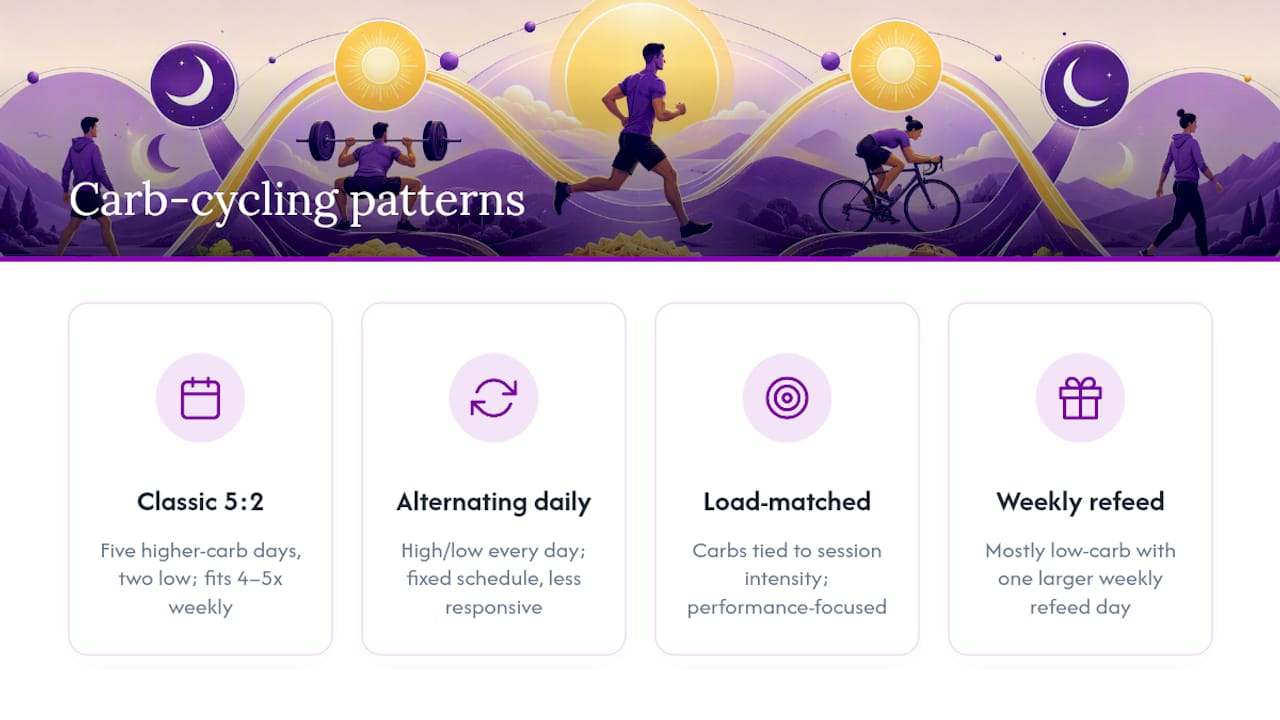
Comparing Carb Cycling Patterns: Which Split Fits You
Not all carb cycling looks the same, and the pattern you choose should match your training frequency and personality, not a template you found online.
The classic 5:2 split runs five moderate-to-high carb days against two low-carb days, usually placed on rest days. This suits people training four to five times weekly who want simplicity over precision.
Alternating daily cycling swaps high and low every single day regardless of training. It’s easier to plan around a fixed schedule but less responsive to how you’re actually training that week, which can leave you under-fueled on an unexpectedly hard session.
Training-load-matched cycling, the approach this article centers on, ties carbs directly to session intensity rather than the calendar. Applied guidance on periodized carbohydrate availability backs this as the version with the clearest link to performance and recovery outcomes, since it fuels the sessions that actually need the glycogen.
Weekly refeed cycling keeps carbs low most days and schedules one larger refeed day weekly, often on the biggest training day or a rest day used for psychological relief. This fits people who find sustained low-carb eating easier than daily fluctuation but need a periodic reset.
For most readers chasing fat loss while training regularly, training-load matching offers the best return because it ties the variable you’re manipulating (carbs) to the variable that actually needs it (glycogen for performance), rather than an arbitrary schedule.
Fitting Carb Cycling Around Strength Training, Cardio, and HIIT
Different training styles burn through glycogen at different rates, and your carb allocation should follow suit rather than using one blanket number across every workout type.
Strength training, especially in the 6 to 12 rep range with heavy loads, depends heavily on muscle glycogen for sustained output across multiple sets.
Steady-state cardio, like a 45-minute jog or a long bike ride, relies more on fat oxidation at moderate intensities, meaning it doesn’t demand the same glycogen load as heavy lifting. These can comfortably sit on moderate or even low-carb days without hurting performance much, since the body shifts fuel sources naturally at lower intensities.
HIIT is the exception that surprises people. Short, maximal-effort intervals burn through glycogen fast because they’re anaerobic, even though the total session might only run 20 minutes. Treat HIIT days like strength days for carb purposes, not like a quick cardio session. Underfueling a HIIT day is one of the more common reasons people feel like their performance falls off a cliff mid-cycle.
If your week mixes all three, the practical order looks like this: heaviest carbs on strength and HIIT days, moderate carbs on steady cardio days, and lowest carbs on full rest days.
Managing Hunger and Energy Dips While Cycling Carbs
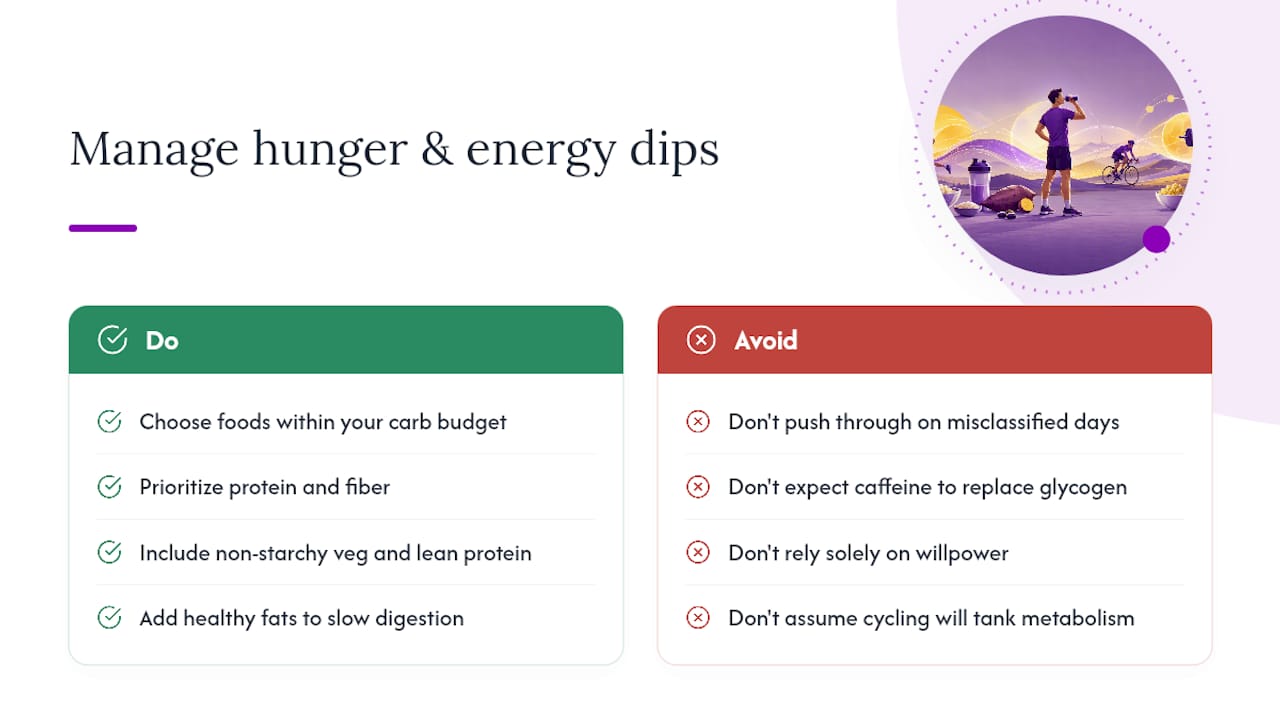
Low-carb days are where most people’s willpower gets tested, and the fix usually isn’t more discipline. It’s better food choices within the carb budget you’ve got.
Protein and fiber do the heavy lifting for satiety on low-carb days. Leaning on non-starchy vegetables, eggs, and lean meats keeps volume high without spending your limited carb allowance. Pair that with healthy fats like avocado or olive oil, which slow digestion and stretch the feeling of fullness between meals.
Energy dips tend to show up as afternoon fog or a flat feeling during workouts on low-carb days, and this is normal rather than a sign something’s broken. If it happens on a day you didn’t expect to train hard, that’s a signal to double-check your day classification rather than push through. Caffeine timed before a low-carb training session can help offset some of the perceived fatigue, though it won’t replace glycogen that isn’t there.
A preliminary trial on short-term diet cycling paired with exercise found participants achieved meaningful fat loss without a significant drop in resting energy expenditure, suggesting the body tolerates these fluctuations reasonably well over a study period of several months when the program includes structured exercise. That’s reassuring if you’re worried alternating intake will tank your metabolism.
Pro Tip: Keep a stash of high-protein, low-carb snacks on hand for the days you underestimate hunger. Something like the ideas in these low-carb pre-workout snacks can bridge the gap without blowing your carb target for the day.
The Mental Side of Carb Cycling and How to Stick With It
Alternating between restrictive and more generous eating days plays tricks on people’s heads in ways a flat daily calorie target doesn’t. Some people thrive on the variety and look forward to their high-carb days as a built-in reward. Others find the constant mental math of “what day is this” more exhausting than helpful.
Watch for a specific pattern: using high-carb or refeed days as a license to massively overeat “because I earned it.” That mindset turns a structured tool into a cycle of restriction and overcorrection, which undoes the calorie deficit you built the whole plan around. A refeed day should hit your planned macro numbers, not become a free-for-all.
The adherence advantage carb cycling offers is real when it’s used correctly. Knowing a higher-carb day is coming in 48 hours makes a strict low-carb Tuesday easier to sit through than an open-ended, indefinite restriction would. That structure is the actual psychological benefit, not some hormonal fat-burning switch flipping on.
If you notice food anxiety increasing, obsessive tracking creeping in, or guilt around eating carbs at all, that’s worth stepping back from the framework and talking to a professional. Carb cycling should feel like a tool you’re using, not a set of rules controlling you.
How to Transition Off Carb Cycling for the Long Haul
Carb cycling isn’t meant to run forever. Once you’ve hit your fat-loss target or you’re ready to shift into maintenance, the transition should be gradual rather than an abrupt jump back to unstructured eating.
Start by averaging your weekly carb intake across the cycling structure you were using, then apply that average as a flatter daily target for two to three weeks. This prevents the jarring swing from, say, 450 grams on hard days to a flat 200 grams overnight, which can feel like a shock to appetite and energy levels.
Keep the protein floor exactly where it was. This is the one number that shouldn’t change whether you’re cutting, cycling, or maintaining. Dropping protein during the transition is the single most common reason people regain fat faster than expected after finishing a structured cutting phase.
Reassess your calorie target for maintenance rather than continuing the deficit indefinitely. A body that’s lost weight typically needs somewhat fewer calories to maintain than it did at the start, so recalculating your TDEE at your new body weight avoids a slow, invisible calorie surplus creeping in over subsequent months.
Many people choose to keep a lighter version of carb cycling going long-term, simply because tying carbs to training day intensity is a sound habit independent of fat loss. There’s nothing wrong with that. Just recognize it’s become a training-fueling strategy at that point, not a fat-loss protocol anymore.
Start Simple, Then Adjust
Most people overcomplicate this. Match carbs to training volume, hold protein steady, and run it for two to four weeks with honest tracking before changing anything. Save the elaborate periodization schemes for coached athletes chasing marginal performance gains, not your first attempt at a cut.
— Mark
Optional Support From Dietexerciseshop While You Cut
Carb cycling works better when the planning and prep don’t eat up your entire week, and that’s exactly the gap Dietexerciseshop’s tools are built to close. The 24 HOUR FAT BURN eBook hands you ready-made weekly meal templates and tracking worksheets built around the same g/kg carb framework covered above, so you’re not building a spreadsheet from scratch on day one.

For the days when appetite control is the harder part of staying in a deficit, the Fat Burner with MCT is designed as optional support alongside your nutrition plan, not a replacement for it. If you know you’ll be running a cut for several months, the 3-Pack Fat Burner with MCT Supplements bundle covers more ground without repeat single-unit orders. Pick up the eBook first if you want the structure, then add the supplement bundle once you know the plan fits your routine.
Sources
The practical targets in this guide draw on a mix of clinical research and applied sports-nutrition guidance:
- Optimal Diet Strategies for Weight Loss and Weight Loss Maintenance
- What is carb cycling and what are the benefits?
- Harvard T.H. Chan School: Carbohydrates
FAQ
What Is the 3-3-3 Rule for Fat Loss?
There’s no single, universally recognized “3-3-3 rule” tied to fat loss in the research behind this article. Definitions vary online, so treat any version you find as informal advice rather than an established clinical guideline.
How Does a 7-Day Carb Cycling Plan Work?
A 7-day plan typically assigns 3 to 4 hard-training days at 4 to 6 g/kg carbs, 1 to 2 moderate days at 3 to 4 g/kg, and 2 to 3 rest days at 2 to 3 g/kg, while protein stays fixed at 1.6 to 2.2 g/kg every day regardless of carb level.
How Long Should You Carb Cycle For?
Run it in 2 to 4 week blocks and reassess based on weight trend, strength performance, and recovery before deciding whether to continue, adjust calories, or transition toward maintenance.
What Is an Example of a Carb Cycling Diet?
A common example alternates high-carb days (around 4 to 6 g/kg on heavy training days) with low-carb days (around 2 to 3 g/kg on rest days), keeping protein constant and letting fat fill remaining calories, an approach detailed in the Dietexerciseshop carb cycling guide.