

Dumbbell Chest Workout for Home and Gym Gains
Here is a complete dumbbell chest workout you can run today: flat dumbbell press (3 sets × 10 reps), incline dumbbell press (3 sets × 10 reps), dumbbell fly (3 sets × 12 reps), and dumbbell floor press (2 sets × 12 reps). Rest 60–90 seconds between sets. Total session time: roughly 35–40 minutes. Equipment needed: a pair of dumbbells and a bench or flat floor.
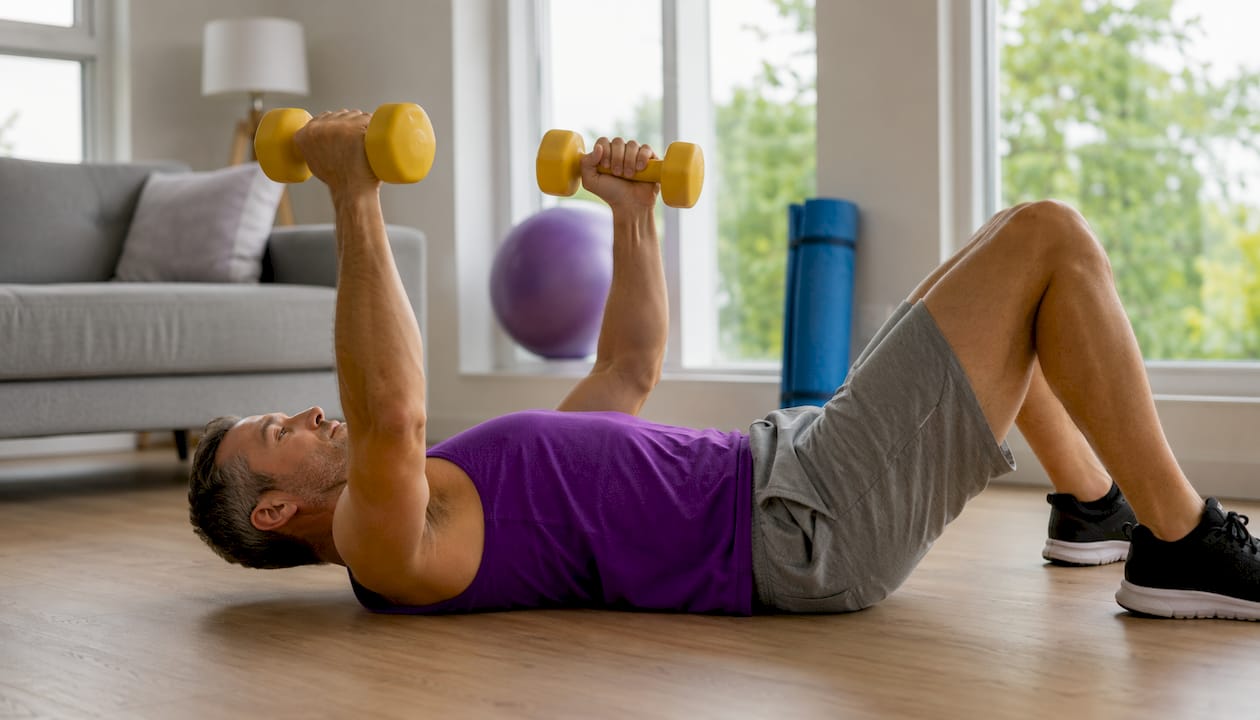
Why this works: dumbbells give you a greater range of motion than a barbell, which means a deeper stretch at the bottom of every rep and more time under tension for the pecs. Stopping just short of full lockout at the top keeps that tension on the chest rather than shifting it to the joints.
Progression rule: when you hit the top end of your rep range for two sessions in a row, add 5 lbs to each dumbbell. That single habit, applied consistently, is what drives size and strength over a 6–8 week block.
- Flat dumbbell press: 3 × 10 reps, 90 sec rest
- Incline dumbbell press: 3 × 10 reps, 90 sec rest
- Dumbbell fly: 3 × 12 reps, 60 sec rest
- Dumbbell floor press: 2 × 12 reps, 60 sec rest
- Total time: 35–40 minutes
Pro Tip: Set your dumbbells and bench before you start. Transition time between exercises is where most people bleed rest time without realizing it.
Table of Contents
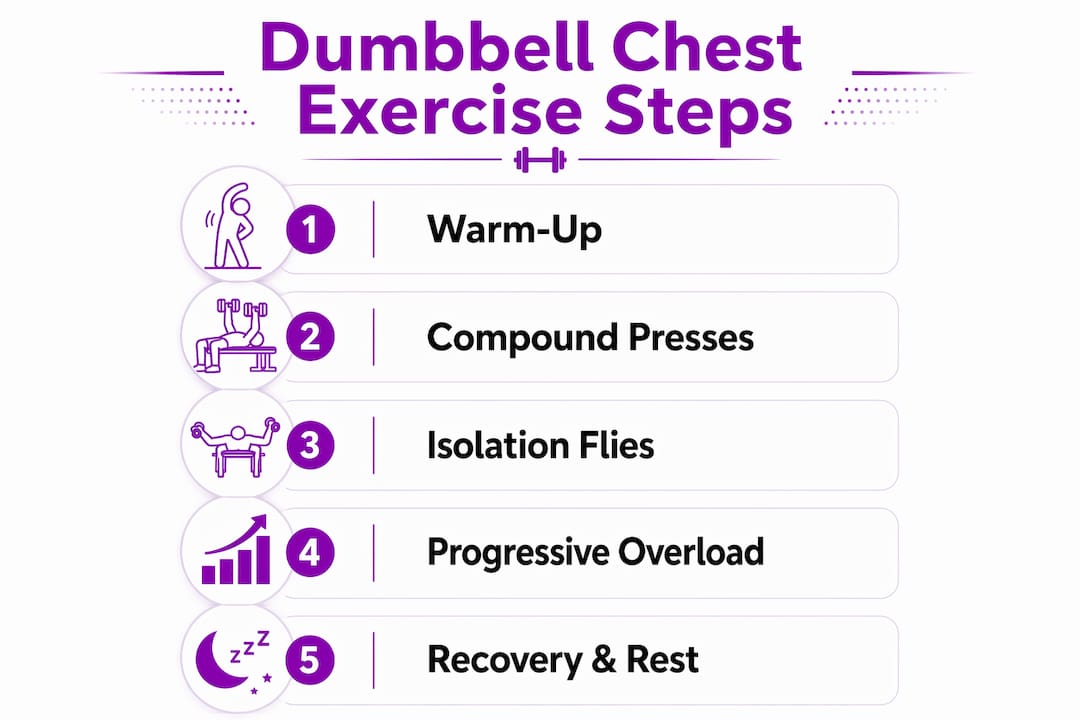
- What are the best dumbbell chest exercises?
- Sample dumbbell chest workouts for every level
- How do you program progressive overload with dumbbells?
- How should you warm up and set up for chest day?
- What mistakes kill chest gains and how do you fix them?
- Key Takeaways
- What most people get wrong about dumbbell chest training
- Build your chest training setup with Dietexerciseshop
- Useful sources
- FAQ
What are the best dumbbell chest exercises?
The exercises below cover every region of the pec: upper, mid, and lower fibers, across pressing and fly patterns. You do not need all of them in one session. Pick 3–5 based on your goal and equipment, and rotate variations every 4–6 weeks.
Flat dumbbell bench press
How to do it: Lie on a flat bench, feet flat on the floor. Hold dumbbells at chest height, palms forward. Press straight up, stopping just before full lockout. Lower slowly over 2–3 seconds until you feel a stretch in the chest.
Muscles targeted: Pectoralis major (sternal fibers), anterior deltoids, triceps.
Common mistake: Elbows flaring out to 90°. Fix it by tucking your elbows to roughly 45° from your torso. This protects the shoulder joint and keeps more load on the pecs.
Variation: Neutral-grip press (palms facing each other) for a more shoulder-friendly option.
Incline dumbbell press (15–30°)
How to do it: Set the bench to a 15–30° incline. Press from chest height, keeping elbows at 45°. Lower with control.
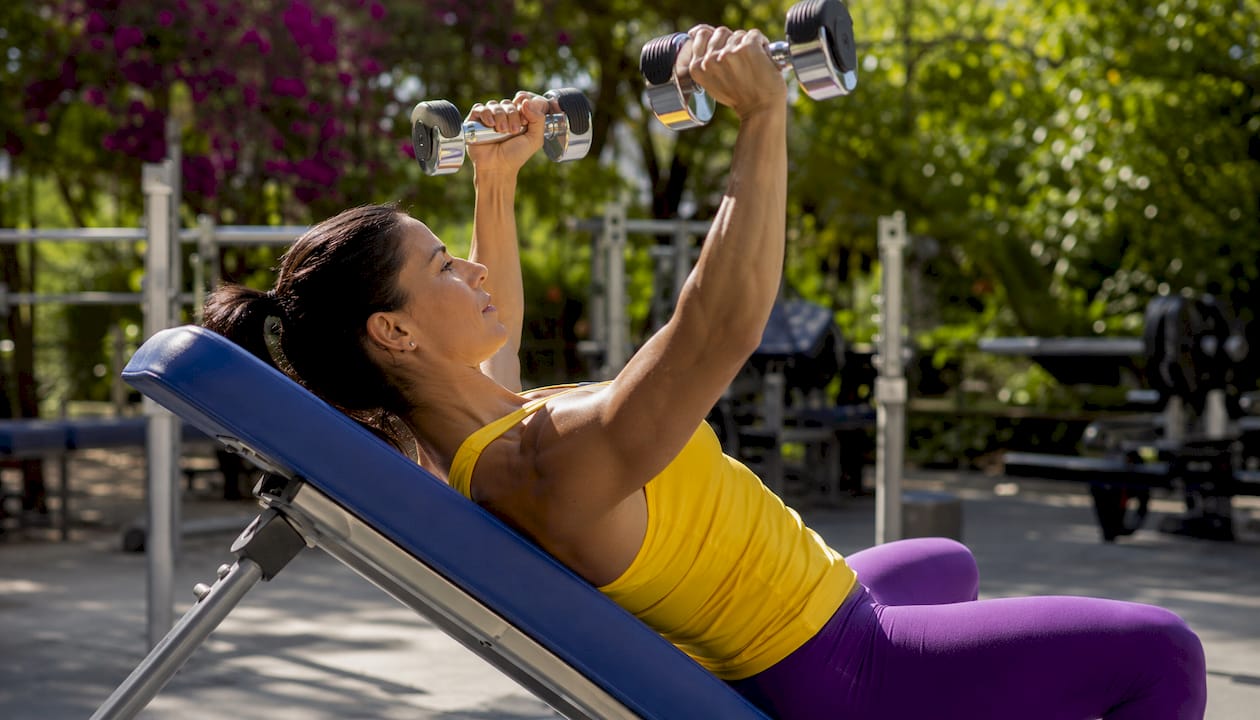
Muscles targeted: Clavicular (upper) head of the pectoralis major, anterior deltoids, triceps.
The 15–30° incline range is the sweet spot for upper-chest emphasis. Push the bench past 45° and the anterior deltoid takes over. Many people over-incline and wonder why their upper chest never develops.
Common mistake: Setting the bench too steep. Stay at a modest angle and focus on the mind-muscle connection with the upper pec.
Decline dumbbell press
How to do it: Lie on a decline bench (or elevate your feet on a stable surface for a floor variation). Press dumbbells from lower-chest height, lower with control.
Muscles targeted: Lower pectoralis major, triceps, front delts.
Variation: Decline floor press — lie flat, elevate your feet on a chair or bench, and press from the floor. Effective when a decline bench is not available.
Dumbbell fly (flat and incline)
How to do it: Lie on a flat or incline bench. Hold dumbbells above the chest, palms facing in, with a slight bend in the elbows. Lower in a wide arc until you feel a deep chest stretch, then squeeze the pecs to bring the weights back together. Do not clank the dumbbells at the top.
Muscles targeted: Pectoralis major and minor, anterior deltoids.
Common mistake: Bending the elbows too much, turning the fly into a press. Keep the elbow angle fixed throughout the movement.
Pro Tip: Flies are not a strength exercise. Use a weight you can control through the full arc, and focus on the stretch at the bottom rather than the load.
Dumbbell floor press
How to do it: Lie flat on the floor, dumbbells held above the chest. Lower until your elbows touch the floor, pause briefly, then press up. The floor acts as a natural depth limiter, which makes this safer for shoulder joints than a full bench press for many people.
Muscles targeted: Mid-to-lower chest, triceps.
Best for: Home training without a bench, or anyone managing shoulder discomfort.
Single-arm dumbbell press
How to do it: Perform a standard flat or incline press with one dumbbell while the other arm rests at your side or on your torso. Alternate sides each set.
Single-arm pressing exposes left-right strength gaps immediately. If one side struggles to hit the same reps, prioritize it by starting every set on the weaker side.
Muscles targeted: Chest, triceps, obliques, core stabilizers.
Squeeze press (hex press)
How to do it: Lie on a bench or floor. Press the flat sides of two dumbbells together and hold that squeeze throughout the entire set. Lower to the chest and press back up.
Muscles targeted: Inner pecs, triceps.
The constant inward force creates tension across the inner chest that a standard press cannot replicate. Keep the squeeze tight at every point in the range.
Dumbbell pullover
How to do it: Lie perpendicular to a bench with your upper back supported. Hold one dumbbell with both hands above the chest. Lower it in an arc behind your head until you feel a rib-cage stretch, then pull it back over the chest.
Muscles targeted: Chest, lats, serratus anterior.
Common mistake: Bending the elbows too much on the way down. Keep a slight, fixed bend and let the stretch drive the movement.
Dumbbell push-up (weighted)
How to do it: Place two dumbbells on the floor shoulder-width apart. Grip the handles and perform a push-up. The handles raise your hands off the floor, increasing the range of motion at the bottom.
For even more depth, push-up bar stands elevate your hands further and reduce wrist strain, making this variation accessible for people with wrist discomfort.
Muscles targeted: Chest, triceps, anterior deltoids, core.
Pro Tip: Pause for one second at the bottom of each push-up rep. That brief pause eliminates momentum and forces the chest to do the work.
Standing dumbbell chest press
How to do it: Stand with feet shoulder-width apart. Hold dumbbells at chest height, elbows slightly forward. Press straight out in front of you, then return with control.
Best for: When no bench or floor space is available. Lower load than a bench variation, but useful as a finisher or warm-up movement.
Pro Tip: For any pressing movement, set your scapulae before you press: pull your shoulder blades back and down, hold that position, and do not let them shrug up during the rep. This one cue fixes most shoulder-stress complaints.
Sample dumbbell chest workouts for every level
Three plans below, each built around the same principle: compound presses first, isolation work after. Session times align with 30-minute circuits for time-efficient training and 45–70 minutes for fuller hypertrophy sessions.
Beginner plan (3 exercises, ~35 minutes)
Two presses plus one fly gives you complete chest stimulus without overwhelming recovery. Adjust sets and reps as needed to keep intensity high and total session around 35 minutes.
| Exercise | Sets | Reps | Rest |
|---|---|---|---|
| Flat dumbbell bench press | 3 | 8–10 | 90 sec |
| Incline dumbbell press | 3 | 10 | 90 sec |
| Dumbbell fly | 3 | 12 | 60 sec |
Frequency: Once per week. Add a second chest day after 4 weeks when recovery feels easy.
If you wish to include the dumbbell floor press as a fourth exercise, keep each movement to 2 sets to maintain total session time at about 35 minutes.
Intermediate plan (4–5 exercises, ~45–50 minutes)
| Exercise | Sets | Reps | Rest |
|---|---|---|---|
| Flat dumbbell bench press | 4 | 8–12 | 90 sec |
| Incline dumbbell press | 3 | 8–12 | 90 sec |
| Decline dumbbell press | 3 | 8–10 | 90 sec |
| Dumbbell fly | 3 | 12–15 | 60 sec |
| Squeeze press | 2 | 10–12 | 60 sec |
Frequency: Twice per week, with at least 48 hours between sessions. Split one day as a heavier press focus (4–8 reps) and the other as a higher-rep pump session (10–15 reps).
Advanced plan (6 exercises with supersets, ~60–70 minutes)
| Exercise | Sets | Reps | Rest |
|---|---|---|---|
| Incline dumbbell press | 4 | 6–10 | 90 sec |
| Flat dumbbell bench press | 4 | 8–12 | 90 sec |
| Incline dumbbell fly | 3 | 12–15 | 60 sec |
| Dumbbell fly | 3 | 12–15 | 60 sec |
| Squeeze press | 3 | 10–12 | 60 sec |
| Dumbbell pullover | 3 | 12–15 | 60 sec |
Supersets: Pair incline fly with flat fly (back-to-back, no rest between), then rest 90 seconds. This technique increases volume without adding session time.
Frequency: Twice per week. Use the first session for strength-focused presses (lower reps, heavier load) and the second for volume and isolation.
- Beginners: 1x/week, 3–4 exercises, 35 minutes
- Intermediate: 2x/week, 4–5 exercises, 45–50 minutes
- Advanced: 2x/week, 6 exercises with supersets, 60–70 minutes
- All levels: compound presses first, isolation last
How do you program progressive overload with dumbbells?
Progressive overload is the primary driver of long-term muscle growth. Rotating exercises without tracking is the most common reason people stall after 6–8 weeks of training.
The core progression rules
- Add reps before adding weight. If your target is 3 × 10 and you hit 3 × 12 two sessions in a row, move up 5 lbs.
- Log every session. Write down the weight, sets, and reps. You cannot progress what you do not measure.
- Manipulate tempo. A 3-second lowering phase increases time under tension without adding load. Use this when you cannot increase weight.
- Adjust rest periods. Cutting rest from 90 seconds to 60 seconds on the same weight is a form of progressive overload.
- Add sets before adding load. Going from 3 sets to 4 sets on the same weight is a legitimate progression step.
6–8 week block structure
| Week | Focus | Rep Range | Load |
|---|---|---|---|
| 1–2 | Technique and baseline | 12–15 | Moderate (RPE 6) |
| 3–4 | Volume accumulation | 10–12 | Moderate-heavy (RPE 8) |
| 5–6 | Intensity increase | 6–10 | Heavy (RPE 8) |
| 8 | Deload or test | 12–15 | Light (RPE 5–6) |
What to log each session: exercise name, weight per dumbbell, sets completed, reps per set, and any notes on form or fatigue. A simple notebook or a free app like Strong works fine.
Recovery signals: if performance drops for two sessions in a row, sleep quality is poor, or joints feel persistently sore rather than just tired, take a deload week. Drop volume by 40–50% and keep intensity moderate.
Pro Tip: Single-arm presses belong in every 6–8 week block, at least once. They reveal imbalances that bilateral pressing masks, and fixing those gaps early prevents plateaus later.
How should you warm up and set up for chest day?
A proper warm-up takes 5–8 minutes and reduces injury risk while priming the chest and shoulder complex for heavier work. Band pull-aparts, scapular retractions, and light pressing sets are the three non-negotiables.
Dynamic warm-up checklist
- Band pull-aparts: 2 × 15 reps. Pulls the shoulder blades together and activates the rear delts.
- Scapular retractions: 2 × 10 reps. Stand or sit, pull shoulder blades back and down, hold 2 seconds.
- Arm circles: 30 seconds each direction. Opens the shoulder joint through its full range.
- Light dumbbell press: 2 × 15 reps at 40–50% of your working weight. Primes the pressing pattern.
- Push-up or floor press: 1 × 10 bodyweight reps. Activates the chest before loading.
Bench-angle guidance
Set the incline between 15° and 30° for upper-chest work. Beyond 45°, the anterior deltoid takes over and upper-pec stimulus drops. A modest incline with a strong mind-muscle connection beats a steep angle every time.
For a flat press, keep the bench level. Slight arch in the lower back is fine; excessive lumbar arch that lifts the glutes off the bench is not.
Home adaptations
No bench? You have two solid options. First, the floor press: lie flat, press from the floor. Range of motion is limited, but it is effective and shoulder-friendly. Second, elevate your back using stable yoga blocks or a firm, low surface to let your elbows drop below the torso plane. This restores range of motion and makes home pressing significantly more effective than a flat floor alone.
For compact home gym setups, adjustable dumbbells are the most space-efficient choice. A single pair covers the full load range you need for every exercise in this guide.
Essential equipment list
- Adjustable dumbbells: cover all load ranges without taking up floor space. See the best dumbbells for home gym guide for specific recommendations.
- Flat or adjustable bench: needed for full range of motion on presses and flies. A sturdy chair can substitute for incline work in a pinch.
- Push-up bar stands: raise your hands off the floor for deeper push-up range of motion and reduce wrist strain.
- Resistance bands: useful for warm-up pull-aparts and as a finisher for shoulder health.
Pro Tip: If you train on a hard floor without a mat, place a folded towel under your elbows for floor press work. It prevents bruising and lets you focus on the set instead of the discomfort.
What mistakes kill chest gains and how do you fix them?
Most form problems in chest training come down to a few repeating patterns. Catching them early saves months of stalled progress.
Problem-solution pairs
- Elbows flaring to 90°. This shifts load to the anterior deltoid and strains the shoulder joint. Fix: tuck elbows to 45° from the torso on every press.
- Shrugging the shoulders during the press. Shoulders creep up toward the ears, reducing chest activation. Fix: set scapulae before each set (back and down) and hold that position throughout.
- Locking out fully at the top. Full lockout transfers load to the triceps and joints. Fix: stop 10–15° short of full extension to keep tension on the pecs.
- Bouncing the weights at the bottom. Using momentum instead of muscle. Fix: pause for one second at the bottom of each rep.
- Asymmetric pressing. One side pressing higher or faster than the other. Fix: use single-arm presses to identify the weaker side, then prioritize it.
Red-flag signs to stop or regress
- Sharp, pinching pain in the shoulder joint (not muscle burn) during any pressing movement.
- Loss of control on the descent, especially with heavier dumbbells.
- Excessive lumbar arch that lifts the glutes off the bench.
- Wrist pain that persists after adjusting grip angle.
When any of these appear, drop the weight, reduce range of motion, or switch to a floor press until the issue resolves.
When to see a professional: if shoulder pain persists across three or more sessions despite form corrections, or if you have a long-standing mobility deficit that limits your pressing range, a physical therapist or certified strength coach can identify the root cause faster than any self-correction attempt.
Key Takeaways
A consistent dumbbell chest workout built around progressive overload, 3–4 sets of 8–12 reps, and proper form will produce visible chest gains within 8–12 weeks.
| Point | Details |
|---|---|
| Start with the BLUF routine | Four exercises, 35–40 minutes, 60–90 sec rest — enough to train today. |
| Progressive overload drives gains | Add reps first; increase weight by 5 lbs when you hit top-end reps two sessions in a row. |
| Incline angle matters | Keep incline between 15–30° for upper chest; above 45° shifts work to the shoulders. |
| Three exercises can be enough | Two presses plus one fly at high intensity covers a complete chest session. |
| Dietexerciseshop gear supports the routine | Adjustable dumbbells, push-up bar stands, and resistance bands from Dietexerciseshop give you everything needed for the plans above. |
What most people get wrong about dumbbell chest training
The conventional wisdom says you need a barbell to build a serious chest. That is wrong, and the reason it persists is that most people comparing dumbbells to barbells are comparing them at the same load. You cannot press as much with dumbbells. But that is not the right comparison.
What dumbbells give you is independent movement at each joint, a deeper stretch at the bottom of every rep, and the ability to adjust your pressing path to fit your anatomy rather than the bar’s fixed path. For hypertrophy, that stretch at the bottom of a dumbbell fly or press is where a significant portion of the growth stimulus comes from. Cutting that range short to use heavier weight is a bad trade.
The other thing people underestimate is the value of unilateral work. Dumbbells are essential for advanced lifters precisely because independent movement corrects the imbalances that heavy barbell work builds over time. If you have been pressing a barbell for years and one shoulder always feels off, single-arm dumbbell pressing will show you exactly why.
Realistic timeline: with consistent training and progressive overload, most people see visible chest development within 8–12 weeks. The first four weeks are mostly neural adaptation. Weeks 5–12 are where the size starts to show. Track your weights. If the numbers are not going up, the muscle is not growing.
Build your chest training setup with Diet & Exercise Shop
The routines in this guide work with minimal gear, but the right equipment makes every session more effective and more consistent. Diet Exercise Shop carries the specific tools that support these chest workouts directly.
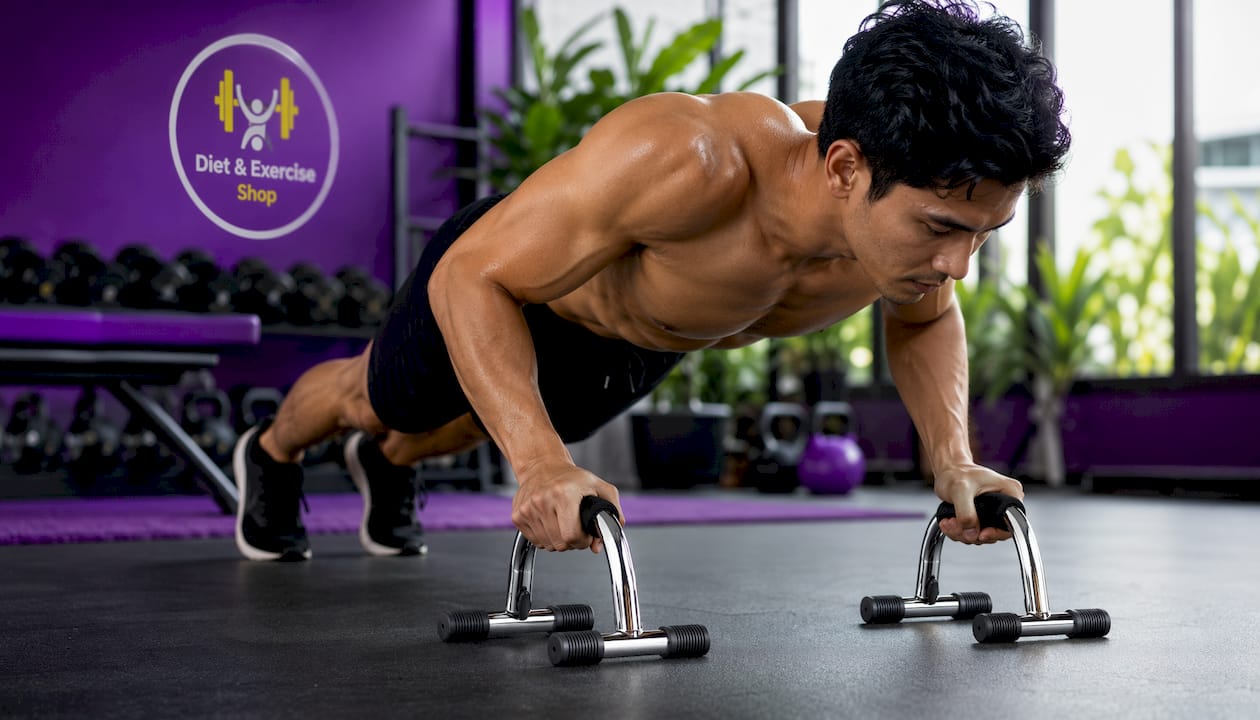
Adjustable dumbbells cover every load range in the beginner through advanced plans without cluttering your space. Pair them with push-up bar stands to add depth to your push-up variations and protect your wrists during high-rep finisher sets. Resistance bands round out the warm-up routine with pull-aparts and shoulder mobility work before every session. For readers building a home setup from scratch, the home gym equipment essentials guide on the dietexerciseshop.com site walks through exactly what to prioritize and in what order. Check the store’s current product pages for available bundles and current stock.
Useful sources
The following sources informed this guide and are worth bookmarking for deeper reading:
- Men’s Health — Best Dumbbell Chest Exercises: Covers exercise selection, set/rep guidance, and progressive overload principles with input from certified coaches.
- Muscle & Fitness — 30-Minute Dumbbell Chest Workout: Practical home adaptations including floor press setup and bench alternatives.
- MajorFitness — Dumbbell Chest Workout: Twelve exercises with four structured training plans and session-time estimates.
- Bells of Steel — Chest Workout with Dumbbells: Strength and size programming with incline-angle guidance and warm-up protocols.
- PowerBlock — Best Push Day Workout: Push-day structure for home gyms using only dumbbells, with and without a bench.
FAQ
Can you build a chest with dumbbells only?
Yes. Dumbbells allow a full range of motion, correct muscle imbalances, and activate stabilizers that barbells and machines do not. Consistent progressive overload with proper volume is what drives growth, not the equipment type.
What is the best dumbbell chest workout?
The flat dumbbell bench press is the single best all-round chest exercise, but pairing it with an incline press for the upper chest and a fly for stretch and isolation gives you complete development that no single movement can match alone.
Is 3 exercises enough for a chest day?
Three focused exercises are enough when intensity is high. Two presses and one fly at close to maximum effort covers the full chest stimulus a beginner or intermediate lifter needs in one session.
What are the top 3 chest exercises with dumbbells?
Flat dumbbell bench press, incline dumbbell press, and dumbbell fly. These three cover overall mass, upper-chest development, and stretch-focused isolation across the full pectoralis major.
How often should you train chest with dumbbells?
Once per week works well for beginners. Most intermediate and advanced lifters benefit from twice per week, with at least 48 hours between sessions and one day focused on heavier pressing and the other on higher-rep volume work.