

How to Stick to a Workout Routine That Lasts
Starting a workout routine is the easy part. The real test? Showing up on week three, month three, and beyond.
The secret to making fitness a non-negotiable part of your life isn't about finding a magical workout plan. It's about building a solid foundation from the start.
It all begins with why you're doing this and what you truly want to accomplish.
Building a Foundation for Lasting Success
Before you lift a single dumbbell, get honest about your motivation. Vague goals like “get in shape” fizzle out because they lack emotional weight.
To build a routine that sticks, find your "deep why"—the real, heartfelt reason you're committing to this.
Maybe you want the energy to chase your kids around the park. Perhaps it's about feeling confident on that beach vacation. Or maybe it's taking control of your health for your family. This is what will pull you off the couch when motivation is low.
Set Goals That Actually Work
Once you know your ‘why,’ it's time to draw a clear map. This is where the S.M.A.R.T. goal framework turns a wish into a concrete plan.
Here’s how it works:
- Specific: Instead of "I will do strength training," try "I will complete three 30-minute full-body strength workouts at home each week."
- Measurable: Keep track of your progress. How many reps did you complete? What weight did you use? This gives you proof that you're getting stronger.
- Achievable: If you haven't exercised in years, aiming for six workouts a week is a recipe for burnout. Start with two or three.
- Relevant: Does your goal directly support your "deep why"? Your plan should reflect that.
- Time-bound: Give yourself a deadline. For instance, "In 12 weeks, I will be able to consistently complete my three weekly workouts without missing a session."
This isn't just a planning exercise. Research shows people with specific goals are up to 50% more likely to stick with their fitness routines.
Find Joy in the Movement
Let's be real: the best workout is the one you'll actually do. If you hate running, forcing yourself onto a treadmill is setting yourself up for failure.
Experiment and find activities you genuinely enjoy.
Consistency is built on enjoyment, not just discipline. When your workout feels more like a hobby and less like a chore, showing up becomes the easy part.
To create a strong foundation, you also need the energy to show up. That's why incorporating good diet habits is a critical first step.
If you're building your routine at home, having the right gear can make all the difference. You don’t need a massive home gym. Versatile equipment like our Pro-Grip Adjustable Dumbbells is perfect for an effective strength program. For more great ideas, check out our guide on home gym equipment essentials.
Weaving Workouts Into Your Daily Rhythm
Motivation is great for getting started, but it's a terrible long-term strategy. It's fickle. It comes and goes.
The real secret to making fitness stick is to embed it so deeply into your daily routine that it becomes automatic.
The Power of Habit Stacking
Instead of pulling a new habit out of thin air, use habit stacking. You anchor your new workout habit to something you already do without thinking.
The formula is simple: "After I [CURRENT HABIT], I will [NEW WORKOUT HABIT]."
Let’s say you drink coffee every morning. Your new rule could be, "After I finish my coffee, I will do my 15-minute home workout." You're piggybacking the new behavior onto an existing one.
Make Your Workout Something You Look Forward To
Here’s another great psychological trick: temptation bundling. You pair something you love—a guilty pleasure—exclusively with your workout.
Here are a few ways this works:
- Save your podcast: Only listen to your favorite podcast during your runs or gym sessions.
- Binge-watch while you sweat: Only stream the next episode of that show while you’re on the stationary bike. We demonstrate this on our Diet & Exercise YouTube channel.
- Build a "workout-only" playlist: Create a playlist of songs that make you feel like a superhero, and only listen to it during workouts.
When you link something you want to do with something you feel you should do, the workout stops feeling like a chore and starts feeling like a treat.
The single best thing you can do to guarantee consistency is to remove every possible barrier between you and your workout. Make it the path of least resistance.
Clear the Path to the Gym (or Your Living Room)
Think about every little thing you have to do before you can start exercising. Each one is a tiny hurdle. Eliminate them ahead of time.
- Lay out your workout clothes the night before.
- Pack your gym bag and put it by the front door.
- Have your post-workout shake ready to go in the fridge.
These small acts of planning dismantle decision fatigue. To dial in this process, our Fitness Journey Planner & Tracker is built to help you map out your week, track your prep, and see your progress.
Designing Your Weekly Fitness Blueprint
A good workout habit is built on a solid plan. It takes the guesswork out and turns intentions into actions.
The best plans are a mix of different exercises. You'll want to weave in strength training, cardio, and dedicated recovery time. The right balance depends on your goals.
Matching Your Plan to Your Goals
Someone training to build muscle needs a different schedule than someone focused on losing fat. Your workouts and your diet must work together.
If building muscle is your priority, hit the weights 3-4 days a week and eat enough protein to repair muscle tissue.
For fat loss, you might do more cardio alongside strength training while maintaining a moderate calorie deficit.
A great plan isn't about being perfect; it's about being prepared. Knowing your workout and nutrition goals for the week ahead makes consistency the easy choice.
This quick guide can help you structure your weekly workouts and diet based on your goals.
Matching Your Workout Plan to Your Fitness Goals
| Primary Goal | Workout Frequency | Workout Focus | Nutrition Tip |
|---|---|---|---|
| Fat Loss | 4-5 days/week | Mix of strength training (2-3 days) and cardio (2-3 days) | Maintain a slight calorie deficit with high protein to preserve muscle. |
| Muscle Gain | 3-4 days/week | Prioritize progressive strength training | Eat in a slight calorie surplus with a focus on protein (1.6-2.2g per kg of body weight). |
| General Fitness | 3-5 days/week | Balanced full-body strength, cardio, and mobility work | Focus on whole, unprocessed foods and stay hydrated. |
| Endurance | 4-6 days/week | Primarily cardio-based (running, cycling) with 1-2 strength days | Ensure adequate carbohydrate intake to fuel long sessions. |
Remember, this table is a starting point. Find a structure that works for your life and your body.
Building Your Weekly Schedule
A solid week might feature two full-body strength sessions, a couple of days of cardio, and one day of active recovery like stretching.
Here’s a simple, practical example for a beginner:
- Monday: Full-Body Strength (Focus on big compound movements).
- Tuesday: 30-Minute Brisk Walk or Light Jog.
- Wednesday: Full-Body Strength (Incorporate different exercises).
- Thursday: Rest or Active Recovery (Stretching works wonders).
- Friday: 30-Minute Cardio of Your Choice (Bike, dance, whatever you enjoy!).
- Saturday & Sunday: Rest.
This visual shows simple strategies to help you follow through on your plan.
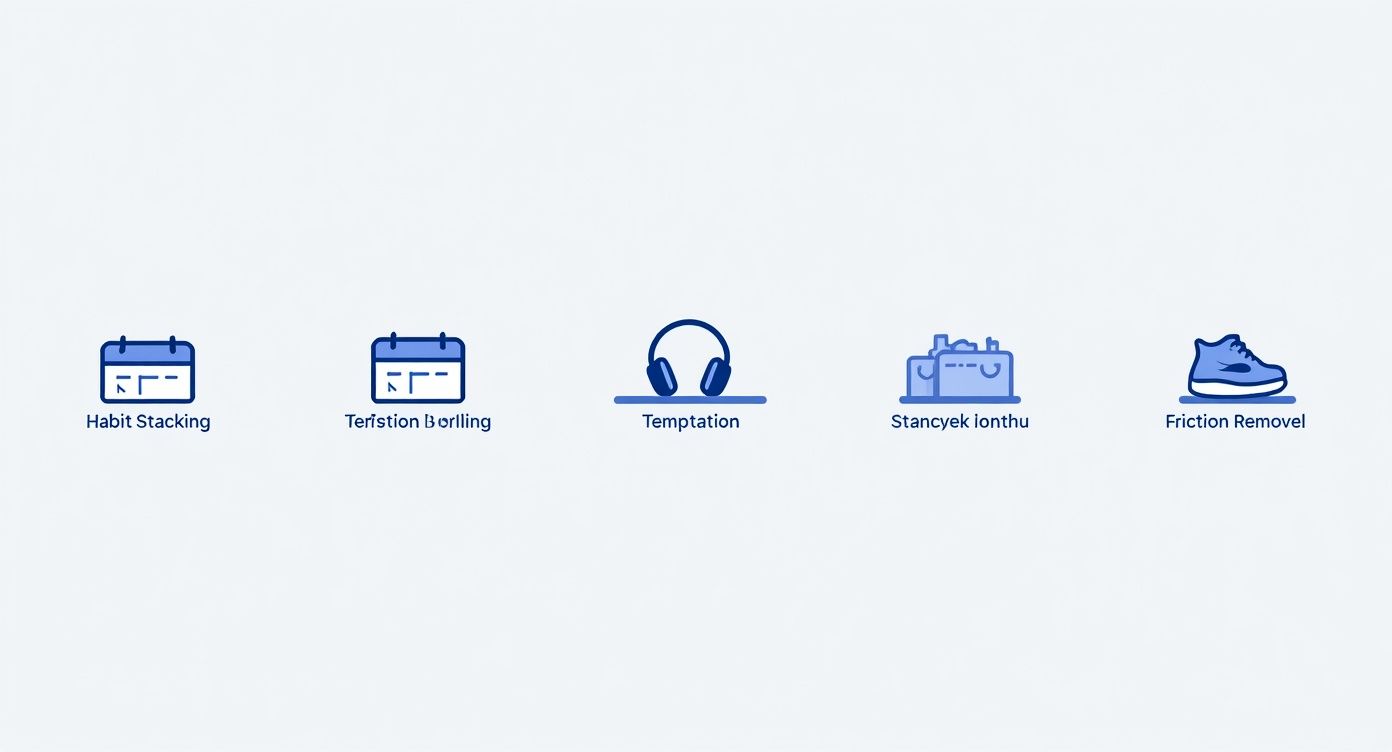
Tricks like habit stacking and temptation bundling are the glue that holds a new routine together. For more ideas, check out our guide on workout routines for beginners at home.
Fueling Your Progress
You can have the best workout plan, but it won't get you far if your nutrition is off. Food is the fuel for your fitness engine.
It doesn’t have to be complicated. Aim to build your meals around simple, whole foods. Each plate should ideally include:
- A Protein Source: Essential for muscle repair (chicken, fish, beans).
- A Complex Carbohydrate: For sustained energy (oats, brown rice).
- Healthy Fats: Crucial for hormone function (avocado, nuts).
Our Aura Activewear Set was designed to be comfortable and confidence-boosting. When you feel good in your gear, you're more likely to get moving.
Overcoming Roadblocks and Rekindling Motivation
Even the most dedicated fitness enthusiast hits a wall. This isn't a sign of failure; it’s a normal part of the journey.
First, figure out what's going on. Are you genuinely exhausted and need a rest day, or just feeling uninspired? True fatigue is a deep, bone-weary feeling. Lack of motivation is a mental game.
If boredom is the culprit, your routine has become stale. It's time to inject some new energy.
- Buddy Up: It's harder to skip a workout when someone is waiting for you.
- Try Something New: Step out of your comfort zone. Try a yoga class or a new hiking trail.
- Change Your Scenery: Take your home workout to a nearby park for fresh air.
Bouncing Back from Setbacks
A missed workout isn’t the end of the world. The biggest mistake is letting one missed session derail your entire week.
The most important workout is always the next one, especially right after you’ve missed a session. Don't waste energy dwelling on what you didn’t do—just focus on getting right back on track.
Simply resume your schedule as planned. Resist the urge to "make up for it" with a grueling workout. Just get back to it.
The Power of Community and Confidence
Your environment and the people you surround yourself with play a massive role in your success. For example, urban residents make up 81% of gym memberships, while rural residents account for just 19%.
Social support is a game-changer. Couples and families often have higher gym retention rates than single individuals.
Sometimes, little things give you a mental edge. Feeling good in your workout gear can be a surprisingly effective motivator. Our comfortable apparel, like our fun fitness T-shirts, can give you that boost on days you’d rather stay on the couch.
Tracking Progress and Evolving Your Routine
Want the secret to sticking with a workout? Seeing proof that it's working. But many people only measure progress with one number—the one on the bathroom scale.
To stay fired up long-term, broaden your definition of a "win." Celebrate all the small victories that prove you're getting stronger and healthier.
Redefining What Progress Looks Like
It’s time to look beyond your total poundage and notice the changes that reflect your hard work.
Track wins like these:
- Performance Gains: Did you lift a heavier weight? Squeeze out an extra rep? Shave 10 seconds off your mile time?
- Energy Levels: Are you avoiding that 3 PM wall at work?
- Progress Photos: A monthly photo can reveal incredible changes the scale misses.
- How Your Clothes Fit: Is that favorite pair of jeans feeling a little looser?
When you track progress this way, your fitness journey becomes a fun game of beating your personal bests.
The scale only measures your relationship with gravity, nothing more. Tracking your strength, energy, and confidence tells the real story of your progress—and that's the key to staying motivated.
For a truly complete, data-driven picture, our Smart Body Composition Scale is an amazing tool. It goes way beyond weight to measure key metrics like body fat percentage and muscle mass, giving you detailed feedback.
Evolving Your Routine for Continued Success
As you get stronger, your body adapts. That workout that felt impossible a month ago might start to feel like a warm-up.
To keep seeing results and avoid a plateau, your routine must evolve. This is where progressive overload comes in.
Progressive overload means you gradually increase the demand on your body. You can do this by:
- Increasing the weight you lift
- Adding more repetitions or sets
- Reducing your rest time between sets
- Focusing on better form
This constant challenge forces your body to keep adapting. Of course, consistency is key. Research shows that people who hit the gym more than 100 times a year make up nearly half (49%) of all memberships and are far more likely to stick with it.
Answering Your Top Questions About Sticking with a Workout Routine
Once you start trying to make fitness a real part of your life, questions will pop up. Let's tackle some of the most common ones.
How Long Does It Actually Take to Form a Workout Habit?
Forget the "21 days" myth. Research shows building a new habit can take anywhere from 18 to 254 days. The average is about 66 days.
If you're at the three-week mark and still have to drag yourself to the gym, you're normal. Be patient and give yourself a solid two months of consistent effort.
What’s the “Best” Time of Day to Work Out?
The best time to work out is whenever you'll actually do it. There's no universal magic window.
Some people love working out first thing. Others feel stronger in the afternoon. Experiment to see what works for you. Once you find your groove, protect that time on your calendar.
An "all-or-nothing" mindset is the enemy of long-term consistency. One missed week is a minor blip in the context of a year of sustained effort. The most important action is to simply get back on track.
I Missed a Whole Week of Workouts. Should I Just Start Over?
Absolutely not. Life happens—you get sick, work gets crazy, you go on vacation.
Jump right back into your routine with the next planned workout. Don't try to squeeze in extra sessions to "make up" for lost time. Just pick up where you left off.
How Can I Stay Motivated When I’m Not Seeing Results?
This is a big one. When you feel like you're spinning your wheels, motivation takes a nosedive. This often happens when we fixate on the scale.
Start looking for other kinds of progress:
- Performance Wins: Did you lift heavier or do one more rep?
- Energy Levels: Are you getting through the afternoon without a third coffee?
- Sleep Quality: Notice you're sleeping more soundly?
- How Your Clothes Fit: Is that pair of jeans feeling a little less snug?
These are real signs of progress. Tracking them gives you more reasons to stay motivated. For extra inspiration, check out the community stories on our Diet & Exercise YouTube channel.
Here at Diet & Exercise, we know that feeling good in your gear can be a huge motivator. Celebrating your consistency is part of the fun! Our unique and comfortable apparel is designed for people who love fitness and aren't afraid to show it.
Explore our collection of fun fitness-themed T-shirts and find your new favorite workout motivation!