

Meal Prep High Protein: Simple Weekly System That Works
Batch-cook chicken thighs, hard-boiled eggs, and canned tuna this Sunday, and you can hit a high daily protein intake with less than two hours of actual cooking. Here’s the sample day that proves it:
| Meal | Example | Protein |
|---|---|---|
| Breakfast | 4 scrambled eggs + ½ cup cottage cheese | ~38 g |
| Lunch | Chicken burrito bowl (rice, black beans, salsa) | ~42 g |
| Snack 1 | Greek yogurt (1 cup) + 1 oz beef jerky | ~24 g |
| Dinner | Baked salmon + quinoa + roasted broccoli | ~41 g |
| Snack 2 | 2 hard-boiled eggs + string cheese | ~26 g |
| Daily total | ~171 g |
One-line grocery summary: Chicken thighs or breasts, canned tuna, salmon fillets, eggs, Greek yogurt, cottage cheese, quinoa, brown rice, frozen broccoli, black beans, and a bag of mixed veg.
A Sunday session runs about two hours. Plan a 20-minute midweek reset on Wednesday to restock fresh components for days 4–7. This two-stage approach keeps food tasting fresh instead of sad by Friday.
- Top 3 staples to batch every week: seasoned chicken, cooked quinoa or rice, and hard-boiled eggs
- Aim for a substantial protein amount per main meal with a moderate amount from snacks
- Store cooked proteins in airtight containers; refrigerate within 2 hours of cooking
Table of Contents
- What are the best high protein meal prep recipes to batch-cook?
- How do you spread 100–150 g of protein across the day?
- How to build your grocery list and batch-cook schedule
- What are the storage and food safety rules for meal prep?
- Quick protein boosters and swaps that actually work
- Three sample 7-day meal-prep templates
- What are the best no-cook high protein options for busy days?
- How do you adjust meal prep for muscle gain vs fat loss?
- Key Takeaways
- Why the “just cook more chicken” advice misses the point
- Gear and apparel to match your meal-prep commitment
- Useful sources
- FAQ
What are the best high protein meal prep recipes to batch-cook?
Think of your recipe bank as a rotation, not a rigid menu. Pick 2–3 proteins, one starch, and two vegetables each week. That framework alone reduces decision fatigue and keeps you consistent longer than any complicated plan.
Breakfasts
Egg and cottage cheese scramble Four eggs scrambled with ½ cup cottage cheese and spinach. ~38 g protein, 2 servings, 10 minutes total. Keeps 4 days in the fridge. Batch tip: cook 8–10 eggs at once and portion into containers.
Overnight oats with protein powder ½ cup rolled oats, 1 scoop whey protein, 1 cup Greek yogurt, berries. ~30 g protein, 1 serving, 5 minutes (no cook). Keeps 3 days. Batch tip: prep 4 jars at once on Sunday night.
Turkey and egg muffins 6 eggs, 4 oz ground turkey, diced peppers, baked in a muffin tin. ~28 g protein per 3 muffins, 12 muffins total, 25 minutes. Keeps 5 days in the fridge or freeze up to 2 months. Batch tip: double the batch and freeze half.
Greek yogurt parfait 1 cup full-fat Greek yogurt, 2 tbsp almond butter, ½ cup granola. ~25 g protein, 1 serving, 3 minutes. Best eaten fresh or within 2 days (keep granola separate to avoid sogginess).
Protein pancakes (plant-based) 1 cup oat flour, 1 scoop plant protein, 1 banana, 1 cup almond milk. ~22 g protein per 3 pancakes, 4 servings, 20 minutes. Freeze well up to 1 month. Vegan swap: use flax egg (1 tbsp ground flax + 3 tbsp water).
Lunches and Dinners
Chicken burrito bowl Seasoned chicken breast, brown rice, black beans, corn, salsa, lime. ~42 g protein per serving, 5 servings, 30 minutes. Keeps 4 days. Batch tip: cook chicken in bulk and portion over pre-cooked rice.
High-protein chicken meal prep bowl Seasoned chicken thighs, quinoa, roasted zucchini and bell peppers. ~42 g protein per serving, 4–5 servings, ~60 minutes. Keeps 4 days. Season with garlic-lemon one week, smoked paprika the next.
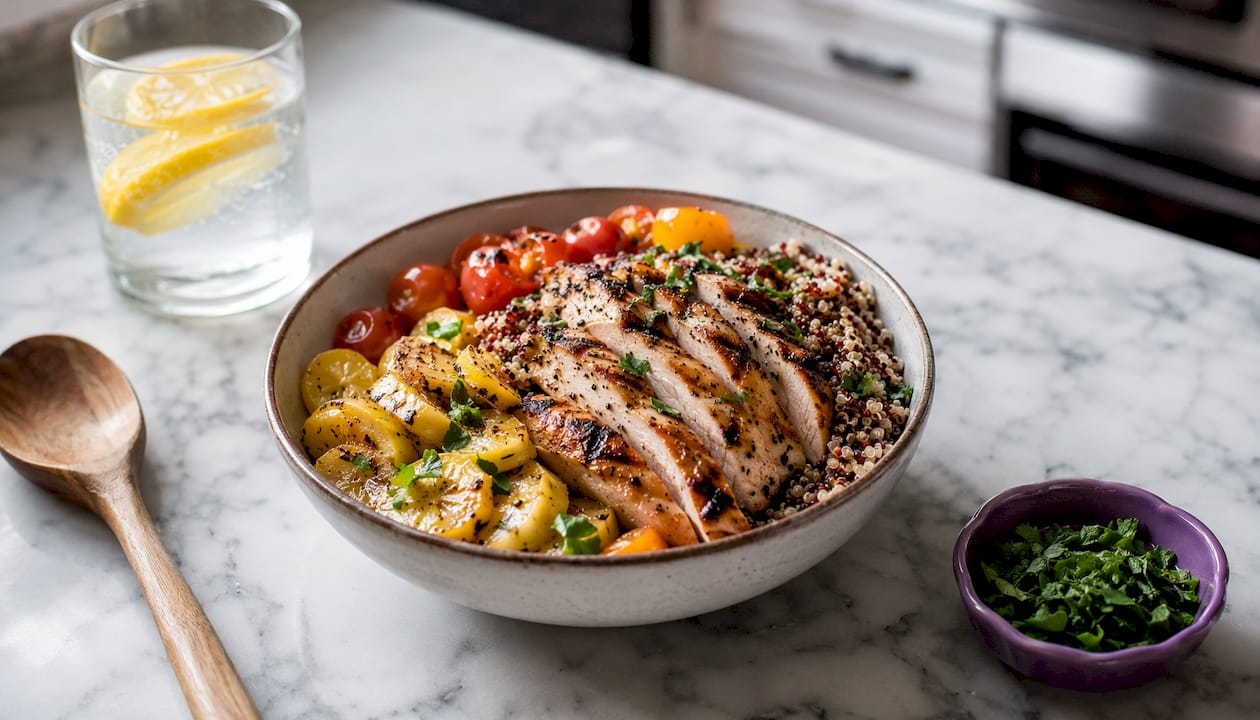
Mediterranean salmon bowl Baked salmon fillet, quinoa, cucumber, cherry tomatoes, tzatziki. ~41 g protein per serving, 4 servings, 25 minutes. Keeps 3 days (fish doesn’t hold as long). Freeze raw portions instead.
Ground beef and broccoli Lean ground beef (90/10), broccoli florets, soy-ginger sauce over rice. ~45 g protein per serving, 4 servings, 20 minutes. Keeps 4 days. Batch tip: brown 2 lbs of beef at once.
Lentil and chickpea stew (vegan) Red lentils, canned chickpeas, diced tomatoes, cumin, turmeric. ~22 g protein per serving, 6 servings, 35 minutes. Keeps 5 days or freeze up to 3 months. Protein boost: stir in 2 tbsp tahini or serve over quinoa to push toward 30 g.
Turkey taco bowls Ground turkey, taco seasoning, black beans, brown rice, shredded cabbage. ~40 g protein per serving, 5 servings, 25 minutes. Keeps 4 days. Rotate seasoning: cumin-lime one week, chipotle the next.
Tempeh stir-fry (vegetarian) Tempeh, edamame, snap peas, sesame-ginger sauce over brown rice. ~35 g protein per serving, 4 servings, 25 minutes. Keeps 4 days. Swap: replace tempeh with extra-firm tofu for a milder flavor.
For Mediterranean chicken bowl inspiration with bold flavors that hold up well through the week, Forkward Kitchen’s zhoug-based version is worth bookmarking.
Snacks
Hard-boiled eggs: 2 eggs = ~12 g protein. Batch 8–10 at once; keeps 7 days in the shell.
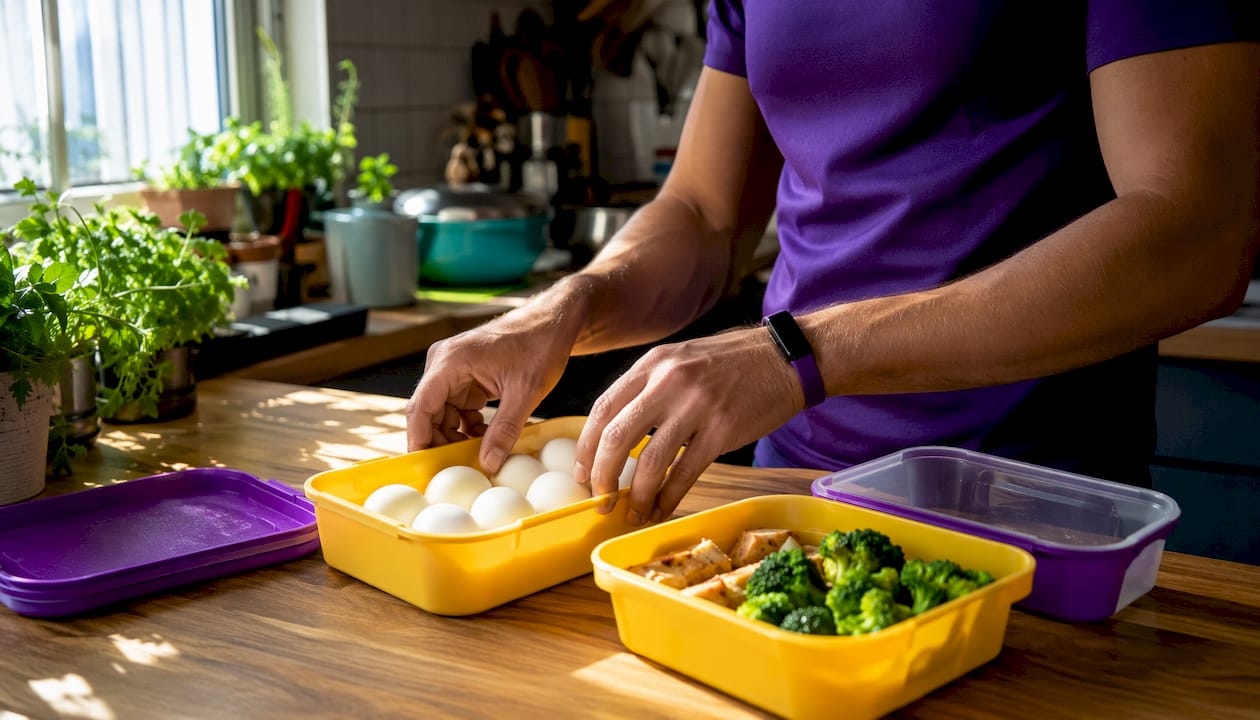
Tuna salad cups: 1 can tuna + 2 tbsp Greek yogurt + mustard = ~28 g protein. Keeps 3 days.
Edamame packs: 1 cup shelled = ~17 g protein. Buy frozen, microwave in 3 minutes.
Statistic callout: Rotating your protein seasoning across the week, such as garlic-lemon for chicken, cumin for beef, and smoked paprika for salmon, is one of the most practical adherence strategies recommended by professional meal preppers. Variety in flavor prevents the “same meal every day” burnout that derails most prep routines by week three.
How do you spread 100–150 g of protein across the day?
Total daily protein is the primary lever for muscle gain and fat loss. Meal timing and frequency matter mainly for adherence, not physiology. That said, spreading intake across meals makes it far easier to hit your number without cramming 80 g into one sitting.
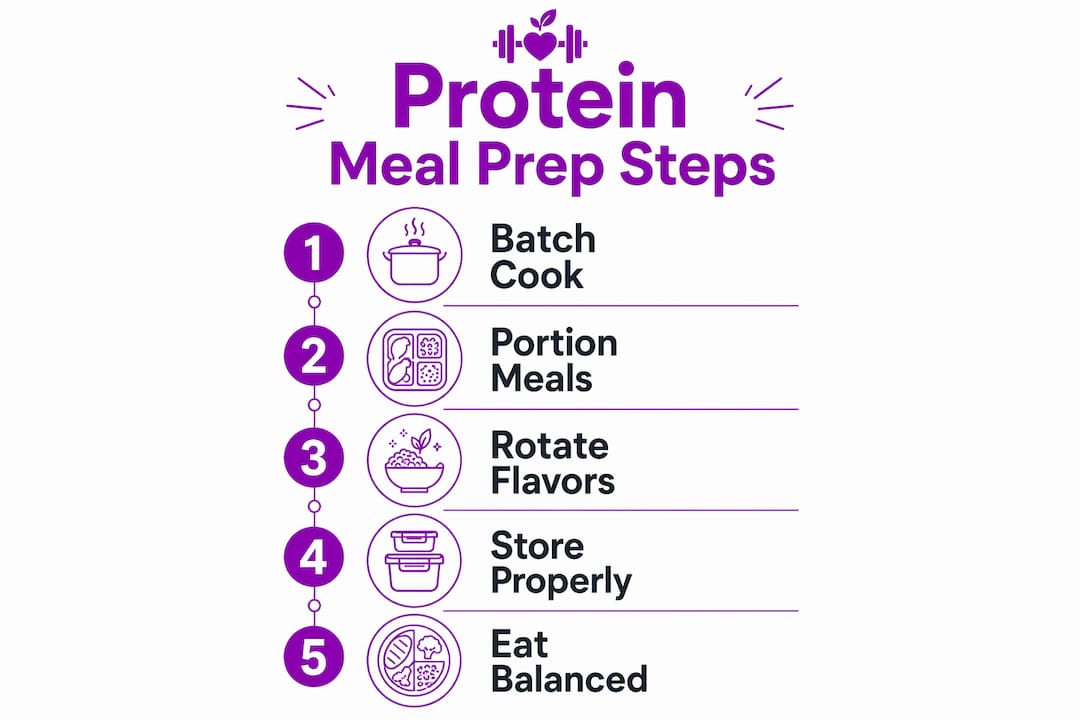
The practical target: 30–40 g at each main meal, plus 15–20 g from snacks. That rhythm stabilizes energy and supports muscle protein synthesis better than one large protein load.
Here’s how three common daily targets break down using the recipes above:
| Target | Breakfast | Lunch | Dinner | Snacks | Total |
|---|---|---|---|---|---|
| 100 g/day | Overnight oats (~30 g) | Turkey taco bowl (~40 g) | Lentil stew (~22 g) | Hard-boiled eggs (~12 g) | ~104 g |
| 130 g/day | Egg scramble (~38 g) | Chicken burrito bowl (~42 g) | Salmon bowl (~41 g) | Greek yogurt (~15 g) | ~136 g |
| 150 g/day | Turkey egg muffins + yogurt (~43 g) | Ground beef + broccoli (~45 g) | Chicken bowl (~42 g) | Tuna cups + jerky (~38 g) | ~168 g |
A few practical notes: if you’re closer to 150 lbs and targeting fat loss, 100 g/day is a solid floor. At 180+ lbs building muscle, 150 g is a reasonable daily goal. The math gets simple once you have prepped anchors in the fridge.
How to build your grocery list and batch-cook schedule
Grocery list template
Proteins: Chicken thighs or breasts, ground beef or turkey, salmon fillets, canned tuna, eggs, Greek yogurt, cottage cheese
Grains/starches: Brown rice, quinoa, rolled oats, whole-grain wraps
Vegetables: Broccoli (fresh or frozen), bell peppers, zucchini, cherry tomatoes, baby spinach, frozen edamame
Pantry/condiments: Black beans, chickpeas, olive oil, soy sauce, taco seasoning, cumin, smoked paprika, garlic powder
Snacks: String cheese, beef jerky, almond butter packets, protein bars
A week of high-protein meal prep using cost-effective staples like eggs, canned tuna, chicken thighs, and dry lentils runs an affordable cost for one person.
The 3-3-3 rule explained
The 3-3-3 rule is a simple framework: prep 3 proteins, 3 starches, and 3 vegetables each week. Mix and match them into different combinations daily so you’re not eating the exact same bowl every day. Chicken over quinoa with broccoli on Monday becomes chicken in a wrap with bell peppers on Tuesday. Same prep, different meal.
2-hour Sunday batch-cook timeline
- Preheat oven to 400°F. Season chicken thighs and salmon; place on separate sheet pans.
- Start rice and quinoa on the stovetop (both take 15–20 minutes).
- Roast vegetables on a third sheet pan (20–25 minutes).
- While oven runs, brown ground beef or turkey on the stovetop.
- Hard-boil a batch of 8–10 eggs (12 minutes, then ice bath).
- Pull proteins from the oven; let everything cool 15–20 minutes before sealing containers.
- Portion into individual containers by meal type. Label with the date.
Total: approximately 2 hours, covering days 1–3.
20-minute midweek reset (Wednesday)
- Cook a fresh batch of grains (rice or quinoa, 15 minutes hands-off)
- Reheat or quickly sear a second protein (e.g., canned tuna or a fresh salmon fillet)
- Chop fresh veg or open a bag of pre-washed greens
- Refill snack containers (yogurt, eggs, jerky)
This two-stage approach keeps food fresher through Friday and prevents the “I’m sick of Sunday’s food” problem that kills most prep routines.
Pro Tip: Run the oven, stovetop, and rice cooker simultaneously during your Sunday session. Staggering start times by 5 minutes means everything finishes within the same window, cutting total active time to under 30 minutes.
What are the storage and food safety rules for meal prep?
Batch-cooking components separately and letting them cool for 15–20 minutes before sealing is the single most effective way to prevent sogginess and bacterial growth. Sealing hot food traps steam, which turns crispy chicken rubbery and makes grains clump.
Fridge and freezer storage windows
| Food | Fridge (safe window) | Freezer |
|---|---|---|
| Cooked chicken | 3–4 days | Up to 4 months |
| Cooked ground beef/turkey | 3–4 days | Up to 4 months |
| Cooked salmon/fish | 3 days | Up to 3 months |
| Hard-boiled eggs (peeled) | 5 days | Not recommended |
| Cooked grains (rice, quinoa) | 4–5 days | Up to 3 months |
| Cooked legumes | 4–5 days | Up to 3 months |
| Greek yogurt/cottage cheese | Per package date | Not recommended |
| Cooked vegetables | 3–4 days | Up to 3 months |
The USDA recommends refrigerating cooked food within 2 hours of cooking (1 hour if ambient temperature exceeds 90°F).
Reheating by food type
- Chicken and beef: Microwave with a damp paper towel over the container (traps steam, prevents drying). Or reheat in a skillet with a splash of broth over medium-low heat.
- Fish: Oven at 275°F for 10–15 minutes is gentler than a microwave and preserves texture.
- Grains: Add 1–2 tbsp water before microwaving; stir halfway through.
- Eggs: Reheat gently in the microwave at 50% power in 20-second bursts.
Quick food-safety rules
- Cool food to room temperature (no more than 2 hours) before refrigerating
- Use airtight glass or BPA-free plastic containers
- Store sauces and dressings separately to prevent sogginess
- Reheat to an internal temperature of 165°F for poultry and leftovers
- When in doubt about a container’s age, throw it out
Statistic callout: The USDA advises that most cooked proteins stay safe for 3–4 days when refrigerated promptly in airtight containers. For longer storage, freeze immediately after portioning; cooked beef, poultry, and seafood all freeze well for up to 3–4 months.
Quick protein boosters and swaps that actually work
Sometimes the easiest win is adding 15–20 g of protein to a meal you already made. These add-ons require zero extra cooking.
Easy add-ons (10–20 g protein each)
- ½ cup cottage cheese stirred into scrambled eggs or pasta sauce: ~14 g
- 1 can tuna mixed into a grain bowl: ~25 g
- 1 scoop whey or plant protein powder blended into oatmeal or a smoothie: ~20–25 g
- 2 tbsp hemp seeds sprinkled on a salad: ~10 g
- 1 cup edamame added to any stir-fry: ~17 g
- 2 tbsp almond butter on overnight oats: ~7 g (plus healthy fat)
For a deeper look at bodybuilding supplements and how to use protein powders responsibly, Dietexerciseshop’s guide covers dosing and cost-benefit clearly.
Portable snacks with protein estimates
| Snack | Protein | Notes |
|---|---|---|
| Greek yogurt (1 cup) | ~17–20 g | Pair with fruit for carbs |
| String cheese (2 sticks) | ~14 g | Shelf-stable for hours |
| Beef jerky (1 oz) | ~7 g | Watch sodium content |
| Hard-boiled eggs (2) | ~12 g | Pre-peel for easy grab |
| Edamame pack (1 cup) | ~17 g | Microwave from frozen |
| Protein bar | ~15–25 g | Check sugar; varies widely |
| Tuna pouch | ~17 g | No refrigeration needed |
These are the on the go protein snacks worth keeping in your bag or desk drawer. A tuna pouch and two string cheeses add up to ~31 g of protein with no prep at all.
Plant-based protein swaps
| Instead of | Use | Protein delta |
|---|---|---|
| 3 oz chicken breast (~25 g) | 6 oz tempeh (~31 g) | +5 g |
| 3 oz chicken breast | ½ cup lentils + ¼ cup quinoa (~20 g) | –6 g (add hemp seeds to close gap) |
| 1 cup Greek yogurt | 1 cup silken tofu blended (~10 g) | –8 g (add protein powder to match) |
| 2 eggs (~12 g) | ½ cup firm tofu scramble (~10 g) | –2 g |
For a full breakdown of vegan protein sources, Dietexerciseshop’s guide covers the top 12 plant options with gram-per-serving comparisons.
Three sample 7-day meal-prep templates
These templates are sized for one person. Protein estimates are per serving.
Template 1: 100 g/day target
Daily structure: Overnight oats (~30 g) + turkey taco bowl (~40 g) + lentil stew (~22 g) + hard-boiled eggs snack (~12 g) = ~104 g
- Shopping list: Rolled oats, whey protein, Greek yogurt, ground turkey, black beans, brown rice, red lentils, chickpeas, eggs, taco seasoning, cumin, canned tomatoes, frozen veg
Template 2: 130 g/day target
Daily structure: Egg and cottage cheese scramble (~38 g) + chicken burrito bowl (~42 g) + salmon bowl (~41 g) + Greek yogurt snack (~15 g) = ~136 g
- Shopping list: Eggs, cottage cheese, chicken breasts (3 lbs), brown rice, black beans, salmon fillets (1.5 lbs), quinoa, Greek yogurt, salsa, lime, frozen broccoli
Template 3: 150 g/day target
Daily structure: Turkey egg muffins (~28 g) + Greek yogurt (~15 g) + ground beef and broccoli (~45 g) + chicken bowl (~42 g) + tuna cups (~28 g) + beef jerky (~10 g) = ~168 g
- Shopping list: Ground turkey, eggs, ground beef (2 lbs), chicken thighs (3 lbs), salmon, canned tuna (4 cans), Greek yogurt, quinoa, brown rice, broccoli, bell peppers, beef jerky, string cheese
Mix and match days within each template to avoid eating the same combination back-to-back. Swap the salmon bowl for a ground beef bowl on day 4 and the flavor rotation alone makes it feel like a different week.
Pro Tip: The midweek reset is the single habit that separates people who stick with meal prep from those who quit by Thursday. A 20-minute Wednesday session, just fresh grains, one new protein, and restocked snacks, keeps quality high and prevents the “I’ll just order pizza” decision.
What are the best no-cook high protein options for busy days?
Some days the oven stays off. These five-minute assemblies keep your protein on track without touching a pan.
- Tuna salad wrap: 1 tuna pouch + 2 tbsp Greek yogurt + mustard in a whole-grain wrap. ~28 g protein, 5 minutes.
- Overnight oats jar: ½ cup oats + 1 scoop protein powder + 1 cup Greek yogurt + berries. ~30 g protein, 3 minutes of assembly the night before.
- Greek yogurt parfait: 1 cup Greek yogurt + 2 tbsp almond butter + ½ cup granola. ~25 g protein, 2 minutes.
- Deli turkey wrap: 4 oz deli turkey + string cheese + spinach in a whole-grain wrap. ~30 g protein, 3 minutes.
- Cottage cheese bowl: 1 cup cottage cheese + sliced cucumber + cherry tomatoes + everything bagel seasoning. ~25 g protein, 2 minutes.
- Protein shake + jerky: 1 scoop whey in water or milk + 1 oz beef jerky. ~35 g protein, 1 minute.
Keep a tuna pouch, a container of Greek yogurt, and two hard-boiled eggs in your bag or desk and you have a 30+ g protein backup for any day that goes sideways. For travel-friendly packaging, small leak-proof containers work for yogurt and cottage cheese; tuna pouches and jerky need no refrigeration at all.
How do you adjust meal prep for muscle gain vs fat loss?
The protein target stays high either way. What changes is the calorie context around it.
Muscle gain
- Target 0.7–1 g of protein per pound of bodyweight daily
- Add calorie-dense carbs: extra rice, sweet potato, or oats at each meal
- Include healthy fats: avocado, olive oil drizzle, nut butter
- Training-day additions: larger rice portion pre-workout, extra protein serving post-workout
- Rest-day swaps: reduce rice by half, add more vegetables to keep volume without excess calories
For detailed bulking meal prep templates with calorie targets, Dietexerciseshop’s bulking guide covers 8 specific ideas.
Fat loss
- Target 0.7–0.8 g of protein per pound of bodyweight to preserve muscle in a deficit
- Reduce carb portions (half the rice, swap to cauliflower rice) while keeping protein servings identical
- Increase vegetable volume to maintain meal size without adding calories
- Training-day swaps: keep carbs around workouts, cut them at other meals
- Rest-day swaps: drop grains entirely, replace with extra leafy greens and a protein source
For weight-loss-focused meal prep with calorie-adjusted templates, Dietexerciseshop’s guide covers eight specific approaches that work.
Protein is the primary lever. Adjust calories by changing carb and fat portions, not by cutting protein. A 150 g protein target on a fat-loss plan looks almost identical to a muscle-gain plan in terms of what you cook. The difference is portion size on the rice.
Key Takeaways
Consistent high-protein meal prep comes down to one system: batch three proteins and two starches on Sunday, hit 30–40 g per main meal, and run a 20-minute midweek reset to stay fresh through Friday.
| Point | Details |
|---|---|
| Batch three staples weekly | Cook chicken, a second protein, and one grain to cover 3–4 days of meals. |
| Hit 30–40 g per main meal | Spread protein across meals and snacks to reach 100–150 g/day without cramming. |
| Two-stage prep schedule | A 2-hour Sunday session plus a 20-minute Wednesday reset keeps food fresh all week. |
| Store safely, reheat right | Refrigerate within 2 hours; most cooked proteins stay safe for 3–4 days in airtight containers. |
| Dietexerciseshop resources | The MEAL PREP & MUSCLE REPS Hoodie and TRUST THE PROCESS T-Shirt support the meal-prep identity, alongside Dietexerciseshop’s guides for bulking, fat loss, and vegan protein. |
Why the “just cook more chicken” advice misses the point
Most meal-prep content tells you to batch chicken and call it a day. That works for about two weeks before you start dreading Sunday. The real problem isn’t protein math. It’s that eating the same four containers of identical food by Thursday feels like a punishment, not a strategy.
The system that actually holds up long-term has two components most guides skip. First, flavor rotation. Seasoning your chicken with garlic-lemon this week and smoked paprika next week costs nothing and makes the same ingredient feel like a different meal. Second, the midweek reset. Prepping all seven days on Sunday sounds efficient until you’re eating four-day-old salmon on Thursday. A 20-minute Wednesday session isn’t extra work. It’s what makes the system sustainable.
There’s also a mental framing issue. Meal prep works best when you treat it as building a component library, not assembling finished meals. Cook the proteins, cook the grains, roast the veg. Then mix and match daily. That flexibility is what separates people who prep for years from those who quit after a month.
One specific trick worth stealing: pack your sauces and dressings in separate small containers. It sounds minor, but it keeps textures intact through day four and gives you one more variable to change without any extra cooking.
Gear and apparel to match your meal-prep commitment
If you’re putting in the work on Sunday, you might as well look the part the rest of the week. Dietexerciseshop carries two pieces of apparel built specifically for the meal-prep and muscle-building mindset.
The MEAL PREP & MUSCLE REPS Hoodie is the Sunday session uniform. Wear it during your batch cook and it doubles as a statement that the prep is part of the training, not separate from it. The TRUST THE PROCESS T-Shirt is for the days when the scale hasn’t moved yet but you’re still packing your containers. Both are sold directly through Dietexerciseshop.
Beyond apparel, Dietexerciseshop’s digital guides cover the full system: grocery templates, weekly meal-prep plans for bulking and fat loss, and vegan protein source breakdowns. Three things you get when you shop:
- Printable shopping lists sized to your protein target
- Weekly templates for 100 g, 130 g, and 150 g daily goals
- Bonus recipe ideas with macros included
Head to Dietexerciseshop and grab the apparel or digital guide that fits where you are in your training right now.
Useful sources
- 7 Day High-Protein Meal Plan (With Grocery List) — Nourish Move Love
- High Protein Meal Prep for Muscle Gain: Proven Guide — Meal Prep Insider
- High-Protein Chicken Burrito Bowl: 42g Protein, Meal Prep in 30 Min — Cook Protein Well
- The 2-Hour Sunday Meal Prep Plan for a Week of High-Protein Lunches — The Fit Cook
- High Protein Chicken Meal Prep Bowl with Rice and Veggies — Lean By Plate
- 7-Day High-Protein Meal Prep Plan — Beefsteak Veg
- High Protein Meal Prep Dinner for the Week — Lean By Plate
- Healthy meal prep ideas for weight loss — Dietexerciseshop
FAQ
What should I meal prep for high protein?
Batch-cook chicken thighs or breasts, ground beef or turkey, and hard-boiled eggs as your protein anchors, then pair them with cooked rice or quinoa and roasted vegetables. Aim for 30–40 g of protein per main meal and 15–20 g from snacks to hit 100–150 g daily.
What is the 3-3-3 rule for meal prep?
The 3-3-3 rule means prepping 3 proteins, 3 starches, and 3 vegetables each week, then mixing and matching them into different combinations daily. It prevents repetition without requiring you to cook a new recipe every day.
How do you get 150 g of protein a day?
Break it into four eating occasions: roughly 40–45 g at lunch and dinner, 28–38 g at breakfast, and 20–30 g across two snacks. Using prepped anchors like chicken burrito bowls (~42 g), ground beef and broccoli (~45 g), and tuna cups (~28 g) makes hitting 150 g a portioning exercise rather than a daily planning challenge.
How can I get 40 g of protein in one meal?
A chicken burrito bowl with seasoned chicken breast, brown rice, and black beans delivers approximately 42 g per serving in about 30 minutes of prep. A chicken meal prep bowl with quinoa and roasted vegetables hits the same range. Both batch well for 4–5 servings at once.
How long does meal-prepped food stay safe in the fridge?
Most cooked proteins, including chicken, beef, and turkey, stay safe for 3–4 days when refrigerated in airtight containers within 2 hours of cooking. Cooked fish is best within 3 days. For anything beyond that window, freeze immediately after portioning.