

Resistance Band Levels Explained: Colors, Force, and Fit
The usual resistance band lineup runs from extra light to extra heavy, often labeled Tan, Yellow, Red, Green, Blue, Black, Silver, and Gold on clinical-grade bands, or a simpler light-to-heavy set on retail packs. Skip the color guessing game with one test: pick a band that lets you do 3 sets of 8 to 12 reps with clean form. If you fail before rep 8, go lighter. If you cruise past 12 with room to spare, go heavier.
Colors are not standardized across brands, so a “red” band from one company can be stronger than a “blue” from another. The number that actually matters is the force rating in pounds or kilograms printed on the packaging or product page.
- Common sequence (clinical style): Tan → Yellow → Red → Green → Blue → Black → Silver → Gold
- Common sequence (retail shorthand): X-Light → Light → Medium → Heavy → X-Heavy
- Selection test: 3 sets of 8 to 12 reps, full range of motion, no shaking or joint pain
Pro Tip: Keep the packaging or write down the kg/lb rating of any band you like. When it wears out, you’ll replace it with the right strength instead of guessing by color again.
Key Takeaways
Resistance band levels are best chosen by kg/lb force rating and the 3×8–12 rep test, not by color, since color schemes vary by brand and format.
| Point | Details |
|---|---|
| Skip color guessing | Colors vary by brand and band type, so check the kg/lb rating on the label instead. |
| Use the 3×8–12 test | Pick a band that lets you complete 3 sets of 8 to 12 clean reps before moving heavier. |
| Know your elongation | Force ratings apply at fixed stretch points, usually 100% and 200% elongation, not a single number. |
| Match format to goal | Mini loops suit activation, flat bands suit rehab, and power bands suit heavy compound lifts. |
| Shop by range, not color | Diet & Exercise’s strength resistance band sets list kg/lb ranges so you can match your test result directly. |
Table of Contents
- Resistance Band Color Meaning and Why It Changes by Brand
- How Manufacturers Measure Resistance and Why Stretch Changes It
- How Do You Pick the Right Resistance Band Level?
- Loop, Mini, Flat, and Tube Bands: Which One Fits Your Goal
- The TheraBand Force Chart and Its Predictable Percentage Jumps
- Matching Diet & Exercise Bands to Your Strength Level
- Why Band Material and Thickness Change How Resistance Feels
- Do Temperature and Humidity Affect Resistance Bands?
- Where These Numbers Come From
- Why the Color Chart Is the Wrong Starting Point
- Build Your Band Collection with Diet & Exercise
- Sources
- FAQ
Resistance Band Color Meaning and Why It Changes by Brand
Every band manufacturer builds its own color system, and that’s the single biggest source of confusion in this category. The clinical benchmark most physical therapists reference is TheraBand’s eight-color progression: Tan, Yellow, Red, Green, Blue, Black, Silver, Gold, running from lightest to heaviest. Tan sits at the bottom for post-surgical patients and rotator cuff work. Gold sits at the top, reserved for advanced strength training or big lower-body lifts.
Retail resistance band sets sold in five-packs or seven-packs almost never follow that exact scheme. A typical five-color set might run Yellow (lightest), Green, Red, Blue, Black (heaviest), skipping Tan and Silver entirely. Some brands even reverse the logic and make black the lightest band in their line, which trips up anyone assuming black always means heavy duty.
- Yellow and tan-toned bands usually signal the lightest end of a set, but not always.
- Black is inconsistent: sometimes the heaviest in a five-pack, sometimes mid-pack in an eight-color clinical set.
- Blue and green cluster in the middle of most lineups, making them the safest “default” pick for general fitness.
- Metallic tones (silver, gold) almost always sit at the top when a brand uses them.
There’s no international standard governing any of this, physiotherapy sources confirm, which is why a rehab clinic and a big-box retailer can label bands completely differently. Treat color as a rough sorting tool inside one product line, never as a cross-brand comparison.
How Manufacturers Measure Resistance and Why Stretch Changes It
Force charts report resistance at fixed stretch points, usually 100% elongation (the band stretched to double its resting length) and 200% elongation (stretched to triple). That distinction matters because a band pulled to 100% delivers noticeably less resistance than the same band pulled to 200%, even though it’s the identical piece of rubber.
TheraBand’s published figures illustrate the range: Tan measures about 2.4 lb (1.1 kg) of force at 100% elongation, while Gold measures roughly 14.2 lb (6.5 kg) at that same stretch point. Both numbers climb higher at 200% elongation.
| Elongation | What it means | Practical effect |
|---|---|---|
| 100% | Band stretched to double its resting length | Lower end of the resistance range for that color |
| 200% | Band stretched to 2.5 times resting length | Mid-range resistance, typical for most standing exercises |
| 200% | Band stretched to triple its resting length | Highest resistance the chart reports for that color |
This is the length-tension relationship: stretch more, and the band pulls back harder. A shoulder external rotation with 6 inches of stretch feels completely different from the same band pulled to 18 inches. Think of any band as delivering a resistance range, not a single fixed number, and adjust your starting distance from the anchor point to dial in the right load for a specific exercise.
How Do You Pick the Right Resistance Band Level?
Start with the one rule that beats every color chart: pick a band that lets you complete 3 sets of 8 to 12 reps with full range of motion and no compensation, as explained in this partner fitness blog. This benchmark, commonly cited in strength progression guidance, works for beginners and gym veterans alike because it tests the band against your actual strength curve instead of a marketing label.
Here’s how to run the test yourself:
- Grab a band you think is close to your level. Guess conservatively, especially for a new exercise.
- Perform one working set of 8 to 12 reps. Watch your form closely on the last three reps.
- Score the set honestly. If your form breaks down before rep 8, the band is too heavy. If you finish 12 with zero strain, it’s too light.
- Repeat for 3 total sets. Consistency across all three sets, not just the first, confirms you picked correctly.
- Log the band’s kg/lb rating, not its color, so you can track progress over weeks.
Muscle group matters here too. Lighter bands suit shoulders, rotator cuffs, and most rehab protocols, where clinical guidance favors control over load. Heavier bands suit glutes, hamstrings, and compound lower-body movements like banded squats or deadlifts, where bigger muscle groups need more resistance to feel challenged at all.
When you’re ready to progress, don’t just jump two colors up. If you can finish 3×12 but the last couple reps wobble, try micro-progression first: shorten the band, widen your grip, or move the anchor point farther away before switching to a heavier level entirely.
Pro Tip: A band that fails you at rep 6 isn’t a “bad” band, it’s the wrong level for that specific exercise. The same band might be perfect for a different movement pattern.
Watch for two red flags that mean you’ve picked wrong regardless of rep count: joint pain during the movement, or your torso and hips compensating to finish a rep. Either signal means drop down a level immediately, no exceptions.
Loop, Mini, Flat, and Tube Bands: Which One Fits Your Goal
Resistance bands come in four common formats, and the right one depends entirely on what you’re training, not just how strong you are.
- Mini loop bands are short, small-diameter loops best for glute activation, hip work, and warmups before squats or lunges.
- Full-size loop bands (sometimes called power bands) handle heavier compound lifts and barbell-accommodating resistance, adding load throughout a squat or deadlift.
- Flat long bands stretch further and suit rehab protocols, shoulder mobility, and stretching routines where a gentler pull matters more than raw force.
- Tubing with handles works well for gym-style rows, presses, and curls that mimic cable machine movements.
The same color can mean different things across these formats, which is exactly why checking the kg range on the label beats trusting the color alone. A “green” mini loop and a “green” power band are built for entirely different jobs.
The TheraBand Force Chart and Its Predictable Percentage Jumps
TheraBand’s chart is the closest thing this industry has to a shared benchmark, largely because physical therapists have used it for decades to write measurable rehab programs. The full eight-color sequence runs Tan, Yellow, Red, Green, Blue, Black, Silver, Gold, with force increasing at both 100% and 200% elongation as you move up.
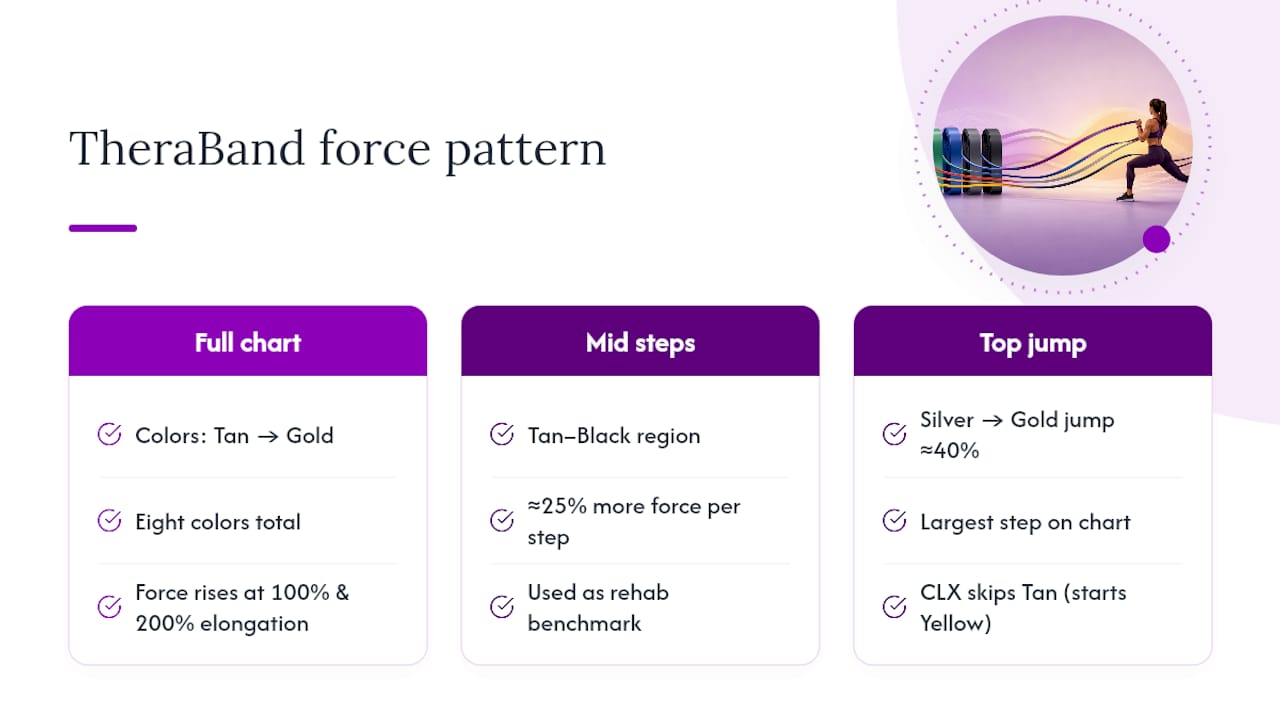
That pattern holds fairly steady across the middle of the scale, roughly 25% more force per step, until the top two levels, where Silver to Gold jumps closer to 40%. One detail worth knowing if you use TheraBand’s CLX loop line: it skips Tan entirely and starts at Yellow, so switching between CLX and standard flat bands means the “lightest” option isn’t equivalent. When a rehab program needs precision, this manufacturer chart beats guessing by color every time.
Matching Diet & Exercise Bands to Your Strength Level
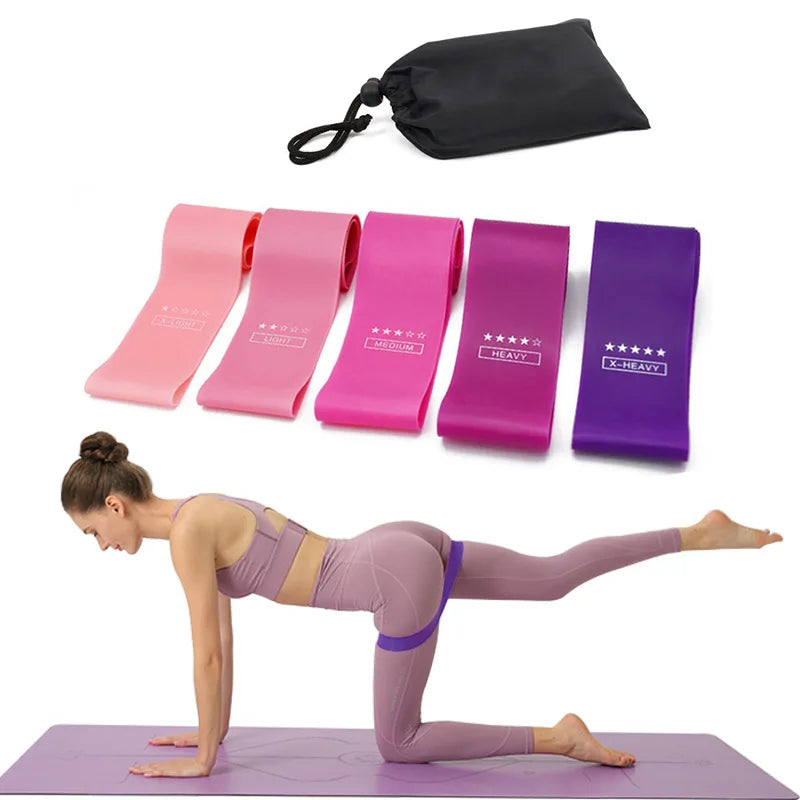
Diet & Exercise carries resistance equipment built for both ends of the strength spectrum, and matching the product listing’s kg/lb range to your own 3×8–12 test result matters more than the color on the packaging. The strength resistance band sets cover progressive loop and mini-band options suited to beginners moving through rehab-style ranges into general strength work. For heavier compound lifts or pull-up assistance, the tough latex resistance bands hold up under more aggressive stretch.
Beyond bands, Diet & Exercise’s catalog supports the training mindset around them: apparel like the TRUST THE PROCESS T-Shirt, the SQUATS? I THOUGHT YOU SAID SQUASH? T-Shirt, and the TURNIP THE GAINS T-Shirt, plus training gear like the Abs Stimulator for supplemental core work.
Pro Tip: Check the product listing’s stated kg/lb range before you buy, not the swatch color in the photo. That number is what actually tells you whether a band matches your 3×8–12 test result.
Why Band Material and Thickness Change How Resistance Feels
Latex and fabric-covered bands behave very differently under load, and thickness within either material shifts how consistent that resistance feels rep after rep. Pure latex bands stretch smoothly and predictably, which is why most force charts, including TheraBand’s, are built on latex. Thicker latex bands resist more per inch of stretch than thin ones of the same length, which is the physical reason color progressions correspond to actual thickness changes on the manufacturing line.
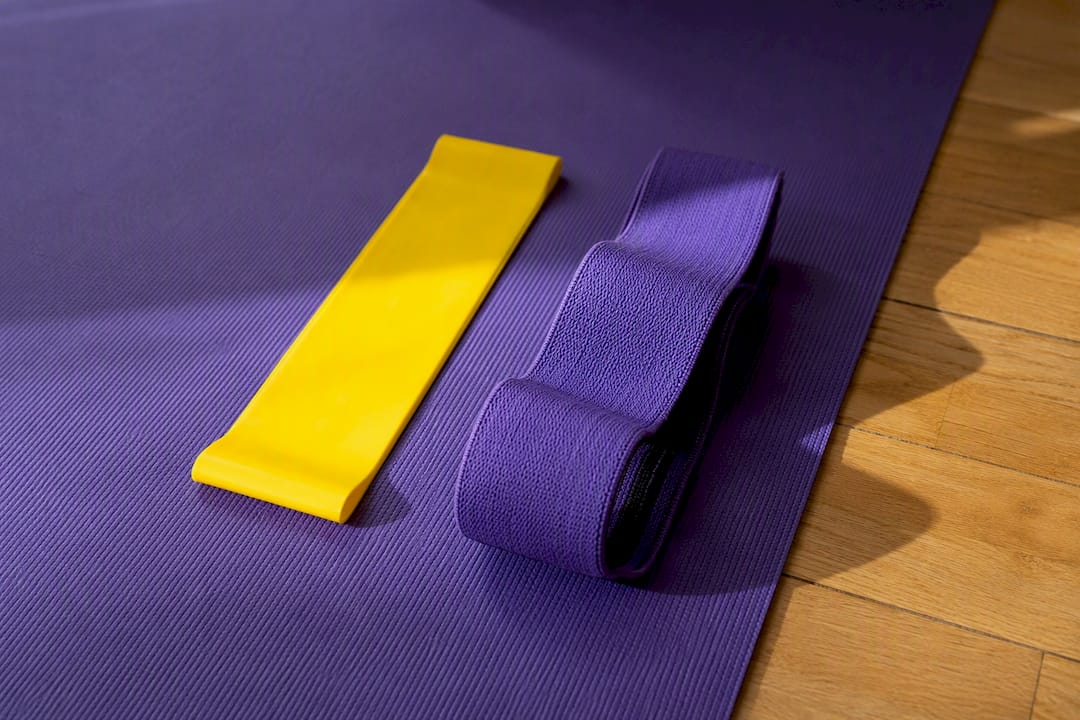
Fabric-covered bands, often used for glute work and hip activation, grip skin and clothing better and tend to resist rolling during a set, but they generally stretch less than latex before reaching peak tension. That means a fabric band’s usable resistance range is narrower even when its rated force looks similar to a latex equivrange band on paper.
Thickness also affects durability more than most people expect. A thin latex band under repeated 200% elongation stretches, over months of consistent use, breaks down faster than a thicker band of the same resistance rating pushed to a lower percentage. If you’re routinely stretching a band to its maximum rated elongation to hit your target resistance, you’re also shortening its working lifespan. Buying a band one level heavier and using less stretch per rep often preserves both your joints and the band itself longer than maxing out a lighter one.
Do Temperature and Humidity Affect Resistance Bands?
Latex resistance bands are sensitive to temperature in ways that actually change your workout. Cold rubber stiffens and resists stretch more, which is why a band left in a cold garage or car trunk overnight can feel noticeably heavier for the first few reps of a session than the same band at room temperature. Warm rubber loosens slightly, so bands used outdoors in summer heat can feel a touch lighter than their rated force suggests.
Humidity and direct sunlight matter even more for long-term durability than short-term feel. Latex degrades faster with repeated UV exposure, which is why bands stored near a sunny window or used consistently outdoors tend to develop surface cracking sooner than bands kept indoors. Talc or cornstarch residue, common on latex bands to prevent sticking, also breaks down faster in humid climates, leaving the material tackier and more prone to microtears during stretch.
Storage habits matter as much as workout habits. Keep bands away from direct heat sources, out of prolonged sunlight, and loosely coiled rather than tightly knotted between uses. A band stored folded in a hot car for a season will typically show wear well before one kept in a gym bag at room temperature, even with identical use.
Where These Numbers Come From
- TheraBand’s color force chart gives the manufacturer-measured pull-force values at 100% and 200% elongation across all eight colors.
- Performance Health’s clinical guidance backs the form-over-load principle used throughout the progression advice.
- Lose It’s progression benchmark is the source of the 3×8–12 rep rule used as the primary selection test.
Why the Color Chart Is the Wrong Starting Point
Most resistance band advice online starts with color and treats the kg/lb rating as a footnote. That’s backwards, and it’s probably cost plenty of people a wasted purchase or a frustrating first workout when their “medium” band from one brand behaved nothing like the “medium” they used at a physical therapy clinic.
The 3×8–12 rule solves a problem color charts can’t: it tests the band against your body, on that day, for that specific exercise. A band that’s perfect for banded rows might be too heavy for lateral raises, and no color label will ever capture that. Force charts like TheraBand’s are useful precisely because they replace a vague adjective with an actual number you can compare across products.
If there’s one habit worth building, it’s writing down the kg/lb rating of any band that works well for a given exercise. That number is portable across brands. The color printed on it is not.
Build Your Band Collection with Diet & Exercise
Dietexerciseshop stocks resistance band sets with the kg/lb ranges printed clearly on the listing, so you can match your 3×8–12 test result to an actual number instead of hoping a color label translates across brands. That’s the gap most retail band packs leave open, and it’s the exact problem this guide just walked you through solving.
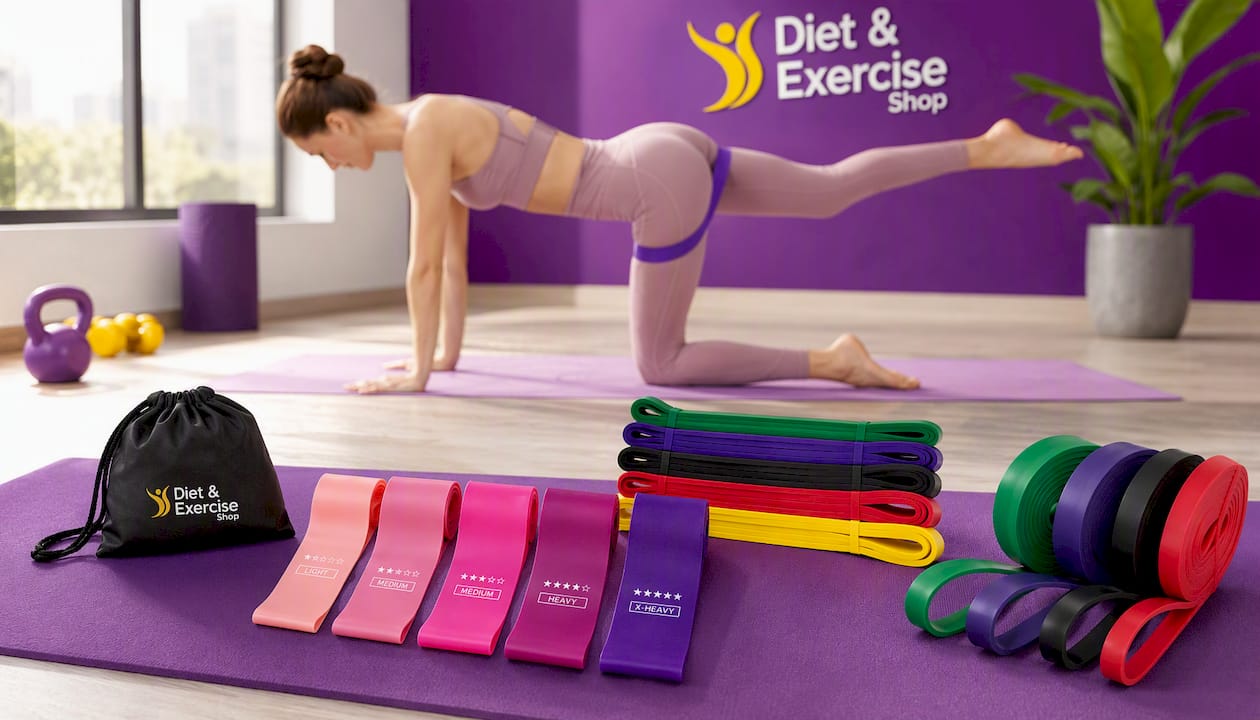
Whether you need a lighter set for rehab-style shoulder work or a heavier option for banded squats and deadlifts, the tough latex resistance bands and progressive strength sets cover both ends of that range. Pair your bands with the FUNCTIONAL FITNESS eBook for structured programming that applies the same rep-based progression rules covered in this guide. Browse the current band lineup, check the listed resistance range against your own 3×8–12 result, and add the set that matches where you actually are right now, not where a color chart guesses you should be.
Sources
- TheraBand Colors: Full Resistance Level Chart by Color | OT Mastery
- Resistance Band Colours & Sizes Explained | POWERBANDS®
- What is the difference in colored resistance bands? | Lose It
- Elastic resistance training | Science for Sport
FAQ
What level of resistance band should I get?
Start with a band that lets you complete 3 sets of 8 to 12 reps with clean form for your target exercise; if you fail before rep 8, drop to a lighter level.
What are the different levels of resistance bands?
Clinical-style sets typically run Tan, Yellow, Red, Green, Blue, Black, Silver, and Gold from lightest to heaviest, while retail packs often simplify this to five color-coded levels.
What is the order of strength for resistance bands?
Within a single product line, strength generally increases from light colors like tan or yellow through mid-range colors like green and blue, up to black, silver, or gold at the heaviest end, though the exact order varies by brand.
Which color of resistance band has the highest resistance?
Gold typically marks the highest resistance level in clinical eight-color systems like TheraBand’s, but always check the printed kg/lb rating since color meanings shift between manufacturers.
How much weight is a resistance band equivalent to?
It depends on the color, elongation, and brand.