

Timing Your Creatine With Coffee: Science Backed Steps
Yes, mixing creatine with coffee is generally safe and effective for most healthy adults, and it won’t stop creatine from working. The main risks are mild: a jumpier stomach if you’re sensitive to caffeine, and a small hydration debt if you skip water. Measure your dose, stir it into coffee that’s not scalding hot, drink the whole cup, and you’ve covered the basics.
TL;DR:
- Mixing creatine with coffee does not affect its stability or absorption, provided the coffee is not excessively hot or acidic over prolonged periods.
- Caffeine does not chemically interfere with creatine’s mechanism, but timing may influence performance gains, with some evidence favoring post-loading or spaced intake.
- A standard dose of 3 to 5 grams daily is more important than precise timing or beverage choice, especially for long-term muscle saturation.
- Ingesting creatine with hot coffee briefly increases the risk of gastrointestinal discomfort and mild dehydration, which can be mitigated by proper dosing and hydration.
- Using micronized creatine monohydrate ensures faster dissolving and a smoother mixing experience, with no added benefit from alternative creatine forms unless specific needs arise.
Table of Contents
- Does Hot or Acidic Coffee Destroy Creatine?
- Does Caffeine Cancel Creatine or Reduce Its Benefits?
- Timing and Dosing: Loading, Maintenance, and Caffeine Timing
- Gastrointestinal Effects, Hydration, and Safety Considerations
- How to Mix Creatine With Coffee: Step-by-Step
- Which Creatine Form Should You Use for Mixing With Coffee?
- Evidence Summary: What Systematic Reviews and Trials Actually Show
- Author Perspective and DietExerciseShop Resources
- The Real Question Isn’t Safety, It’s Whether You’ll Stick With It
- Keep Your Creatine Routine On Track With the Right Gear
- Sources
- FAQ
Does Hot or Acidic Coffee Destroy Creatine?
No, typical coffee temperatures won’t meaningfully break down creatine monohydrate. Creatine is a stable molecule at the temperatures you actually drink coffee at. It only degrades into creatinine at a meaningful rate under prolonged heat well above what a mug holds, or over extended time in liquid, which is more of a concern for pre-mixed liquid supplements sitting on a shelf for weeks than for a cup you’re about to drink.
Acidity is a smaller worry than most people assume. Coffee sits around pH 5, and creatine’s stability issues show up at much lower pH extremes over long exposure times, not in the few minutes between stirring and swallowing.
That said, a few practical habits keep things simple:
- Let coffee sit for a minute after brewing if it’s fresh off a hot burner or espresso machine, since very high heat over time is still the one condition worth avoiding.
- Aim to keep the liquid under roughly 140°F when you add the powder, which is easy to eyeball: if it’s too hot to sip, it’s too hot to mix into yet.
- Stir thoroughly. Creatine monohydrate doesn’t dissolve as instantly as sugar, and clumps at the bottom of the mug mean a partial dose.
- Cold brew or iced coffee works just as well and sidesteps the heat question entirely, which makes it a solid option for hot-weather training days.
Does Caffeine Cancel Creatine or Reduce Its Benefits?
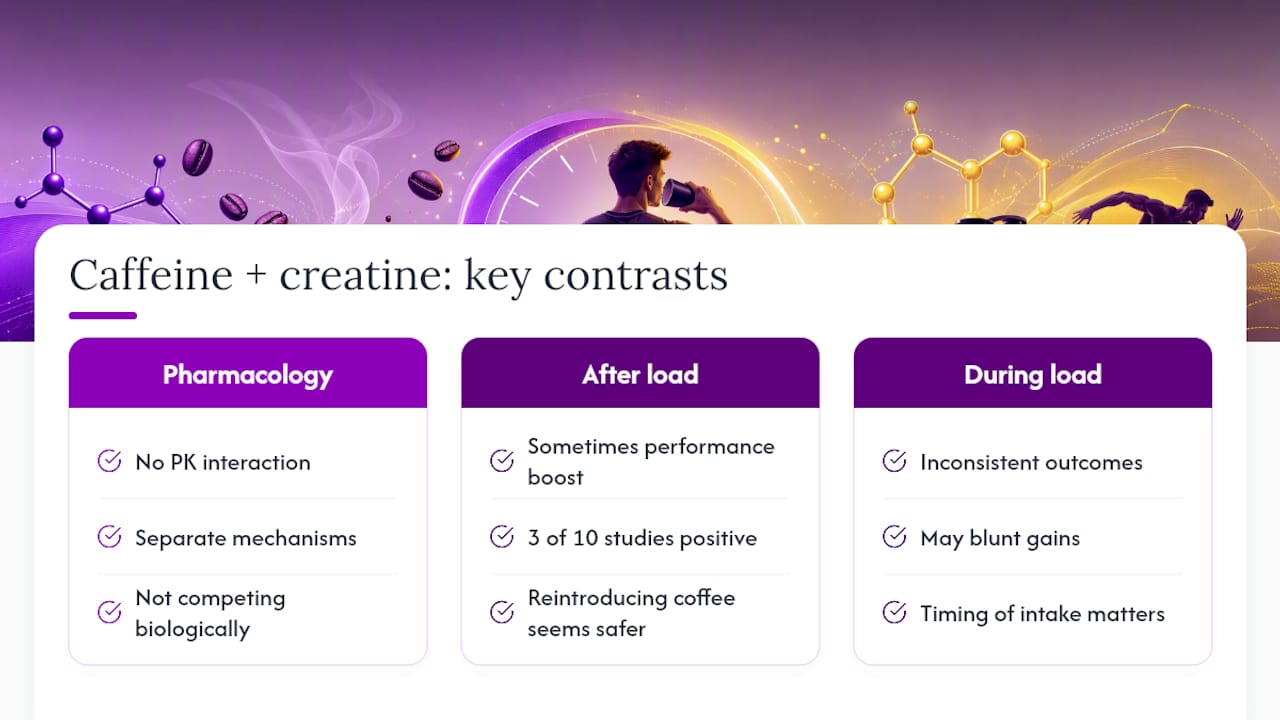
The short answer: caffeine and creatine don’t fight each other at the chemical level. Research on athletes who ingested coffee or caffeine anhydrous during a creatine loading protocol found no consistent pharmacokinetic interaction, meaning your body absorbs and uses creatine normally whether or not caffeine is in the picture. The two compounds work through separate pathways: creatine replenishes phosphocreatine stores in muscle, caffeine blocks adenosine receptors in the nervous system. They’re not competing for the same biological real estate.
Where it gets more interesting is performance outcomes, which are murkier than the “no interaction” headline suggests. A systematic review of trials combining creatine and caffeine found that timing changes the story. Out of ten studies reviewed, three reported an added performance boost when caffeine was taken acutely, after a creatine loading phase was already complete. But when caffeine was co-ingested chronically during the loading phase itself, results were inconsistent, with some studies showing blunted gains compared to creatine alone.
Adding caffeine on top of an already-loaded creatine store seems to work differently than dumping both into your system from day one. The order and timing of exposure appears to matter more than whether the two ever touch in a mug.
Caffeine and creatine benefits don’t cancel out for most users, but the research does suggest a smarter sequencing strategy. If you’re in a creatine loading phase (the first five to seven days), some evidence suggests your caffeine intake during that window might matter more than once you’re on a steady maintenance dose. After loading, adding your usual coffee back in appears to carry less risk of blunting results.
Here’s a testable approach instead of overthinking the science: track your own performance. Log a few weeks of workouts where you take creatine with coffee, then a few weeks where you space them by 30 to 60 minutes, and compare how you feel and perform. Individual response varies enough that self-tracking often tells you more than a population-level study ever will. For structured timing ideas, pre-workout supplement timing strategies can help you build a routine around whichever pattern works best for you.
Timing and Dosing: Loading, Maintenance, and Caffeine Timing
Getting the dose right matters more than the delivery vehicle. Creatine research generally supports two approaches, both validated in sports nutrition literature:
- Loading phase (optional): A scaled creatine dose based on body weight, split into multiple doses, taken over several days. For an average adult, this typically amounts to a higher daily intake divided across doses.
- Maintenance phase: 3 to 5 grams per day, taken consistently, whether or not you loaded first. Skipping the loading phase just means it takes three to four weeks instead of one to fully saturate muscle stores.
- Caffeine timing for performance: caffeine reaches peak blood levels around 60 minutes after ingestion, and ergogenic doses generally fall between 2 and 6 mg per kilogram of body weight, which for that same 175-pound adult works out to roughly 160 to 475 mg, a range that spans a strong cup of coffee to a couple of cups plus a pre-workout formula.
The practical takeaway: if you’re drinking coffee specifically to time a caffeine boost before training, have it about an hour before you lift, not five minutes before. That gives blood caffeine levels time to peak right as you start warming up.
If you’re caffeine-sensitive, or you already drink coffee daily for reasons unrelated to training, you don’t need to engineer a perfect window. Just keep your creatine dose consistent day to day. That consistency, more than precise timing, is what actually drives the muscle saturation that makes creatine work. If your goal is more about recovery and adaptation than pre-workout stimulation, pairing your dose with post-workout nutrition timing instead of morning coffee is a reasonable alternative for anyone who wants to keep caffeine and creatine on separate schedules entirely.
Gastrointestinal Effects, Hydration, and Safety Considerations
The most common complaint people report when combining the two isn’t dangerous, it’s just uncomfortable: a slightly upset stomach or looser stools. Caffeine speeds up gut motility on its own, and creatine, especially in larger loading doses, has a known tendency to cause mild GI discomfort in a subset of users. Stack the two together and that risk can compound, particularly if you’re new to either supplement or you’re taking a large loading dose on an empty stomach.
Hydration is the other piece people get wrong. Creatine pulls water into muscle cells, which is part of how it supports performance and the slight weight gain many people notice in the first week. Caffeine has a mild diuretic effect, but that effect is blunted in people who drink coffee regularly, so your daily latte isn’t dehydrating you the way a single big dose might in someone who never touches caffeine.
Practical guidance that covers most cases:
- Split your creatine dose across meals or drinks rather than dumping a large loading dose into a single cup if your stomach is sensitive.
- Take creatine with food, coffee included, rather than on an empty stomach, which tends to reduce GI complaints.
- Watch urine color as a simple hydration gauge. Pale yellow is the target. Consistently dark urine means drink more water, regardless of what supplements you’re taking.
- If you have kidney concerns, are on medications that affect fluid balance, or have a diagnosed GI condition, talk to a doctor before combining supplements, since individual medical history changes the risk calculation.
Pro Tip: If you notice stomach discomfort after adding creatine to coffee, try splitting your dose in half, morning and afternoon, instead of taking the full 5 grams at once. It’s a simple fix that solves the problem for a lot of people before they give up on the combination entirely.
How to Mix Creatine With Coffee: Step-by-Step
A few small habits are the difference between getting your full dose and leaving powder stuck to the bottom of the mug.
- Measure your dose first. Use the scoop that comes with your creatine or a small kitchen scale. Eyeballing it leads to underdosing more often than overdosing.
- Let scorching-hot coffee cool for a minute. You’re not trying to hit a lab-precise temperature, just avoid dumping powder into liquid straight off the burner.
- Add the powder and stir well, for longer than feels necessary. Creatine monohydrate takes more effort to dissolve than sugar or creamer. Give it a real 20 to 30 seconds.
- Drink the entire cup. Creatine doesn’t fully dissolve into a true solution, some settles as fine sediment, so a half-finished mug means a partial dose.
- For travel mugs, swirl before your last sip. Powder resettles at the bottom during a commute, and the last gulp is often where most of the missed dose hides.
Common mistakes worth calling out: dry scooping the powder straight into your mouth (unpleasant and easy to under-swallow), adding creatine to coffee that’s still actively steaming, and leaving a visible white residue in the cup, which is a sign you didn’t stir long enough or didn’t finish the drink. If mixing into coffee ever feels like more hassle than it’s worth, a shaker bottle with water works just as well; the coffee is a matter of habit and preference, not a requirement for creatine to function.
Which Creatine Form Should You Use for Mixing With Coffee?
Creatine monohydrate remains the gold standard, and it’s not close. It’s the form behind the vast majority of clinical research, including the loading and maintenance protocols referenced earlier, and it’s well characterized chemically with decades of safety data behind it.
Within monohydrate, look specifically for micronized creatine. It’s the same molecule, just ground into a finer particle size, which means it dissolves faster and leaves less grit at the bottom of your coffee mug. If you’ve tried mixing creatine before and gave up because of the chalky texture, a micronized product solves that specific complaint without changing anything about effectiveness.
Other forms exist, creatine HCl, buffered creatine, and various blends, marketed on claims of better solubility or fewer side effects. The evidence behind these alternatives is thinner and less consistent than what backs monohydrate, so unless you have a specific reason to try one, there’s no performance case for paying more.
When you’re buying, a few things to check:
- Look for a label that says pure creatine monohydrate, not a proprietary blend with unlisted ratios.
- Third-party testing (look for certifications like Informed Sport or NSF) matters more for creatine than for most supplements, since it’s a category with a history of underfilled or contaminated products.
- Micronized versions will usually say so directly on the label; if it doesn’t mention it, assume it’s standard-grind.
Evidence Summary: What Systematic Reviews and Trials Actually Show
The clinical picture on creatine and caffeine together is more nuanced than most marketing copy suggests, and that nuance is worth sitting with before you build a routine around it.
- Trials examining coffee and caffeine anhydrous during creatine loading found no consistent pharmacokinetic interaction, confirming the two supplements don’t block each other’s absorption or function.
- A systematic review of ten combined studies found mixed performance results: acute caffeine use after loading sometimes added benefit, chronic co-ingestion during loading sometimes didn’t.
- Study protocols vary widely, some measure strength, others measure sprint performance or endurance, and caffeine doses range from a single cup’s worth to concentrated anhydrous supplements, which makes it hard to draw one universal rule.
- Sample sizes across many of these trials are modest, and most track healthy, trained males, so how well findings generalize to other populations, like older adults or women across different training levels, is less certain.
What the research supports with reasonable confidence: creatine works whether or not you drink coffee, and caffeine doesn’t block its core mechanism. What remains genuinely uncertain is whether the specific timing of caffeine relative to a loading phase produces a measurable difference for your particular training goals, and that’s a question better answered by tracking your own results than by waiting for a definitive trial that may never arrive.
Author Perspective and DietExerciseShop Resources
Mark’s practical take: the biggest reason people fall off a creatine routine isn’t safety, it’s forgetting to take it. Anchoring your dose to something you already do every day, like brewing coffee, solves that problem better than any timing optimization. If you drink coffee at 7 a.m. regardless of what’s on your training calendar, that’s a reliable trigger. Consistency is what actually saturates your muscle creatine stores over time, not the precision of your caffeine window.
For related routines, post-workout nutrition timing and muscle protein synthesis fundamentals round out the picture of what your body does with the creatine once it’s absorbed. And if you’re new to supplement stacking generally, creatine dosing basics from Onemor cover ground this article doesn’t need to repeat.
One caveat worth stating plainly: if you have an existing kidney condition, are pregnant, or take medication that affects fluid balance or heart rate, talk to a healthcare professional before adding creatine, caffeine, or both to your daily routine.
The Real Question Isn’t Safety, It’s Whether You’ll Stick With It
The conventional wisdom on this topic spends too much energy on chemistry questions that the research has already settled, and not enough on the behavioral question that actually determines results. Creatine’s benefits depend almost entirely on consistent daily intake over weeks and months. Whether you take it in coffee, water, or a smoothie is a rounding error next to whether you take it at all.
Where I think most advice gets it backwards: people treat the loading phase and caffeine timing like they’re the hard part, when the hard part is remembering a mundane supplement every single day for months. If mixing it into a drink you already love makes that easier, that’s a bigger performance lever than shaving 30 minutes off your caffeine window ever will be.
Prioritize the habit first. Get the dose consistent, get the hydration right, and treat the fine print about heat and timing as optimization, not prerequisites.
— Mark
Keep Your Creatine Routine On Track With the Right Gear
Since a morning coffee habit is one of the most reliable ways to remember your daily creatine dose, it helps to have gear built around that exact ritual. The WORKOUT HOT, CUCUMBER COOL Coffee Mug from Dietexerciseshop keeps that pairing visible and intentional instead of an afterthought you forget on rushed mornings.

Beyond creatine, Dietexerciseshop also carries supplement lines built for other goals in your routine. The Fat Burner with MCT is a different category entirely from creatine, aimed at readers layering fat metabolism support into a cutting phase rather than muscle performance. For anyone who’s found a supplement they want to stick with long term, the 3-pack Fat Burner with MCT bundle covers a few months at once instead of reordering constantly.
None of these replace creatine, they solve different problems, but they’re worth a look if your morning routine already includes a supplement stack and you’re deciding what belongs in it. Browse the full lineup and build out your own routine at Dietexerciseshop.
Sources
- Effects of coffee and caffeine anhydrous intake during creatine loading
- Effects of creatine and caffeine ingestion in combination on exercise performance: A systematic review
- Creatine and caffeine: How they interact, pros, cons, best practices
- Creatine — PubChem
This article is general information, not a substitute for advice from a qualified doctor. Consult a qualified healthcare professional about your own circumstances before acting on anything here.
FAQ
What Should You Avoid Mixing With Creatine?
Avoid mixing creatine with very hot liquids for extended periods and with alcohol, since alcohol can worsen dehydration risk. Acidic juices in small amounts are fine, but there’s no evidence they improve absorption over water or coffee.
Does Coffee Affect Creatinine Levels?
Coffee itself doesn’t meaningfully raise creatinine, the waste product your kidneys filter, though heavy creatine supplementation can slightly increase measured creatinine on a blood test without indicating actual kidney harm. If you’re getting routine bloodwork, mention your creatine use to your doctor so they can interpret the result correctly.
What’s the Best Thing to Mix Creatine With?
Plain water remains the simplest and most reliable option, but coffee, juice, or a protein shake all work fine since creatine’s effectiveness doesn’t depend on the beverage. The best choice is whichever drink you’ll consistently remember to take it with every day.
Is Creatine Good for Your Brain?
Creatine supports energy production in brain cells the same way it does in muscle, and researchers are actively studying its role in cognitive function, though this is a separate line of evidence from its well-established use for muscle performance. If cognitive support is your primary goal, treat that as an emerging area rather than a settled benefit the way muscle gains are.