

8–12 Week Fitness Course for Beginners That Builds Lasting Habits
The best starting point is a structured 8 to 12 week progressive course with 2 to 4 full-body sessions a week, done at home or in a gym with minimal gear. You don’t need a plan to begin, just a workout: today, do 20 to 30 minutes of squats, push-ups, rows, and a plank, resting as needed between moves. Everything else builds from there.
TL;DR:
- Progression should focus on adding repetitions before increasing weight to prevent injury and build good form gradually.
- Deload weeks every four to six weeks are crucial for recovery and avoiding fatigue plateaus.
- Exercises should be performed with proper form, emphasizing technique to maximize benefits and reduce injury risk.
- Beginners need a phased, structured program lasting 8 to 12 weeks, rather than random workouts, to build competence and confidence.
- Consistent logging and anchoring workouts to daily routines help maintain motivation and ensure steady progress.
Table of Contents
- What a Fitness Course for Beginners Actually Looks Like
- A Sample 8 to 12 Week Course Roadmap You Can Follow
- Ready-to-Use Workout Templates for Home and Gym
- Equipment and Space: What You Actually Need
- Safety, Progression, and Recovery Rules That Actually Matter
- Basic Nutrition and Recovery for Beginners
- Why Trust This Guide
- Common Beginner Mistakes and How to Avoid Them
- Motivation and Habit-Building Strategies to Maintain Consistency
- How to Set Realistic and Measurable Fitness Goals
- Why Proper Form Matters More Than Effort
- Adapting the Course for Different Fitness Levels and Limitations
- The Roadmap Beats the Random Workout
- Starter Picks That Support the Beginner Course
- Sources
- FAQ
What a Fitness Course for Beginners Actually Looks Like
A real fitness course for beginners is not a random collection of workouts pulled from the internet. It’s a sequence with a beginning, middle, and end, built around phases that layer on top of each other.
Most beginner programs run a structured course with a phased progression over several weeks, allowing the nervous system to adapt before load increases meaningfully, which matters because early strength gains come mostly from motor learning, not muscle growth. Harvard’s Starting to Exercise course builds its beginner instruction around exactly this kind of gradual, phased progression.
Frequency matters more than intensity at this stage. Multiple sessions a week is the recommended minimum for building a habit; more sessions risk hampering recovery for someone new to training. Session length can flex between 20 and 60 minutes depending on the day and your schedule.
Here’s roughly what changes phase by phase:
- Weeks 1 to 3: you’re learning what a squat, hinge, push, and pull actually feel like.
- Weeks 4 to 8: the habit solidifies. You stop dreading the workout and start expecting it.
- Weeks 8 to 12: measurable strength shows up. You add reps, weight, or both without your form falling apart.
Programs that repeat the same core movements week after week, rather than constantly swapping exercises, speed up motor learning and cut injury risk compared to routines that change everything every session.
A Sample 8 to 12 Week Course Roadmap You Can Follow
Structure beats improvisation. A course with defined phases tells you what to focus on this week instead of leaving you to guess.
- Weeks 1 to 4, Foundation phase. The goal is repetition, not exhaustion. Train the same five or six movements (squat, hinge, push, pull, carry, plank) two to three times a week. Keep loads light enough that you could do five more reps than assigned. This phase is about grooving the pattern until it feels automatic, not about how much you can lift.
- Weeks 5 to 8, Development phase. Bump frequency to three or four sessions if recovery allows. Increase load slightly and introduce variations, like a goblet squat instead of a bodyweight squat, or a single-arm row instead of a two-arm one. Volume creeps up here, usually by adding a set rather than piling on weight.
- Weeks 9 to 12, Consolidation and test phase. This is where you check your work. Test how many push-ups you can do with good form, or how much you can carry for a farmer’s walk across the room. Compare it to week one. Use the results to decide whether to repeat the course at a higher intensity or move into a more advanced program.
The progression rules that hold this together are simple, and they’re the same ones used in structured strength programs regardless of setting:
- Add reps before you add weight. If your target is multiple sets of a recommended number of squats, get comfortable performing the reps with good form before adding weight.
- When you do add weight, keep the jump small. For dumbbells, that often means the next size up, not doubling the load.
- Build in a deload every four to six weeks, meaning one week at reduced volume or intensity, even if you feel fine. This is standard advice from clinicians tracking overtraining and fatigue patterns in people who train consistently without a break.
- Reassess after every phase instead of guessing whether you’re ready to progress.
Pro Tip: Write your reps down on your phone after every session. It takes ten seconds and it’s the single easiest way to know whether you’re actually progressing or just repeating the same workout for three months.
Mixing short bursts of harder effort with resistance work can be genuinely time-efficient for someone new to exercise, according to a PubMed Central review of exercise physiology, as long as intensity gets scaled to the individual and progression stays conservative. That’s the whole philosophy behind this roadmap: nothing fancy, just consistent exposure with a plan for when to push a little harder.
Ready-to-Use Workout Templates for Home and Gym
Pick the template that matches where you’ll actually train, not where you wish you trained.
No-equipment home session (20 to 30 minutes). Warm up for 5 minutes with marching in place, arm circles, and bodyweight squats. Then: 3 sets of 10 to 15 bodyweight squats, 3 sets of push-ups (knee push-ups are fine) to near-failure, 3 sets of 10 glute bridges, and a 3 round plank hold of 20 to 30 seconds. Rest 60 to 90 seconds between sets. Cool down with a 5 minute walk and light hamstring and chest stretches.
Minimal-equipment home session (30 to 40 minutes) with adjustable dumbbells or bands. After the same warm-up: 3 sets of 10 dumbbell goblet squats, 3 sets of 10 dumbbell rows per arm, 3 sets of 10 dumbbell floor presses, and 3 sets of 12 band-resisted deadlifts. Rest 60 to 90 seconds. Finish with a slower walk and static stretching for the legs and shoulders.
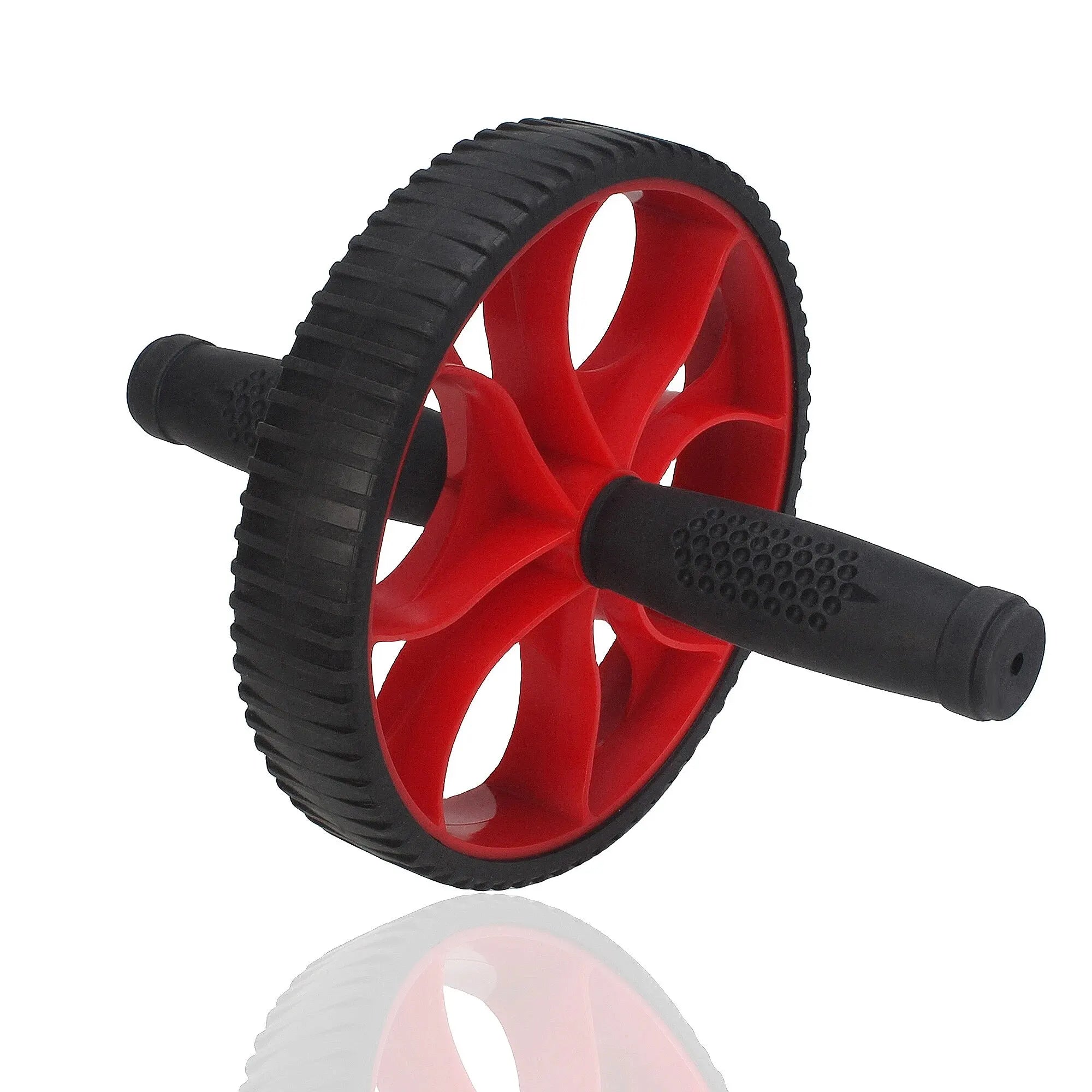
Basic gym session focused on compound lifts. Warm up on a bike or rower for 5 minutes, then do a light set of each main lift before working weight. Core lifts: 3 sets of 8 to 10 goblet or barbell squats, 3 sets of 8 to 10 dumbbell bench presses, 3 sets of 8 to 10 seated cable rows, and 3 sets of 8 leg press or lunges. Rest 90 seconds between sets on the heavier lifts.
Mayo Clinic’s strength training guidance recommends most healthy adults train major muscle groups at least twice a week, which any of these three templates satisfies if you repeat them two to four times weekly. Warm-ups and cool-downs aren’t optional filler here. The American Heart Association points to warming up and cooling down as a real factor in reducing injury risk and helping the body recover between sessions, not a box to check before the “real” workout starts.
Equipment and Space: What You Actually Need
You don’t need a garage gym. Three items cover almost everything in the templates above.
- Adjustable dumbbells replace an entire rack of fixed weights and take up the space of one dumbbell. They’re the single highest-value purchase for progressing the minimal-equipment template over months, since you can add weight in small increments instead of buying new pairs.
- Resistance bands are cheap, packable, and useful for warm-ups, deadlift variations, and travel days when dumbbells aren’t an option.
- A mat protects your knees and back during floor work like glute bridges and planks, and gives you a defined space to train in a small apartment.
For a deeper breakdown of what to buy first and what to skip, Diet & Exercise’s guide to home gym equipment for beginners covers budget-friendly picks in more detail, and the small-space equipment guide is worth a look if floor space is tight. If you’d rather get a professional gym-side checklist before joining a facility, Unleash’d Strength’s beginner equipment checklist walks through what’s actually worth using on day one.
Safety, Progression, and Recovery Rules That Actually Matter
Most beginner injuries come from doing too much too soon, not from the exercises themselves. A few rules keep you in the game long enough to see results.
Know when to stop mid-session. Sharp or shooting pain (different from normal muscle burn), breathlessness that feels disproportionate to the effort, or any faintness or dizziness are all reasons to stop immediately, not push through. The Moving Medicine risk consensus framework used by exercise clinicians treats these as standard screening flags before recommending someone with an existing health condition ramp up activity, and the same caution applies to anyone new to exercise, regardless of age.
Scale down before you scale up. If a set feels harder than it should on a normal day, that’s your body telling you to drop the weight or the reps, not grind through it. Every four to six weeks, take a deliberate deload week, cutting volume or intensity by roughly a third even if you feel strong. It’s one of the most reliable ways to avoid the fatigue plateau that derails consistent training.
- Stop for sharp pain, unusual breathlessness, or faintness. Always.
- Reduce load, not just skip the session, when you’re consistently under-recovered.
- Sleep and protein aren’t extras. They’re part of the program.
- Take at least one full rest day between sessions targeting the same muscle groups early on.
Pro Tip: If you can’t hold a conversation during your warm-up walk, you’re starting too hot. Slow down. The warm-up is supposed to prepare you, not tire you out.
Basic Nutrition and Recovery for Beginners
You don’t need a meal plan to make progress in the first 12 weeks. You need a few habits that don’t get in the way.
Aim for roughly 20 to 40 grams of protein per meal, spread across three or four meals a day, which lands most adults in a reasonable daily range to support muscle repair without any tracking apps. Sleep is doing more work than most people give it credit for: consistently short sleep undermines recovery and makes every session feel harder than it should. Eating enough overall, not restricting hard while also trying to build strength, matters just as much as hitting a protein number.
- Batch-cook a protein source (chicken, tofu, lentils, eggs) once or twice a week so meals don’t depend on willpower.
- Keep a simple snack, like Greek yogurt or a protein shake, on hand for busy days.
- Treat 7 to 9 hours of sleep as part of the training plan, not separate from it.
- Don’t skip meals before or after a session; being underfed makes workouts feel worse and recovery slower.
Why Trust This Guide
This roadmap draws on structured, safety-first frameworks like Harvard’s Starting to Exercise course and clinical guidance from Mayo Clinic and the American Heart Association, translated into a practical course any beginner can follow. It’s written by Mark for Diet & Exercise, a specialist online store built around beginner workout plans, equipment guides, and eBooks that map directly onto the phases described here. If a section raised a question, there’s likely a deeper guide covering it already published on the site.
Common Beginner Mistakes and How to Avoid Them
The biggest mistake isn’t laziness. It’s starting too aggressively and burning out by week three.
New exercisers routinely try to do too much volume, too much intensity, and too many new exercises all in the same week. That combination overwhelms recovery capacity before the body has a chance to adapt, which is exactly why phased programs exist. Another common trap is chasing soreness as proof of a good workout. Soreness is a byproduct of novelty, not a scoreboard, and chasing it often means you’re skipping the technique-focused foundation phase entirely.
Skipping warm-ups is another one. It saves five minutes and costs you weeks if it leads to a strain. Comparing your week one to someone else’s week twelve is a mistake too, since it sets an unrealistic bar and makes normal, slow progress feel like failure.
Here’s what fixes most of it: follow the phase you’re actually in, not the one you wish you were in. Log your workouts so progress becomes visible instead of assumed. And treat rest days as part of the plan, not as time off from it. Beginners who skip planned rest days almost always end up taking unplanned ones later, usually because of an overuse issue that a single missed session wouldn’t have caused.
Motivation and Habit-Building Strategies to Maintain Consistency
Motivation gets you to day one. Habit gets you to day ninety.

The most reliable trick for consistency is attaching the workout to something that already happens every day, like training right after your morning coffee or immediately when you get home from work, rather than leaving it floating and “whenever I have time.” Floating plans get skipped. Anchored ones tend to survive bad weeks.
Tracking something simple, whether that’s a checkmark on a calendar or reps logged in a notes app, gives you visible proof of consistency even on weeks where you don’t feel stronger yet. Strength gains can be slow to show up in the mirror but fast to show up on paper, and that paper trail is often what keeps people going through the flat-feeling weeks four through six.
It also helps to lower the bar on hard days. A 15-minute version of your workout beats a skipped one, and it protects the habit even when life doesn’t cooperate. Research on resistance training’s long-term payoff, including its links to lower cardiovascular risk over time, makes clear that the compounding benefit comes from years of shown-up sessions, not any single perfect week.
How to Set Realistic and Measurable Fitness Goals
Vague goals like “get fit” don’t give you anything to check progress against. Specific ones do.
A measurable goal for this course looks like: “do 10 unbroken push-ups by week 8” or “carry two 20-pound dumbbells for a 40-yard walk without stopping by week 12.” Both are testable, both are tied to the templates already in this course, and both give you a clear pass or fail instead of a vague feeling.
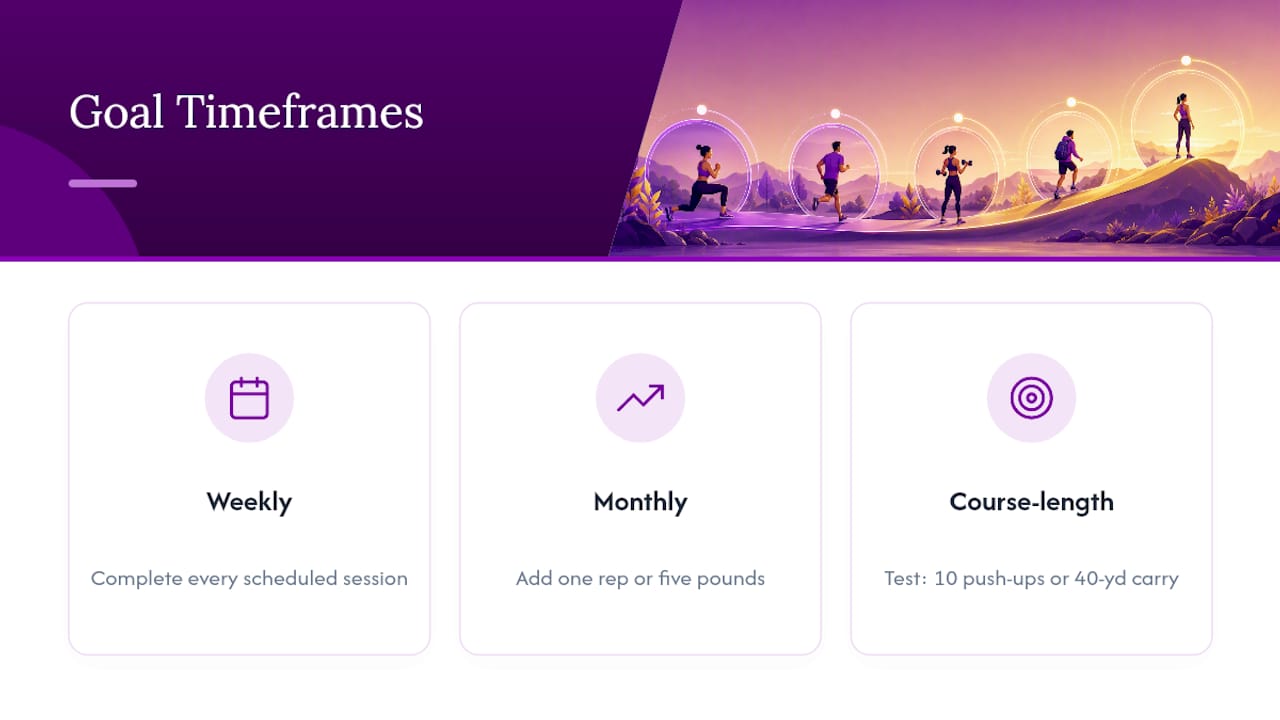
Split goals into three timeframes. A weekly goal might be simply completing every scheduled session. A monthly goal might be adding one rep or five pounds to a specific lift. A course-length goal (8 to 12 weeks) should be tied to the test you’ll actually run in the consolidation phase, like the push-up count or carry distance mentioned above.
Avoid stacking multiple big goals on top of each other in the first course. Trying to lose weight, build visible muscle, and train for a 5K all in the same 12 weeks usually means none of them get the focus they need. Pick one primary outcome for this first course and treat everything else as a side effect.
Why Proper Form Matters More Than Effort
A beginner doing 10 sloppy squats gets less benefit and more risk than a beginner doing 6 clean ones. Form is not a detail you fix later. It’s the whole point of the foundation phase.
For the squat, the cue that matters most is keeping your weight centered over your midfoot, not your toes, and lowering until your hips are roughly level with your knees before standing back up. For the push-up, keep your body in a straight line from shoulders to ankles rather than letting your hips sag, which is the single most common form breakdown beginners show. For the row, pull your elbow back toward your hip rather than up toward your ear, which keeps tension on the back muscles instead of the shoulders.
The plank is deceptively simple to get wrong. Squeeze your glutes and pull your belly button toward your spine rather than just holding the position and hoping your core engages on its own. If any of these positions cause sharp pain rather than muscular effort, that’s the signal to regress to an easier variation, like a wall push-up or a shortened plank hold, not to push through.
Adapting the Course for Different Fitness Levels and Limitations
This roadmap bends. It doesn’t require starting from zero athleticism or a clean bill of health to work.
If you’re older, returning after a long break, or managing a joint issue, the foundation phase can simply run longer, four to six weeks instead of three to four, with lighter loads and a slower rate of adding reps. The Moving Medicine risk consensus framework built for clinicians recommends exactly this kind of graded, screened approach for people managing an existing health condition, which is a reasonable model for anyone starting cautiously.
If mobility or joint pain limits certain movements, swap the pattern, not the goal. A limited squat range can become a box squat to a chair. A painful traditional push-up can become an incline push-up against a countertop. The lower-impact alternatives found in Pilates Mini’s home routine guide are worth exploring if standard strength movements aren’t accessible yet, particularly for building core control before layering on load. If you’re already fitter than a true beginner, compress the foundation phase to two weeks and move faster into the development phase, but keep the deload weeks regardless of your starting point. They’re not a beginner-only precaution.
The Roadmap Beats the Random Workout
Most people don’t fail at fitness because they picked the wrong exercises. They fail because they never had a plan longer than a week, so every session felt like starting over.
The conventional advice on this topic tends to overweight variety and underweight repetition. Fitness content constantly pushes “never do the same workout twice” as if boredom were the real threat, when the actual threat for most beginners is inconsistency caused by never getting good enough at anything to feel confident doing it. Repetition across a defined 8 to 12 week window builds competence, and competence is what makes people show up on a Tuesday when they don’t feel like it.
If there’s one thing worth prioritizing above all else here, it’s picking a course length and sticking to the phases in order, rather than jumping to advanced variations because week two feels easy. Feeling easy in week two is the plan working, not a sign to skip ahead. The equipment, the templates, and the recovery rules all matter, but they’re secondary to simply finishing what you started on the timeline you set.
— Mark
Starter Picks That Support the Beginner Course
Once the roadmap is set, the biggest risk to sticking with it is losing steam around week four or five, which is exactly the gap THE CONSISTENCY CODE eBook is built to close, with practical habit-tracking methods that pair directly with the phased structure covered above.
If your setup leans toward shorter, mixed cardio-and-strength sessions rather than the full templates outlined earlier, the HIIT 2 Fit eBook offers a time-efficient alternative that fits the same 8 to 12 week logic. On the equipment side, the T-shirt collection has options built for actual training rather than just looking the part, and a shirt like BRO, DO YOU EVEN LIFT? or a hoodie like MEAL PREP & MUSCLE REPS makes a decent difference on the days motivation is thin and you need a reason to actually put on gym clothes. None of this is required to take the courses. It’s there for the weeks when a small nudge is what keeps the streak alive. Browse the eBooks collection if you want a structured guide to pair with your first course.
Sources
- Starting to Exercise — Harvard
- Strength training: Get stronger, healthier — Mayo Clinic
- PubMed Central — exercise physiology review
FAQ
What Is the Best Fitness Class or Course for Beginners?
The best option is a structured 8 to 12 week course with 2 to 4 full-body sessions a week, mixing basic strength movements with light cardio, whether that’s a formal class or a self-guided plan like the roadmap in this guide.
What Is the 3-3-3 Rule for Fitness?
Definitions vary, but a common version calls for 3 strength sessions, 3 cardio sessions, and 3 mobility or stretching sessions spread across the week, adjusted down for true beginners who need more recovery time between sessions.
What Is the Best Fitness Program for Someone Just Starting Out?
A phased program built around foundation, development, and consolidation stages, like the 8 to 12 week roadmap outlined above, tends to work better than an unstructured mix of random workouts because it builds skill before it adds load.
What Are 7 Exercises a Beginner Can Do Every Day?
Bodyweight squats, push-ups, glute bridges, planks, walking lunges, bird dogs, and a brisk walk cover most major movement patterns and can reasonably be done daily at low intensity, though heavier strength work still needs rest days between sessions targeting the same muscles.
How Many Days a Week Should a Beginner Work Out?
A few sessions per week is the recommended frequency for beginners, providing enough consistency to build habit and see progress without overwhelming recovery capacity early on.