

HMB Benefits for Muscle Preservation and Growth
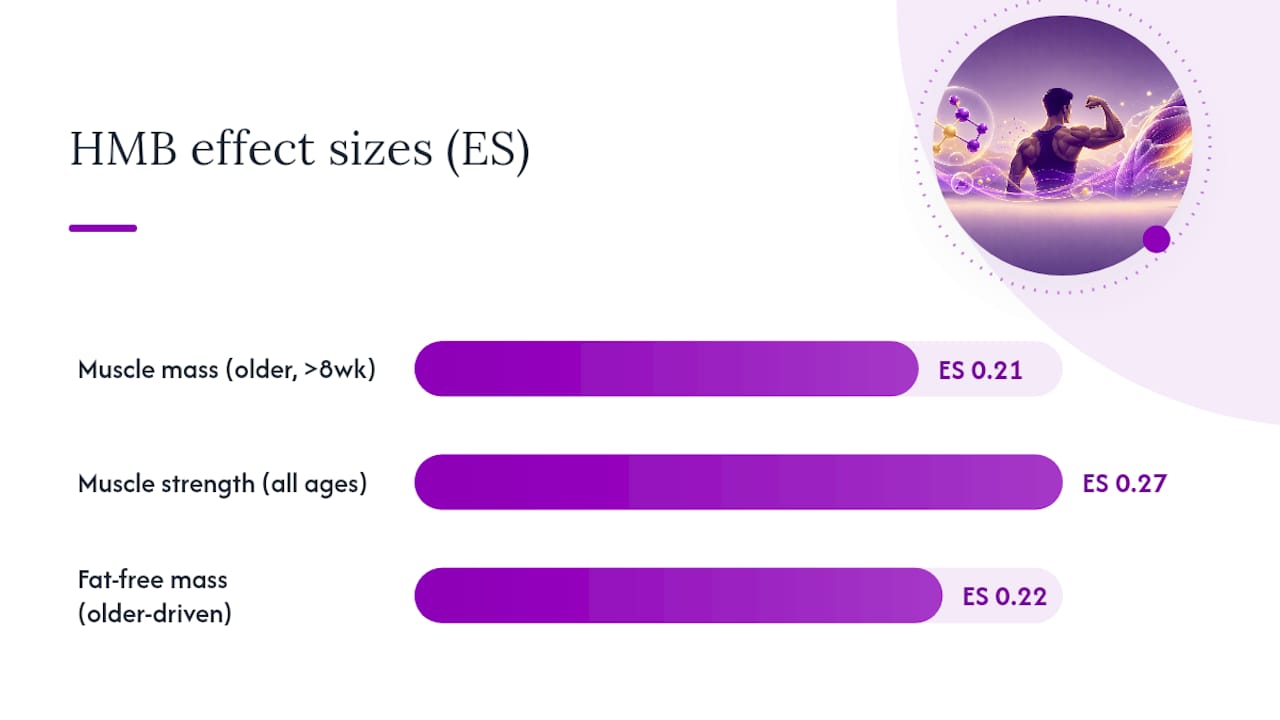
HMB reliably helps preserve and modestly increase muscle in older adults and untrained individuals when combined with resistance training. An umbrella review of meta-analyses found statistically significant gains in muscle mass (effect size: 0.21), strength (ES: 0.27), and fat-free mass (ES: 0.22), with the largest effects appearing in older adults and in longer trials. For trained young athletes, the picture is murkier — benefits exist but are smaller and less consistent.
Three things to know before you read further:
- Who benefits most: Older adults losing muscle to age, beginners starting resistance training, and people recovering from surgery or prolonged bed rest see the clearest gains.
- Recommended daily dose: 3 g/day (roughly 38 mg per kilogram of body weight), split across two or three doses.
- Safety caveat: HMB is well tolerated in healthy adults, but anyone with liver or kidney disease, or taking prescription medications, should check with a clinician before starting.
Key Takeaways
HMB produces small-to-moderate, statistically significant improvements in muscle mass, strength, and fat-free mass, with the largest and most reliable effects in older adults and trials lasting more than eight weeks.
| Point | Details |
|---|---|
| Best responder profile | Older adults (65+), beginners, and people in catabolic states see the clearest gains. |
| Standard dose | approximately 3 g per day (around 38 mg per kilogram body weight), typically split into two or three doses with meals. |
| Minimum trial duration | Allow at least 8 weeks before judging results; recovery benefits may appear within 2 weeks. |
| Safety profile | Well tolerated in healthy adults; consult a clinician if you have liver, kidney, or medication concerns. |
| Foundation required | HMB works through training-activated pathways; progressive resistance training and adequate protein are non-negotiable. |
| Dietexerciseshop | Offers fitness apparel, eBooks, and a Bodybuilding Guide to support the structured training HMB needs to work. |
Table of Contents
- What do the best clinical studies show about HMB benefits?
- How does HMB actually work inside muscle tissue?
- Who is most likely to benefit from HMB supplementation?
- Breaking down each specific HMB benefit
- HMB dosage, timing, and which form to choose
- Is HMB safe to take every day?
- Where the evidence is weak and what HMB is not
- Three evidence-based protocols for using HMB
- Should you try HMB? A practical decision checklist
- An editorial perspective on HMB’s real place in a supplement stack
- Gear that keeps you consistent while the science does its work
- Sources
- FAQ
What do the best clinical studies show about HMB benefits?
The strongest signal in the HMB literature comes not from any single trial but from pooled analyses that aggregate dozens of randomized controlled trials. The PMC umbrella review is the most comprehensive synthesis available, covering multiple meta-analyses and reporting effect sizes across muscle mass, strength, and fat-free mass simultaneously.
Effect sizes around 0.2 to 0.3 are considered small-to-moderate in exercise science. To put that in practical terms: a 70-year-old woman doing resistance training twice a week might preserve or add a modest amount of lean mass over three months compared to training without HMB. That gap matters more at 70 than it does at 25, because the baseline rate of muscle loss (sarcopenia) is already working against her.
Two patterns emerge consistently across reviews:
- Older adults and untrained people drive the largest effect sizes. Studies focused on adults aged 65 and above show meaningfully stronger responses than those in trained young athletes.
- Duration matters. Trials of longer duration tend to show clearer lean-mass and strength gains, with shorter trials showing weaker or inconsistent results.
The ISSN position stand adds an important recovery dimension: HMB can attenuate exercise-induced muscle damage and speed recovery, particularly when training volume or intensity is high. That finding holds across both trained and untrained populations, even when hypertrophy effects are modest.
| Outcome | Evidence Strength | Typical Effect Size | Notes |
|---|---|---|---|
| Muscle mass | Small-to-moderate | ES: 0.21 | Larger in older adults, >8-week trials |
| Muscle strength | Small-to-moderate | ES: 0.27 | Consistent across age groups |
| Fat-free mass (FFM) | Small-to-moderate | ES: 0.22 | Driven largely by older adult subgroups |
| Recovery / muscle damage | Moderate | Not pooled as ES | Supported by ISSN; clearest with high training loads |
| Fat mass / body weight | Limited | No consistent effect | Not a fat-loss supplement |
One honest caveat: heterogeneity across studies is high. Populations, training programs, dosing protocols, and HMB forms vary widely, which means pooled effect sizes are averages across very different conditions. The number tells you the direction and rough magnitude, not a guarantee for any individual.
How does HMB actually work inside muscle tissue?
HMB is a metabolite of the amino acid leucine. Your body produces it naturally, but only about 0.3 g per day from dietary leucine, which is far below the 3 g/day used in clinical trials. That gap explains why eating more protein or leucine-rich foods rarely replicates the effects of direct HMB supplementation.
Inside muscle cells, HMB appears to act through several pathways simultaneously:
- mTOR activation (human and animal evidence): HMB stimulates the mTOR signaling pathway, which drives muscle protein synthesis. This is the same pathway leucine itself activates, but HMB may do so more efficiently at lower concentrations.
- Ubiquitin-proteasome inhibition (human and animal evidence): HMB slows the cellular machinery that tags proteins for breakdown. This anti-catabolic effect is arguably its most clinically relevant action, particularly during caloric restriction, illness, or aging.
- Satellite cell activation (animal and in vitro evidence): Satellite cells are the muscle’s repair crew. HMB appears to support their proliferation and differentiation, which may accelerate recovery after damage.
- Membrane stabilization (in vitro evidence): HMB may reduce the permeability of muscle cell membranes under stress, limiting the leakage of enzymes like creatine kinase that signal damage.
- Anti-inflammatory and antioxidant effects (human evidence): Several trials report lower inflammatory markers after HMB supplementation during intense training blocks.
The practical implication of this mechanism profile is important: HMB is primarily anti-catabolic. It slows breakdown more reliably than it accelerates building. That distinction explains why it shines in situations where muscle loss is the main threat — aging, surgery, bed rest, aggressive caloric restriction — rather than in a healthy 25-year-old already eating 180 g of protein per day and training five times a week.
Who is most likely to benefit from HMB supplementation?
Older adults (65+): This is the group with the clearest, most consistent evidence. Sarcopenia, the age-related loss of muscle mass and function, is partly driven by elevated protein breakdown rates and blunted anabolic signaling. HMB addresses both. Healthline’s summary of the pooled evidence confirms that older adults see meaningfully larger effects than younger populations. Combining HMB with progressive resistance training and adequate protein (at least 1.2 g per kilogram of body weight daily) produces the best outcomes in this group.

Beginners and untrained individuals: Someone starting resistance training for the first time experiences significant muscle damage in early weeks. HMB’s anti-catabolic and recovery effects are most pronounced when the training stimulus is novel and the damage is high. Beginners may see faster early strength and lean-mass gains compared to training alone, though the advantage narrows as they adapt.
Clinical and catabolic states: Post-surgical patients, people on extended bed rest, and individuals with cancer cachexia represent the highest-need population. In these contexts, preserving any lean mass is clinically meaningful. HMB has been studied in ICU patients and cancer populations with encouraging results, though this is a specialized area requiring clinician oversight.
Trained athletes: The honest answer here is that effects are smaller and less reliable. A trained athlete with an optimized diet and structured program may see modest recovery benefits, particularly during high-volume training blocks or caloric restriction phases. Expecting significant hypertrophy on top of an already-optimized program is unrealistic based on current evidence.
Breaking down each specific HMB benefit
Muscle mass: Small-to-moderate effect (ES: 0.21). The gain is real but not dramatic. Think of it as a meaningful edge in populations where muscle loss is the primary concern, not a shortcut to size.
Strength: The most consistent outcome across reviews (ES: 0.27). Strength improvements track closely with lean-mass gains and appear across age groups, though older adults and untrained people show the clearest signal.
Recovery: Moderate evidence, supported by the ISSN. HMB taken before or during high-intensity training reduces markers of muscle damage and speeds return to full training capacity. Acute recovery effects can appear within two weeks of starting supplementation.
Aerobic capacity: Limited evidence. A handful of trials suggest modest improvements in VO2 max or endurance performance, but this is not a primary use case and the data are too thin to draw firm conclusions.
Fat mass and body composition: No consistent effect on fat mass. HMB is not a fat-loss supplement. Some studies show improved body composition ratios simply because lean mass is preserved while fat mass stays stable, but direct fat reduction is not a reliable outcome.
Timeline expectations: Acute recovery benefits can appear within two weeks. Meaningful changes in lean mass and strength in trained individuals generally require at least six to eight weeks of consistent use alongside structured training.
HMB dosage, timing, and which form to choose
The standard dose used across clinical trials is 3 g per day. The ISSN’s position stand formalizes this as approximately 38 mg per kilogram of body weight daily. For a 70 kg (154 lb) person, that works out to 2.66 g, which rounds practically to 3 g. A 90 kg (198 lb) person would land at roughly 3.4 g, still close enough to the standard 3 g dose that most protocols use.
Split dosing across two or three servings per day maintains more stable plasma HMB levels than a single large dose, which matters for the chronic anti-catabolic effect.
HMB-Ca vs. HMB-FA:
| Feature | HMB-Ca (calcium salt) | HMB-FA (free acid) |
|---|---|---|
| Absorption speed | Slower (peak ~60 minutes) | Faster (peak ~30–60 min) |
| Pre-exercise timing | about 60 minutes before training | 30–60 min before training |
| Long-term evidence | Extensive; most trials use this form | Limited; fewer long-term studies |
| Practical recommendation | Best for daily chronic use | Potentially better for acute pre-exercise use |
HMB-FA raises plasma HMB concentrations faster, which makes it theoretically better for acute pre-exercise timing. However, the ISSN notes that long-term comparative evidence between the two forms is still limited. For most people, HMB-Ca taken daily in split doses is the practical default. Taking it with a meal containing carbohydrates and protein may support absorption and reduce any gastrointestinal discomfort.
Pro Tip: If you train in the morning, take one serving of HMB-Ca with breakfast 60–90 minutes before your session, then split the remaining dose across lunch and dinner. This covers both the acute pre-exercise window and the chronic daily target without requiring a separate pre-workout ritual.
Is HMB safe to take every day?
The short answer is yes, for most healthy adults. Multiple trials lasting up to 12 months have not found clinically significant adverse effects in young or older populations. WebMD’s summary confirms HMB is generally well tolerated, while appropriately noting that evidence of benefit is not universal across all healthy exercisers.
Reported side effects are rare and mild when they occur:
- Mild gastrointestinal discomfort (nausea, loose stools) at higher doses
- No consistent adverse effects on liver enzymes, kidney function, or blood lipids have been observed in trial populations
- No documented hormonal disruption in published studies
Specific concerns addressed:
- Liver safety: Trials have not shown HMB to elevate liver enzymes at standard doses. That said, anyone with pre-existing liver disease should get a baseline liver panel and discuss supplementation with their physician before starting.
- Kidney safety: No evidence of nephrotoxicity at 3 g/day in healthy adults. People with chronic kidney disease should consult a nephrologist, as protein and metabolite load matters in that context.
- Pregnancy and breastfeeding: No adequate safety data exist for these populations. Avoid supplementation during pregnancy or breastfeeding unless a clinician specifically recommends it.
- Drug interactions: No well-documented interactions, but HMB’s anti-inflammatory properties could theoretically interact with NSAIDs or immunosuppressants. Disclose all supplements to your prescribing physician.
When to pause: stop supplementation and consult a clinician if you notice unexplained fatigue, jaundice, significant GI distress, or any symptom that coincides with starting HMB.
Where the evidence is weak and what HMB is not
HMB is not creatine. This comparison comes up constantly, and it misleads people in both directions. Creatine works primarily by increasing phosphocreatine stores, which fuels short, explosive efforts and drives meaningful strength and power gains in trained athletes. HMB works through anti-catabolic and protein-synthesis pathways. The best supplements for bodybuilding guides often list both, and for good reason: they target different mechanisms and can be used together. But expecting HMB to replicate creatine’s strength gains in a trained lifter is a category error.
Key research gaps and honest limitations:
- High heterogeneity across studies. Pooled effect sizes mask wide variation in individual trial results. Study populations, training programs, and HMB forms differ enough that the average effect may not reflect your specific situation.
- Small sample sizes in many trials. Several individual RCTs have fewer than 30 participants per arm, which limits statistical power and generalizability.
- Limited head-to-head form comparisons. HMB-Ca vs. HMB-FA has not been rigorously compared in long-term trials across diverse populations.
- Long-term outcomes beyond 12 months are largely unknown. Most trials run 8–12 weeks; what happens to muscle mass trajectories over two or three years of continuous use is not well characterized.
- Combination strategies are promising but inconsistent. Some studies suggest combining HMB with other supplements may provide additional benefits, though results vary and are not definitive.
Who is unlikely to benefit: a well-trained athlete eating adequate protein (1.6–2.2 g/kg/day) on a structured progressive program. The anti-catabolic effect has less room to operate when breakdown rates are already well managed through nutrition and programming.
Three evidence-based protocols for using HMB
Protocol 1: Older adult (preservation and function)
Goal: Slow sarcopenia, maintain functional strength, support recovery between sessions.
- Take 3 g HMB-Ca daily, split across two or three doses with meals.
- Pair with a progressive resistance training program, two to three sessions per week targeting major muscle groups.
- Aim for at least 1.2–1.6 g of protein per kilogram of body weight daily.
- Run the protocol for a minimum of 12 weeks before assessing outcomes.
- Track: grip strength, timed up-and-go test (functional mobility), body weight, and self-reported recovery quality.
Protocol 2: Beginner or untrained individual
Goal: Reduce early-training soreness, accelerate lean-mass gains in the first 8–12 weeks.
- Start HMB-Ca at 3 g/day, split across two doses, beginning one week before your first training session.
- Follow a structured beginner resistance program three days per week.
- Maintain protein intake at 1.4–1.8 g/kg/day.
- Reassess at eight weeks: if soreness and recovery have normalized and strength is progressing, continue for another four weeks, then evaluate whether to maintain or cycle off.
- Track: session-to-session strength progression (e.g., squat, press, row), perceived soreness on a 1–10 scale, and body composition if accessible.
Protocol 3: Trained athlete (recovery and high-intensity support)
Goal: Reduce muscle damage during high-volume training blocks or caloric restriction phases.
- Use HMB-FA at 3 g/day, taken 30–60 minutes before training sessions during the high-volume block.
- On rest days, take HMB-Ca in split doses to maintain plasma levels.
- Combine with adequate carbohydrate intake around training to support recovery.
- Limit the protocol to the high-volume or caloric-restriction phase (typically 6–10 weeks). Reassess after the block.
- Track: session RPE, performance benchmarks (1RM or rep-max tests), body composition, and any adverse symptoms.
Markers to monitor across all protocols: strength benchmarks every four weeks, body composition every eight weeks (DEXA or skinfold), functional tests (timed up-and-go for older adults), adherence log, and any adverse events.
Pro Tip: HMB’s anti-catabolic effect is most active when muscle protein breakdown is elevated — during intense training, caloric restriction, or aging. If your training is moderate and your diet is adequate, the supplement has less to do. Maximize its impact by pairing it with the highest-intensity training block you can sustain with good form.
Should you try HMB? A practical decision checklist
The evidence supports a qualified yes for the right person. Before spending money on a three-month supply, run through this checklist:
- You fit a high-probability responder profile. You are over 50, just starting resistance training, in a caloric deficit, or recovering from illness or surgery. If you are a well-trained athlete in a caloric surplus with an optimized diet, temper your expectations.
- Your training and nutrition foundation is in place. HMB does not replace progressive resistance training or adequate protein. Without both, the supplement has limited impact. Get those right first.
- You have a plan to track outcomes. Commit to objective markers: strength tests, body composition, functional assessments. If you cannot measure it, you cannot know whether it is working for you specifically.
One-sentence recommendation: start with 3 g/day of HMB-Ca for at least eight weeks alongside a structured resistance program and adequate protein, and measure your results before deciding whether to continue.
An editorial perspective on HMB’s real place in a supplement stack
The HMB conversation tends to split into two camps: enthusiasts who cite the meta-analysis effect sizes as proof it works, and skeptics who dismiss it because the gains look small compared to creatine or protein. Both miss the point.
HMB is not trying to compete with creatine for raw strength gains. It is doing something more specific and, for the right person, more valuable: slowing the breakdown side of the muscle equation. In a 72-year-old who cannot train as hard as they used to, or in someone coming back from a hip replacement, that anti-catabolic effect is not a consolation prize. It is exactly what the situation calls for.
What I find underappreciated in most HMB discussions is the timeline mismatch between expectation and evidence. People try it for four weeks, feel nothing dramatic, and conclude it does not work. The umbrella review’s clearest effects appear in trials over eight weeks. Recovery benefits show up faster, but hypertrophy takes time regardless of what you are taking. The supplement is not failing; the evaluation window is wrong.
The other thing worth saying plainly: HMB without a training stimulus is largely inert. Every mechanism it operates through, from mTOR activation to satellite cell support, is amplified by the mechanical stress of resistance training. Take it while sitting on the couch and you are paying for a very expensive placebo. Pair it with a structured program and adequate protein, and you are giving it something to work with.
Gear that keeps you consistent while the science does its work
If you are serious about the kind of long-term, consistent training that makes HMB worth taking, the mindset matters as much as the protocol. Dietexerciseshop carries fitness apparel built for people who show up every week, not just when motivation is high.

The MEAL PREP & MUSCLE REPS Hoodie is made for the person who understands that results come from the boring, repeated work: prepping food, hitting sessions, tracking progress. The TRUST THE PROCESS T-Shirt carries the same message in a lighter layer. Both are designed for the fitness enthusiast who knows the process is the point. If you want to go deeper on the training side, the Bodybuilding Guide eBook pairs well with any HMB protocol, giving you the structured programming that makes the supplement worth taking. Browse the full range at Dietexerciseshop and find what fits your current phase.
Sources
- Ergogenic Benefits of β‐Hydroxy‐β‐Methyl Butyrate (HMB) Supplementation on Body Composition and Muscle Strength: An Umbrella Review of Meta‐Analyses - PMC
- International Society of Sports Nutrition Position Stand: beta-hydroxy-beta-methylbutyrate (HMB) | Journal of the International Society of Sports Nutrition | Springer Nature Link
- Hydroxymethylbutyrate (HMB) - WebMD
- Hydroxymethylbutyrate (HMB): Benefits, Downsides, and More
- Β-Hydroxy β-methylbutyric acid - Wikipedia
This article is general information, not a substitute for advice from a qualified doctor. Consult a qualified healthcare professional about your own circumstances before acting on anything here.
FAQ
What are the main downsides of HMB?
The primary downside is modest effect size: gains in muscle mass and strength are real but small-to-moderate, and trained athletes see less benefit than older adults or beginners. Mild gastrointestinal discomfort is the most commonly reported side effect, typically at higher doses.
Is HMB the same as creatine?
No. Creatine increases phosphocreatine stores to fuel explosive efforts and drives stronger strength gains in trained athletes. HMB works through anti-catabolic pathways (slowing protein breakdown) and mTOR activation. They target different mechanisms and can be used together.
Is HMB hard on the liver?
Clinical trials at 3 g/day have not shown HMB to elevate liver enzymes in healthy adults. Anyone with pre-existing liver disease should get a baseline liver panel and discuss supplementation with their physician before starting.
Is HMB safe to take every day?
Yes, for most healthy adults. Trials lasting up to 12 months report no clinically significant adverse effects. WebMD notes it is generally well tolerated, though people with existing health conditions or taking prescription medications should consult a clinician first.