

How to Start Your Weight Loss Journey: a Beginner Plan
Starting your weight loss journey comes down to five evidence-backed actions you can take today: identify your core motivation, set a SMART short-term goal, make one calorie-aware meal swap, add 15–30 minutes of daily movement, and set up a simple tracking system. That’s the whole starter kit. According to the CDC, a safe and sustainable rate of loss is 1–2 pounds per week, which requires a daily calorie deficit of roughly 500–750 calories. Everything else in this guide builds on those five actions.
Here’s your first-day checklist:
- Write down your “why” — one sentence, specific and personal (e.g., “I want to keep up with my kids without getting winded”).
- Set a SMART short-term goal — something like “lose 4–6 pounds in the next month” or “walk 20 minutes every day this week.”
- Make one meal swap today — swap a sugary drink for water, or replace chips with a piece of fruit and a handful of nuts.
- Schedule 15–30 minutes of movement — a brisk walk counts. Put it on your calendar right now.
- Pick a tracking method — a free app, a notebook, or a simple notes file on your phone.
In the next 24–48 hours, complete steps 1 and 2 in writing, then execute step 3 at your very next meal.
Key Takeaways
Starting your weight loss journey safely and sustainably requires five things working together: a clear personal motivation, a SMART goal tied to a 1–2 lb/week target, a calorie-aware eating plan, at least 150 minutes of weekly movement, and consistent tracking.
| Point | Details |
|---|---|
| Safe rate of loss | Target 1–2 lb per week via a 500–750 kcal/day deficit, per CDC guidance. |
| Activity target | Hit 150 minutes of moderate aerobic activity plus 2 strength sessions weekly. |
| Tracking matters | Logging food, weight trends, and workouts is directly tied to better long-term outcomes. |
| Sleep and habits | Aim for 7–9 hours of sleep nightly to support appetite control and recovery. |
| Dietexerciseshop | Offers eBooks, online courses, and motivational apparel to support your first steps and build consistency. |
Table of Contents
- What does it really take to start losing weight?
- How do you set realistic weight loss goals?
- How do you build a sustainable eating plan for weight loss?
- What does a beginner exercise plan actually look like?
- Which habits actually keep weight loss going long-term?
- How do you monitor progress and know when to adjust?
- A practical 2-week starter plan you can use right now
- What actually helps people get started and stay consistent
- What Dietexerciseshop offers to support your first steps
- Sources
- FAQ
What does it really take to start losing weight?
Your motivation is the engine, and readiness is the fuel. Before you change a single meal or lace up your sneakers, get clear on why you want this. Research from the Mayo Clinic consistently points to intrinsic motivation — health, energy, mobility, quality of life — as a stronger predictor of lasting change than external drivers like an upcoming event or someone else’s expectations. External motivators fade. A personally meaningful reason doesn’t.
Ask yourself three quick readiness questions before you begin:
- Time: Can you carve out 30–45 minutes a few times a week for meal prep and movement?
- Stressors: Are you in a period of acute stress (job change, family crisis) that would make new habits nearly impossible to sustain?
- Medical considerations: Do you have a chronic condition, take medications, or have a history of disordered eating?
If you answered yes to that last question, talk to your doctor first. The CDC recommends consulting a healthcare provider before making major diet or activity changes if you have conditions like type 2 diabetes, heart disease, or take medications that could be affected by weight changes. That conversation takes 15 minutes and can prevent real harm.
Pro Tip: Write your “why” on a sticky note and put it somewhere you’ll see it every morning — your bathroom mirror, your coffee maker, your phone lock screen. Behavioral research calls these “implementation intentions,” and they work because they remove the daily decision of whether to stay on track.
How do you set realistic weight loss goals?
Aim for 1–2 pounds per week. That’s the number backed by the CDC and most major health organizations, and it maps to a daily calorie deficit of 500–750 calories. Faster loss is usually water weight or muscle, not fat — and it’s harder to sustain.
| Target | Recommended Range |
|---|---|
| Weekly weight loss | 1–2 lb |
| Daily calorie deficit | 500–750 kcal |
| Sleep per night | 7–9 hours |
| Aerobic activity per week | 150 minutes (moderate intensity) |
| Strength training per week | 2 sessions |
SMART goals separate people who stick with a plan from those who quit after two weeks. Here’s the difference in practice:
- Outcome goal (vague): “I want to lose weight.”
- SMART action goal: “I will walk for 30 minutes at lunch on Monday, Wednesday, and Friday this week.”
The action goal is what you actually control. Outcome goals are the destination; action goals are the directions.
What to expect in the first month:
- Week 1–2: Scale may drop 2–5 pounds quickly — mostly water and glycogen, not fat. Don’t get too excited or too discouraged by this number.
- Week 3–4: Fat loss becomes more visible in the trend. Expect 1–2 pounds of actual fat loss per week if your deficit is consistent.
- Common early plateau: A stall around week 3 is normal. Your body is adjusting. Stay the course and reassess after two full weeks of no movement.
How do you build a sustainable eating plan for weight loss?
Reduce calories by choosing nutritious, higher-volume foods and planning meals ahead of time — not by white-knuckling through hunger on a restrictive diet. The CDC’s healthy eating guidance identifies meal planning and home cooking as two of the most practical, high-impact strategies for sustained calorie reduction because they cut impulsive, higher-calorie choices before they happen.
Concrete tactics that work for beginners:
- Prioritize protein at every meal — chicken, eggs, Greek yogurt, legumes, cottage cheese. Protein keeps you full longer and helps preserve muscle as you lose fat.
- Fill half your plate with vegetables — they’re high in fiber and water, which means more volume for fewer calories.
- Swap liquid calories first — replacing one 20-oz soda per day with water saves roughly 240 calories with zero effort.
- Prep two or three meals on Sunday — even just cooking a batch of grains and proteins cuts weeknight decision fatigue dramatically. See healthy meal prep ideas for specific recipes and storage strategies.
- Use your hand as a portion guide — a palm-sized serving of protein, a fist of vegetables, a cupped handful of carbs, and a thumb of fat is a simple starting framework that requires no scale.
- Limit ultra-processed snacks — not because they’re “bad,” but because they’re engineered to override your fullness signals.
For macro balance, a common beginner starting point includes protein, carbohydrates, and fats in proportions that support your calorie target and mostly whole foods, without emphasizing exact percentages. For more on portion control techniques, Dietexerciseshop has a dedicated guide worth bookmarking.
Pro Tip: When evaluating food-tracking apps, look for three features: a barcode scanner for packaged foods, a large verified food database, and a simple daily calorie summary. Apps that require 10 minutes of data entry per meal get abandoned fast. Simplicity wins.
What does a beginner exercise plan actually look like?
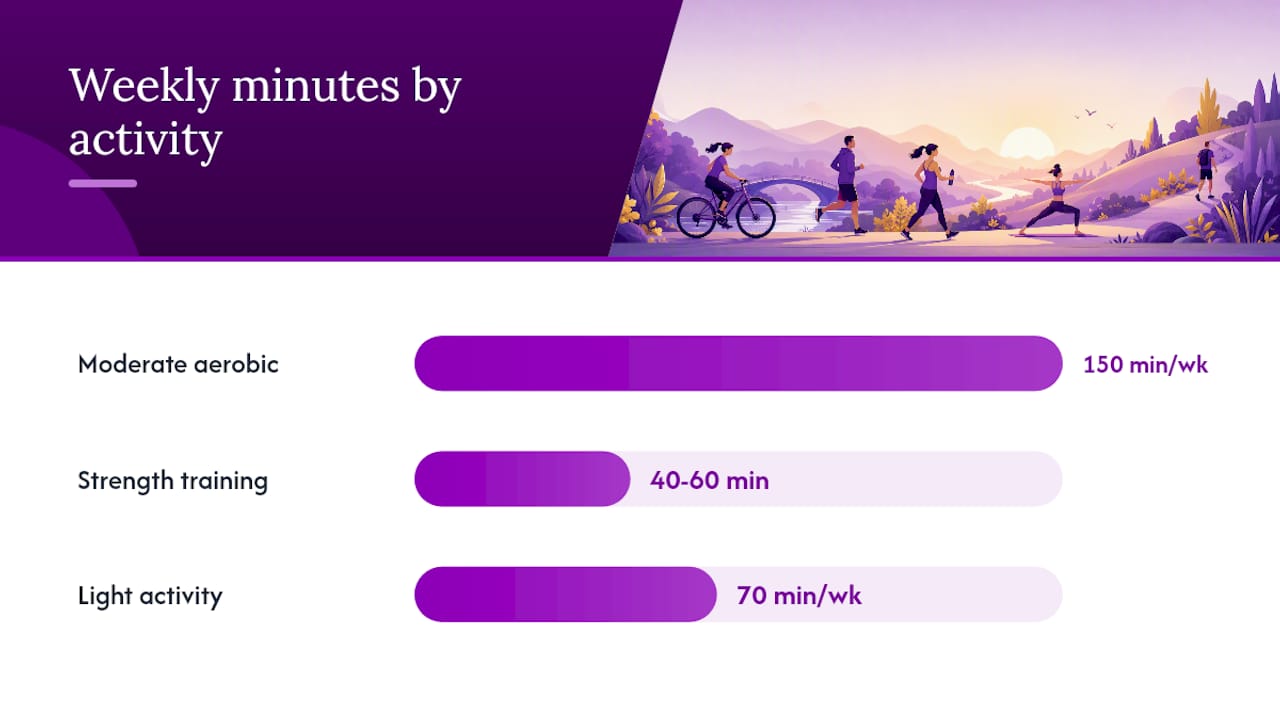
Aim for at least 150 minutes of moderate aerobic activity per week plus two strength sessions, as recommended by NHS physical activity guidelines. That sounds like a lot until you break it down: five 30-minute brisk walks plus two 20-minute bodyweight circuits. Most people can fit that into a week without rearranging their lives.
| Activity Type | Weekly Target | Beginner Session Example |
|---|---|---|
| Moderate aerobic | 150 minutes | 30-min brisk walk × 5 days |
| Strength training | 2 sessions | 20–30 min bodyweight or resistance band circuit |
| Light activity | Daily | 10-min walk after dinner |
Two equipment-light options for strength sessions:
Bodyweight circuit (no equipment needed): 3 rounds of 10 squats, 8 push-ups (knees okay), 10 reverse lunges, 20-second plank, 15 glute bridges. Rest 60 seconds between rounds. Total time: about 20 minutes. For a full progression guide, basic strength training for beginners walks through form and week-by-week progressions.

Resistance band circuit: Banded squats, banded rows, banded lateral walks, banded overhead press, banded deadlifts. Resistance bands are cheap, portable, and surprisingly effective for building the foundational strength that makes cardio easier. Check out beginner home gym equipment for compact gear recommendations.
Week-by-week progression: Start at the lower end (three walks, one strength session) in week 1. Add one session or 10 minutes of aerobic time each week until you hit the full target by week 3 or 4.
Pro Tip: Schedule workouts the same way you schedule meetings — put them in your calendar with a specific time. Research on habit formation consistently shows that “when and where” planning dramatically increases follow-through compared to vague intentions like “I’ll exercise more.”
Which habits actually keep weight loss going long-term?
Habits and support systems predict long-term outcomes more reliably than any specific diet or workout program. The American Heart Association ties tracking behaviors, realistic goal-setting, and consistent activity directly to long-term weight-loss success. The mechanics matter less than the scaffolding around them.
Build these supports into your routine:
- Daily tracking: Log food, activity, and weight trend (not just daily weigh-ins). Even rough estimates outperform no tracking at all.
- Sleep: Target 7–9 hours per night. The CDC reports that adequate sleep supports hormonal balance and appetite regulation — two things that directly affect how hungry you feel and how well you recover from workouts.
- Stress management: Chronic stress elevates cortisol, which drives appetite and fat storage. Even 10 minutes of daily deep breathing, a short walk, or a brief journaling session can blunt that effect.
- Social support: Tell one person your goal. Better yet, find a workout partner or join an online community. Accountability is one of the cheapest performance-enhancers available.
- Professional help: If you’re struggling with emotional eating, consider a therapist who specializes in behavior change. For personalized nutrition guidance, a Registered Dietitian Nutritionist (RDN) is the gold standard — find one through the Academy of Nutrition and Dietetics at eatright.org.
After a slip: Skip the guilt spiral. The most damaging mindset in weight loss is all-or-nothing thinking. The AHA’s guidance recommends returning to the plan at your very next meal — not your next Monday, not next month. One bad meal doesn’t derail a week. A week of guilt does.
How do you monitor progress and know when to adjust?
Track multiple signals rather than fixating on daily scale readings. Weight fluctuates by 1–3 pounds day to day based on water, sodium, and glycogen — none of which reflects fat loss. The CDC notes that progress is non-linear, and focusing on body composition trends over time gives a far more accurate picture than any single morning weigh-in.
Monitor these metrics weekly and monthly:
- Weekly weigh-in: Same day, same time, same conditions (morning, after bathroom, before eating). Record the number and look at the 4-week trend.
- Monthly measurements: Waist, hips, chest, and thighs. The tape measure often shows progress when the scale doesn’t.
- Training log: Track reps, weights, and duration. Getting stronger is a sign your plan is working even if the scale is stalled.
- How clothes fit: A pair of jeans is an honest, zero-cost progress tracker.
When to recalculate: As you lose weight, your total daily energy expenditure (TDEE) drops. The Mayo Clinic advises recalculating your calorie target after meaningful weight loss rather than cutting further without reassessment. A plateau after 3–4 weeks of consistent effort is a signal to recalculate, not to panic.
Red flags — see your doctor if you notice:
- Rapid, unexplained weight loss (more than 3 pounds per week without a significant deficit)
- New symptoms: fatigue, dizziness, hair loss, or heart palpitations
- Mood changes or signs of disordered eating patterns
- Any worsening of a pre-existing condition
The Nutrition reinforces that a healthy weight-loss program pairs a reduced-calorie eating plan with regular activity and behavior-change strategies — if any of those three legs are missing, the stool tips over.
A practical 2-week starter plan you can use right now
Here’s a ready-to-use template that follows the earlier recommendations. Adapt portions up or down by roughly 200 calories based on your size and activity level, and swap any ingredient for an equivalent you actually like.
Week 1 sample meals:
- Breakfast: 2 scrambled eggs + 1 slice whole-grain toast + 1 cup berries
- Lunch: Large salad with grilled chicken, chickpeas, cucumber, and olive oil/lemon dressing
- Dinner: Baked salmon + roasted broccoli + ½ cup brown rice
- Snack: Greek yogurt (plain, low-fat) + a handful of almonds
Week 2 sample meals (add variety):
- Breakfast: Overnight oats with chia seeds, banana, and a tablespoon of peanut butter
- Lunch: Turkey and avocado wrap in a whole-grain tortilla + side of baby carrots
- Dinner: Stir-fry with tofu or shrimp, mixed vegetables, and a small serving of quinoa
- Snack: Apple slices + 1 oz low-fat cheese
Vegetarian swap: Replace any meat with lentils, black beans, tempeh, or extra eggs. Quick option: Rotisserie chicken from the grocery store cuts prep time to under 5 minutes.
Weekly workout schedule:
- Monday: 30-min brisk walk
- Tuesday: 20-min bodyweight strength circuit
- Wednesday: 30-min brisk walk
- Thursday: Rest or 10-min gentle stretch
- Friday: 30-min brisk walk
- Saturday: 20–30 min resistance band circuit
- Sunday: Rest or light activity (leisurely walk, yoga)
Simple grocery list:
- Proteins: eggs, chicken breast, salmon, Greek yogurt, canned chickpeas, lentils
- Vegetables: broccoli, spinach, baby carrots, cucumber, mixed stir-fry vegetables
- Fruits: berries, banana, apple
- Grains: whole-grain bread, brown rice, quinoa, oats
- Fats: almonds, avocado, olive oil, peanut butter
- Extras: low-sodium canned beans, whole-grain tortillas, chia seeds
Adaptation notes:
- Need more calories? Add a second snack or increase grain portions.
- Eating less? Reduce grain portions first, keep protein and vegetables the same.
- Allergy swaps: replace tree nuts with sunflower seeds; replace fish with chicken or tofu.
For more effective exercises for weight loss that fit this schedule, Dietexerciseshop’s exercise guide covers progressions for each movement.
What actually helps people get started and stay consistent
Small, repeatable changes and real-world support structures are the biggest contributors to early success. Not the perfect plan. Not the most aggressive deficit. The people who stick with it longest tend to share a few behaviors: they track consistently even when the numbers aren’t great, they have at least one person who knows their goal, and they treat setbacks as data rather than failures.
Plateaus are not a sign that your body is broken or that the plan isn’t working. They’re a normal part of the process — your body is adapting, which is actually a sign of progress. When a plateau hits, the move is to reassess (recalculate calories, check sleep, review stress levels) and adjust one variable at a time, not overhaul everything at once.
The most consistent finding across public-health guidance is that consistency beats intensity every time. A moderate plan you follow for six months produces better outcomes than an aggressive plan you abandon after three weeks. Give yourself permission to be imperfect and keep going anyway.
What Dietexerciseshop offers to support your first steps
Getting the right tools in place early makes a real difference in follow-through. Dietexerciseshop stocks the gear, apparel, and digital resources that directly support the plan laid out in this guide — without the guesswork of figuring out what you actually need.

For motivation and identity reinforcement, the TRUST THE PROCESS T-Shirt and the MEAL PREP & MUSCLE REPS Hoodie are designed to keep your mindset anchored to the habits that matter — meal prep and consistency. Wearing your goals sounds small, but behavioral research on identity-based habit formation says it isn’t. For structured guidance, THE CONSISTENCY CODE eBook covers the habit-formation mechanics behind staying on track past the first two weeks. The online courses go deeper for readers who want a guided, step-by-step program rather than a self-directed plan.
Browse the full range of eBooks and digital guides to find the resource that fits where you are right now. If you have a medical condition, check with your healthcare provider before starting any new diet or exercise program.
Sources
These are the primary evidence-based sources behind the guidance in this article. Each covers a distinct piece of the picture:
- Steps for Losing Weight | Healthy Weight and Growth | CDC
- Physical activity guidelines for adults aged 19 to 64 — NHS
- 5 Steps to Lose Weight and Keep It Off | American Heart Association
- Nutrition
For a personalized plan, consult a Registered Dietitian Nutritionist (RDN) or your primary care provider — especially if you have a chronic condition or take medications.
This article is general information, not a substitute for advice from a qualified doctor. Consult a qualified healthcare professional about your own circumstances before acting on anything here.
FAQ
How do I kick-start my weight loss in the first week?
Define your motivation in writing, set one SMART action goal, make a single calorie-aware meal swap, and schedule at least three 30-minute walks. Tracking what you eat from day one is the single habit most consistently linked to early success.
What is the 3-3-3 rule for weight loss?
The “3-3-3 rule” is not a standardized clinical framework, so definitions vary across sources. A common version refers to eating three balanced meals, including three food groups per meal, and allowing no more than three hours between eating occasions to stabilize blood sugar and reduce overeating.
What is the 50/30/20 rule for weight loss?
The more important principle for beginners is hitting a consistent calorie deficit while eating mostly whole, nutrient-dense foods.
How quickly can I realistically lose 20 pounds?
At the safe rate of 1–2 pounds per week supported by the CDC, losing 20 pounds takes roughly 10–20 weeks. Faster approaches tend to sacrifice muscle and are harder to sustain, which is why most health authorities recommend the slower, steadier target.
Do I need to see a doctor before starting a weight loss plan?
The CDC recommends consulting a healthcare provider before making major diet or activity changes if you have chronic conditions, take medications, or have a history of health issues that could be affected by weight loss. For otherwise healthy adults, starting with modest changes — like the five-step checklist at the top of this guide — is generally safe.