

Beginner Macro Tracking: Your First 30 Days, Simplified
Macro tracking means logging grams of protein, carbs, and fat instead of just counting calories. Protein and carbs each supply 4 calories per gram, while fat supplies 9, and knowing those numbers is the first real step toward using NASM’s macro framework instead of guessing at portions.
Start tonight with three moves: calculate your rough calorie target, set your protein grams first, then pick an app and log one meal on a kitchen scale. Beginner macro tracking doesn’t require perfection in week one. It requires showing up.
- Define your daily calorie target using your weight, activity level, and goal.
- Set protein in grams per kilogram of body weight, not as a percentage.
- Download a tracking app tonight and log one real meal, weighed, before you sleep.
- Judge progress by your weekly average after two to four weeks, not by one day’s number.
Key Takeaways
Beginner macro tracking succeeds when protein is set first in grams per kilogram, food is weighed rather than estimated, and progress is judged by weekly averages instead of daily fluctuations.
| Point | Details |
|---|---|
| Set protein first | Use 1.2 to 2.0 g/kg depending on your goal instead of a default percentage split. |
| Weigh your food | A digital kitchen scale prevents the estimation errors that stall most beginners. |
| Build a staple library | Save 20 to 30 repeat meals so daily logging drops to a few minutes. |
| Judge weekly averages | Wait two to four weeks before adjusting calories by 100 to 150 kcal. |
| Use Dietexerciseshop resources | Courses like Fortify Your Success and eBooks like Functional Fitness support the habit-building this article recommends. |
Table of Contents
- What Is Beginner Macro Tracking and Where Do You Start?
- How Do You Calculate Your Calorie and Macro Targets?
- What’s the Fastest Way to Log Macros Every Day?
- How Do You Meal Prep to Make Tracking Easier?
- Why Isn’t Your Weight Changing Even Though You’re Tracking?
- How Should You Use Macro Data to Improve Nutrition Quality?
- How Do You Track Macros While Eating Out or at Social Events?
- What Beginners Get Wrong About Macro Tracking
- How Dietexerciseshop Helps You Stick With Macro Tracking
- Sources
- FAQ
What Is Beginner Macro Tracking and Where Do You Start?
Beginner macro tracking is a 30 minute setup, not a weekend project. You need four things before your first log entry: a calorie target, protein grams, an app, and a scale.
- Get your TDEE. Most apps calculate this automatically using the Mifflin-St Jeor formula once you enter your age, height, weight, and an activity multiplier (sedentary, lightly active, moderately active). Pick the closest one. You’ll refine it later.
- Set protein first, in grams per kilogram of body weight, not a percentage of calories. Fat gets a floor, not a ceiling. Carbs fill whatever calories are left.
- Install a tracking app, add 15 to 20 foods you eat regularly to your favorites, and grab a $10 kitchen scale if you don’t already own one.
- Pre-log tomorrow’s meals tonight, then weigh your food before you eat it and adjust the entry to match.
Pro Tip: Weigh your food raw when a recipe calls for raw weight. A cooked chicken breast loses water weight during cooking, which throws off your protein number if you weigh it after the pan instead of before.
How Do You Calculate Your Calorie and Macro Targets?
Your calorie target comes from the Mifflin-St Jeor equation, run through an activity multiplier. A sedentary desk worker might multiply their basal number by 1.2; someone training five days a week might use 1.55. Get that baseline number from any macro calculator or app, then build your macros around it using protein-first logic instead of the default 40/30/30 percentage split most apps suggest.
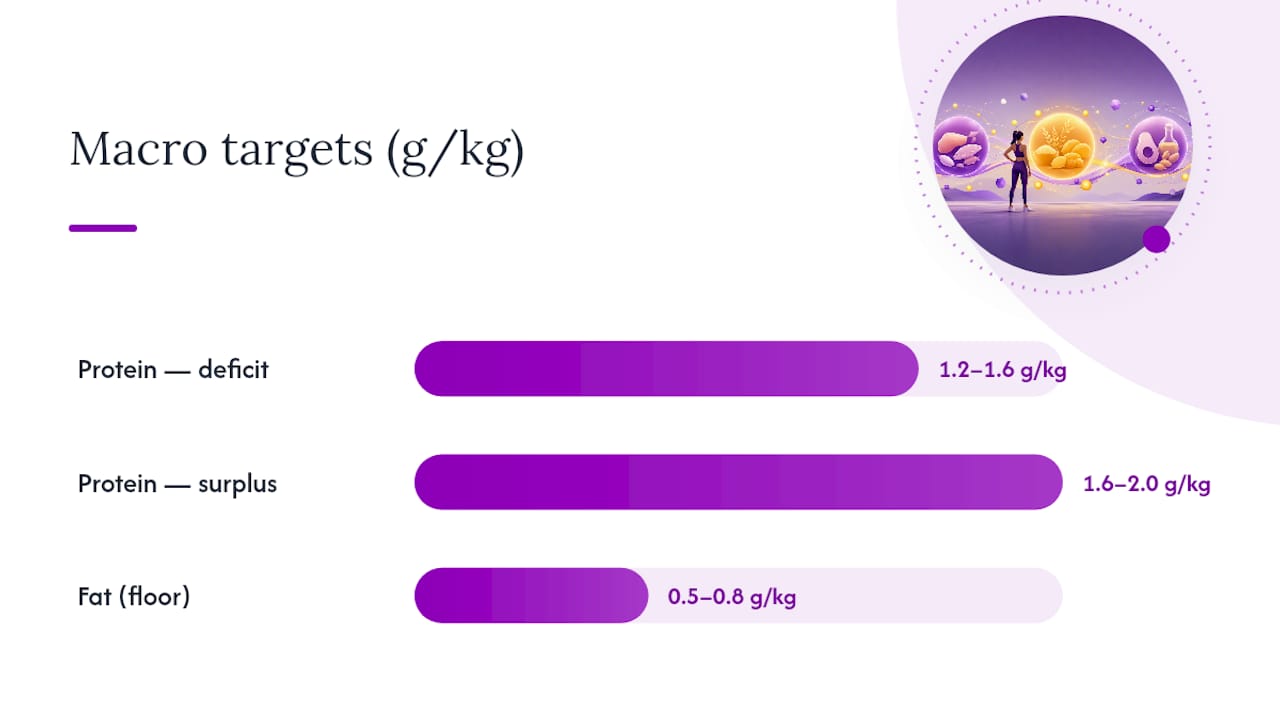
Protein comes first because it’s the macro that suffers most when people default to percentages. Research on protein intake supports a floor of about 1.2 to 1.6 grams per kilogram of body weight for anyone in a calorie deficit, and resistance-trained lifters chasing muscle gain often benefit from 1.6 to 2.0 g/kg. Set that number in grams, not as a slice of your total calories, or a deficit can quietly starve your muscle-building efforts.
Fat needs a floor too, generally 0.5 to 0.8 g/kg, and should rarely drop below roughly 20% of total calories since it supports hormone production. Carbs take whatever calories remain after protein and fat are set. That’s the protein-first method in practice: estimate maintenance, apply your deficit or surplus, lock protein and fat, let carbs fill the gap.
Here’s what that looks like for a 68 kg (150 lb) beginner:
- Fat loss scenario: approximately a moderate calorie deficit with a protein target in the higher range and fat set at a healthy floor, with carbohydrates making up the remainder.
- Muscle gain scenario: approximately a calorie surplus with protein and fat targets set to support muscle growth and overall health, with carbohydrates filling remaining calories.
Those ranges shift with your actual activity level and starting weight, but the order of operations stays the same regardless of your goal.
What’s the Fastest Way to Log Macros Every Day?
The IIFYM approach (If It Fits Your Macros) breaks tracking into calculating your baseline, adjusting for your goal, and then weighing food so your numbers actually mean something. Skip the scale and your macros are a guess dressed up as data.
A few habits separate people who track for years from people who quit in three weeks:
- Favorite 15 to 20 foods in your app on day one so search time drops to seconds.
- Use the barcode scanner for packaged food instead of typing brand names from memory.
- Weigh raw proteins and grains before cooking; weigh sauces, oils, and powders on a scale set to grams, not cups, since a “tablespoon” of peanut butter is rarely an actual tablespoon.
- Build a rotating library of 20 to 30 staple meals you eat often. Once a meal is saved, logging it takes under three minutes.
Pro Tip: Log meals as you eat them, not at the end of the day. Waiting until 9 PM to reconstruct what you ate from memory is where most tracking accuracy quietly disappears.
Your daily routine can be this simple: check your remaining macros in the morning, log meals as they happen, and do a two-minute review at night to see what needs adjusting tomorrow, usually just a protein source or a carb swap.
How Do You Meal Prep to Make Tracking Easier?
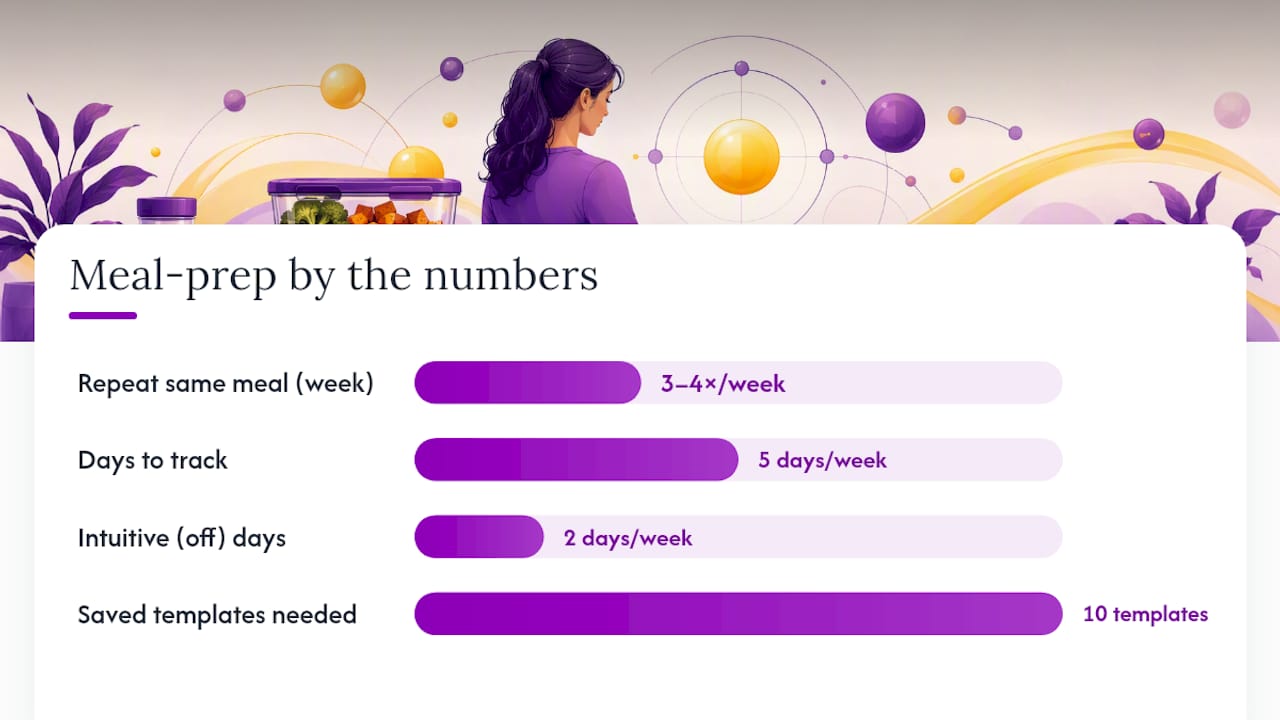
Meal prep is what turns macro tracking from a daily chore into a five-minute task. The template is basic: pick a protein base, a carb base, a vegetable, and a sauce, then log the combination once and repeat it three or four times that week.
- Cook a protein in bulk (chicken thighs, ground turkey, tofu) and portion it by weight into containers.
- Add a carb base (rice, potatoes, oats) measured before cooking, since dry weight and cooked weight are very different numbers.
- Fill in vegetables freely; they add volume without threatening your targets.
- Measure sauces and oils separately since these hide more calories than people expect.
- Log the finished meal once, save it as a template, and reuse it all week without re-entering ingredients.
Track protein first if the full macro picture feels like too much on day one. Expanding to complete tracking once that habit sticks beats quitting because you tried to do everything at once. Building in a planned off-day, tracking five days and eating intuitively for two, also keeps burnout from creeping in during month one. Our guide on high-protein meal prep walks through a full weekly system if you want more structure, and this step-by-step macro guide covers a few alternate meal templates worth trying.
Pro Tip: Save every meal you log as a reusable template in your app. Once you have ten templates, most weeks become a matter of mixing and matching instead of building new entries from scratch.
Why Isn’t Your Weight Changing Even Though You’re Tracking?
Four mistakes account for most beginner stalls. Not weighing food is the biggest one; eyeballing a cup of rice can be off by 40 to 50 calories in a single serving, and that error compounds across three meals a day. Ignoring liquid calories, coffee creamer, alcohol, and juice, is the second. Relying on your app’s default percentage split instead of setting protein in grams is the third, since percentage presets can quietly cut protein during a deficit exactly when you need it most. Sloppy food database entries, picking the wrong serving size from a crowdsourced database, round out the list.
The fix for stalled progress lives in your weekly average, not your daily scale reading. Weigh yourself most mornings, average the week, and compare it to the week before. If your average hasn’t moved in two to four weeks and the goal is fat loss, drop 100 to 150 calories, mostly from carbs. If strength or energy in the gym starts slipping, that’s a signal to add rather than cut, particularly on training days.
How Should You Use Macro Data to Improve Nutrition Quality?
Hitting your macro numbers and eating well aren’t automatically the same thing. You can hit 150 grams of protein with fried chicken and hit it just as easily with grilled chicken and Greek yogurt, and your app won’t tell you which choice serves you better long term.
Use your logged data to spot patterns, not just totals. Open your weekly history and look at where your carbs are coming from: mostly added sugar and refined grains, or mostly fruit, oats, and vegetables. Look at your fat sources the same way. Nuts, olive oil, and fatty fish read very differently on a body than the same gram count from fried food and pastries, even though the macro app treats them identically.
A practical habit: once your calorie and protein targets feel automatic, add a fiber goal (25 to 35 grams daily) and a micronutrient check, hitting at least a few servings of vegetables or fruit daily. Neither shows up in a basic macro breakdown, but both show up in how you feel and perform. Tracking macros gets you the scaffolding. What you build inside that scaffolding, whole foods versus processed convenience, determines whether the plan holds up for years or just for a few motivated weeks. Rotating in high-protein snacks that also carry real nutritional value is a simple way to raise quality without adding tracking complexity.
How Do You Track Macros While Eating Out or at Social Events?
Restaurant meals are where most beginners either panic or give up tracking entirely. Neither reaction is necessary. Most major chains publish nutrition information online, and checking it before you order takes less time than deciding what to eat once you’re at the table.
For sit-down restaurants without published numbers, estimate using the closest comparable item in your app’s database and lean slightly higher on the calorie estimate. Restaurant food consistently uses more oil and butter than home cooking, so rounding up protects you better than rounding down. Ordering proteins grilled or roasted instead of fried, asking for sauce on the side, and choosing a vegetable side over fries are small requests that keep your macros close to plan without making the meal feel like a chore.
Social events call for a different strategy. Eat a protein-forward meal before you arrive if you know the food will be unpredictable, so you’re not tracking from zero when the buffet opens. If you can’t log in real time, estimate your plate afterward rather than skipping the entry altogether; a rough log beats no log for keeping your weekly average honest. And if a birthday dinner or holiday meal blows past your target one night, that single day barely moves your weekly average. The habit only breaks if one off night turns into an excuse to stop logging for a week.
What Beginners Get Wrong About Macro Tracking
Most advice aimed at beginners overcomplicates day one. Every guide wants to explain periodization, refeed days, and nutrient timing before a person has even weighed a single chicken breast. That’s backward. The people who stick with macro tracking past month one are the ones who mastered one habit at a time: protein first, then a food scale, then a small library of repeatable meals.
The conventional wisdom oversells precision. A beginner who hits 90% of their protein target every day for a month will out-perform someone chasing exact numbers who quits after two weeks of frustration. Consistency beats precision every time it’s actually been tested against it. What gets underrated is the pre-logging habit, entering tomorrow’s meals tonight, because it removes decision fatigue at the exact moment most people abandon their plan: standing hungry in front of a fridge with no answer ready.
If there’s one thing beginners should prioritize above all else, it’s building a short list of staple meals before worrying about anything else. Everything else, adjusting calories, fine-tuning fat intake, managing social meals, gets easier once logging itself stops requiring willpower.
— Mark
How Dietexerciseshop Helps You Stick With Macro Tracking
Dietexerciseshop gives you the tools and structure that turn a good intention into a habit that survives past week three. Instead of piecing together advice from a dozen different blogs, you get a starter course, focused eBooks, and gear designed around the exact protein-first, staple-meal approach covered above.
If you want the calculation part handled for you, the Fortify Your Success with Healthy Habits mini course walks through goal-setting and consistency systems beginners actually need. The Functional Fitness eBook pairs well with a new tracking plan if your goal includes building strength alongside fat loss. And for the days your motivation needs a nudge, the Trust the Process T-shirt and Meal Prep & Muscle Reps hoodie make the identity shift visible, which matters more than people expect when a new habit is still fragile.
Start with one product that matches where you are right now, whether that’s a course to learn the calculations or apparel that keeps the goal in front of you, and build from there.
Sources
- Examine
- Keatley MNT — Macros for weight loss
- Healthline — How to track your macros without it taking over your life
FAQ
How Long Does Beginner Macro Tracking Take Each Day?
Once you’ve favorited 15 to 20 foods and built a few staple meals, daily logging typically takes two to five minutes using barcode scanning and saved templates.
Do I Need a Food Scale to Track Macros?
A food scale isn’t strictly required, but it’s the single biggest accuracy improvement available to beginners since eyeballed portions are commonly off by 40 to 50 calories per serving.
What Percentage of Calories Should Come From Protein?
Skip percentages and use grams per kilogram instead. Aim for 1.2 to 1.6 g/kg during a deficit or up to 2.0 g/kg if you’re resistance training for muscle gain.
How Often Should I Adjust My Macros?
Wait two to four weeks and judge your weekly average weight trend before adjusting calories by 100 to 150 per day.
What’s the Biggest Mistake Beginners Make With Macros?
Not weighing food and relying on an app’s default percentage split instead of setting protein in grams are the two most common errors that stall progress.
Can Dietexerciseshop Help Me Get Started With Macros?
Yes. Dietexerciseshop’s starter course and eBooks, including the Fortify Your Success with Healthy Habits mini course, walk beginners through goal-setting and consistency systems that support macro tracking.
Should I Track Macros or Just Calories as a Beginner?
Tracking macros gives you more control over body composition since protein intake specifically affects muscle retention during a deficit, something calorie counting alone can’t capture.
How Do I Track Macros When Eating at a Restaurant?
Check the restaurant’s published nutrition information before ordering when available, and round your calorie estimate upward for places without listed data since restaurant meals tend to run higher in added fat.