

The Best Dumbbell Workout Plan for Building Muscle at Home
The best dumbbell workout plan comes down to three formats: a 3-day full-body routine, a 5-day dumbbell split, or a 4-week progressive plan that layers volume and load on top of a full-body base. Each works because it forces you to hit the same compound patterns (squats, hinges, presses, rows) often enough to build real strength, with 3 to 4 sessions per week and sessions running 20 to 40 minutes hitting the sweet spot between stimulus and recovery.
- Short on time, new to lifting? The 3-day full-body plan gets you the most muscle per minute spent.
- Want more volume per muscle group? The 5-day split gives you room to specialize.
- Need structure and milestones? The 4-week progressive plan tells you exactly what to change each week.
Whichever you pick, the same rule applies: add reps or weight over time, or you’ll stall.
Key Takeaways
The most reliable dumbbell workout plan pairs a 3-day or 5-day compound-movement template with progressive overload applied weekly across reps, weight, and tempo.
| Point | Details |
|---|---|
| Pick your format by schedule | Choose the 3-day full-body plan for time efficiency or the 5-day split for more per-muscle volume. |
| Keep sessions in the 20 to 40 minute range | This window balances real training stimulus with sustainable recovery for most lifters. |
| Progress reps before weight | Add a rep or two first, then increase load once you clear the top of your rep range across all sets. |
| Balance push, pull, and lower-body volume | Compare weekly sets across opposing movement patterns and correct any imbalance over 20%. |
| Extend your training with Dietexerciseshop | The KETTLEBELL TRANSFORMATION eBook offers a structured next step once you outgrow this dumbbell block. |
Table of Contents
- What Is a Good Dumbbell Workout Routine?
- Which Dumbbell Workout Fits Your Available Time?
- Which Dumbbell Exercises Should Actually Be in Your Plan?
- How Much Weight Should You Lift and How Fast Should You Progress?
- A 4-Week Dumbbell Workout Program You Can Start Tomorrow
- Who Wrote This Dumbbell Training Guide
- Do You Need to Warm Up Before a Dumbbell Workout?
- How Do You Balance a Dumbbell Plan for Full-Body Development?
- How Do You Keep Good Form With Dumbbells to Avoid Injury?
- How Do Dumbbell Workouts Fit Different Fitness Goals?
- Where This Dumbbell Training Advice Comes From
- Why Simple Dumbbell Plans Beat Complicated Ones
- Ready to Build Your Home Gym for This Plan?
- Sources
- FAQ
What Is a Good Dumbbell Workout Routine?
A good dumbbell workout routine hits every major movement pattern across the week and gives you a clear number to beat next session. That’s the whole game. Two templates below cover the most common training goals: one for people who want maximum results from minimum days, and one for people who enjoy more granular splits.
The 3-day full-body template
This is the format Legion Athletics and most efficient strength programs default to, and for good reason: hitting each muscle group three times a week beats hitting it once, even if total weekly volume is similar. Train on Monday, Wednesday, and Friday, resting the days between.
- Goblet squat, 3 sets of 8 to 12 reps
- Dumbbell Romanian deadlift, 3 sets of 8 to 12 reps
- Dumbbell bench press or floor press, 3 sets of 8 to 12 reps
- Single-arm dumbbell row, 3 sets of 8 to 12 reps per side
- Standing dumbbell shoulder press, 3 sets of 8 to 12 reps
- Dumbbell farmer’s carry, 3 sets of 30 to 40 seconds
Six exercises, three sets each, roughly 30 minutes including rest. That’s the whole session.
The 5-day split template
If you’d rather train more often with less volume per session, split the body into pushing, pulling, legs, shoulders/arms, and a full-body or conditioning day:
- Day 1, Push: Dumbbell bench press, incline press, overhead press, triceps kickback (4 exercises, 3 to 4 sets of 8 to 15 reps)
- Day 2, Pull: Bent-over row, single-arm row, rear delt fly, biceps curl (4 exercises, 3 to 4 sets of 8 to 15 reps)
- Day 3, Legs: Goblet squat, Romanian deadlift, reverse lunge, calf raise (4 exercises, 3 to 4 sets of 8 to 15 reps)
- Day 4, Shoulders and arms: Lateral raise, front raise, hammer curl, overhead triceps extension (4 exercises, 3 sets of 10 to 15 reps)
- Day 5, Full-body or conditioning: Thrusters, renegade rows, swings, or a 20-minute circuit from the section below
Full-body training tends to build overall functional strength faster because you touch every muscle more often, while a split lets you pile more direct volume onto smaller muscle groups. Neither approach is wrong. The right call depends on your schedule and whether you enjoy variety or repetition.
Adapting either plan to limited equipment
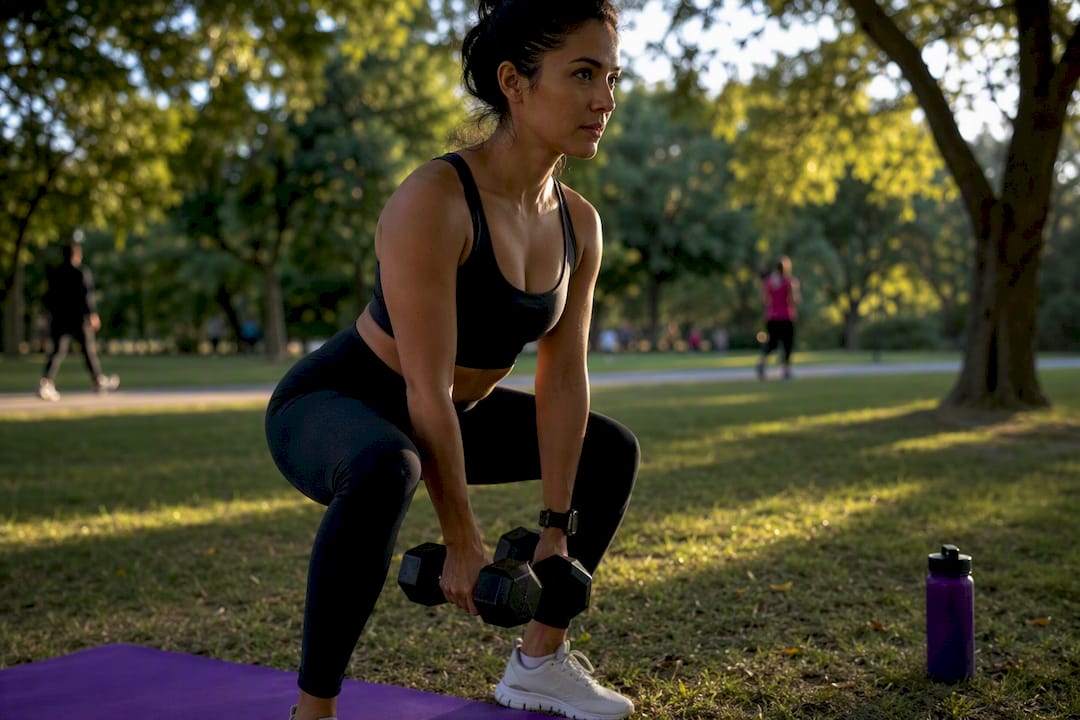
Only own one pair of dumbbells? Slow your tempo down (3 seconds down, 1 second up) on the easier lifts to make them harder, and save your heaviest effort for compound moves like squats and rows. If you have an adjustable set or multiple pairs, assign heavier weights to lower-body and pulling movements and lighter weights to shoulder and arm isolation work, since smaller muscles fatigue faster under the same load.
Which Dumbbell Workout Fits Your Available Time?
Not every day allows for a full session. These three formats scale by time, not by cutting corners on effort.
- The 20-minute AMRAP. Set a timer and run through five moves (goblet squat, push-up or floor press, bent-over row, reverse lunge, plank shoulder tap) for as many rounds as possible in 20 minutes, resting only when your form breaks down. Score your total rounds and try to beat that number next time. This structure works because a focused 20-minute session using compound combos delivers a meaningful stimulus when intensity stays high, and the round count gives you a built-in progress marker.
- The 30-minute circuit. Pair movements like lunge-plus-row and squat-plus-press into 40-second work intervals with 20 seconds of rest, cycling through six pairs three times. Healthline’s 30-minute full-body dumbbell format uses this exact hybrid-move approach and recommends running it about three times a week for most people.
- The 35-minute strength session. Drop the circuit pacing and lift heavier: 4 sets of 6 to 8 reps on three or four compound lifts (squat, deadlift, press, row), resting 90 seconds to 2 minutes between sets. Heavier loads and longer rest let you push closer to your true strength ceiling, which a 35-minute structured session built around compound movement is designed to support.
Pick based on your day, not your ambition. A rushed 35-minute session beats a skipped one, but an honest 20-minute AMRAP beats a distracted 35-minute session every time.
Which Dumbbell Exercises Should Actually Be in Your Plan?
Every template above pulls from six movement families. Master these and you can build your own workout on the fly.
- Squat family (goblet squat, split squat): Keep your chest tall and push knees out over your toes. Common fault: letting the heels rise, which shifts load to your knees instead of your hips and glutes.
- Hinge family (Romanian deadlift, single-leg deadlift): Push your hips back first, keep the dumbbells close to your shins. Common fault: rounding the lower back to chase depth.
- Press family (bench press, overhead press): Brace your core before you press, and stop the descent when your elbow reaches shoulder height. Common fault: flaring elbows too wide on the bench press, which strains the shoulder joint.
- Row and pull family (bent-over row, single-arm row): Pull with your elbow, not your hand, and squeeze your shoulder blade at the top. Common fault: using momentum instead of the back muscles to move the weight.
- Unilateral movement (single-arm press, reverse lunge): These expose side-to-side strength gaps that bilateral lifts hide. Slow the tempo down if you feel wobbly.
- Core (renegade row, farmer’s carry): Keep your ribs stacked over your hips rather than letting your back sag. Common fault: holding your breath instead of bracing.
To make any of these easier, drop the weight or slow the tempo. To make them harder, switch to a single-arm or single-leg version, or add a 3-second lowering phase.
Pro Tip: If a lift feels off no matter how much you adjust the weight, film yourself from the side for one set. Most form breakdowns are invisible in the moment but obvious on video.
How Much Weight Should You Lift and How Fast Should You Progress?
For muscle growth, most sets should land in the 8 to 15 rep range, stopping one or two reps before you’d fail. That’s a wide enough window that you don’t need to obsess over hitting an exact number. In fact, training close to fatigue matters more for muscle growth than the exact rep range you land in, whether that’s 8 reps with a heavier dumbbell or 18 reps with a lighter one.
Progress in this order: add a rep or two first, and once you can comfortably clear the top of your rep range across all sets, add weight and drop back down toward 8 reps. Upper-body lifts usually only need small jumps of 2 to 5 pounds, while lower-body lifts can often handle 5 to 10 pound jumps without wrecking your form, since your legs recruit more total muscle mass per lift.
Most effective programs settle on 3 to 4 sessions per week, with each session running 20 to 40 minutes. That’s the range where muscle-building stimulus and recovery stay in balance for the average lifter.
- Train each muscle group at least twice weekly, ideally three times if you’re using the full-body format.
- Take at least one full rest day between sessions targeting the same muscles.
- Watch for deload signs: stalled lifts for two straight weeks, joint aches that linger, or feeling flat before every set. When you spot two or more, cut your volume in half for a week.
A 4-Week Dumbbell Workout Program You Can Start Tomorrow
A structured four-week block gives your training a clear arc instead of repeating the same session on autopilot. This progression mirrors the foundation-to-tempo structure used in well-designed recomposition plans, adapted to either the 3-day or 5-day template above.
- Week 1, foundation. Use lighter weights than you think you need and focus entirely on form. Run your chosen template at 3 sets per exercise, stopping well short of failure. This week is about competency, not intensity, and beginners typically progress faster by adding a training day before adding weight.
- Week 2, volume. Keep the weights the same but add a fourth set to each main lift, or extend circuit rounds by one. Your muscles are now working harder without any added load risk.
- Week 3, load. Hold your rep target steady and increase weight on every exercise where you hit the top of your rep range in week 2. Expect the last two reps of each set to feel genuinely hard.
- Week 4, tempo and test. Slow every rep down to a 3-second lowering phase to increase time under tension, then finish the week by retesting one lift for max reps at your week-1 starting weight. Compare that number to where you started. Track it in a notebook or a downloadable calendar so the improvement is visible in black and white.
Who Wrote This Dumbbell Training Guide
This guide comes from Mark at Dietexerciseshop, who covers practical, no-fluff training content including the dumbbell chest workout breakdown and the best dumbbells for home gym buying guide.
For readers who want more depth on setup and form:
- Check the home gym equipment essentials guide before buying anything beyond a basic dumbbell set.
- Small apartment or shared space? The small-space equipment guide covers storage-friendly options.
- If you finish this plan and want a new challenge, the KETTLEBELL TRANSFORMATION eBook offers a structured follow-up program built around a different tool that trains the same movement patterns from new angles.
Do You Need to Warm Up Before a Dumbbell Workout?
Yes, and it doesn’t need to take long. A 5 to 10 minute dynamic warm-up before you pick up a dumbbell lowers injury risk and sharpens the quality of your first working sets, according to sports medicine guidance on pre-lifting preparation.
Run through bodyweight squats, walking lunges, arm circles, and a light set of whatever your first exercise is, using just the dumbbell’s weight without any added resistance. That last part matters more than people realize: rehearsing the actual movement pattern at low intensity primes your nervous system for the heavier sets to come far better than generic stretching does.
Recovery matters just as much as the warm-up. Muscle actually grows during the rest between sessions, not during the workout itself, which is why cramming five hard dumbbell sessions into five consecutive days usually backfires. Give each muscle group at least 48 hours before training it again with real intensity. Sleep is the recovery tool most people shortchange. Poor sleep blunts strength gains and makes the next session feel harder than it should, regardless of how well you programmed your sets and reps.
A short cool-down of walking or light stretching after your last set won’t accelerate muscle repair dramatically, but it helps bring your heart rate down gradually and makes the transition back into your day less jarring, especially after a high-intensity circuit or AMRAP.
How Do You Balance a Dumbbell Plan for Full-Body Development?
Balance comes down to ratios, not just variety. A plan that includes ten pressing exercises and two rowing exercises will build a strong chest and weak, rounded shoulders over time, no matter how hard you train. Aim for roughly equal weekly volume between pushing and pulling movements, and between quad-dominant and hip-dominant lower-body work.
The 3-day full-body template naturally enforces this balance because every session touches every pattern. The 5-day split requires more attention, since it’s easy to let Push day sessions creep longer than Pull day sessions simply because pressing movements often feel more satisfying.
Check your week against this simple test: count your total working sets for chest and shoulders, then count your sets for back and rear shoulders. Do the same comparison for quad-focused moves like lunges and squats against hip-focused moves like Romanian deadlifts and hip thrusts.
Core and grip work often get skipped entirely because they’re not the “main” lift of a session. Building them into your warm-up or as a finisher, farmer’s carries after your last set, a plank hold between rounds, keeps them from becoming the weak link in an otherwise well-balanced plan.
How Do You Keep Good Form With Dumbbells to Avoid Injury?
Dumbbells demand more stabilization than a barbell or machine because each arm works independently, which is exactly why form breaks down faster as fatigue sets in. Watch for these signals rather than just chasing the weight on the dumbbell.
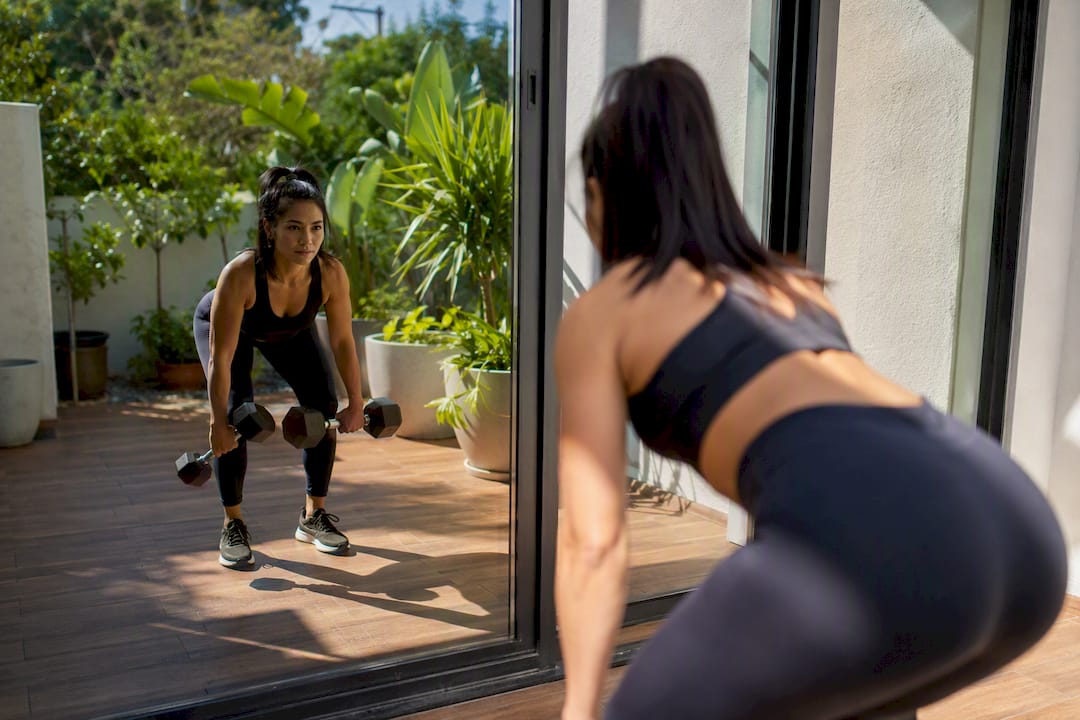
Your first checkpoint is symmetry. If one arm consistently finishes a set before the other, or one side of a row pulls higher than the other, the weight is too heavy for that particular lift, even if it feels manageable on your stronger side. Drop the load until both sides move identically.
Your second checkpoint is your spine position. Rounding your lower back on a Romanian deadlift or arching it hard on an overhead press are the two most common faults that turn a muscle-building exercise into a back-strain risk. Brace your core like you’re about to take a light punch to the stomach before every rep, and keep that brace throughout the set.
Your third checkpoint is rep quality at the end of a set. The last two reps should look almost identical to the first two. If your range of motion shrinks or your torso starts swaying to help move the weight, that’s your body telling you the set is over, regardless of what number you had planned to hit.
How Do Dumbbell Workouts Fit Different Fitness Goals?
The same dumbbell toolkit serves strength, hypertrophy, and endurance goals. What changes is how you load the variables, not which exercises you choose.
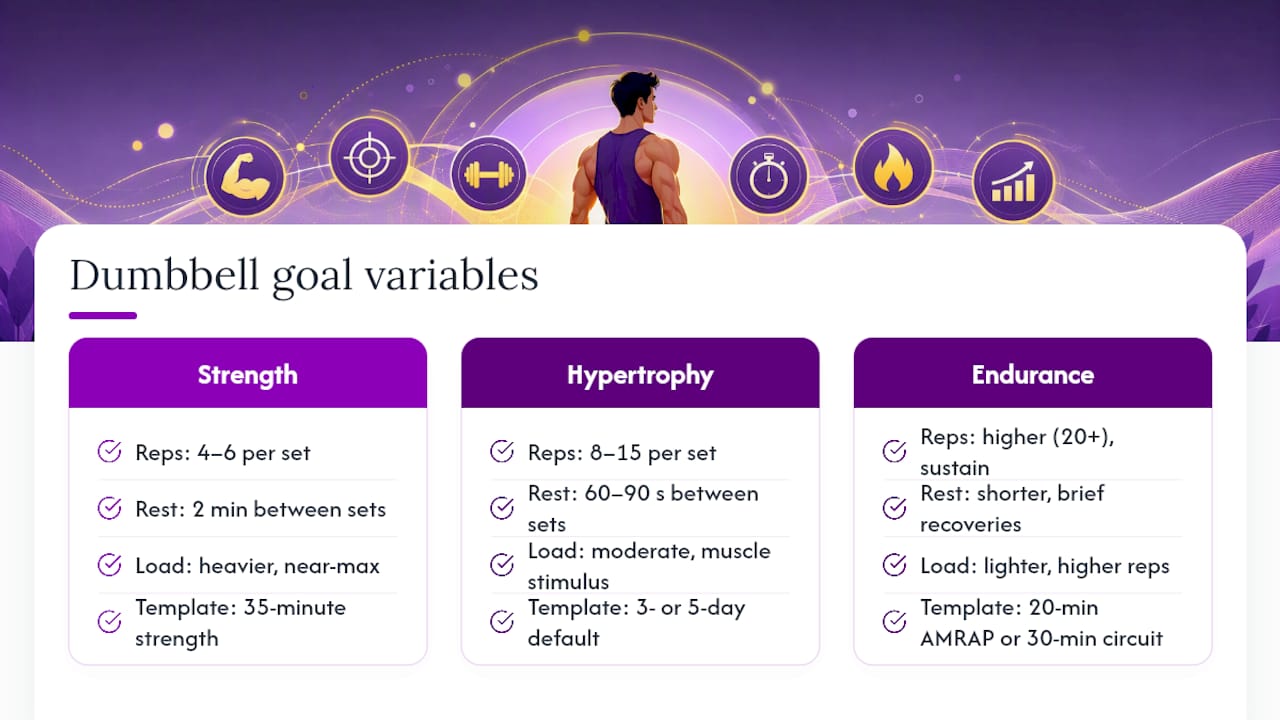
For strength, lean toward the 35-minute strength template: heavier weights, 4 to 6 reps per set, and full 2-minute rest periods so you can lift close to your max each set without residual fatigue dragging your numbers down.
For hypertrophy, or building visible muscle, the 8 to 15 rep range with 60 to 90 seconds of rest hits the sweet spot most programs are built around, and it’s the range both the 3-day and 5-day templates default to.
For endurance, shift toward the 20-minute AMRAP or 30-minute circuit format, using lighter dumbbells, higher rep counts, and shorter rest. The goal shifts from moving maximum weight to sustaining output over a longer stretch of time, which trains a different energy system entirely.
Many readers want a blend of all three, and that’s reasonable. A common approach is running the 5-day split with two strength-focused days, two hypertrophy-focused days, and one endurance-style circuit, adjusting the mix every few weeks based on which quality feels like it’s lagging.
Where This Dumbbell Training Advice Comes From
This plan draws on programming standards from Lift Vault’s compound dumbbell index, Legion Athletics’ full-body routine, and Women’s Health’s 4-week progression guide, among others cited above.
- Check exercise demo videos before attempting an unfamiliar movement for the first time.
- Downloadable calendars or trackers make the 4-week progression far easier to follow accurately.
Why Simple Dumbbell Plans Beat Complicated Ones
The fitness industry loves to make dumbbell training sound more complicated than it is. Supersets, drop sets, tempo manipulation, cluster sets, all of it has a place eventually, but none of it matters if you’re not adding load or reps over time. That’s the gap I see constantly: people chase workout variety when what they actually need is workout consistency.
Here’s what the conventional advice gets wrong. Most articles treat the 3-day and 5-day formats as competing philosophies, as if picking wrong will sabotage your results. It won’t. Both work when you apply progressive overload, and both fail when you don’t. The format is a scheduling decision, not a results decision.
What actually separates people who build visible muscle from people who spin their wheels for a year is boringly simple: they write down their weights, and they add to them. If you take one thing from this guide, make it that habit before you make it a new exercise variation.
Ready to Build Your Home Gym for This Plan?
Every template in this guide assumes you’ve got a decent pair of dumbbells and maybe a mat, not a garage full of machines. That’s the point. Dietexerciseshop stocks the actual equipment these plans call for, alongside the apparel and recovery gear that make consistency easier to stick with, so you’re not piecing together your setup from three different retailers.
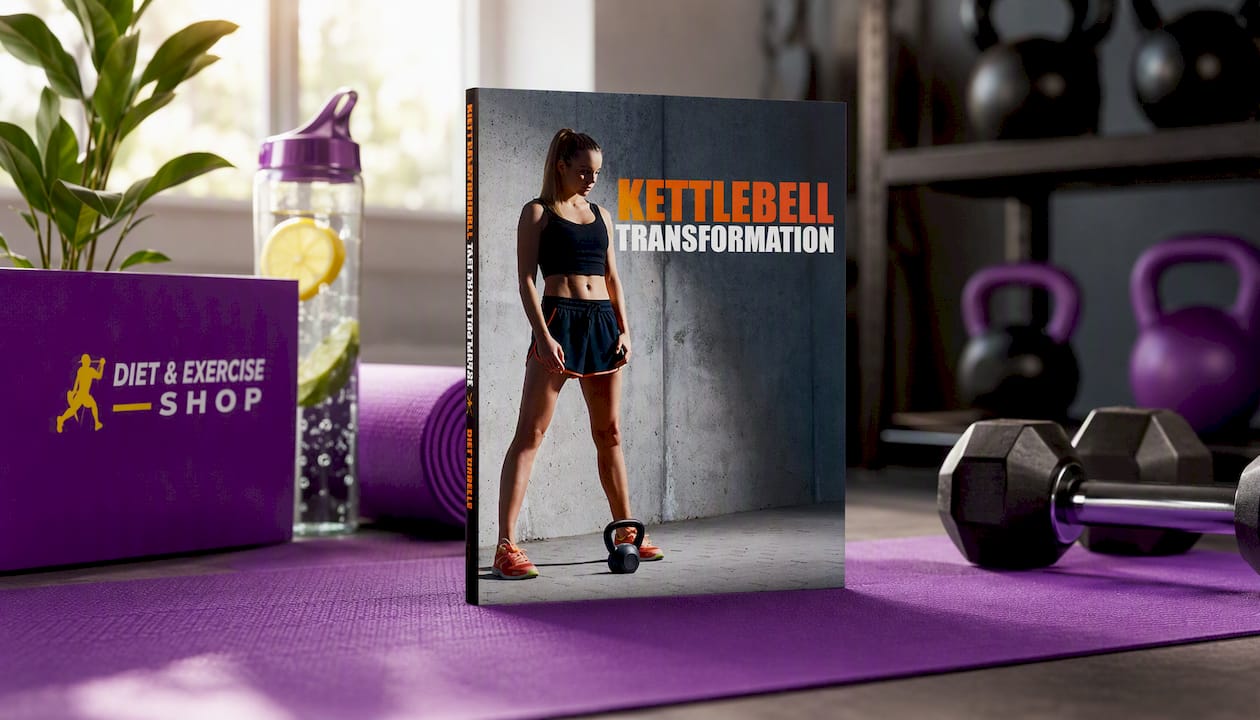
If you’ve finished a few weeks of the 4-week plan above and want to keep the momentum going with a new stimulus, the KETTLEBELL TRANSFORMATION eBook gives you a structured program built around a tool that trains the same squat, hinge, and press patterns from angles a straight dumbbell can’t quite match. Browse the dumbbell selection to find the right weight range for your current program, then grab the eBook when you’re ready for round two.
Sources
- Compound dumbbell exercise index (Lift Vault)
- Full-Body Dumbbell Workout: 30-Minute Routine (Healthline)
- 4-Week full-body dumbbell body recomposition workout plan (Women’s Health)
- The best 3-day full-body dumbbell workout routine (Legion Athletics)
FAQ
Can you build muscle with just dumbbells?
Yes. Muscle growth depends on progressive overload and mechanical tension, not the specific tool, and dumbbells deliver both when you consistently increase reps or weight over time.
What is a good dumbbell workout routine?
A good routine covers squat, hinge, press, and row patterns across 3 to 5 sessions per week, with sessions lasting 20 to 40 minutes and most sets in the 8 to 15 rep range.
Is a 20-minute dumbbell workout enough?
Yes, if intensity stays high. A focused 20-minute AMRAP or circuit using compound combos delivers a real training stimulus, especially when run consistently three times a week.
How many days a week should I do a dumbbell workout plan?
Most effective plans run 3 to 4 sessions per week, which gives each muscle group enough frequency to grow while leaving room for recovery between sessions.
How do I know when to increase my dumbbell weight?
Increase weight once you comfortably complete the top of your rep range across all sets, typically adding 2 to 5 pounds for upper-body lifts and 5 to 10 pounds for lower-body lifts.