

3–6 g Post Workout: When Glutamine Helps Athletes Recover
Glutamine can measurably lower muscle damage markers and soreness after hard training, but the effect isn’t universal. It works best as a targeted post-workout tool for eccentric or exhaustive exercise, not a daily supplement everyone needs. A short trial of 3 to 6 grams after tough sessions, tracked against how you feel and perform, is the most defensible way to find out if it works for you.
TL;DR:
- Glutamine shows the strongest benefits after eccentric or exhaustive workouts, with doses around 3 to 6 grams taken post-exercise.
- Its effectiveness depends on exercise type, timing, and training status, with post-training dosing being more reliable than pre-loading.
- Benefits include reducing muscle damage markers and soreness, but it does not consistently improve performance or muscle growth.
- A short trial over two to four weeks can help determine if glutamine works for an individual, especially during intense training periods.
- Supplement choice should consider stability and cost, with free L-glutamine suitable for most, while dipeptide forms may aid hydration and gut support in heat or long endurance sessions.
Table of Contents
- What the Clinical Evidence Says About Glutamine for Recovery
- How Does Glutamine Aid Recovery at the Cellular Level?
- When Should You Take Glutamine for Muscle Recovery?
- Free L-Glutamine vs. Dipeptide Forms: Which Should You Buy?
- Is Glutamine Safe? Side Effects and Who Should Be Cautious
- What’s a Practical Glutamine Protocol for Athletes?
- Where the Evidence Falls Short, and Why That’s Fine
- Build a Complete Recovery Plan, Not Just a Supplement Stack
- Primary Sources and Further Reading
- Sources
- FAQ
What the Clinical Evidence Says About Glutamine for Recovery
The strongest human data on glutamine for recovery comes from a crossover study of professional basketball players, where athletes took a fixed daily dose of glutamine for a fixed period. Blood markers of muscle damage, creatine kinase, aspartate transaminase, and myoglobin, dropped compared to placebo. Basketball is brutal on connective tissue and muscle fibers because of constant jumping, cutting, and landing, all of which load muscles eccentrically. That’s exactly the kind of stress where glutamine seems to earn its place.
An older but often-cited trial found something similar in a different context. Research from 2011 showed glutamine supplementation attenuated strength loss and reduced soreness following eccentric exercise, the kind that comes from downhill running, heavy negatives, or unfamiliar lifting volume. Eccentric contractions cause more microtrauma than concentric ones, which may explain why glutamine’s benefits show up more reliably in this category of training than in general endurance or steady-state work.

Animal research adds a useful wrinkle. A 2023 study on exhaustive exercise found that giving L-glutamine as a post-exercise treatment reduced markers of muscle damage more effectively than giving it beforehand as a preventive measure. That timing detail matters more than most supplement marketing suggests, and it’s the reason this guide leans so heavily on post-workout dosing rather than pre-loading.
Not every source is this optimistic. Cleveland Clinic’s overview of glutamine notes that while some studies show soreness and immune-support benefits, the evidence doesn’t consistently show gains in performance or muscle mass. That’s an important distinction: glutamine may help you recover from damage, but it isn’t shown to make you stronger, faster, or bigger on its own.
Why do results vary so much between studies? A narrative review of glutamine’s biochemical mechanisms and timing strategies points to several moderating factors:
- Training status: well-trained athletes and untrained participants don’t respond the same way.
- Exercise type: eccentric-heavy and exhaustive protocols show clearer effects than steady, moderate training.
- Dosing and timing: post-exercise dosing appears more effective than pre-exercise loading in several models.
- Sex representation in trials: most study populations skew male, leaving open questions about how well findings generalize.
By the numbers: In the basketball crossover trial, 20 days of 6 grams daily produced measurably lower CK, AST, and myoglobin levels than placebo, a meaningful signal in a sport defined by repetitive eccentric loading.
Put together, the honest evidence grade is this: glutamine is supportive for specific recovery outcomes tied to muscle damage and soreness, particularly after eccentric or exhaustive sessions. It is not a proven universal performance enhancer, and anyone expecting strength or hypertrophy gains from the supplement alone will likely be disappointed.
How Does Glutamine Aid Recovery at the Cellular Level?
Glutamine’s role in recovery comes down to a handful of biological jobs it performs once intense exercise depletes the body’s stores. It’s the most abundant free amino acid in the body, but heavy training can burn through it faster than normal metabolism replaces it.
- Glutathione synthesis: Glutamine is a precursor for glutathione, the body’s primary antioxidant. More glutathione means better defense against the oxidative stress that heavy training generates, which is part of why damage markers like CK can drop with supplementation.
- Anaplerosis and mTOR signaling: Post-exercise glutamine can help replenish TCA cycle intermediates (a process called anaplerosis) and support mTOR-mediated protein synthesis during the early repair window, according to the same narrative review. This gives a mechanistic reason why dosing right after training, rather than before, lines up with better outcomes in several trials.
- Immune cell fuel: Rapidly dividing immune cells rely heavily on glutamine as an energy source. Depleted glutamine after prolonged or exhaustive training has long been linked to temporary immune suppression, which is one reason endurance athletes sometimes get sick after big events.
- Intestinal barrier support: Enterocytes, the cells lining your gut, use glutamine as a primary fuel. Endurance training and heat stress both compromise gut barrier integrity, and adequate glutamine may help limit the systemic inflammation that leaks in when that barrier weakens.
Pro Tip: If you train in heat or do long endurance sessions where gut integrity is a real concern, glutamine’s role in supporting the intestinal lining is arguably more relevant to you than its muscle-damage effects.
None of these mechanisms guarantee a noticeable result every time, but together they explain why glutamine shows up consistently in recovery research even when clinical outcomes vary.
When Should You Take Glutamine for Muscle Recovery?
Timing is where the research gets genuinely useful. The trials showing the clearest benefit used dosing in the range of 3.6 grams up to 6 grams per day, and some protocols scale by body weight around 0.3 grams per kilogram daily. The basketball trial ran a daily dose for a fixed period, while the animal research on exhaustive exercise found post-exercise dosing outperformed pre-exercise dosing for reducing CK-MM, a specific muscle damage marker.
That timing difference has a plausible explanation. Glutamine has a relatively short half-life in circulation, and taking it after training, when your body is actively repairing tissue and replenishing energy pathways, appears to line up better with the anaplerosis and repair processes described above than taking it as a “preventive” dose beforehand.
Here’s how to translate that into a practical range:
- Starter dose: 3 to 5 grams post-workout, mixed into a shake or taken with your recovery meal.
- Moderate dose: 5 to 10 grams daily, split into two servings if you’re targeting sustained training blocks.
- Athlete-intensive dose: Up to 6 grams daily, matching the dosing used in the basketball crossover trial, reserved for short, defined windows around heavy competition or eccentric-heavy training.
Body size matters too. A 200-pound athlete and a 130-pound athlete shouldn’t necessarily take the same flat dose. Scaling to roughly 0.3 grams per kilogram of body weight gives a more individualized target than picking a number off a label.
If you notice stomach discomfort, it’s often tied to taking a large dose right before exercise on an empty stomach. Research on timing strategies suggests that shifting the dose to post-exercise, or splitting it into two smaller servings, usually resolves the issue while preserving the benefit. Pairing glutamine with carbohydrates and protein in a normal post-workout meal also tends to improve tolerance since it isn’t hitting your gut in isolation.
Free L-Glutamine vs. Dipeptide Forms: Which Should You Buy?
Most glutamine supplements sold as powder are free L-glutamine, the amino acid on its own, unbonded to anything else. It’s cheap, widely available, and works fine for most post-workout use cases described above.
The alternative is L-alanyl-L-glutamine, a dipeptide form where glutamine is bonded to alanine. This bonding changes its behavior in a few practical ways:
- Stability: Dipeptides are more heat and pH stable than free glutamine, which matters if you’re mixing supplements into hot liquids or storing them in a hot car or gym bag.
- Bioavailability: Preclinical research shows dipeptide forms can raise plasma and muscle glutamine levels effectively, sometimes outperforming free-form glutamine for raising circulating levels.
- Fluid and electrolyte absorption: Dipeptides appear to help fluid and electrolyte uptake in stress conditions, which is relevant for endurance athletes training in heat or dealing with dehydration.
- Price and access: Free L-glutamine is cheaper and easier to find; dipeptide forms cost more and show up less often on store shelves.
If you’re training in hot conditions or doing long endurance work where gut absorption and hydration matter, a dipeptide form may be worth the extra cost. For general strength training recovery, free L-glutamine covers the bases without the premium price tag. Readers comparing specific commercial formulations can look at outside reviews like this breakdown of a Kyowa-sourced glutamine product to see how ingredient sourcing gets evaluated in practice.
Is Glutamine Safe? Side Effects and Who Should Be Cautious
Glutamine has a relatively clean safety profile at the doses used in the trials referenced here, but it isn’t risk-free for everyone.
- Mild GI discomfort is the most commonly reported issue, especially with large doses taken before exercise on an empty stomach.
- Splitting doses or moving your intake to after training generally reduces stomach upset without giving up the benefit, based on timing research from recent reviews.
- People with kidney or liver conditions, or anyone on medications that affect amino acid metabolism, should talk to a clinician before adding glutamine, since amino acid supplementation can interact with how those organs process nitrogen.
- Pregnant or breastfeeding individuals should check with a doctor first, since most trial data comes from healthy adult athletes and doesn’t cover these populations.
- Stick to trial-informed upper limits. Most positive human research tops out around 6 grams daily; there’s little reason to exceed that without a specific, supervised reason, and Cleveland Clinic’s guidance reflects that same caution about routine, unsupervised high-dose use.
A short, monitored trial, say two to four weeks around a demanding training block, beats committing to indefinite daily supplementation without ever checking whether it’s doing anything for you.
What’s a Practical Glutamine Protocol for Athletes?
The right protocol depends on what kind of training you’re doing and what problem you’re actually trying to solve.
- General strength or hypertrophy training: Take 3 to 5 grams within 30 to 60 minutes after a demanding session, mixed with protein and carbohydrates. This matches the post-exercise timing that performed better than pre-loading in animal research on exhaustive exercise.
- Eccentric-heavy team sports (basketball, soccer, field sports with lots of cutting and jumping): Try 6 grams daily for a defined window, two to four weeks, during a congested competition schedule, mirroring the basketball crossover trial’s protocol.
- Endurance or heat-stress training: Consider a dipeptide form mixed with a fluid and electrolyte solution immediately post-session, given the gut-support and hydration advantages discussed earlier.
How do you know if it’s working? Track soreness on a simple 1 to 10 scale for the 48 hours after hard sessions, note training performance and sleep quality, and if you have access to lab testing, occasional CK checks can offer an objective data point. Combine glutamine protocols with proven basics: adequate protein, sleep, and smart post-workout food choices rather than expecting the supplement to do the job alone.
Pro Tip: Run a two-week baseline without glutamine, then a two-week trial with it, using the same training load. That side-by-side comparison tells you more about your personal response than any study ever will.
Where the Evidence Falls Short, and Why That’s Fine
Most recovery supplements get marketed as if the science is settled. Glutamine’s research doesn’t support that kind of certainty, and that’s actually a useful thing to know before you spend money on it.
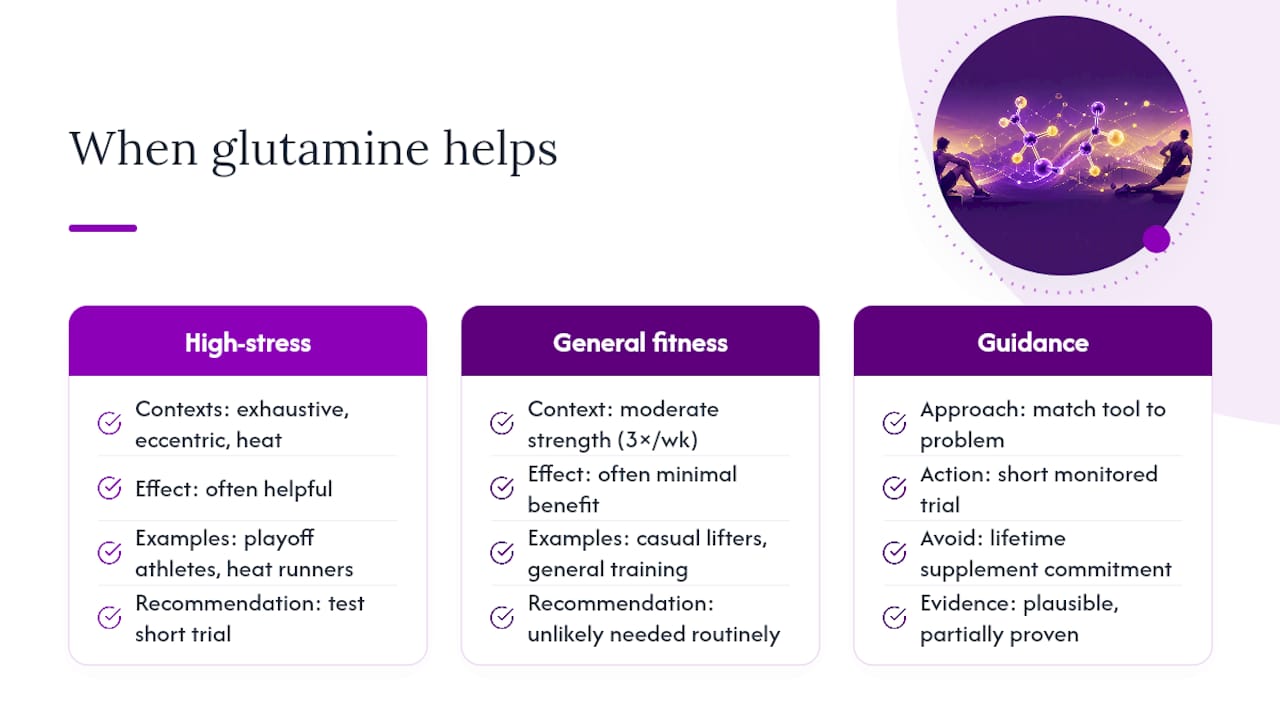
The pattern across these trials is consistent: glutamine tends to help most when the training itself is punishing, eccentric-heavy, exhaustive, or run in heat, and it tends to underdeliver as a blanket daily supplement for general fitness. That’s a meaningful distinction most product labels skip entirely. A lifter doing moderate strength work three times a week probably won’t notice much. A basketball player grinding through a congested playoff schedule, or a distance runner training through a heat wave, has a much better shot at feeling a difference.
Our approach has always leaned toward matching the tool to the problem rather than selling a one-size-fits-all fix. That’s why the recommendation here is a short, monitored trial rather than a lifetime commitment to a supplement stack. Evidence-based doesn’t mean evidence-perfect, and glutamine sits in that honest middle ground: plausible, partially proven, and worth testing deliberately rather than blindly.
— Mark
Build a Complete Recovery Plan, Not Just a Supplement Stack
Glutamine can support recovery, but it works best paired with real programming, not taken in isolation. Our eBook library provides the structured side of that equation: the training and nutrition framework that determines whether any supplement has a chance to matter.

The Muscle Gain Secrets eBook breaks down programming and nutrition specifically for building lean mass, so your recovery tools have an actual training stimulus to support. The Power Mass Blueprint eBook walks through a structured approach to gaining size, useful if you’re stacking supplementation with a defined mass-building phase. And the Bodybuilding Guide eBook covers training and recovery strategy in more depth for readers competing or training at a higher intensity.
None of these replace good sleep, food, or programming, but they give you the framework glutamine alone can’t provide. Pick the eBook that matches your current goal and start building the plan around it today.
Primary Sources and Further Reading
The clinical and mechanistic claims in this article draw on the following sources:
- Effect of Glutamine Supplementation on Muscular Damage Biomarkers in Professional Basketball Players, the 2021 crossover trial referenced throughout.
- L-Glutamine is better for treatment than prevention in exhaustive exercise, the 2023 animal study on timing.
- Glutamine Supplementation and Exercise: A Narrative Review of Biochemical Mechanisms and Timing Strategies, covering mechanisms and clinical heterogeneity.
- Glutamine - Cleveland Clinic, a general safety and evidence overview.
- Role of glutamine, as free or dipeptide form, on muscle recovery from resistance training, covering dipeptide bioavailability.
Sources
- Effect of Glutamine Supplementation on Muscular Damage Biomarkers in Professional Basketball Players
- L-Glutamine is better for treatment than prevention in exhaustive exercise
- Glutamine Supplementation and Exercise: A Narrative Review of Biochemical Mechanisms and Timing Strategies
FAQ
Does Glutamine Actually Help Recovery?
For eccentric-heavy or exhaustive exercise, targeted glutamine use has reduced muscle damage markers and soreness in trials like the basketball crossover study, but it hasn’t consistently improved performance or muscle mass for general training.
Is There Any Downside to Taking L-Glutamine?
The main downside is mild gastrointestinal discomfort, especially at high pre-exercise doses, which usually improves when the dose is split or shifted to after training. People with kidney or liver conditions should consult a clinician before use.
How Long Does L-Glutamine Take to Heal the Gut?
There’s no established timeline from human trials for gut healing specifically, but glutamine’s role as the primary fuel for intestinal cells makes it biologically relevant to gut barrier support during heavy endurance or heat-stress training.
How Much Glutamine Should I Take for Muscle Recovery?
Most positive trials used doses between 3.6 and 6 grams daily, with 6 grams post-workout matching the protocol used in the basketball study. A practical starting range is 3 to 5 grams after demanding sessions.