

Aim 1.2–1.6 g/kg Per Day: Weight Based Protein Targets and Meal Plans
Most healthy adults should aim for 1.2 to 1.6 grams of protein per kilogram of body weight daily, well above the 0.8 g/kg RDA, which only marks the minimum needed to avoid deficiency. For a 150 pound person, that works out to roughly 80 to 110 grams a day according to recent guidance. Push toward the top of that range if you’re strength training or trying to build muscle, and toward the bottom if you’re sedentary or focused on maintenance. Age, pregnancy, and lactation can shift that number higher.
TL;DR:
- Most active adults should aim for 1.2 to 1.6 grams of protein per kilogram of body weight daily, with higher amounts recommended for older adults and pregnant women.
- Consuming about 20 to 40 grams of protein per meal effectively stimulates muscle growth and preservation, especially for resistance trainees and older individuals.
- Whole foods like eggs, chicken, fish, beans, and dairy should be prioritized, with supplements used mainly to fill gaps or for convenience.
- Intakes up to 2.0 grams per kilogram are safe for most healthy adults, and exceeding this range rarely provides additional benefits for muscle gain.
- Building consistent habits, such as including a protein source at every meal, is more effective than obsessing over exact daily totals.
Table of Contents
- How to Calculate Your Daily Protein Target
- What’s the Right Protein Range for Your Goals?
- How Much Protein Do Older Adults and Pregnant Women Need?
- Does Protein Timing Actually Matter for Muscle Growth?
- Whole Foods or Protein Powder: Which Should You Rely On?
- Is Eating Too Much Protein Actually Dangerous?
- Sample Meal Plans for 80g, 110g, and 150g Protein Days
- What I’ve Learned About Making Protein Targets Actually Stick
- Turn Your Protein Target Into a Real Training Program
- Sources
- FAQ
How to Calculate Your Daily Protein Target
You don’t need a nutritionist or a spreadsheet for this. You need your body weight and about thirty seconds.
Step 1: Convert pounds to kilograms. Divide your weight in pounds by 2.205. A 180 pound person weighs about 81.6 kg.
Step 2: Multiply by the range. Take that kilogram figure and multiply by 1.2 for your low end, and by 1.6 for your high end. For our 180 pound example: 81.6 × 1.2 = 98 grams, and 81.6 × 1.6 = 130 grams.
Step 3: Pick your spot in the range based on activity level and goal, which the next section breaks down in detail.
If you’d rather skip the conversion step entirely, there’s a shortcut that works surprisingly well for quick mental math: roughly 0.55 to 0.73 grams of protein per pound of body weight lands you in the same zone as the g/kg formula, since the two units track closely once you round.
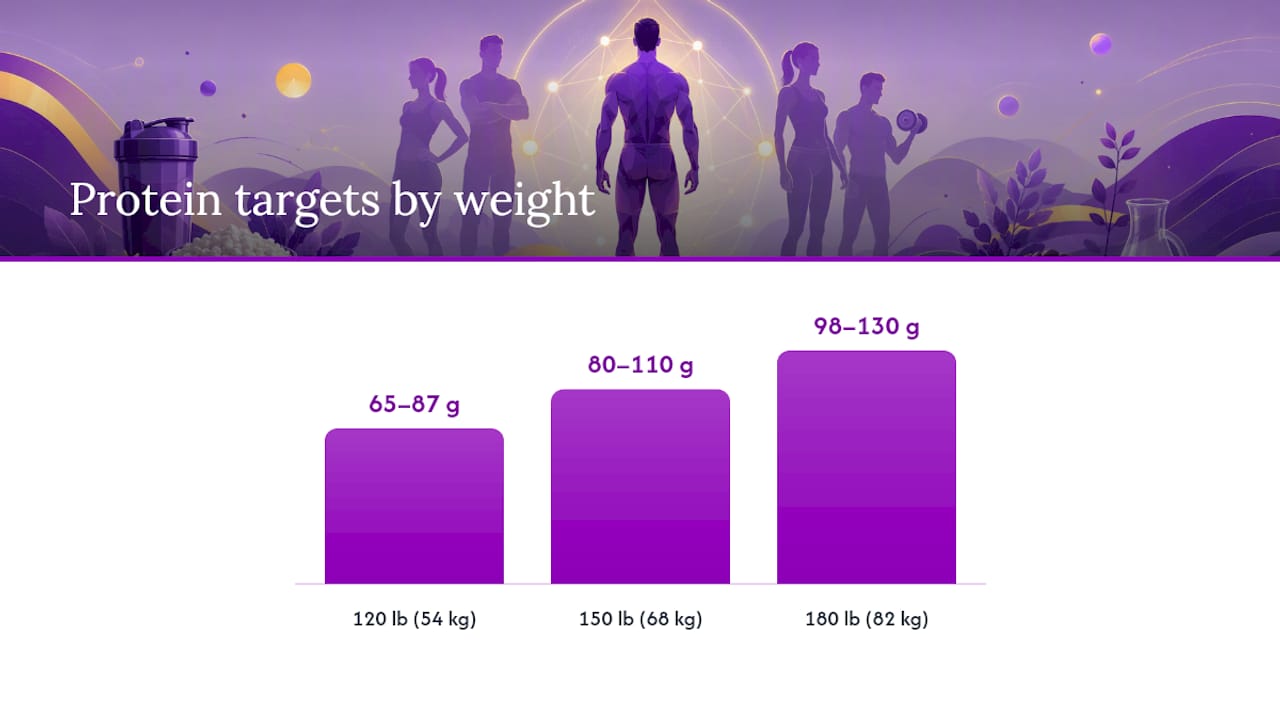
Here’s how that plays out across a few common body weights:
- 120 lb (54 kg): about 65 to 87 grams per day
- 150 lb (68 kg): about 80 to 110 grams per day
- 180 lb (82 kg): about 98 to 130 grams per day
Where you land inside your range depends on what you’re doing with your body:
- Mostly sedentary, no training goals: stick close to the low end, maybe even slightly above the 0.8 g/kg RDA floor.
- Regular cardio or moderate activity, no specific muscle goal: middle of the range, around 1.4 g/kg.
- Strength training, trying to build muscle, or in a calorie deficit and wanting to preserve lean mass: high end, 1.6 g/kg or occasionally above it.
Examine’s protein intake calculator uses this same kg-based multiplier logic, and it’s worth running your numbers through it once just to see where you fall, especially if you’re training hard enough that the standard range might undersell what you need.
What’s the Right Protein Range for Your Goals?
The 1.2 to 1.6 g/kg range isn’t a single number pulled from thin air. It’s a band that recent expert summaries converged on after years of research kept nudging recommendations upward from the old 0.8 g/kg standard, which was only ever designed to prevent outright deficiency, not to support an active life.
That distinction trips people up constantly. The RDA of 0.8 g/kg is the floor, not the target. If you’re only hitting that number, you’re avoiding malnutrition, not optimizing anything.
The numbers that matter: 0.8 g/kg is the minimum to prevent deficiency. 1.2 to 1.6 g/kg is the practical, evidence-backed range most active adults should actually aim for, according to guidance summarized by Cleveland Clinic.
Where you sit inside that range, or even above it, depends on what you’re trying to accomplish:
- Maintenance (no specific body composition goal): 1.2 to 1.4 g/kg keeps most people comfortably fueled without overthinking it.
- Muscle gain: Lean toward 1.6 g/kg, and some serious lifters push toward 1.8 g/kg during aggressive training blocks.
- Fat loss: Higher protein, often at or above 1.6 g/kg, helps preserve lean muscle while you’re in a calorie deficit, which matters more than most dieters realize.
- Endurance or strength athletes in heavy training: Examine’s evidence review notes some athlete contexts push closer to 2.0 to 2.7 g/kg, though that’s the exception, not the rule for most gym goers.
Put concrete numbers on it. A 165 pound (75 kg) office worker who lifts weights twice a week probably does fine around 95 to 110 grams daily. A 200 pound (91 kg) competitive lifter in a bulking phase might target approximately 140 to 150 grams. Neither number is wrong. They’re just answering different questions.
One thing worth knowing: research on muscle protein synthesis suggests gains taper off once you’re well past 1.6 g/kg for most non-elite trainees. Doubling your protein intake past that point rarely doubles your results. You’re better off spending that effort on training consistency or sleep.
How Much Protein Do Older Adults and Pregnant Women Need?
Standard guidance doesn’t apply evenly across every life stage, and two groups in particular need more than the general range suggests.
Older adults lose muscle mass through a process called sarcopenia, and the mechanism that turns dietary protein into muscle becomes less efficient with age. That means older bodies often need more protein per meal just to trigger the same muscle-building response a younger body gets from less. Stanford Lifestyle Medicine recommends adults over 50 aim for roughly 1.2 to 2.0 g/kg daily, toward the higher end of the general population’s range, with particular attention to spreading that protein evenly across meals rather than loading it all at dinner.
- Target 25 to 30 grams of protein at each meal, not just dinner.
- Pair protein intake with resistance training. Grams alone don’t rebuild muscle. Muscle needs a stimulus, and protein is the raw material for that stimulus to matter.
- Don’t skip breakfast protein. It’s the meal older adults most often shortchange.
Pregnant and lactating people also need meaningfully more than baseline. Some clinical reviews put the practical target around 1.7 g/kg during pregnancy and breastfeeding, reflecting the added demands of fetal growth and milk production. In real terms, that’s an increase most people can absorb through slightly larger portions at existing meals rather than a complete diet overhaul.
Pro Tip: If you’re over 50, don’t just add a protein shake at the end of the day and call it done. Split your target across three or four meals with at least 25 grams each. Even distribution matters more for older adults than for anyone else in this article.
One caveat that applies regardless of age or life stage: people with chronic kidney disease should talk to their doctor or a renal dietitian before increasing protein intake. Higher protein loads make the kidneys work harder to filter waste byproducts, and for someone with reduced kidney function, that’s a conversation worth having before adjusting anything.
Does Protein Timing Actually Matter for Muscle Growth?
For most adults, total daily protein intake matters far more than exactly when you eat it. If you hit your daily gram target, your body doesn’t fall apart because you ate more protein at lunch than breakfast.
That said, timing isn’t irrelevant, especially for two groups: older adults and people doing serious resistance training. Research on protein timing and distribution shows that per-meal thresholds of roughly 20 to 40 grams help stimulate muscle protein synthesis more effectively than the same total protein eaten in one or two oversized meals.
Here’s a practical way to think about it:
- Set your daily total first. Use the calculation from earlier in this article. That number is your real target.
- Divide it across three to four meals, aiming for 25 to 35 grams per meal if you’re training for muscle maintenance or growth.
- Add a protein-focused snack around your workout if your schedule leaves a long gap between meals. It doesn’t need to be exactly “before” or “after.” Within a few hours either side works fine for most people.
A realistic day that hits per-meal thresholds without obsessing over exact minutes: eggs and Greek yogurt at breakfast (around 30g), a chicken and bean bowl at lunch (around 35g), a protein shake or cottage cheese snack midafternoon (around 25g), and salmon or tofu at dinner (around 30g). That’s 120 grams spread evenly, with no single meal doing all the work.
Pro Tip: Stop worrying about the “30 minute window” myth. It’s mostly marketing. What matters is getting a solid protein-rich meal within a few hours of training, and hitting your daily total. The window is hours wide, not minutes.
For a deeper look at what to eat immediately around a workout, the post-workout nutrition guide covers specific meal timing and composition in more detail.
Whole Foods or Protein Powder: Which Should You Rely On?
Whole foods should do most of the heavy lifting, and supplements should fill the gaps. That’s the practical hierarchy, and it’s backed by more than convenience.

Whole-food protein sources come packaged with micronutrients, fiber, and satiety benefits that isolated protein powders simply don’t offer, as highlighted in some high-protein traditional Indian snacks which provide a cultural approach to whole-food protein sources. Cleveland Clinic’s guidance recommends prioritizing whole foods for most people, reserving supplements for situations where convenience genuinely matters, like a busy morning or right after a workout when you don’t have time to cook.
Good whole-food sources worth building meals around:
- Eggs, chicken breast, and lean beef for dense, complete animal protein
- Greek yogurt and cottage cheese for protein you can eat without cooking
- Beans, lentils, and tofu for plant-based options with fiber attached
- Fish like salmon and tuna for protein plus omega-3s
If you don’t eat animal products, the vegan protein sources guide walks through twelve plant-based options that can realistically get you to your daily target without relying on powder for every gram.
Supplements earn their place when eating enough whole food isn’t practical, not as a replacement for real meals. A shake after a workout, a bar in your bag for a long day, that’s smart use. A diet built primarily on powder is a missed opportunity for the other nutrition whole food provides.
Here’s how common servings map to actual grams, which makes portioning far less guesswork than it sounds:
If you’re deciding which powder to buy, the best protein powder for muscle gain guide breaks down what to look for so you’re not just grabbing whatever’s on the shelf.
Is Eating Too Much Protein Actually Dangerous?
For healthy adults, intakes up to roughly 2.0 g/kg are generally considered safe, and the fear surrounding “too much protein” is mostly built on myths that haven’t held up well under scrutiny.
The kidney damage claim is the most persistent one. The idea that eating more protein than the RDA harms healthy kidneys traces back to studies on people who already had kidney disease, not healthy populations. If you have normal kidney function, higher protein intake within the evidence-backed range doesn’t appear to cause damage. If you have chronic kidney disease, that’s a different situation entirely, and you should work with your doctor on a target, since the guidance here doesn’t apply the same way.
The real numbers: The RDA of 0.8 g/kg is a floor set to prevent deficiency, not a ceiling. Evidence-backed guidance from Stanford Medicine puts the practical upper range for healthy adults around 2.0 g/kg, well above what most people ever actually eat.
The bone calcium myth deserves the same treatment. The old theory claimed higher protein intake leaches calcium from bones, weakening them over time. More recent research points the opposite direction. Adequate protein appears to support bone health rather than undermine it, particularly in older adults who are already at higher risk for fractures.
A few other things worth clearing up:
- Eating protein doesn’t automatically convert to muscle. You still need a training stimulus.
- Extra protein beyond what your body uses gets used for energy or stored, not necessarily muscle.
- There’s no evidence that protein above the recommended range is more effective than staying within 1.2 to 1.6 g/kg for most non-elite trainees.
The bottom line on safety: unless you have a diagnosed kidney condition, worrying about “too much protein” within the ranges discussed here is largely unnecessary energy spent on the wrong problem.
Sample Meal Plans for 80g, 110g, and 150g Protein Days
Seeing a target on paper is one thing. Filling a plate to hit it is another. Here are three day plans built around common targets, so you can see how the math plays out in actual food.
80 grams per day (a reasonable target for a smaller or more sedentary adult):
- Breakfast: 2 eggs plus Greek yogurt (34g)
- Lunch: Turkey sandwich with cheese (28g)
- Dinner: 3 oz grilled chicken with vegetables (26g)
110 grams per day (a solid target for a moderately active adult):
- Breakfast: Protein shake with oats (30g)
- Lunch: Chicken and quinoa bowl (35g)
- Dinner: Salmon with beans (35g)
- Snack: Cottage cheese (12g)
150 grams per day (fits someone in a serious muscle-building phase):
- Breakfast: 3 eggs, Greek yogurt, and toast with peanut butter (45g)
- Lunch: Large chicken bowl with rice and beans (48g)
- Dinner: 6 oz lean beef with vegetables (42g)
- Snack: Protein shake (24g)
Quick swaps if you need to adjust on the fly: add a scoop of whey powder to raise any meal by roughly 24 grams, swap chicken for tofu or tempeh if you’re eating plant-based, or add a cup of lentils to any meal for about 18 grams without touching meat at all. For readers targeting the higher end of these numbers as part of a bulking phase, the bulking meal prep ideas guide has full weekly plans built around exactly this kind of target. And if you want a repeatable weekly system rather than rebuilding your plan from scratch every Sunday, the high protein meal prep guide covers batch cooking that keeps these numbers consistent without daily decision fatigue.
What I’ve Learned About Making Protein Targets Actually Stick
Most people don’t fail at hitting their protein target because the math is hard. They fail because they try to hit a number instead of building a repeatable pattern. I use the 1.2 to 1.6 g/kg range as a rough compass, not a daily obsession, and I’ve found that people who track every gram for a week and then quit are worse off than people who just build two or three protein-forward habits and repeat them for months.
The habit that’s done the most for me: a protein source at every meal, decided in advance, so I’m never solving that problem while hungry. Supplements are a helpful tool when time is tight, not a requirement. If you’re someone who trains regularly and wants a structured way to turn this range into an actual weekly plan, the meal prep system is a good place to stop guessing and start repeating what works.
— Mark
Turn Your Protein Target Into a Real Training Program
Knowing your daily gram target is only half the equation. The other half is a structured plan that tells you what to eat and how to train to actually use that protein for muscle, not just maintenance. That’s where Dietexerciseshop’s eBooks come in, giving you a done-for-you framework instead of piecing one together from scattered articles.

The Muscle Gain Secrets eBook lays out meal plans and progressive training designed specifically around hitting daily protein targets while building lean mass. If you want a more complete system, the Bodybuilding Guide eBook covers structured programming alongside nutrition strategy for readers serious about long-term muscle development. And for anyone focused on maximizing mass through progressive overload, the Power Mass Blueprint eBook ties nutrition and training together so your protein intake actually translates into strength and size gains.
Each guide is transparent about what’s inside: real meal plans, structured training progressions, and practical recipes, not vague advice. Start with the Muscle Gain Secrets eBook if you’re ready to put a number like 130 grams a day to actual use.
Sources
- How much protein should we really be eating? Five things to know — Stanford Medicine
- How much protein do you need? — Cleveland Clinic
- Protein timing and distribution — PMC review
FAQ
Is 100 Grams of Protein a Day a Lot?
Not for most active adults. A 150 pound person aiming for the upper end of the 1.2 to 1.6 g/kg range needs roughly 80 to 110 grams daily, so 100 grams sits comfortably within a normal, evidence-backed target rather than being excessive.
Is 30 Grams of Protein in One Meal Too Much?
No. Research on protein timing shows 20 to 40 grams per meal is the range that best stimulates muscle protein synthesis, so 30 grams fits squarely in the effective zone rather than being excessive.
Are Four Eggs a Lot of Protein?
Four large eggs provide about 24 grams of protein, roughly a quarter to a third of a moderate daily target. That makes them a solid breakfast contribution, not an unusually large amount.
How Much Protein Does a 70-Year-Old Woman Need Daily?
Older adults generally benefit from higher intake, around 1.2 to 2.0 g/kg, according to Stanford Lifestyle Medicine. For a 140 pound woman, that translates to a higher protein amount spread evenly across meals to support muscle maintenance.