

Read U.S. Supplement Labels Like a Seller: Spot Hidden Blends & COAs
Read the Supplement Facts panel before anything else on the bottle. Check the serving size against what you actually take, then use the %DV column to spot anything unusually low (5% or less) or high (20% or more). Skip proprietary blends that do not disclose specific ingredient amounts, look for a third-party seal or Certificate of Analysis, and scan the bottom of the label for allergens, drug interactions, and a real manufacturer address.
TL;DR:
- Check for a third-party seal or Certificate of Analysis to verify supplement purity and avoid products with undisclosed ingredient amounts in proprietary blends.
- Review the Serving Size and calculate your actual daily intake by adjusting the amount per serving to match how much you take, especially for nutrients with different units like mg, mcg, or IU.
- Be cautious of high %DV values for fat-soluble vitamins or when stacking multiple products, as these can lead to nutrient excess and potential health risks.
- Examine the ingredient list order to ensure active ingredients are listed before fillers or inactive substances; a long list of inactive ingredients first may indicate a product mostly composed of fillers.
- Always scan the bottom of the label for allergen warnings, drug interactions, and expiration dates to prevent adverse reactions and ensure product potency.
Table of Contents
- How to read supplement labels: the Supplement Facts panel
- What does percent Daily Value mean on a label?
- What order are ingredients listed on a supplement label?
- Why do proprietary blends make labels harder to trust?
- How can you verify supplement quality before buying?
- Are supplement label claims regulated the same as drug claims?
- Where do allergen warnings and drug interactions appear on a label?
- Quick checklist: evaluating a supplement label in under a minute
- Publisher expertise behind this guide
- Do supplements have expiration dates and storage rules?
- What do fillers and additive disclosures actually tell you?
- Which marketing terms on supplement labels are mostly hype?
- What I actually check before buying a supplement
- Shop supplements and guides built around clear labels
- Sources
- FAQ
How to read supplement labels: the Supplement Facts panel
Every legally sold supplement in the United States carries a Supplement Facts panel, and it’s built the same way every time: serving size at the top, servings per container just below it, then a table of nutrients with amounts and %DV. The FDA requires this exact structure, which means once you learn to read one label, you can read all of them.
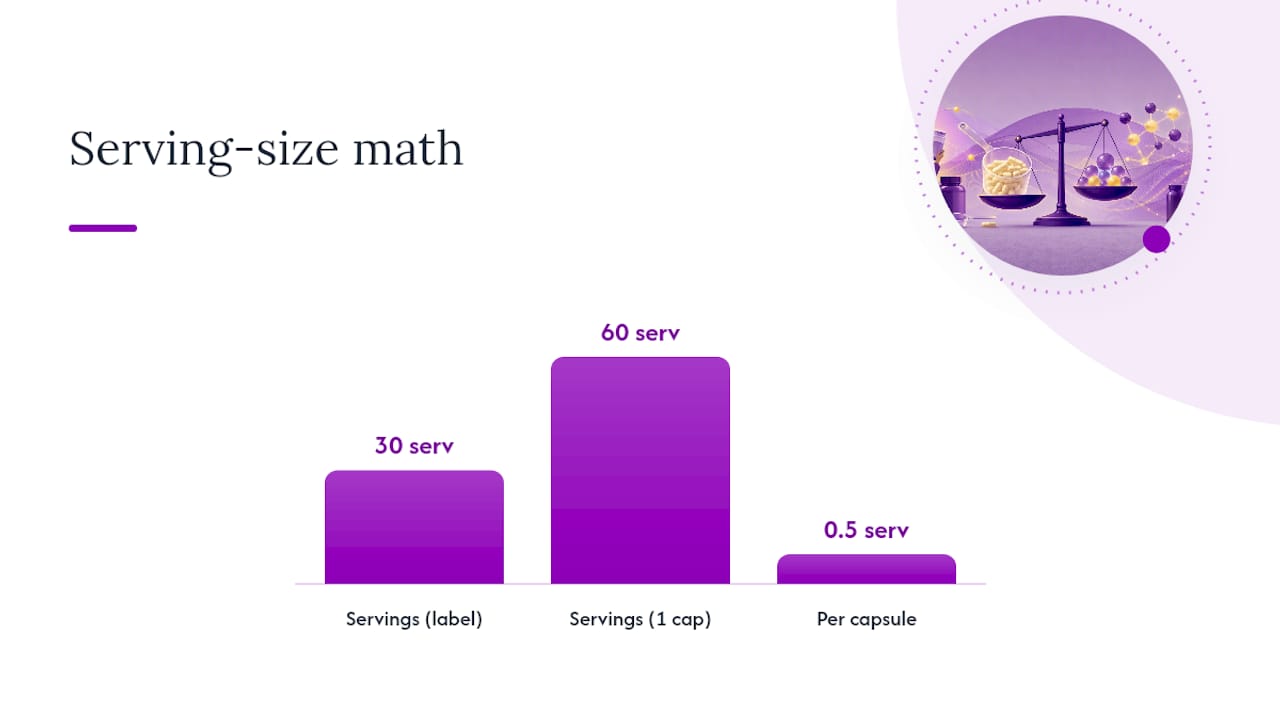
Serving size tells you what one “dose” looks like according to the manufacturer, which may differ from your actual use. A bottle might list “2 capsules” as one serving, but if you only take one capsule a day, you’re getting half the nutrient amounts printed on that panel. This trips up more shoppers than any other part of the label.
Servings per container matters for value and planning, but it also matters for consistency. A 60 capsule bottle with a 2 capsule serving size gives you 30 servings, or a month’s supply if you take it daily. Run that math before you buy, especially when comparing prices between two products with different serving sizes.
Amounts per serving show up in different units depending on the nutrient: milligrams (mg) for minerals like magnesium, micrograms (mcg) for nutrients like vitamin B12 or vitamin D, International Units (IU) for some vitamins, and CFU (colony-forming units) for probiotics. These units aren’t interchangeable, and a label listing “5,000 IU” of vitamin D means something different than “125 mcg,” even though those happen to be roughly equivalent doses.
Here’s how to adjust for your own use:
- Find the serving size (for example, “2 capsules”).
- Find the amount per serving for the nutrient you care about (for example, 1,000 mg).
- Divide by the serving size to get the per-unit amount (500 mg per capsule).
- Multiply by how many capsules you actually take to find your real daily intake.
Skipping this step is how people accidentally take half a dose, or double one, without realizing it.
What does percent Daily Value mean on a label?
Percent Daily Value, or %DV, tells you how much a nutrient in one serving contributes to a general daily target based on a 2,000 calorie diet. The FDA sets 5% DV or less as low and 20% DV or more as high, and that single rule of thumb is the fastest way to judge any supplement label without doing math.
A quick reference: the FDA publishes exact Daily Value numbers for label use, including 1,300 mg for calcium and 20 mcg for vitamin D. These DVs are single reference numbers, not personalized targets. Actual recommended intakes vary by age and sex, which is a distinction the NIH Office of Dietary Supplements explains in more detail.
A high %DV isn’t automatically good, and a low one isn’t automatically bad. Context decides which:
- A multivitamin showing 20% DV or higher for vitamin D might genuinely help someone who tested deficient.
- The same 20% DV becomes a problem if you’re already taking a separate vitamin D supplement and a fortified cereal, because those percentages stack across everything you consume in a day.
- Fat-soluble vitamins (A, D, E, K) build up in body tissue rather than flushing out, so chronic high intake carries more risk than it does with water-soluble nutrients like vitamin C.
Experts specifically caution that more vitamin D is not automatically better, and the same logic extends to most fat-soluble nutrients when you’re combining multiple products.
What order are ingredients listed on a supplement label?
Ingredients appear in descending order by weight, meaning whatever comes first makes up the largest portion of that serving. The FDA’s labeling guide requires manufacturers to list dietary ingredients in this exact predominance order, so a glance at the first three items tells you what you’re really paying for.
That order also separates active from inactive ingredients. Active ingredients are the nutrients or compounds doing the work: the actual vitamin, mineral, herb, or amino acid. Inactive ingredients are everything holding the product together or extending its shelf life:
- Fillers like microcrystalline cellulose or rice flour, used to bulk out capsules.
- Binders and anti-caking agents like magnesium stearate or silicon dioxide.
- Coloring agents and coatings, especially in gummies and chewables.
- Preservatives that extend shelf stability.
None of these are inherently dangerous in normal amounts, but if an inactive ingredient shows up before the active nutrient you’re buying the product for, that’s worth noticing. It usually means you’re paying for a capsule that’s mostly filler.
Units and ingredient form matter just as much as position on the list. Mineral supplements especially vary in how well your body absorbs them depending on the compound form: magnesium oxide is cheap and common but poorly absorbed, while magnesium citrate or glycinate costs more but tends to absorb better. The same goes for iron (ferrous sulfate versus bisglycinate) and zinc (oxide versus picolinate). A label that only says “magnesium 400 mg” without specifying the compound form is giving you less information than one that spells it out.
Why do proprietary blends make labels harder to trust?
A proprietary blend lists a group of ingredients under one combined weight instead of breaking out each ingredient’s individual amount. You’ll see the blend name, the total milligrams, and then a list of everything inside it with no per-ingredient breakdown. That means you have no way of knowing whether the active ingredient you actually want is present at a meaningful dose, or whether it’s a token amount sitting behind three cheaper fillers that make up most of the weight.
The NCOA’s guidance on reading supplement labels specifically flags proprietary blends as a transparency red flag, alongside a few other warning signs worth training your eye to catch:
- No individual ingredient amounts inside a “blend,” “complex,” or “matrix” label.
- Suffix patterns on unfamiliar botanical or stimulant names that have shown up on anti-doping watchlists.
- Claims that sound too dramatic for a supplement (“melts fat,” “cures anxiety,” “eliminates disease”).
- No manufacturer address, phone number, or website printed anywhere on the label.
- Allergen statements that are missing entirely, even though the ingredient list includes common allergens like soy or tree nuts.
Pro Tip: If a product buries a stimulant-heavy blend under a creative name you don’t recognize, search that exact ingredient name before buying. Many hidden stimulants get renamed specifically to dodge recognition on ingredient scans.
How can you verify supplement quality before buying?
Third-party seals exist because the FDA doesn’t pre-approve supplements for safety or effectiveness before they hit shelves. That’s the core problem labels solve: manufacturers self-certify their own ingredient lists, and outside verification is the only real check on that claim.
Two seals show up most often: USP (U.S. Pharmacopeia) and NSF. Both send third-party auditors to test that a product contains what the label says, in the amounts stated, without contaminants above set limits. Neither seal guarantees the supplement works for its intended purpose, only that it’s manufactured and labeled honestly.
A Certificate of Analysis, or COA, goes a step further by testing the specific batch you’re buying, not just the manufacturer’s general practices. Look for a QR code on the label or a batch number you can search on the manufacturer’s website. According to the NCOA’s reading guide, a COA is one of the strongest transparency signals available because it verifies purity and potency for that exact lot, not just the product line in general.
A few more signals worth checking before you commit to a purchase are explained in detail in The Functional Sip — kava vs kratom, which highlights why ingredient transparency matters for botanical blends.
- CGMP (Current Good Manufacturing Practice) compliance, usually printed near the manufacturer info.
- A working phone number, email, or mailing address, not just a generic web contact form.
- Ingredient amounts stated individually rather than folded into an unlabeled blend.
- Batch or lot numbers that match what’s referenced in any published COA.
Products that pass all four checks aren’t guaranteed to work, but they’ve cleared a much higher transparency bar than something with none of them.
Are supplement label claims regulated the same as drug claims?
No, and the difference matters more than most shoppers realize. Supplements can legally make structure/function claims, statements like “supports immune health” or “helps maintain healthy joints,” but they cannot legally claim to treat, cure, prevent, or diagnose a disease. Any label that crosses into disease-claim territory is making an illegal claim, full stop.
Marketing words like “natural,” “clinically studied,” or “doctor recommended” carry no fixed regulatory definition on a supplement label. “Natural” doesn’t mean regulated or safer. “Clinically studied” doesn’t tell you whether that study used the same dose, same form, or same population as what’s in your bottle.
Cross-check any front-of-package claim against three things:
- The Supplement Facts panel, to confirm the active ingredient is actually dosed at a meaningful amount.
- A third-party seal or COA, to confirm the label matches what’s inside.
- The ingredient list order, to see whether the “clinically studied” ingredient sits near the top or is buried near the fillers.
Where do allergen warnings and drug interactions appear on a label?
Allergen and caution statements typically sit near the bottom of the label, close to the manufacturer’s contact information, and they’re easy to skip if you’re only scanning the nutrient panel. Finding them takes seconds and can prevent a serious reaction or a dangerous drug interaction.
Follow these steps before taking anything new:
- Scan the bottom third of the label for a “Contains” statement listing common allergens like soy, tree nuts, shellfish, or dairy.
- Check for a caution or warning line, often set in bold or a different font, noting who shouldn’t take the product.
- If you take prescription medication, search for known interactions before buying. Vitamin K can interfere with warfarin, and St. John’s wort interacts with a wide range of prescriptions, from antidepressants to birth control.
- Look for pregnancy and breastfeeding warnings specifically, since many supplements carry a “consult your doctor” note for these groups that’s easy to miss.
- Check the expiration date, usually stamped on the bottom or side of the container.
The NCCIH recommends treating the Supplement Facts panel as the objective source of truth and consulting a healthcare professional before starting anything that could interact with existing medications. That advice matters most for anyone managing a chronic condition or taking more than one prescription.
Quick checklist: evaluating a supplement label in under a minute
Run through these steps at the shelf or before you check out online:
- Read the Supplement Facts panel first, not the front of the box.
- Check serving size and compare it to how much you’d actually take.
- Scan %DV for anything under 5% (low) or over 20% (high).
- Check whether ingredients are individually dosed or hidden inside a proprietary blend.
- Confirm the ingredient form (citrate vs. oxide, for example) if absorption matters to you.
- Look for a USP or NSF seal, or a COA you can access by QR code or batch number.
- Read allergen statements and interaction warnings near the manufacturer contact info.
- Check the expiration date and any storage instructions before buying.
If you’re taking more than one supplement, add up %DV for shared nutrients across all of them, not just one bottle at a time. Two products each providing 60% DV of vitamin D adds up to 120%, and that total is what actually matters for your body.
Pro Tip: Keep a running list of every supplement you take and its dosed amounts. It takes five minutes to build and makes stacking calculations and doctor conversations dramatically easier.
When totals get complicated, or when you’re managing a health condition, a pharmacist or physician can check your full supplement stack in a way a label alone can’t.
Publisher expertise behind this guide
This guide was written by Mark, drawing on FDA labeling rules and NCOA’s consumer guidance to break down what every panel section actually means for a shopper standing in an aisle or scrolling a product page.
Dietexerciseshop’s supplements collection is built around the same transparency standards covered here: clear labeling, and Certificates of Analysis where a product line makes one available. Readers who want to go deeper on the fundamentals behind smart nutrition choices can also check the nutrition labels guide for a comparison with standard food labeling, since the two systems overlap more than most people expect.
Do supplements have expiration dates and storage rules?
Yes, and both appear directly on the label, usually stamped near the bottom or on the container’s base or shoulder. An expiration date reflects how long the manufacturer guarantees full potency, not a hard safety cutoff. A supplement past its date generally won’t turn dangerous, but the active ingredients can degrade, meaning you may be getting less of the nutrient than the label states.
Storage instructions matter more than most people assume. Probiotics, fish oil, and certain herbal extracts often require refrigeration after opening to preserve potency; a probiotic left in a hot car can lose most of its live cultures within days. Other products specify “store in a cool, dry place,” which rules out the bathroom medicine cabinet, where humidity from showers accelerates breakdown of gel capsules and powders.
A few practical habits worth building:
- Check the storage line the day you buy, not months later when you’re already midway through the bottle.
- Note whether refrigeration is required “after opening” versus from the start, since these differ by product.
- Buy quantities you’ll realistically finish within the stated shelf life rather than stockpiling large bottles for the discount.
- Discard anything showing a changed smell, color, or texture even if it hasn’t technically expired.
Manufacturers set these dates based on stability testing for that specific formulation, so a fish oil softgel and a mineral tablet won’t degrade at the same rate even if they sit on the same shelf.
What do fillers and additive disclosures actually tell you?
Fillers, binders, and artificial additives get disclosed in the “other ingredients” section beneath the main Supplement Facts table, and this section deserves the same attention as the nutrient panel above it. These are the inactive ingredients that hold a capsule together, add bulk to a powder, or extend shelf life, and they’re required by law to appear even though they’re not the reason you bought the product.
Common fillers include microcrystalline cellulose, rice flour, and maltodextrin, all generally recognized as safe in typical amounts. Artificial colors and flavors show up mostly in gummies and chewables, disclosed by name (like “FD&C Red No. 40”) rather than buried under a vague “natural and artificial flavors” line, though that vaguer phrasing still appears often enough to watch for.
The disclosure itself isn’t a red flag. Nearly every capsule needs some kind of binding agent to hold its shape. What matters is proportion: if the “other ingredients” list is longer and more prominent than the active nutrient list above it, you’re likely paying for a product that’s mostly filler with a modest dose of the thing you actually wanted. Comparing two similar products side by side, the one with a shorter, more recognizable additive list is usually the more efficiently formulated option, even at a slightly higher price.
Which marketing terms on supplement labels are mostly hype?
Beyond the legal structure/function versus disease-claim line, plenty of front-of-package language exists purely to sound convincing without meaning much in practice. “Premium,” “pharmaceutical grade,” and “advanced formula” have no standardized regulatory definition, so any manufacturer can print them regardless of actual quality.
“Clinically proven” deserves particular skepticism unless the label or company website names the actual study, the dose tested, and the population involved. A single small trial on a different dose than what’s in the bottle doesn’t support the same claim being printed on a much lower-dose consumer product.
Terms like “detox” and “cleanse” rarely correspond to any defined physiological process; your liver and kidneys handle that work without help from a supplement. Similarly, “natural” says nothing about safety or effectiveness. Arsenic and hemlock are natural too. The FTC’s guidance on deceptive claims covers how loosely regulated marketing language can leave consumers with a misleading impression even when nothing on the label is technically false.
Front-of-package jargon works because it’s the first thing you see, and it’s designed to earn your trust before you flip the bottle over. The Supplement Facts panel behind it doesn’t need clever language to make its case. It just needs to be honest.
What I actually check before buying a supplement
I go straight to the back of the bottle before I ever read the marketing copy on the front. Serving size and %DV first, then whether ingredients are dosed individually or buried in a blend. A proprietary blend without disclosed amounts is a transparency red flag for me, especially on anything with a stimulant listed inside it.
Products carrying a COA or a USP/NSF seal tend to get more trust in my decision, because they’ve been checked by someone other than the company selling them. None of this replaces professional advice. If you’re on medication or managing a health condition, a pharmacist can catch interactions a label alone won’t flag.
— Mark
Shop supplements and guides built around clear labels
Dietexerciseshop treats the label the same way this guide just walked you through: serving sizes stated plainly, ingredients listed without vague blends, and Certificate of Analysis information made available where a product line offers one.

If you want to go beyond the panel and understand how nutrient timing, dosing, and training goals connect, the FUNCTIONAL FITNESS eBook and FITNESS ELEMENTS 101 eBook both break down practical nutrition and training fundamentals in plain language, without the jargon that makes most supplement marketing hard to trust. Browse the supplements collection to check product pages directly, compare ingredient amounts side by side, and see exactly what you’re buying before you check out.
This article is general information, not a substitute for advice from a qualified doctor. Consult a qualified healthcare professional about your own circumstances before acting on anything here.
Sources
- Dietary and herbal supplements — NCCIH
- How to read supplements labels — National Council on Aging (NCOA)
FAQ
How do you read a dietary supplement label?
Start with the Supplement Facts panel: check serving size, servings per container, and %DV for each nutrient. Then check the ingredient list for proprietary blends, scan for a third-party seal or COA, and read allergen and interaction warnings near the manufacturer contact information.
What does USP or NSF on a supplement label mean?
Both are third-party organizations that test finished products to confirm they contain what the label states, in the stated amounts, without unsafe contaminant levels. Neither seal confirms the supplement is effective for its intended use, only that the label is accurate.
What are the 13 essential vitamins?
The vitamins the body needs include A, C, D, E, K, and the B vitamins (thiamin, riboflavin, niacin, pantothenic acid, B6, biotin, folate, and B12). The FDA’s Daily Value reference table lists the specific DV amount used for each on supplement and nutrition labels.
What’s the difference between a high and low %DV?
The FDA defines 5% DV or less as low and 20% DV or more as high, based on a 2,000 calorie reference diet. A high %DV can be appropriate for correcting a known deficiency but can also signal a risk of excess, particularly with fat-soluble vitamins or when stacking multiple supplements.
Why should I avoid proprietary blends?
Proprietary blends list a combined weight for several ingredients without breaking out individual amounts, making it impossible to know if the ingredient you want is present at a meaningful dose. Products with individually dosed ingredients give you a clearer picture of exactly what you’re taking.