

A Protein Shake Before Bed: What It Does for Muscle and Sleep
Yes, a protein shake before bed helps most active adults, mainly by supporting overnight muscle repair and curbing late-night snacking, as long as your total daily protein is already on target. The research points to 25 to 40 grams as the useful range. For most people, a slow-digesting option like casein or a cup of cottage cheese beats a fast-absorbing whey shake for this specific use, simply because it stays in your system longer while you sleep.
Key Takeaways
A pre-bed protein shake of 25 to 40 grams supports overnight muscle repair and curbs late-night hunger, but only matters when your total daily protein intake is already adequate.
| Point | Details |
|---|---|
| Dose range | Aim for 25 to 40 grams of protein, adjusted for your body size and training load. |
| Protein type | Casein or a slow-digesting milk protein blend works best; whey performs comparably in trials. |
| Timing window | Drink 30 to 60 minutes before lying down, longer if the shake contains fat or fiber. |
| Who should be cautious | Anyone with kidney disease, reflux, or lactose intolerance should adjust or consult a doctor. |
| Dietexerciseshop’s role | Offers nutrition eBooks and training gear, like the MEAL PREP & MUSCLE REPS Hoodie, to support the habit long term. |
This article is general information, not a substitute for advice from a qualified doctor. Consult a qualified healthcare professional about your own circumstances before acting on anything here.
Table of Contents
- What Happens Physiologically When You Drink Protein Before Sleep
- Pros and Cons of a Pre-Bed Protein Shake
- Who Benefits Most and Who Should Be Careful
- How Much Protein and How Long Before Bed
- Whole-Food Alternatives and Simple Pre-Bed Recipes
- Fitting a Shake Into Your Day Without Wrecking Your Calories
- Sources
- FAQ
What Happens Physiologically When You Drink Protein Before Sleep
Your body doesn’t stop building or breaking down muscle tissue overnight. It just does both more slowly, and without incoming amino acids, the balance tips toward breakdown. A randomized trial in middle-aged men found that a moderate amount of milk protein before bed prevented the negative whole-body protein balance that showed up in the group given a protein-free placebo. That’s a meaningful finding: it means your body was actively losing more protein than it gained overnight without that drink.

A separate randomized controlled trial gave endurance athletes 45 g of either casein or whey before sleep and measured muscle protein synthesis directly. Both groups saw increased mitochondrial and myofibrillar protein synthesis compared to placebo, and neither protein type had a clear edge over the other in that particular study.
Here’s the part people miss: timing helps, but it isn’t the main event.
- Total daily protein intake remains the biggest lever for muscle growth, according to NIH nutrition reviews.
- Pre-sleep protein works best as a way to close a gap in your daily total, not as a standalone trick.
- Slow-digesting proteins produce sustained aminoacidemia, meaning amino acids stay elevated in your blood for hours instead of spiking and dropping, according to research on milk protein digestion kinetics.
- A 2018 study using 35 g casein doses found nighttime and daytime supplementation produced similar strength and size gains when total protein was matched.
That last point matters if you’ve heard that nighttime protein is somehow “wasted.” It isn’t. It’s just not magic either.
Pros and Cons of a Pre-Bed Protein Shake
The upside is straightforward. A shake before bed can blunt overnight muscle breakdown, help you hit a daily protein target you’re otherwise missing, and satisfy the kind of hunger that sends people to the pantry at 11 PM. Dietitians frequently point to that last one as the real-world reason people stick with the habit, according to sports dietitians interviewed by BarBend.
The downside list is shorter but worth respecting:
- Extra calories add up fast if you don’t account for the shake in your daily total, which matters if weight loss is the goal.
- A large liquid volume close to bedtime can trigger reflux or general digestive discomfort in sensitive people.
- Shakes loaded with added sugar or flavored syrups can spike blood sugar right before you lie down, which isn’t ideal for sleep quality.
| Factor | Pro-bed shake benefit | Potential downside |
|---|---|---|
| Muscle recovery | Slows overnight protein breakdown | None significant if dosed correctly |
| Appetite control | Reduces late-night snacking | Adds calories if not tracked |
| Digestion | Convenient, quick to prepare | Can disrupt sleep if too large or too close to bed |
Pro Tip: Keep the shake under 12 ounces of liquid and drink it at least 30 minutes before lying down. If it contains high-fat add-ins like peanut butter, push that buffer to a full hour.
Who Benefits Most and Who Should Be Careful
Resistance-trained lifters chasing muscle growth are the clearest winners here, especially if they train in the evening and want to capitalize on the overnight recovery window. Older adults working to preserve muscle mass against age-related sarcopenia also tend to benefit, since the milk protein trial was conducted specifically in middle-aged men and showed a real protective effect. Endurance athletes coming off a hard evening session, and anyone using a shake purely to avoid raiding the fridge at midnight, round out the group.
Caution applies to a few specific situations.
- People with diagnosed kidney disease should talk to a doctor before adding extra protein at any time of day.
- Lactose-intolerant readers may want to skip whey or milk-based casein and choose a plant protein instead.
- Anyone prone to acid reflux or sleep-disrupting digestion should test a smaller serving first.
If you have kidney disease, are on a protein-restricted diet, or have a history of reflux that worsens at night, check with a clinician before making a pre-bed shake a habit. The dose that works for a healthy 28-year-old lifter isn’t automatically safe for everyone.
How Much Protein and How Long Before Bed
The gram range that shows up across trials sits between 25 and 45 grams, with 25 to 40 grams being the practical sweet spot for most adults. Larger individuals or those training hard may lean toward the higher end; smaller-bodied or older adults often do fine closer to 25 grams, based on the dosage used in the middle-aged men study.
Timing matters less than people assume, but a few rules of thumb help:
- Drink your shake 30 to 60 minutes before lying down to give digestion a head start.
- If it includes high-fat or high-fiber ingredients, lean toward the 60-minute end of that window.
- Use a protein calculator to see how a pre-bed serving fits your personalized daily target rather than guessing.
The single biggest factor remains your total daily protein intake, not the exact minute you drink this shake. If you’re already hitting your daily number through meals, a pre-bed dose is a nice-to-have, not a requirement.
Whole-Food Alternatives and Simple Pre-Bed Recipes
You don’t need a shaker bottle to get this benefit. A few easy options:
- Cottage cheese bowl: 1 cup low-fat cottage cheese delivers roughly 25 g protein. Add cinnamon or a few berries for flavor without added sugar.
- Casein-Greek yogurt mix: stir a scoop of casein powder into plain Greek yogurt for a thicker, higher-protein version with minimal added liquid, an approach that also works well if you dislike drinking a beverage right before bed.
- Low-sugar smoothie: blend one scoop of casein or whey with unsweetened almond milk and a small handful of spinach, keeping total liquid under 12 ounces to avoid disrupting sleep.
- No-blend option: a single-serve cottage cheese cup or a hard-boiled egg with a small piece of cheese works for anyone who wants zero prep.
Fitting a Shake Into Your Day Without Wrecking Your Calories
Count the shake as a real meal component, not a freebie. If you’re tracking calories for weight loss, subtract it from your evening snack allowance rather than tacking it on top. For digestion, smaller volumes and protein isolates (lower in lactose than concentrates) tend to sit better late at night.
- Skip high-sugar flavored powders and anything with caffeine added, both of which work against good sleep.
- Wait at least 30 minutes after drinking before lying flat, longer if you added fat or fiber.
- Watch for reflux, unusually disrupted sleep, or any symptoms tied to chronic kidney disease. Those are signs to stop and talk to a doctor rather than push through.
Pro Tip: If you’re not sure whether pre-bed protein is helping, track your morning soreness and hunger levels for two weeks with and without it. The pattern usually shows up faster than people expect.
A Practical Way to Test This Yourself
I recommend treating pre-bed protein as a two-to-four-week experiment rather than a permanent rule, because the effect is real but modest and worth verifying for your own body. Take an evening lifter who adds 30 g of casein 45 minutes before bed. He tracks sleep quality and daily calorie totals for three weeks; if soreness drops and weight stays on target, he keeps the habit. If not, he drops it without guilt.
Build the Habit With the Right Gear and Fuel
Getting the dose and timing right is only half the battle. Staying consistent with your evening nutrition routine is the other half, and that’s where the right tools and reminders make a real difference.

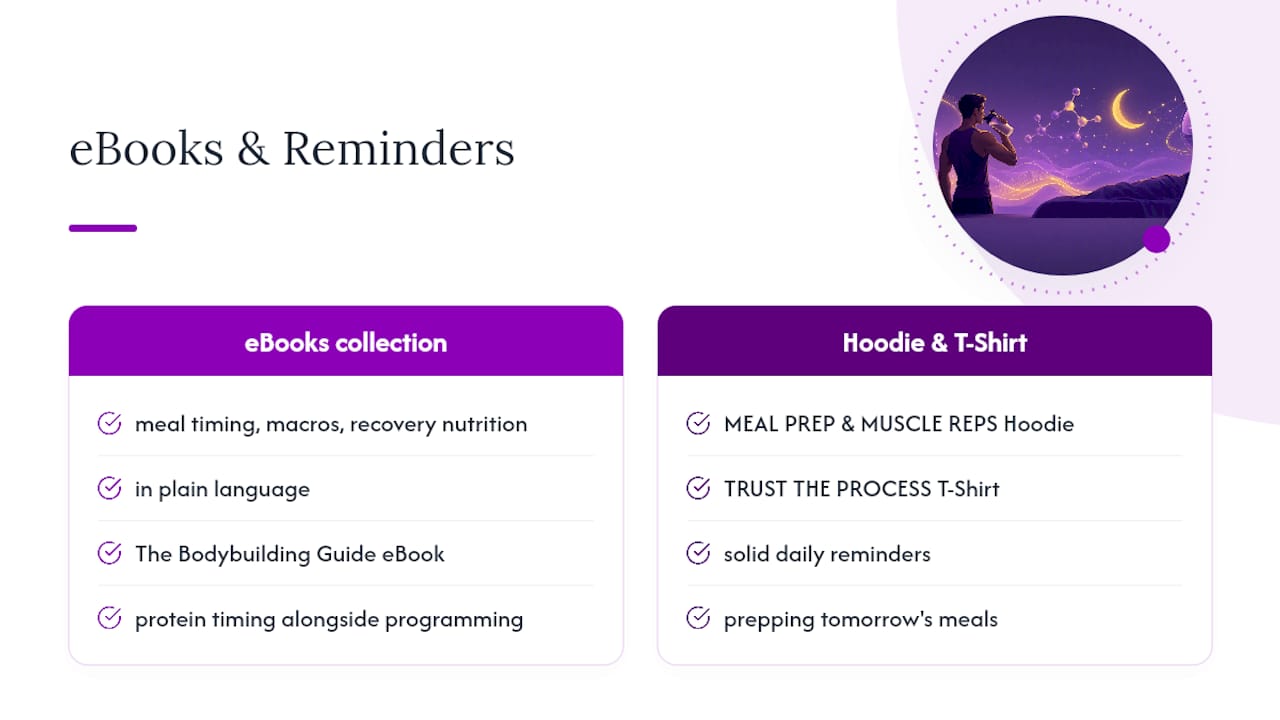
If you’re building an evening routine around better nutrition habits, Dietexerciseshop’s eBooks collection covers meal timing, macros, and recovery nutrition in plain language, without the fluff you’ll find in most fitness content. For lifters who want the science backed by a full training and nutrition framework, The Bodybuilding Guide eBook walks through protein timing alongside programming.
And if you’re the type who likes wearing your habits, the MEAL PREP & MUSCLE REPS Hoodie and the TRUST THE PROCESS T-Shirt make solid daily reminders of the routine you’re building, whether you’re prepping tomorrow’s meals or hitting the gym at 6 AM. Check out the full eBooks collection to find the guide that matches your current goal.
Sources
Casein wins on paper for one simple reason: it clots in the stomach and releases amino acids slowly, which is exactly what you want during eight hours of sleep. Whey, by contrast, digests fast, but the Springer Nature trial found it performed just as well as casein for overnight muscle protein synthesis in that specific study, so it’s far from a bad choice if it’s what you have on hand.
- Daytime and nighttime casein supplements similarly increase muscle size and strength in response to resistance training earlier in the day: a preliminary investigation | Journal of the International Society of Sports Nutrition
- Ingestion of a Pre-bedtime Protein Containing Beverage Prevents Overnight Induced Negative Whole Body Protein Balance in Healthy Middle-Aged Men: A Randomized Trial
- Pre-sleep Protein Ingestion Increases Mitochondrial Protein Synthesis Rates During Overnight Recovery from Endurance Exercise: A Randomized Controlled Trial | Sports Medicine | Springer Nature Link
- Should You Have a Protein Shake Before Bed? Here’s What RDs and Sports Dietitians Say | BarBend
If you’d rather skip the powder altogether, whole foods work just as well. A registered dietitian resource points to Greek yogurt and cottage cheese as excellent stand-ins, since both are naturally rich in slow-digesting milk proteins and tend to be more filling than a liquid shake. Our guide to protein powder for muscle gain breaks down casein versus whey versus blends in more depth if you’re picking a product.
FAQ
Is 10 PM too late for a protein shake?
No, as long as you leave 30 to 60 minutes before lying down to let digestion get a head start. What matters more is the shake’s size and ingredients than the exact clock time.
Should I avoid protein at night?
Most healthy adults don’t need to avoid it. Trials show pre-sleep protein can improve overnight protein balance rather than cause harm, though people with kidney disease or reflux should check with a doctor first.
What is the best protein to drink at night?
Casein is the most commonly recommended option because it digests slowly and keeps amino acids elevated for hours, though whey performed comparably in at least one controlled trial. Whole-food options like Greek yogurt or cottage cheese work just as well.
How much protein is good before bedtime?
Most research points to a range of 25 to 40 grams, with 25 grams shown to prevent negative overnight protein balance in one trial. Your ideal amount depends on body size, training volume, and how close you already are to your daily protein target.