

8 Week Resistance Band Progressive Overload Plan With Setup Logs
Yes, you can build progressive overload with resistance bands, and the most reliable way to do it is double progression: work within a rep range, and once you hit the top of that range for every set, increase the band’s effective tension and drop back down. Success looks like a logged, repeatable increase in reps, tension, or tempo, not a vague sense that a workout felt harder.
TL;DR:
- Progression relies on increasing tension only after all sets reach the top of the rep range for several sessions; trying multiple variables keeps overload consistent.
- Changing anchor point, shortening the band, stacking multiple bands, and manipulating tempo are effective ways to escalate resistance without buying new equipment.
- Tracking specific setup details such as stance, anchor point, and tempo is crucial for meaningful progress, as variations affect actual resistance.
- Inspect bands for wear and avoid sudden jumps in resistance by first stacking or adjusting setup variables before switching to heavier bands.
- An eight-week structured cycle alternating volume and intensity phases optimizes strength and hypertrophy gains through micro-variations in load.
Table of Contents
- Five Practical Methods to Increase Load With Bands
- How to Track Progress and Build an 8-Week Plan
- Safety, Common Mistakes, and Breaking Plateaus
- Where Diet & Exercise Products Fit Into This Plan
- What Actually Matters in Band Progression
- Which Band Kit Actually Gets You Progressing
- Sources
- FAQ
Five Practical Methods to Increase Load With Bands
Bands don’t have fixed plates you can stack, but that’s not the same as saying they can’t progress. You have at least five separate levers, and most lifters only ever touch one.
Anchor point and angle. Moving where you anchor a band changes both the resistance curve and the peak tension you fight at the hardest point of the lift. Anchoring low for a chest press versus anchoring at shoulder height changes which part of the range feels heaviest, and that alone can turn a stale exercise into a new stimulus.
Shortening the working length. Step further onto a loop band or choke up on the handles of a tube band, and resting tension goes up before you even start the rep. This is the fastest micro-adjustment available and costs nothing.
Band stacking. Layering a second light band onto a primary band gives you small, controllable jumps in resistance instead of jumping from a medium band straight to a heavy one. A common approach: pair a light band with a medium band for rows, then swap the light for a heavy once the combo gets easy.
Reps within a range, using double progression. For strength-focused work, aim for 6 to 10 reps per set; for hypertrophy, 10 to 15 tends to work well, which lines up with what the American College of Sports Medicine’s overview of resistance training research identifies as effective rep ranges for both goals. Add a rep or two per session until every set hits the top number, then increase tension and reset to the bottom of the range.
Tempo manipulation. When the next band up feels like too big a jump, slow the eccentric phase to four or five seconds. This increases time under tension without changing the band at all, and it’s an underused bridge between resistance levels.
- Raise or lower the anchor to shift the resistance curve.
- Shorten the band or step further onto it for more resting tension.
- Stack a second band for small, tunable jumps.
- Add reps until you hit the top of your range, then increase tension.
- Slow the eccentric to 4 to 5 seconds as a bridge tactic.
Pro Tip: Before you buy a heavier band, try stacking a light one onto your current band for two sessions. If the lift still feels manageable at the top of your rep range, you’ve found your next progression without spending a cent.
How to Track Progress and Build an 8-Week Plan
Progressive overload with bands falls apart fast without a log, because “it felt harder” isn’t data. Every session, record the exercise name, the exact band or bands used (color or SKU matters more than you’d think, since manufacturers vary), the anchor point, your stance width, sets, reps, tempo, and your effort level using RPE or a simple failure note.
That level of detail matters because band tension shifts with tiny setup changes. A technical guide to estimating band tension shows that stretch percentage, not just the band’s rated strength, determines actual force at any joint angle. Change your stance by six inches and you’ve changed the exercise.
Progression rules stay simple:
- Add one or two reps per session until every set reaches the top of your target range.
- Once you’re there for two consecutive sessions, increase effective tension through stacking, shortening, or a stronger band, then reset reps to the bottom of the range.
- Retest a baseline lift every 6 to 8 weeks using the exact same anchor and stance to see how far your effective tension has climbed.
That 6 to 8 week retest window isn’t arbitrary. A synthesis of resistance training research spanning 137 systematic reviews points to periodic variation in load, volume, and eccentric emphasis as a driver of continued strength and hypertrophy gains, which is exactly what a structured microcycle delivers.
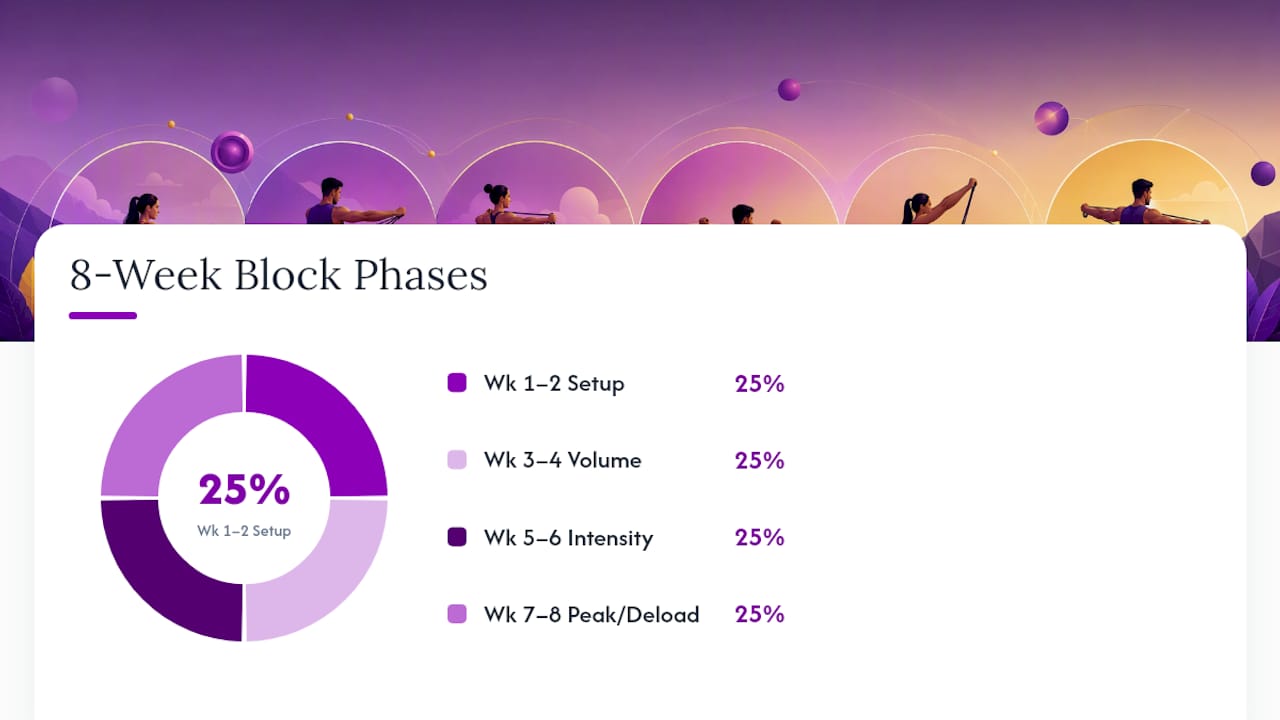
A workable 8-week block: weeks 1 and 2 adapt to the setup and lock in form. Weeks 3 and 4 push volume, adding reps toward the top of your range. Weeks 5 and 6 push intensity through stacking or a shorter working length. Weeks 7 and 8 peak, then deload with lighter tension and fewer sets before repeating the cycle.
Safety, Common Mistakes, and Breaking Plateaus
Bands fail differently than metal plates, and that changes how you inspect them. Check for thinning, cracking, or cloudy discoloration before every heavy session, and retire any band that shows visible wear rather than pushing it to its rated stretch limit.
Most band training goes wrong at the setup stage, not the rep. A Cochrane review of 121 trials covering elastic-band based resistance programs found real strength and function gains, but that only holds when the setup stays consistent session to session.
- Starting a rep with zero tension wastes the bottom of your range; aim for 20% to 30% starting tension so the entire movement is doing work.
- Inconsistent anchor points from one session to the next make your log meaningless, since you’re no longer comparing the same exercise.
- Skipping a light warm-up band before your working sets increases strain on tendons that bands load differently than free weights.
- Hitting a plateau doesn’t mean you need a heavier band immediately; change one variable, tempo, anchor angle, or volume, for 2 to 4 weeks before touching resistance level.
Bands also load stabilizer muscles and joints in a gentler way than free weights, which makes them a legitimate option for home-based training even when recovery or joint sensitivity is a concern, according to the same Cochrane data on progressive resistance training in older adults.
Where Diet & Exercise Products Fit Into This Plan
Every method above needs the right hardware to execute cleanly. Dietexerciseshop stocks a general-purpose loop band set built for stacking light and medium tensions, a tough latex band suited to heavier compound moves like rows and presses, and travel-friendly sets that keep your 8-week block on track when you’re away from home.
If you’re unsure which tension to start with, the resistance band levels guide breaks down how color coding maps to force output. Some suppliers also provide instructional resources paired with product pages, offering setup details for this kind of training.
What Actually Matters in Band Progression
Most band training advice treats resistance level as the only variable that counts, and that’s the part conventional wisdom gets wrong. The band you buy matters far less than how consistently you log your anchor point, stance, and tempo. Two lifters using an identical medium band can get wildly different results because one of them is quietly changing their foot placement every session and calling it “progress” when it’s just noise.
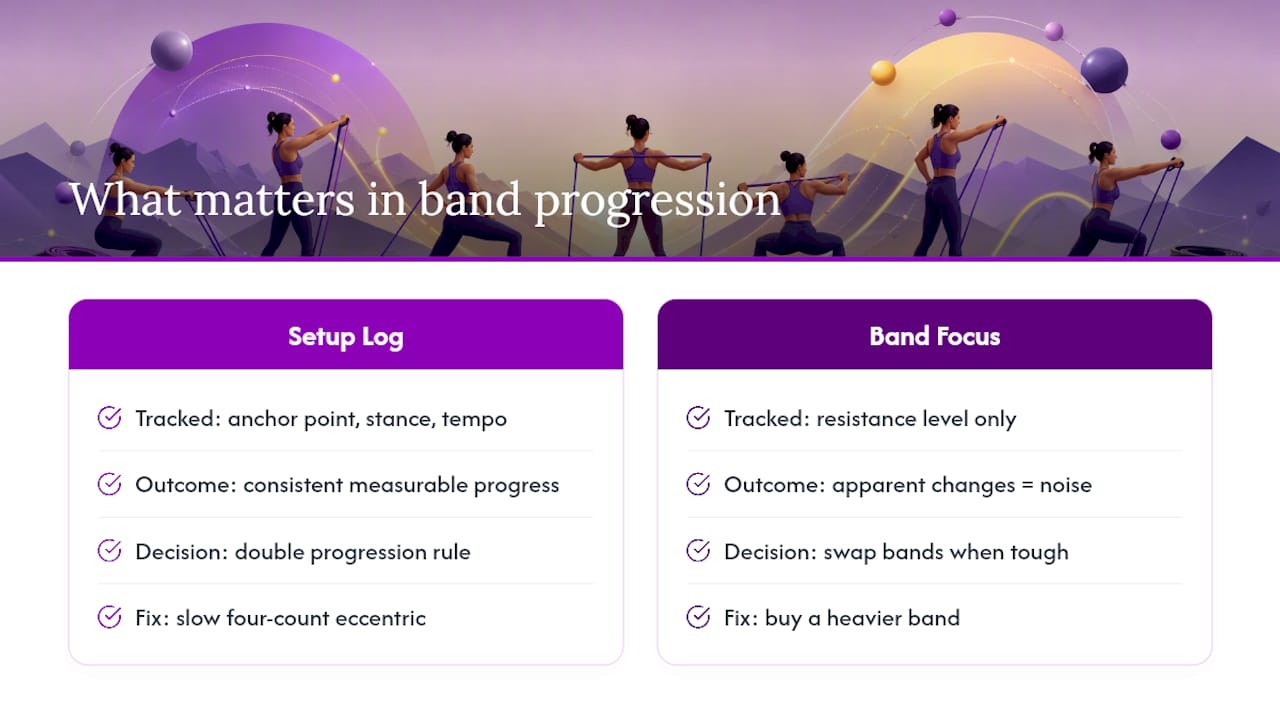
Prioritize the log before the next band purchase. If you can’t tell me exactly how you set up your last session, you can’t tell whether today’s set was harder, easier, or just different. Double progression works because it forces a decision point, hit the top of the rep range, then and only then increase tension, rather than swapping bands on a whim because a workout felt tough.
The eccentric tempo trick is the most underrated tool in this entire toolkit. Most people skip straight to buying a heavier band when a slower four-count lowering phase would have solved the same problem for free.
— Mark
Which Band Kit Actually Gets You Progressing
If you’re starting from zero, buy a three-band starter set with light, medium, and heavy options rather than a single band. Stacking only works when you have more than one tension to combine, and Dietexerciseshop’s pull-up assist and resistance band set gives you that range in one purchase.
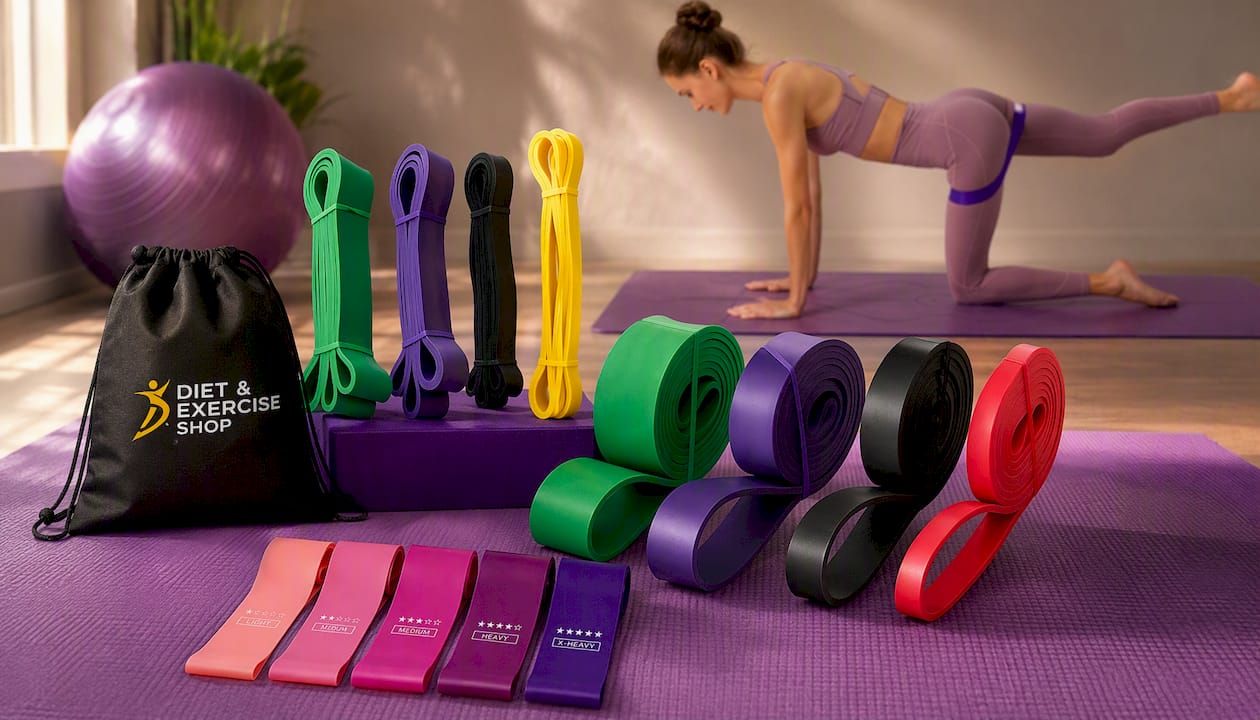
Once compound lifts like rows, presses, and squats start feeling manageable on the heaviest loop in your set, add a tough latex band built for higher-tension compound work rather than jumping to an awkward stack of three loops. For accessory movements and mini-band work, the strength resistance bands line covers flat-band variations that a loop set doesn’t.
If your training doesn’t stop when you travel, a travel-friendly band kit keeps your 8-week microcycle intact instead of forcing a reset every time you’re on the road. Look for sleeved bands if you’re anchoring heavy for pulling movements, since exposed latex against a door or rack edge is where most snapping incidents happen, and a simple door anchor gives you the angle variation the anchor-point method depends on — learn more about wrist wraps and straps for stronger lifts here. Browse the full fitness equipment and apparel collection to build out a kit that matches where you’re at right now.
Sources
- Progressive resistance strength training for improving physical function in older adults - PMC
- American College of Sports Medicine Position Stand. Resistance Training Prescription for Muscle Function, Hypertrophy, and Physical Performance in Healthy Adults: An Overview of Reviews
- How to Calculate Your Optimal Resistance Band Tension: Matching Band Strength to Exercise and Fitness Level for Progressive Overload | Unreliant
FAQ
Can You Really Build Progressive Overload With Resistance Bands?
Yes. Double progression, adding reps until you hit your target range, then increasing tension through stacking, shortening, or a stronger band, gives you a repeatable, measurable way to progress, and trial data on elastic-band training backs real strength gains from this approach.
What Exercises Work Best for Band-Based Progressive Overload?
Compound movements like rows, presses, squats, and deadlift patterns respond best because they let you manipulate anchor angle, stance, and stacking all in the same lift. Beginners can find setup cues in a guide to resistance band exercises.
What Is the 3-2-1 Progressive Overload Method?
Definitions of this method vary across sources, and it isn’t a standardized framework backed by the research reviewed here. Stick with double progression, rep range plus tension increase, since it has clearer support behind it.
What Are the Downsides of Resistance Bands Compared to Free Weights?
Bands have a variable resistance curve that peaks at full stretch rather than staying constant like a barbell, which makes exact load tracking harder without standardizing your anchor and stance every session. They’re also more prone to wear over time and need regular inspection for cracking or thinning, unlike a steel plate that doesn’t degrade.
Where Can I Find the Right Band for My Strength Level?
Dietexerciseshop’s resistance band levels guide breaks down color-to-tension mapping, and current pricing for individual bands and sets is listed on the site.