

Skip the Treadmill: Small Home Gym Plans for $105 to $805
A minimum viable small home gym costs a few hundred dollars and stores in under one square meter: a mat, a set of resistance bands, and adjustable dumbbells cover strength, mobility, and cardio warmups. If you upgrade one item first, make it the adjustable dumbbells. They deliver more training range per square foot than anything else you can buy.
TL;DR:
- Adjustable dumbbells offer the most space-efficient and versatile solution for progressing in strength training within a small home gym.
- Resistance bands, a good mat, and optional doorway pull-up bars form a complete minimal system costing roughly $220 to $430.
- For rooms under 25 square feet, targeted kits with resistance bands and a foldable mat are sufficient for basic bodyweight and band exercises.
- Larger setups up to 100 square feet include a bench, cardio options, and wall storage to accommodate more advanced training.
- Upgrading to a barbell and rack is recommended only when strength plateaus or programming requires heavier lifts, typically needing at least 6 by 8 feet of space.
Table of Contents
- What Counts as a Minimum Viable Small Home Gym?
- Adjustable Weights, Kettlebells, or Bodyweight: What Fits Your Space?
- How Do You Lay Out and Store Equipment in a Small Room?
- Sample Small Home Gym Setups by Footprint and Budget
- Budget Builds: Under $200, $500, and $800 Compared
- When Should You Upgrade to a Barbell, Rack, or Multi-Gym?
- What Do Trainers Actually Recommend for Home Setups?
- Staying Safe When You’re Training in Tight Quarters
- How Do You Keep Home Gym Equipment Lasting Longer?
- Building a Workout Program That Actually Uses Your Small Space
- Building a Small Home Gym You’ll Actually Use
- How Dietexerciseshop Helps You Build a Compact Home Gym
- Sources
- FAQ
What Counts as a Minimum Viable Small Home Gym?
You don’t need a garage full of iron to train seriously. You need three things that cover the movement patterns your body actually uses: pushing, pulling, hinging, and squatting, plus something to get your heart rate up.
Adjustable dumbbells sit at the top of that list. A single pair that ranges from 5 to 50 pounds replaces what would otherwise be six or seven fixed pairs stacked on a rack. Certified trainers and health organizations point to adjustable weights as the more cost- and space-efficient option for anyone without a spare room to dedicate to fitness. You get to progress in small increments instead of jumping straight from 15 pounds to 20, which matters more than most beginners realize.
Resistance bands round out the kit for pulling movements, shoulder work, and mobility. A set of fabric loop bands and a couple of tube bands with handles takes up less space than a shoebox and travels in a backpack, which is exactly why they show up on every list of the best resistance bands for travel. Bands also let you train around minor injuries by adjusting resistance angle instead of just swapping plates.
A quality mat is the piece people skip and regret. A thin $15 mat slides during lunges and offers no cushioning for floor work. Look for something at least 6mm thick with a non-slip bottom. It also does double duty as a visual boundary that marks your workout zone in a multipurpose room.
Here’s the full Tier 1 list:
- Adjustable dumbbells: moderate cost range
- Resistance band set: moderate cost range
- Exercise mat: moderate cost range
- Optional: doorway pull-up bar: moderate cost range
That’s a complete strength, mobility, and light-cardio system for roughly $220 to $430, and it packs into a closet corner. Add a jump rope for under $15 and you’ve got a warmup and conditioning tool that trainers who build their own home setups rely on for quick, high-intensity cardio without needing a treadmill.
Pro Tip: Buy bands in at least three resistance levels. A single band forces you to either overtrain your weak lifts or undertrain your strong ones. Three levels let one piece of equipment cover a squat, a row, and a shoulder press at the right intensity for each.
If you’re new to structuring workouts around minimal equipment, our guide on best home gym equipment for beginners breaks down exactly how to sequence these tools into a weekly routine.
Adjustable Weights, Kettlebells, or Bodyweight: What Fits Your Space?
The equipment decision that trips up most people isn’t what to buy first. It’s what to buy instead of something bulkier.
Adjustable dumbbells vs. fixed pairs. A fixed set that goes from 10 to 40 pounds in 5-pound jumps requires seven pairs of dumbbells and a rack to hold them. That’s a lot of floor space for something an adjustable pair handles in one compact unit. The tradeoff: adjustable dumbbells are slower to change between sets (you’re twisting a dial or pulling pins instead of just grabbing a different pair), and most people outgrow the top weight range within a year or two of consistent training. For a deeper breakdown of when each option makes sense, see our comparison of adjustable dumbbells vs. fixed weights.
Kettlebells are worth considering if your programming leans toward swings, carries, and single-arm work. A single 25 or 35 pound kettlebell takes up less space than a dumbbell rack and covers a different movement pattern than a barbell or dumbbell setup does.
Cardio equipment is where space gets tight fastest. A folding treadmill still needs roughly 30 to 60 inches of clearance when unfolded and a stable spot to store it upright. A foldable bike needs less, usually around 20 by 40 inches folded. If your room genuinely can’t fit either, a jump rope and a set of stairs solve most of the cardio problem for zero additional square footage.
Space-saving substitutes worth knowing:
- Resistance bands replace a cable machine for rows, presses, and pull-downs.
- A sturdy chair or low bench replaces a dedicated step platform for step-ups and dips.
- A weighted vest replaces a second set of dumbbells for loaded carries and bodyweight progressions.
- Suspension trainers (like a TRX-style strap) replace an entire rack of pulley equipment and store in a drawer.
How Do You Lay Out and Store Equipment in a Small Room?
Storage is the difference between a gym you use daily and a room that slowly turns into a place to dump laundry.
Vertical space is your biggest untapped resource. Wall-mounted racks, pegboards, and hooks are consistently recommended in compact home gym roundups because they reclaim floor space that horizontal storage bins waste. A pegboard above a workbench height can hold resistance bands, jump ropes, and lighter dumbbells within arm’s reach.
Here’s a practical setup sequence for a room under 100 square feet:
- Mount a pegboard or slat wall on the emptiest wall, roughly 48 inches wide, to hold bands and small accessories.
- Install two to three heavy-duty hooks rated for at least 20 pounds each for jump ropes and suspension trainers.
- Store adjustable dumbbells on a low shelf or dedicated stand, not stacked on the floor where they become a trip hazard.
- Keep a folding bench against the wall when not in use. Most fold to roughly 6 to 10 inches deep.
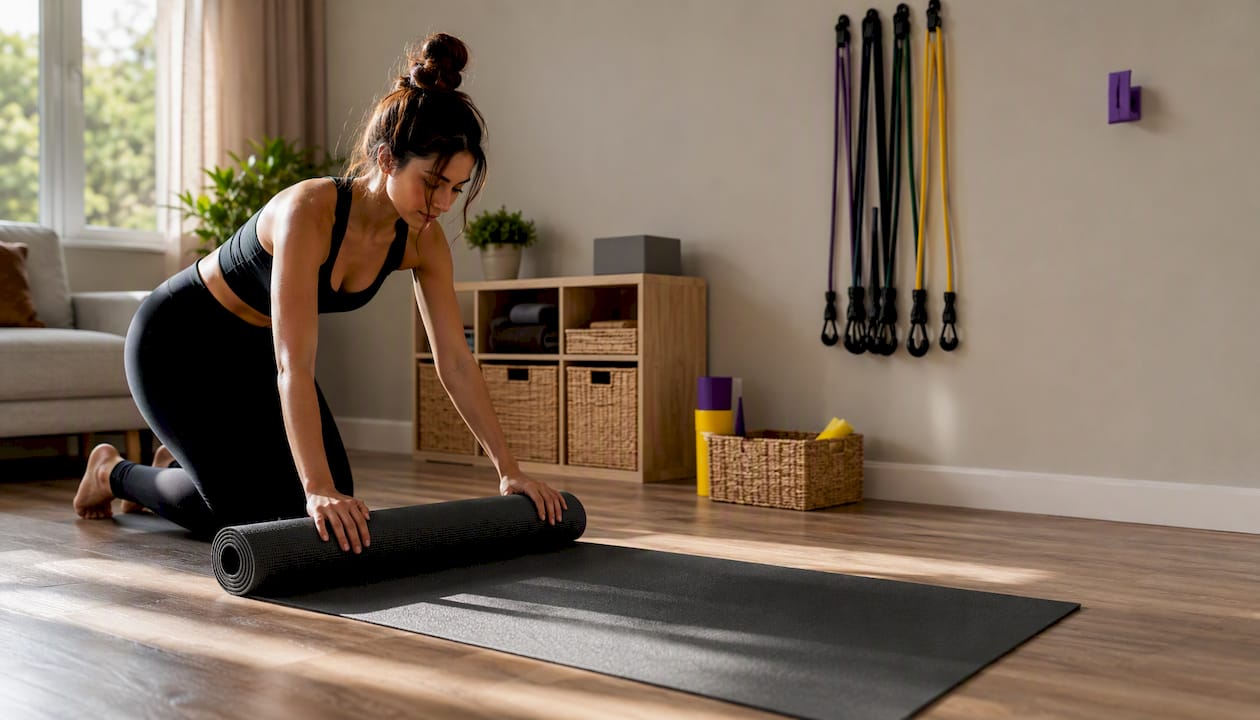
- Roll the mat and stand it in a corner, or leave it flat if the room serves no other purpose during the day.
Clearance guidance matters more than people expect. A folding treadmill needs about 3 feet of open space behind it for safe dismounting. A foldable exercise bike needs roughly 2 feet on each side for pedaling clearance. Adjustable dumbbells racked at floor level need at least 18 inches of open space in front to bend and lift safely.
For a multipurpose room, the mat itself can define the “gym zone.” Unroll it before you train, roll it up when you’re done, and everything else stays wall-mounted and out of the walking path.
Sample Small Home Gym Setups by Footprint and Budget
Three real-world builds, mapped to actual room sizes.
The micro setup (under 25 sq ft, like a closet corner or apartment nook)
- Resistance band set with door anchor
- Jump rope
- Foldable mat, 6mm
- Doorway pull-up bar
Total: around $105. Everything stores in a small bin or hangs on two wall hooks. This setup works for bodyweight circuits, band-resisted rows and presses, and rope conditioning. It’s the right starting point if you’re testing whether home training will actually stick before spending more.
The compact setup (25 to 60 sq ft, a spare bedroom corner or garage nook)
- Adjustable dumbbells
- Resistance band set
- Exercise mat
- Jump rope
- Wall-mounted storage rack
Total: around $380. This is the sweet spot for most people. The adjustable dumbbells handle presses, rows, lunges, and Romanian deadlifts, while bands fill in accessory work. Sketch the layout so dumbbells sit against the wall opposite your mat, giving you a clear rectangle to move through a full workout without rearranging anything mid-session.
The 100 sq ft setup (a dedicated small room)
- Adjustable dumbbells
- Resistance bands
- Foldable bench
- Foldable exercise bike or jump rope
- Wall storage system
- Mat
Total: around $655 to $805. At this footprint you can add a bench for chest presses and step-ups, plus a piece of cardio equipment if your program calls for steady-state work beyond jump rope intervals. This is also the point where a lot of people start eyeing a barbell setup, which the later section on upgrading covers directly.
Each tier builds on the last. You’re never throwing money away by starting small. The mat, bands, and dumbbells from the micro and compact builds carry forward into the 100 square foot version without modification.
Budget Builds: Under $200, $500, and $800 Compared
The order you buy in matters as much as what you buy. Here’s how the three common budget tiers stack up and what each unlocks.
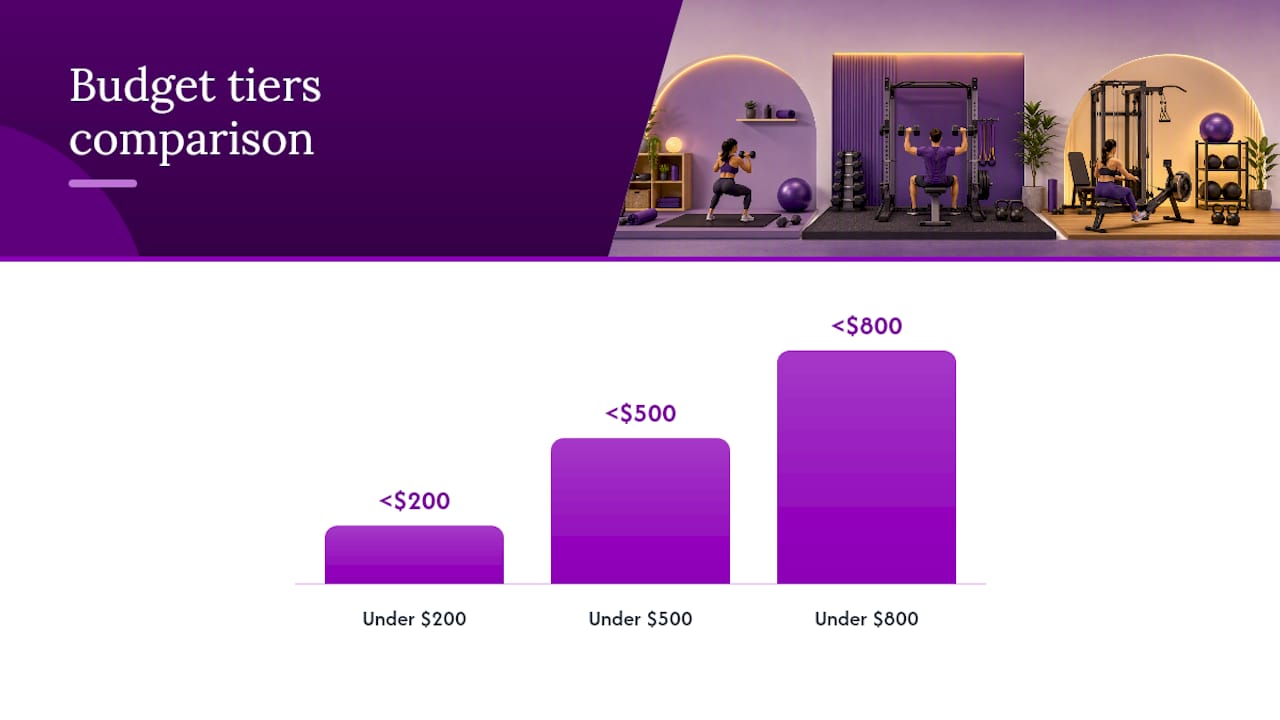
The decision rule for adjustable versus fixed weights is simple: under $500, adjustable dumbbells almost always win because a single unit replaces a rack of fixed pairs you can’t afford yet anyway. Once you’re spending $800 or more and know your training style well, a fixed pair in your most-used weight range (alongside the adjustable set) can speed up transitions during supersets.
Where to save: skip branded gym flooring tiles and buy a single quality mat instead. Where to splurge: don’t cheap out on the resistance bands. Thin latex bands snap within months under regular use, while durable, mid-priced fabric bands last years and don’t pinch skin during heavier pulls. Our roundup of home gym equipment essentials covers specific product picks at each price point if you want exact recommendations instead of ranges.
When Should You Upgrade to a Barbell, Rack, or Multi-Gym?
Three signals tell you your current setup has run its course. First, you’re maxing out your adjustable dumbbells on presses or rows and still have more strength to gain. Second, your program calls for barbell-specific lifts like back squats or deadlifts that dumbbells can’t safely replicate at higher loads. Third, you’re spending more time working around equipment limits than actually training.
A barbell, a set of bumper plates, and a squat rack typically need a footprint of at least 6 by 8 feet of clear floor space, plus overhead clearance of 7 feet or more. Budget for $600 to $1,500 depending on whether you buy a power rack or a simpler half rack, and whether you’re buying new or used plates.
If your space genuinely can’t accommodate that, you have two realistic paths. One is a hybrid approach: keep your compact setup for four or five sessions a week and use a local gym’s barbell section once or twice a week for heavy compound lifts. The other is borrowing garage space from a friend or family member who already has a rack, which costs nothing but a bit of coordination. Neither path means abandoning what you’ve already built. Your dumbbells and bands still handle accessory work and off-days regardless of where the heavy lifting happens.
What Do Trainers Actually Recommend for Home Setups?
Ask a certified trainer what separates people who stick with home training from people who quit, and the answer is rarely “better equipment.” It’s consistency, and consistency depends on gear that’s durable and easy to reach. A personal trainer writing for The Guardian made this point directly: the equipment sitting in professional trainers’ own homes tends to be simple, sturdy, and within arm’s reach, not expensive or elaborate.
That lines up with what shows up across every serious compact home gym guide: adjustable dumbbells, resistance bands, and a decent mat, over and over, because those three items get used regardless of mood or motivation on a given day.
Two habits make a measurable difference in whether you actually use what you’ve bought. The first is habit stacking: attach your workout to something you already do daily, like training right after your morning coffee or right before your evening shower. The second is what you might call the gear accessibility rule: if a piece of equipment takes more than 15 seconds to access, you’ll skip it more often than you’d like to admit. That’s the real argument for wall hooks and pegboards over storage bins buried in a closet.
If you want a structured plan rather than piecing together your own routine, our Functional Fitness eBook and the best home workout equipment for small spaces guide both build directly on these same priorities.
Staying Safe When You’re Training in Tight Quarters
Confined spaces change your injury risk profile, even with light equipment. The most common issue isn’t dropped weight. It’s collision: banging a knuckle on a wall mid-curl, clipping a shelf during a lunge, or losing balance because there’s no room to step out of a movement.
Before your first session, do a “range of motion sweep.” Stand in your workout zone and mimic your biggest movements (overhead press, lunge, squat, band row) without any weight, and check that your hands, feet, and head clear walls, shelves, and furniture by at least a foot in every direction.
Anchor points matter more in small rooms than large ones. If you’re using a doorway pull-up bar or a band anchor, check the manufacturer’s weight rating and re-test the anchor before every session, not just the first time you install it. A door frame that held fine for a 150-pound user can loosen after months of repeated stress.
Keep the floor clear between sets. It sounds obvious, but a dumbbell left mid-room after a superset is exactly what causes an ankle roll during the next exercise. Rack weights or set them against a wall the moment you’re done with them, every time.
How Do You Keep Home Gym Equipment Lasting Longer?
Cheap equipment fails fast, but even good equipment fails early without basic care.
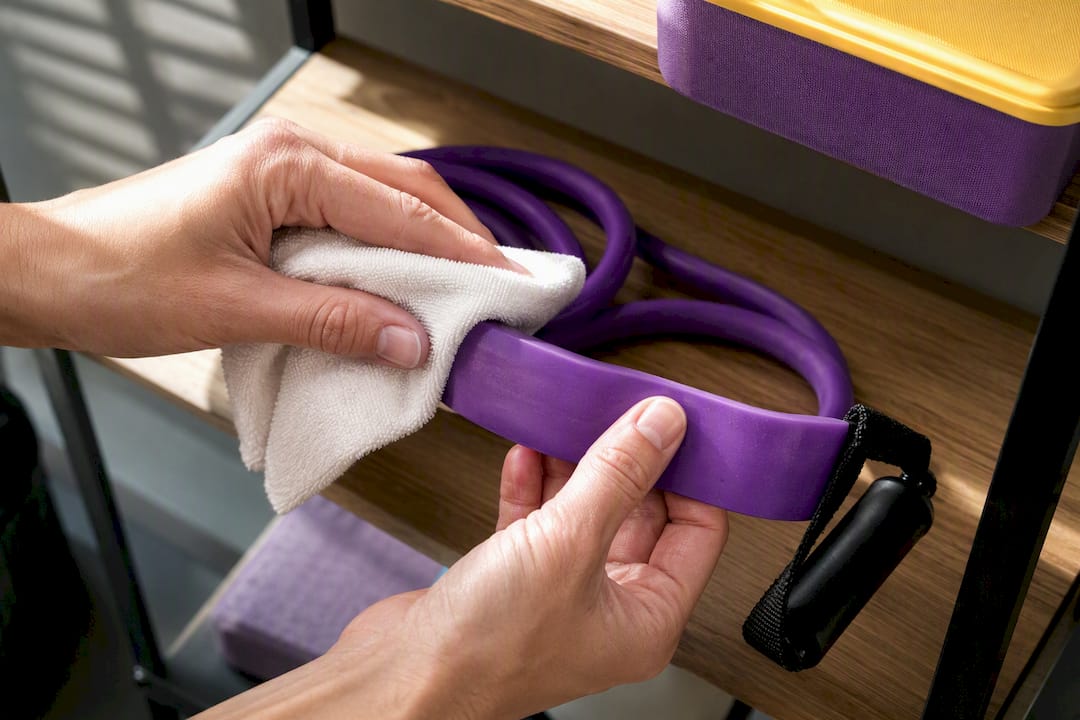
Resistance bands degrade from UV exposure and body oils faster than most people expect. Store them out of direct sunlight and wipe them down after sweaty sessions. A band that starts feeling sticky or shows tiny cracks near the handles is close to snapping. Replace it before that happens, not after.
Adjustable dumbbells with dial or pin mechanisms need occasional attention to the locking system. Grit and dust from a garage floor can jam the mechanism over time, so a quick wipe with a dry cloth every few weeks keeps the adjustment smooth. Check that plates seat fully before every set. A loose plate that shifts mid-lift is both a performance issue and a safety one.
Mats hold onto sweat and bacteria more than people realize. A wipe-down with a mild soap solution after heavy sessions, followed by air drying flat rather than rolled, extends the life of the surface and keeps it from developing that permanent gym-mat smell.
Pull-up bars and door anchors should be re-tightened monthly if you’re using them several times a week. Vibration from repeated use loosens screws and clamps gradually, and it’s the kind of maintenance that’s easy to forget until something slips.
Building a Workout Program That Actually Uses Your Small Space
The equipment only matters if the program built around it makes sense for what you actually have.
A full-body, three-day-per-week split works better than a traditional five-day body-part split in a small home gym, mostly because you’re not swapping through a dozen machines. One day of pushing-focused work (presses, dips), one day of pulling (rows, band pull-aparts), and one day of legs and hinge movements (squats, lunges, deadlifts with dumbbells) covers the same ground a gym membership would, just with fewer tools doing more work per session.
Progressive overload still applies, and it’s arguably easier to track with adjustable dumbbells than with gym machines, since you control the exact increment. Some exercise science research supports short, focused resistance sessions with gradually increasing load as producing real strength and metabolic adaptations, which matters when your instinct might be to assume a home setup can’t compete with a full gym.
Structure each session in three parts: a 5-minute jump rope or bodyweight warmup, 25 to 35 minutes of your main lifts using dumbbells and bands, and a 5-minute mobility cooldown using the same mat you trained on. That structure fits in roughly 40 minutes, which happens to be short enough to actually finish on a weeknight instead of getting cut short by dinner or bedtime.
Building a Small Home Gym You’ll Actually Use
Most people overbuy in their first month and underbuy on the one thing that matters most. I’ve seen the pattern repeat: someone drops $400 on a folding treadmill because it feels like “real” exercise equipment, then trains twice and lets it become a laundry rack. Meanwhile, the $60 pair of resistance bands they almost skipped gets used three times a week for a year.
If I were building this from scratch on a tight budget, here’s what I’d prioritize. Under $200, I’d skip the pull-up bar and put every dollar into a real mat and a three-tier resistance band set. Under $500, adjustable dumbbells are non-negotiable. They’re the one purchase that scales with you instead of becoming obsolete in six months. Under $800, I’d add a folding bench before I’d add a bike or treadmill, because a bench multiplies what you can do with dumbbells you already own.
The uncomfortable truth about home gyms is that the room isn’t what fails people. The routine is. Buy less than you think you need, and spend the difference on making the few things you do own painfully easy to grab and use.
— Mark
How Dietexerciseshop Helps You Build a Compact Home Gym
You’ve seen the equipment list. Now here’s the shortcut: instead of guessing which bands hold up or piecing together a program from scratch, Dietexerciseshop puts the shopping and the programming in one place, so you spend your budget on what works instead of on trial and error.
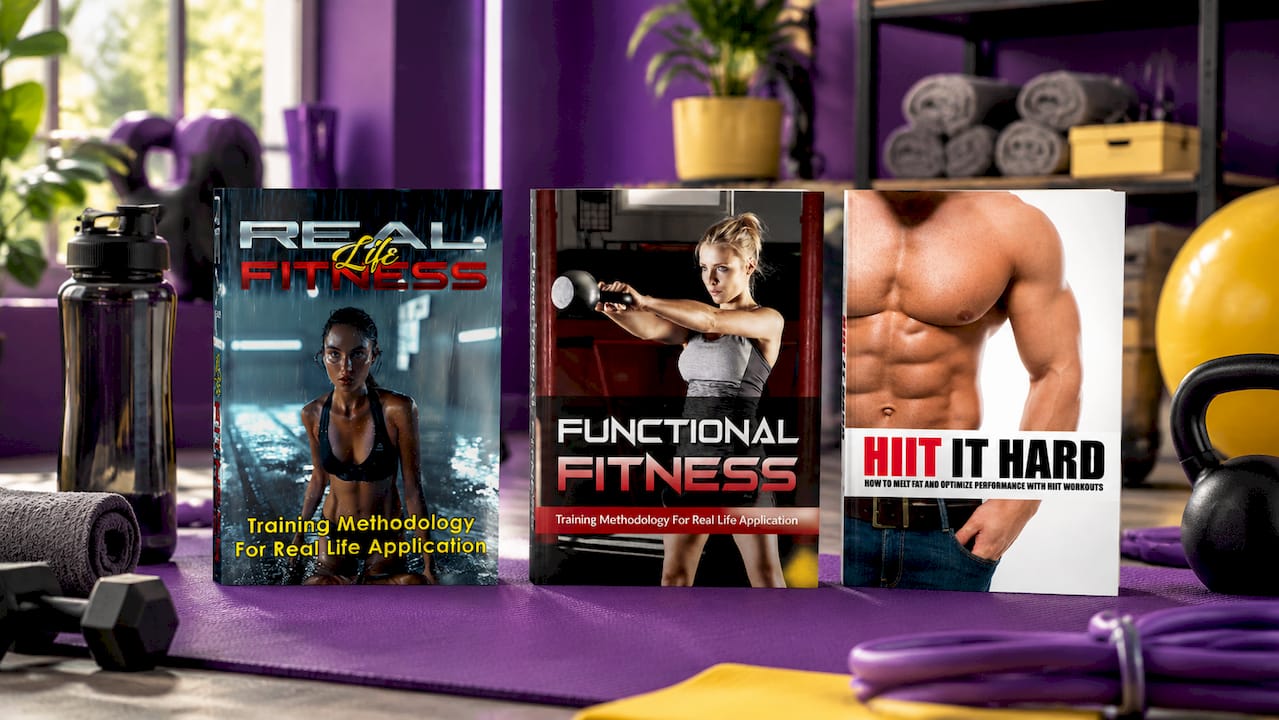
Our catalog includes resistance bands, adjustable dumbbells, mats, and other compact-space essentials suitable for smaller living areas. If you’d rather skip the guesswork on programming entirely, three digital guides do the heavy lifting. The Functional Fitness eBook builds full workouts around exactly the kind of minimal equipment covered here. Fitness Elements 101 breaks down essential movement patterns for anyone starting from zero. And the Real Life Fitness eBook tackles the scheduling problem, fitting training into a week that already feels full.
Browse the full digital guides collection to find the program that matches your goals, then pair it with gear from our small-space equipment picks to get training in a room you already have.
Sources
The equipment and safety guidance in this article draws on trainer-tested advice from The Guardian, equipment recommendations from Cleveland Clinic Health Essentials, compact setup roundups from WIRED, and storage design guidance from The Spruce.
For deeper equipment comparisons, read our breakdowns of exercise equipment for small spaces and adjustable dumbbells vs. fixed weights. If bodyweight and calisthenics programming interests you, the partner guide to calisthenics apps pairs well with a minimal equipment setup, and small space furniture ideas can help you make a multipurpose room feel intentional rather than cluttered.
- I’m a personal trainer. Here’s the exact equipment I use at home | The Guardian
- Best home gym equipment | Cleveland Clinic Health Essentials
- Best Home Gym Setup | WIRED
- Small home gym ideas | The Spruce
FAQ
What is the best home gym for a small space?
For most small spaces, the best setup is adjustable dumbbells, a resistance band set, and a quality mat. This combination covers strength, mobility, and light cardio in under one square meter of storage and typically costs $220 to $430.
Is a small home gym worth it?
Yes, for most people it’s worth it, since a minimum viable setup runs under $500 and delivers real strength gains when paired with consistent, progressively overloaded training. The bigger factor is whether you’ll actually use the equipment, which is why durable, easy-to-access gear matters more than expensive gear.
What is the 3-3-3 rule gym?
Definitions vary across fitness communities, but one common version refers to structuring a workout into three phases of three exercises each (often warmup, main lifts, and accessory work) to keep sessions short and organized. It’s not a standardized training principle, so treat it as a loose organizing framework rather than a strict rule.
What is the best small gym machine for home use?
If you only have room for one larger item beyond dumbbells and bands, a foldable exercise bike or a folding bench tends to offer the most versatility per square foot. A folding bench in particular expands what you can do with dumbbells you already own, from bench presses to step-ups.
How much does a minimum viable small home gym cost?
A functional starter kit, mat, resistance bands, and adjustable dumbbells, generally costs between $200 and $600 depending on weight range and brand, and stores in under one square meter of space.