

Avoid TSA Delays and Customs When Traveling With Supplements
Yes, you can travel with most supplements, in both carry-on and checked bags, without a doctor’s note or special permit. Keep them in carry-on when possible, follow the standard liquid and powder screening rules, and check your destination country’s customs list before you fly internationally. Label everything, and you’ll clear security without a second look.
TL;DR:
- Most solid supplements like pills and gummies face no quantity limits and can be carried in either checked or carry-on luggage without issue.
- Powdered supplements over 12 ounces may trigger extra screening and should be split into smaller, labeled packets or packed in checked bags.
- Liquids or gels exceeding 3.4 ounces require declaration for medically necessary reasons and should be packed in a quart-sized bag; labeling helps speed security.
- Temperature-sensitive supplements like probiotics and fish oil are best kept in carry-on bags to avoid heat degradation from tarmac storage.
- International destinations often restrict supplements or require specific import permits, so checking local customs rules and carrying original packaging or prescriptions is essential.
Table of Contents
- What Does TSA Actually Allow for Vitamins and Supplements?
- How Does the 12-Ounce Powder Rule Work?
- Should You Pack Supplements in Carry-On or Checked Bags?
- Are Your Supplements Legal at Your Destination?
- What Belongs in a Minimal Travel Supplement Stack?
- What Documentation Should You Pack Before You Leave?
- How Should You Time Supplements Across Time Zones?
- How Do You Manage Supplements During Long Flights and Layovers?
- A Publisher’s Take: What We’ve Learned Packing for Travel
- Travel-Ready Products That Make Packing Simpler
- Where to Verify the Latest Rules
- Sources
- FAQ
What Does TSA Actually Allow for Vitamins and Supplements?
Solid pills, capsules, gummies, and tablets face no quantity limit in either carry-on or checked luggage. TSA confirms vitamins are permitted in both bag types, though everything still passes through X-ray screening and an officer can ask to inspect a bottle by hand.
Liquid supplements, think fish oil in gel form that’s leaked, liquid B12, or a protein shake you mixed ahead of time, fall under the standard 3-1-1 rule: containers of 3.4 ounces or less, all fitting in one quart-size bag. Medically necessary liquids get an exception. TSA allows larger quantities of medically necessary liquids in carry-on as long as you declare them to the officer at the checkpoint before screening begins.
- Pills and capsules: no limit, either bag type
- Standard liquids: 3.4 oz max, one quart bag
- Medically necessary liquids: over 3.4 oz allowed if declared
- Everything: subject to X-ray and possible hand inspection
Quick fact: TSA officers have final discretion on any item at the checkpoint, even ones that technically meet the posted rules.
How Does the 12-Ounce Powder Rule Work?
This is where most travelers get tripped up. Powders, including protein powder, creatine, collagen, and pre-workout, aren’t capped at a specific amount, but powder-like substances above a certain size in carry-on trigger extra screening. TSA requires powders over that threshold to go in a separate bin for X-ray screening, and officers may open the container to check it directly. TSA’s own FAQ page backs this up, noting officers may ask you to open large powder containers for closer inspection.
That doesn’t mean protein powder is banned. It means a big tub sitting loose in your bag adds time to your screening.
- Bring single-serve protein packets instead of a full tub for short trips
- Pack bulk powder (over 12 oz) in checked baggage to skip the separate bin entirely
- Transfer unlabeled powder into a container with the product name written on it
- Keep the scoop with the container, not loose in a side pocket
Pro Tip: If you’re bringing a week’s worth of pre-workout or creatine, split it into daily-dose ziplock bags labeled with a marker. It looks less like an unidentified substance and screens faster than one giant tub.
Should You Pack Supplements in Carry-On or Checked Bags?
Carry-on wins for anything you can’t afford to lose or expose to heat. Checked bags sit on tarmacs that can hit well over 100 degrees Fahrenheit in summer, and cargo holds aren’t temperature-controlled the way cabins are. Probiotics and fish oil degrade faster under that kind of heat swing, so keeping them with you protects both your wallet and their effectiveness.
Original bottles aren’t legally required, but they solve problems before they start. A pill organizer works fine for daily vitamins on a short trip, but for anything unusual, a prescription-strength supplement, a compound with an odd name, or a powder without a clear label, the original bottle answers questions before an officer has to ask them.
- Take a photo of every supplement label before you repack it into a travel container
- Keep prescription-only or unusual compounds in their original bottle
- Transfer daily-use vitamins into a labeled pill organizer to save space
- Double-bag any liquid supplement, even ones under 3.4 ounces, to stop leaks and follow TSA-safe steps for packing liquids that apply well to supplements.
- Use a small insulated pouch for fish oil or probiotics on hot-weather trips
- Secure your protein scoop inside the container so it doesn’t rattle loose
Pro Tip: Write the supplement name and dose on a strip of tape and stick it to any container you transfer from the original bottle. If it leaks or gets questioned, you’ve already answered the “what is this” question.
Are Your Supplements Legal at Your Destination?
Clearing airport security at home means nothing once you land somewhere else. Customs rules run entirely separate from domestic screening, and plenty of countries restrict supplements that sit on every American drugstore shelf.
Melatonin is a common trip-up. Several countries classify it as a prescription drug, not a supplement. CBD products, certain herbal extracts, and stimulant-containing pre-workouts get flagged in various countries too, and the list changes by destination. Rules vary widely from country to country, and something perfectly legal to fly with domestically can get confiscated, or worse, at a foreign border. Some destinations require a specific import permit, like Japan’s Yakkan Shoumei certificate, for otherwise-ordinary medications and supplements brought in personal quantities.
- Check the destination country’s customs or embassy website before you pack
- Carry a prescription or clinician letter for anything that might be flagged
- Bring only personal-use quantities, not bulk supplies, for restricted categories
- Declare supplements at customs if the arrival form asks about medications
- Keep items in original packaging when crossing an international border
What Belongs in a Minimal Travel Supplement Stack?
You don’t need your entire home shelf. A short list covers most travel problems: disrupted sleep, a compromised immune system from recycled airplane air, and digestion thrown off by unfamiliar food and water.
A low-dose melatonin (where legal at your destination) helps reset your clock after a long-haul flight. A shelf-stable probiotic strain supports digestion without needing refrigeration, which matters since hotel mini-fridges are inconsistent at best. Zinc and vitamin C are the standard immune-support pairing many travelers reach for during cold and flu season. Magnesium helps with muscle cramping on long flights and can ease travel-related constipation. Electrolyte powder packets fight the dehydration that comes standard with cabin air.
- Sleep: low-dose melatonin, where legal, in tablet or gummy form
- Digestion: shelf-stable probiotic capsules, no refrigeration needed
- Immune support: zinc and vitamin C, single-serve packets or chewables
- Recovery: magnesium tablets for cramping and sleep quality
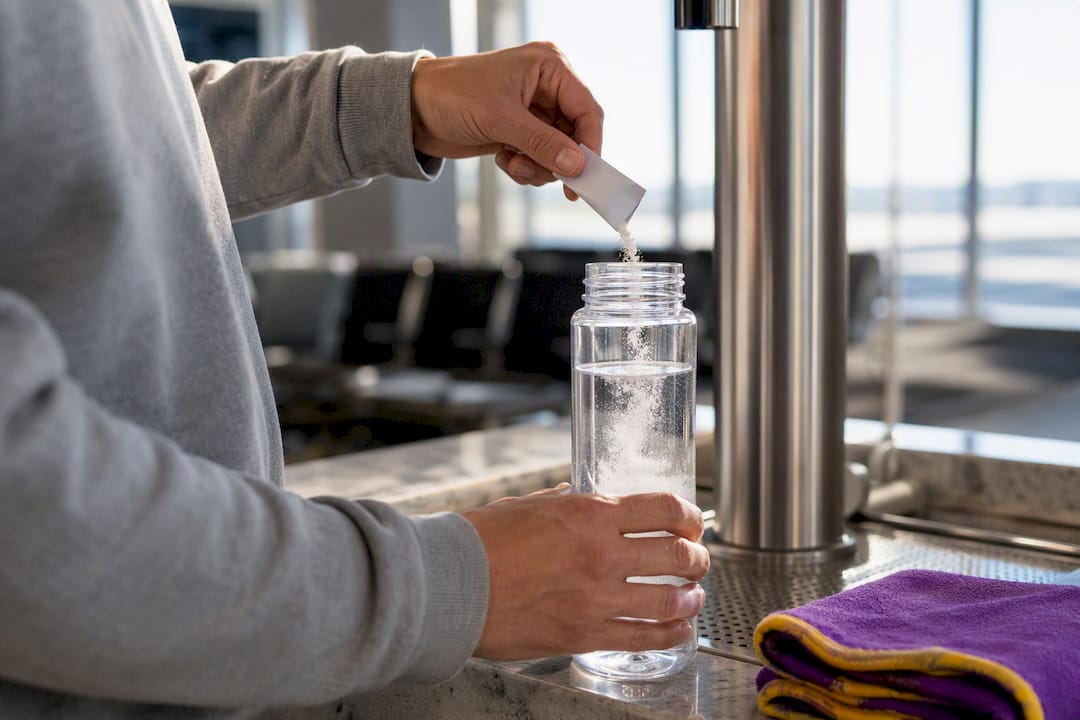
- Hydration: electrolyte powder sticks for long flights or hot climates
For a short trip, stick to your daily essentials only. For anything over a week, add the recovery and electrolyte items. Shelf-stable spore-forming probiotic strains hold up to travel conditions far better than refrigeration-dependent strains, so check the label before you buy travel-specific probiotics.
What Documentation Should You Pack Before You Leave?
A little prep work at home saves a lot of standing around at a checkpoint. Before departure, run through this short list.
- Photograph every supplement label and the ingredient list, and save the images to your phone
- Print a simple sheet listing each supplement, its dose, and why you take it
- Request a prescription or clinician letter for any prescription-only or unusual compound
- Pause subscription shipments or reroute deliveries if you’ll be gone longer than your next order cycle
- Keep original packaging for anything with an ingredient name a customs officer might not recognize
None of this takes more than fifteen minutes, and it’s the difference between a five-second glance at security and a pulled-aside conversation about what’s in your bag.
How Should You Time Supplements Across Time Zones?
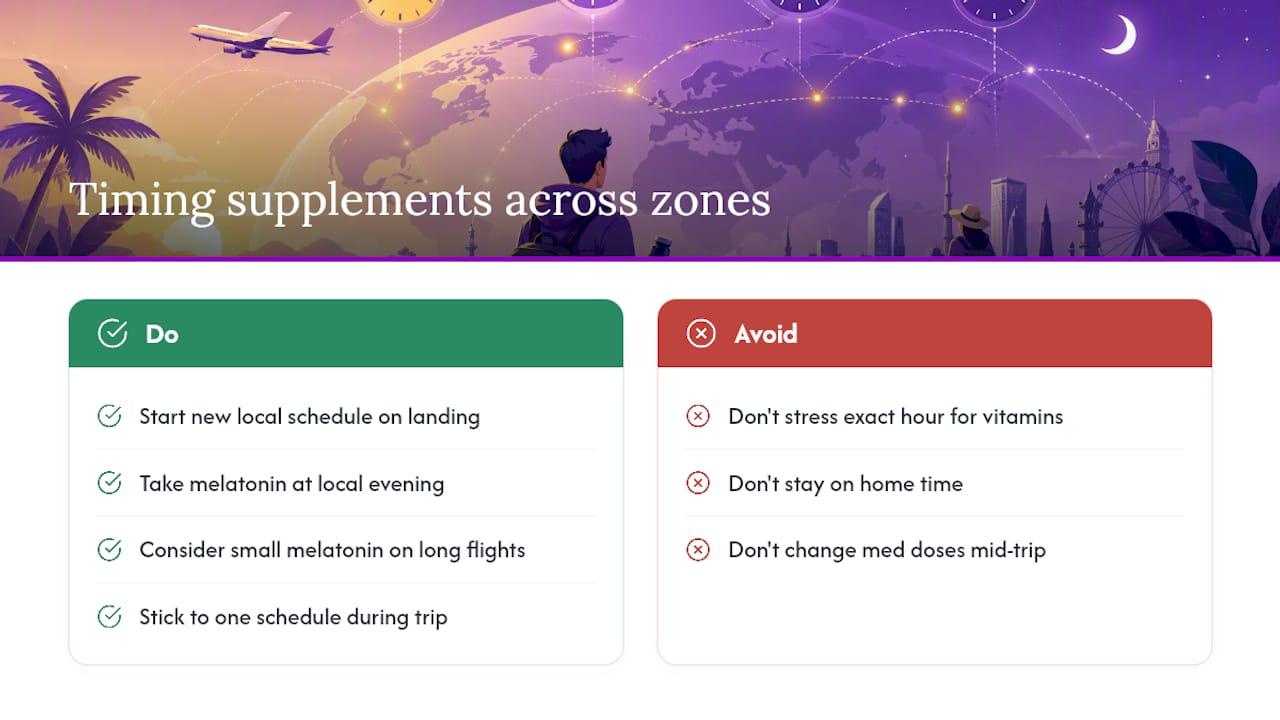
Crossing time zones scrambles more than your sleep schedule. It scrambles when your body expects its usual dose, and getting that wrong can blunt the whole point of taking the supplement in the first place.
The simplest fix: anchor timing to local time at your destination, not your home clock, starting the moment you land. If you take magnesium before bed, take it at your new local bedtime on night one, even if your body insists it’s the middle of the afternoon. This nudges your internal clock toward the new schedule instead of dragging out the adjustment.
Melatonin is the one exception worth handling differently. Taken at your destination’s local evening time, starting the first night, it works with your body’s natural shift rather than fighting your home schedule. Some travelers take a small dose during the flight itself if they’re crossing more than five or six time zones, timed to when it would be evening at the destination.
Daily vitamins and probiotics are far more forgiving. A few hours off in either direction won’t undo their benefit, so don’t stress over hitting an exact hour. What matters more is consistency once you’ve landed: pick a new local time and stick to it for the rest of the trip rather than drifting back and forth between two schedules.
If you’re on a strict medical dosing schedule, that’s a different conversation entirely, and one worth having with your doctor before you fly, not after you land confused about whether to take a dose during a layover.
How Do You Manage Supplements During Long Flights and Layovers?
Cabin air runs drier than most deserts, sitting around 10 to 20 percent humidity compared to a typical 30 to 65 percent at ground level. That dry air, combined with hours of immobility, is exactly why hydration and absorption both take a hit on long-haul flights.
Water first, supplements second. Taking magnesium, zinc, or any capsule with too little water on a dehydrated body slows absorption and can leave you with mild stomach discomfort at 35,000 feet, which is the last thing you want three hours into a nine-hour flight. Aim for a full glass of water with any capsule or tablet, not just a sip.
During layovers, this is your window to actually eat something real and take supplements you skipped on the aircraft. Electrolyte powder packets work well here since layover terminals almost always have a water fountain or a place to buy a bottle. If your itinerary spans two or three flight segments in one day, plan supplement timing around your longest layover rather than trying to squeeze a dose into an aisle seat during turbulence.
Skip alcohol and go light on caffeine if you’re taking magnesium or melatonin for sleep. Both interfere with how well those supplements work, and both are already dehydrating you further at altitude.
A Publisher’s Take: What We’ve Learned Packing for Travel
Every supplement question we get boils down to the same anxiety: will this get flagged? After years of writing about protein powder storage and supplement basics for people trying to stay consistent on the road, the pattern is clear. The travelers who avoid hassle aren’t the ones with the fewest supplements. They’re the ones who labeled everything before they left home.
We offer eBooks and a travel-friendly product lineup inspired by that same lesson. If your workout doesn’t need a full gym, your supplement stack doesn’t need a full medicine cabinet either. Pack for the trip in front of you, not your entire routine.
— Mark
Travel-Ready Products That Make Packing Simpler
This online store provides options to simplify packing with a compact stack of essentials and a digital guide that suggests what to bring and when to take it.

The FITNESS ELEMENTS 101 eBook breaks down supplement basics in plain language, useful for anyone building a travel stack for the first time. The FUNCTIONAL FITNESS eBook covers keeping a routine intact away from your usual gym setup, which pairs naturally with a well-packed supplement bag. Browse the supplements collection for travel-friendly formats before your next trip, and if you want a shirt that survives airport lines and gym floors equally well, the TURNIP THE GAINS T-Shirt is a solid pick for the plane.
Start with the eBook, build your stack from there, and pack once instead of twice.
Where to Verify the Latest Rules
TSA’s own pages on vitamins and protein or energy powders stay current with any policy changes, so check them before a trip if it’s been a while since your last flight. For international travel, the Nutrola guide on customs rules for supplements covers country-specific restrictions in more depth. Always cross-check your destination’s embassy or customs site directly for the most current entry requirements.
This article is general information, not a substitute for advice from a qualified doctor. Consult a qualified healthcare professional about your own circumstances before acting on anything here.
Sources
- Vitamins | Transportation Security Administration - TSA
- Traveling With Supplements: TSA & Customs Guide | Nutrola
FAQ
Do supplements have to be in original containers when flying?
No, TSA doesn’t require original containers for domestic flights. Original bottles help avoid questions at security or international customs, especially for prescription-only or unusual compounds.
What’s the best way to travel with supplements?
Pack solids in carry-on with labels intact, keep liquids under 3.4 ounces or declare medically necessary exceptions, and check any bulk powder over 12 ounces in your checked bag or split it into smaller packets.
Can I fly with vitamins in a Ziploc bag?
Yes, vitamins and pills can go in a Ziploc bag in carry-on or checked luggage with no quantity limit, though a labeled bag speeds up screening if an officer takes a closer look.
Can I take supplements through airport security?
Yes, most solid supplements, liquids under 3.4 ounces, and powders under 12 ounces pass through standard screening without issue, though everything is still subject to X-ray and possible hand inspection.