

Start With 10–20 lb Dumbbells: Rep-Tested Weights for Beginners
Most beginners land somewhere between 10 and 20 pounds per dumbbell for a working starter range, though the right pick depends heavily on the exercise. Run the rep test to confirm it: choose a weight, do your target reps, and check whether the last 2 to 3 reps feel genuinely hard while your form stays clean. If you cruise through every rep, go heavier next time. If your form breaks down early, drop the weight. Compound lower-body lifts like squats require considerably more load than an upper-body isolation move like a lateral raise.
TL;DR:
- Beginners should choose dumbbells based on the exercise: heavier weights for lower-body compound lifts and lighter weights for isolation moves, with adjustments made via the rep test.
- The appropriate starting weight generally ranges from 5 to 20 pounds, depending on the movement and individual strength, with heavier loads reserved for large muscle groups.
- Progression involves increasing weight gradually by 2 to 5 pounds for small movements and 5 to 10 pounds for compound lifts once sets become easy and form remains perfect.
- Age and injury history require starting lighter, prioritizing pain-free, controlled reps, and consulting health professionals before increasing load.
- Using an adjustable dumbbell set simplifies progress and ensures appropriate load without acquiring multiple fixed weights.
Table of Contents
- How Do You Choose Dumbbell Weight for Your Goal?
- How Does the Exercise Change Which Dumbbell You Pick?
- What Are Good Starter Weights by Exercise and Experience Level?
- When Should You Increase Your Dumbbell Weight?
- Who Decided Dumbbell Weight and Health Guidance for This Article?
- How Should Age and Fitness Level Change Your Dumbbell Weight?
- How Should You Pick Dumbbell Weight After an Injury?
- What Actually Matters Most When Choosing a Dumbbell Weight
- What Starter Gear Actually Helps You Get Going?
- Sources
- FAQ
How Do You Choose Dumbbell Weight for Your Goal?
The rep range you’re training in should decide the weight of the dumbbell, not the other way around. Fitness authorities generally agree that endurance, hypertrophy, and strength each call for a different intensity, and picking the wrong weight for your goal is one of the most common reasons people plateau.
Here’s how the three main goals break down in practice:
- Endurance training uses lighter weights with higher reps per set and multiple sets. Fatigue rather than strain ends the set.
- Hypertrophy training focuses on moderate weights and reps, typically involving a moderate rep range suited to most beginners.
- Strength training uses heavier weights with lower reps and longer rest; this involves high intensity often based on a substantial proportion of your one-rep maximum.
If percentages of your one-rep max sound abstract, and for most beginners they are since nobody’s testing a true max in week one, use rate of perceived exertion instead. Aim for a 6 or 7 out of 10 on most working sets. That translates to “I could maybe squeeze out two or three more reps, but I wouldn’t want to.” The last-rep rule from The Manual’s dumbbell guidance works as a simpler stand-in: the correct weight lets you finish your reps with the final two or three feeling genuinely challenging but still controlled. No shaking, no swinging the weight, no borrowing momentum from your hips.
One mistake shows up constantly with beginners, especially women who’ve been told (wrongly) to stick to light weights forever: picking a single weight and using it for everything. A 10 pound dumbbell might be perfect for lateral raises and far too light for goblet squats. Match the weight to the goal, and match both to the specific exercise.
How Does the Exercise Change Which Dumbbell You Pick?
Muscle size and joint mechanics decide how much weight a movement can handle, which is why the same person might curl 12 pounds and squat with 30. Larger muscle groups working through a bigger range of motion simply tolerate more load.
- Compound lower-body lifts demand the most weight. Goblet squats, Romanian deadlifts, and split squats recruit your quads, glutes, and hamstrings, some of the largest muscle groups in the body, so these moves typically require heavier loads than anything you’ll do for your arms. Beginners often start goblet squats with a moderate weight per dumbbell or with a single heavier weight held with both hands.
- Upper-body compound moves sit in the middle. Bent-over rows and dumbbell chest presses use multiple joints and several muscles at once (back, chest, shoulders, and triceps), landing most beginners somewhere around 10 to 15 pounds per hand.
- Isolation moves need the least weight, and that’s fine. Lateral raises, biceps curls, and triceps kickbacks work one muscle through a smaller range of motion. Five to ten pounds is a realistic starting point, and going lighter here isn’t a failure. It’s correct programming.
Because your arms will never keep pace with your legs, one pair of dumbbells rarely covers a full workout. This is the practical case for either owning a couple of weight pairs or investing in an adjustable dumbbell set that lets you dial the load up or down between exercises without cluttering a closet with eight sets of fixed weights.
What Are Good Starter Weights by Exercise and Experience Level?
The table below covers seven common dumbbell moves with beginner, intermediate, and advanced starting ranges, which vary based on individual body size, training history, and exercise. Treat these as a launch point, not a ceiling. Your actual number will land somewhere in the range based on body size, training history, and how the rep test feels on day one.
| Exercise | Beginner | Intermediate | Advanced |
|---|---|---|---|
| Biceps curl | Lower range suitable for many beginners | Moderate weight for regular trainers | Higher weights for advanced lifters |
| Shoulder press | Lower range suitable for many beginners | Moderate weight for regular trainers | Higher weights for advanced lifters |
| Goblet squat | Moderate starting weight for most beginners | Increased weight for intermediate | Heavier loads for advanced |
| Chest press | Moderate starting weight for beginners | Increased weight for intermediate | Heavier loads for advanced |
| Deadlift (dumbbell) | Moderate starting weight for beginners | Increased weight for intermediate | Heavier loads for advanced |
| Lateral raise | Lighter range for beginners | Moderate range | Heavier weights for advanced |
| Bent-over row | Moderate starting range | Intermediate range | Higher range for advanced |
Read this alongside the rep test, not instead of it. Start at the bottom of your column, run a set, and watch your form on the last few reps. If your elbows flare out on a shoulder press or your lower back rounds on a deadlift, the number on the dumbbell is less important than fixing the movement first.
When Should You Increase Your Dumbbell Weight?
Progressive overload, the gradual increase in weight or reps over time, is the mechanism that actually builds strength, and skipping it is one of the fastest ways to plateau or get hurt trying to catch up later. The trick is increasing weight in small, controlled steps rather than big jumps that wreck your form.
Watch for these three signs before you add weight:
- Your target reps feel noticeably easier than they did two weeks ago.
- You’ve hit clean, controlled reps for two consecutive workouts at the same weight.
- Your form hasn’t changed even though the set felt easier.
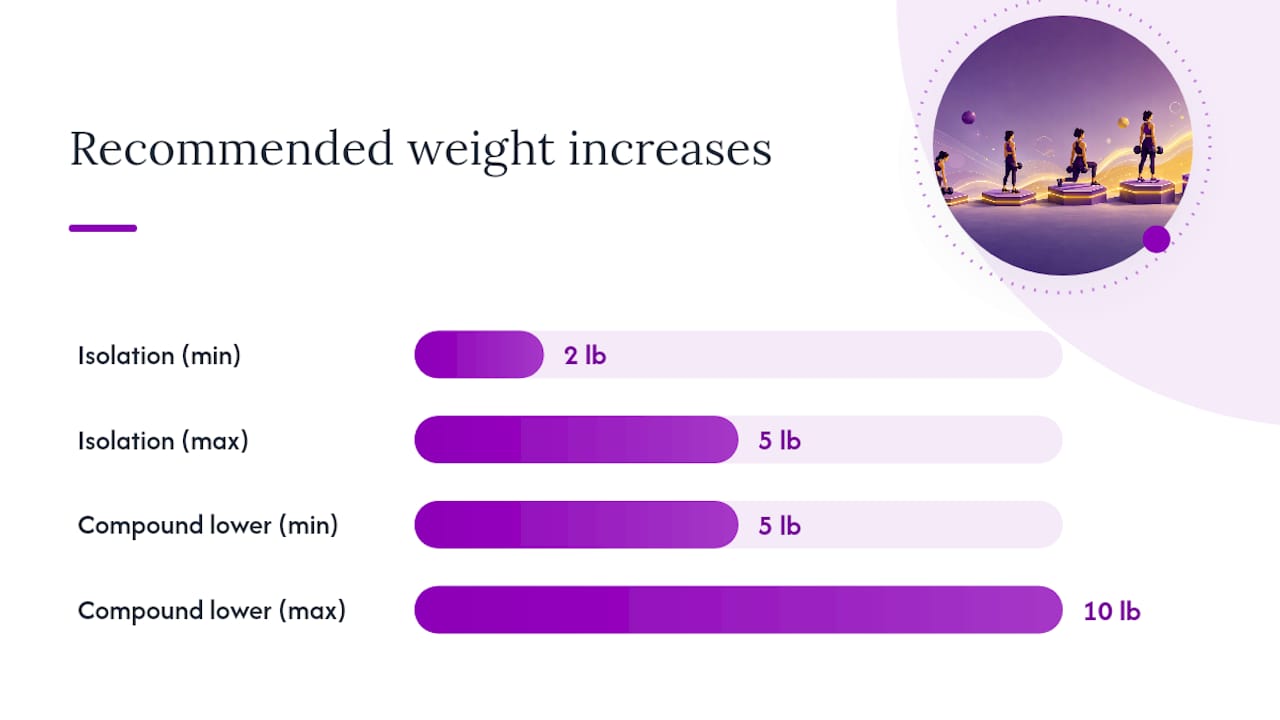
When those boxes check, add 2 to 5 pounds for smaller-muscle isolation moves like curls or lateral raises, and 5 to 10 pounds for larger compound lower-body lifts like squats or deadlifts. Retest every 4 to 6 weeks, or sooner if two workouts in a row feel suspiciously easy. Beginners tend to adapt fast in the first month or two, so don’t be surprised if you’re bumping weights sooner than you expected.
Pro Tip: Log your weights and reps for every session in a notes app or a cheap notebook. It sounds tedious, but “12 reps at 15 pounds, easy” written down beats trying to remember whether last Tuesday felt harder than this one.
The failure mode to avoid is jumping weight because a number sounds more impressive, not because your body earned it. A 20 pound dumbbell that turns your third rep into a shoulder-shrugging mess is doing more harm than a 15 pound dumbbell you can control cleanly for all twelve.
Who Decided Dumbbell Weight and Health Guidance for This Article?
This guide was put together by Mark for Dietexerciseshop, drawing on beginner strength research and practical rep-testing frameworks rather than a one-size-fits-all chart. Resistance training carries documented benefits at every age; the National Institute on Aging points to strength training as a key tool for maintaining muscle and function over the long term, which is part of why picking an appropriate starting weight matters more than picking an impressive one.
If you’re ready to put a plan together, Dietexerciseshop’s guide to choosing between adjustable and fixed dumbbells walks through which setup fits a home gym best, and the best dumbbells for a home gym roundup covers specific models and increments. Once you’ve got weights in hand, a structured dumbbell workout plan turns the numbers in this article into an actual weekly routine.
How Should Age and Fitness Level Change Your Dumbbell Weight?
Age changes recovery capacity and joint tolerance more than it changes your ceiling for strength. A 55-year-old beginner and a 25-year-old beginner might land on nearly identical starting weights, but the older lifter usually needs more recovery time between sessions and a slower pace increasing load, particularly on overhead and rotational movements where shoulders take the brunt.
Fitness level matters even more than age alone. Someone returning to exercise after a long break, regardless of how strong they used to be, should start closer to the beginner end of the ranges above and rebuild the movement pattern before chasing the weight they remember lifting years ago. Muscle memory helps you regain strength faster than a true beginner, but tendons and connective tissue adapt more slowly than muscle does, so easing back in protects joints that haven’t handled load in a while.
For older adults specifically, adding resistance training to a regular routine is linked to longevity and cardiovascular benefits, which is a strong argument for starting light and consistent rather than skipping dumbbells altogether out of caution. The goal at any age is the same rep test: reps that challenge you without wrecking your form on rep ten.
How Should You Pick Dumbbell Weight After an Injury?
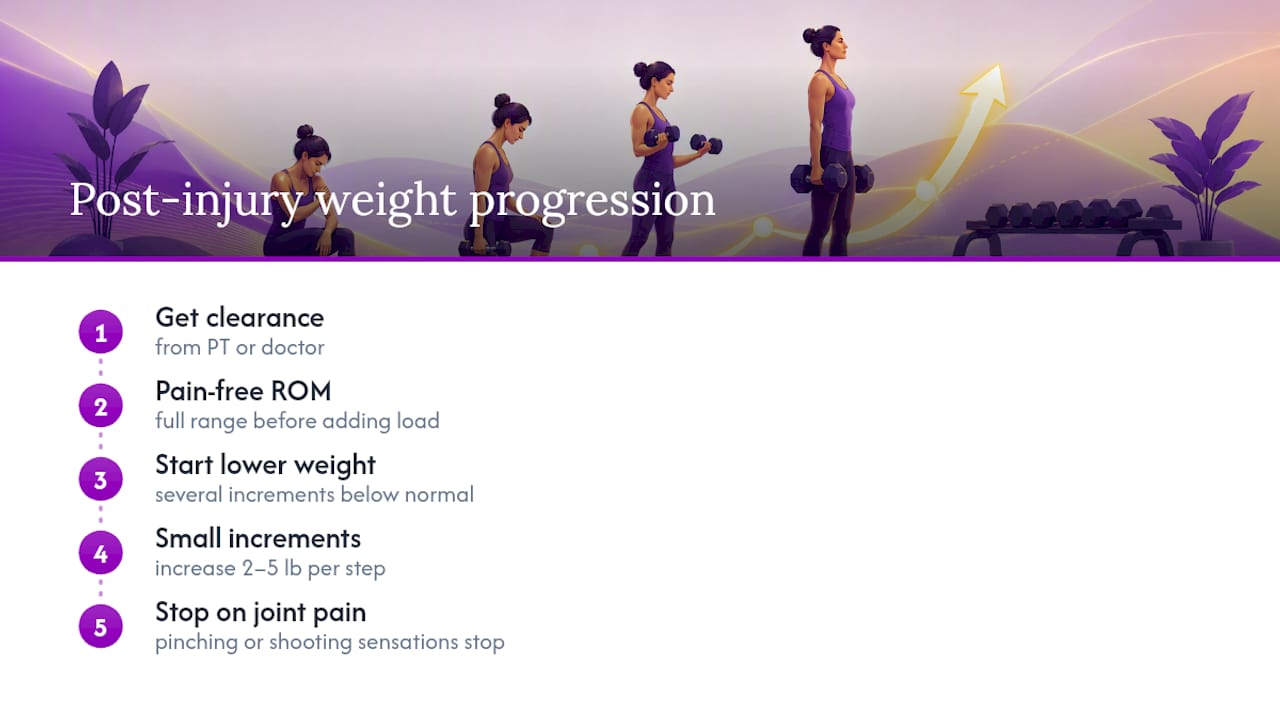
Injury history changes the math on weight selection more than almost any other factor. If you’re rehabbing a previous injury, or training around a joint that’s given you trouble before, drop below the standard beginner range and prioritize full, pain-free range of motion before adding load. A shoulder that’s had issues, for instance, might need a 5 pound dumbbell on overhead presses long after your other lifts have progressed to 15 or 20 pounds.
Pain during a rep, sharp or otherwise, is a stop signal, not a “push through it” signal. Discomfort from muscular fatigue is normal; a pinching or shooting sensation in a joint is not. If a movement consistently triggers pain at a given weight, drop the weight before you drop the exercise entirely, since a lighter, well-controlled version usually beats cutting the movement out completely.
This is also where working with a physical therapist or a doctor pays off, particularly for anyone returning from surgery or a significant injury. They can flag specific ranges of motion or loads to avoid that a general fitness guide simply can’t account for. Once cleared, apply the same rep test used throughout this article, just starting several increments lower than you would otherwise, and progress in the smaller 2 to 5 pound increments even on moves that would normally call for bigger jumps.
What Actually Matters Most When Choosing a Dumbbell Weight
The advice that gets repeated most often, “just pick something that feels challenging,” is technically true and practically useless. It gives a beginner no way to check their own work. What the research and the rep test both point to is something more specific: form failure is the real ceiling, not the number stamped on the dumbbell.
I think the fitness industry has done women in particular a disservice by pushing a permanent light-weight lane, when the actual data on rep ranges says the same principles apply regardless of who’s holding the dumbbell. If you can hit your target reps with the last two feeling hard but controlled, that’s the correct weight for you, full stop.
Prioritize the exercise-specific ranges over a single “my weight” number, since your squat and your lateral raise should never share a dumbbell. And retest more often than feels necessary. Beginners adapt fast, and clinging to a weight that’s become too easy wastes weeks you could spend actually progressing.
— Mark
What Starter Gear Actually Helps You Get Going?
Grabbing the right weight is only half the equation. Dietexerciseshop built its starter lineup around exactly the gap most beginners hit: knowing the range but not having the gear or the plan to act on it. A small adjustable set covers most of the ranges in the table above without you buying five pairs of fixed dumbbells you’ll outgrow in a month.
Pair your dumbbells with something that keeps you showing up, because motivation fades faster than muscle soreness does. The BRO, DO YOU EVEN LIFT? T-Shirt and the GYM HAIR DON’T CARE T-Shirt are small, low-cost ways to make the mirror moment fun instead of a chore. If you want a real structure behind the weights, not just a number to lift, the FORTIFY YOUR SUCCESS WITH HEALTHY HABITS Mini Course walks you through building the habit itself, which is usually the harder part. Start with the course, pick your weights using the rep test above, and check back in four to six weeks to retest.
Sources
- How can strength training build healthier bodies as we age | NIA
- Adding weight lifting to workouts may boost longevity | Harvard Health
- What dumbbell weight should I use? | The Manual
- Beginner dumbbell program | StrengthLog
FAQ
How Do I Know What Weight Dumbbells I Need?
Run the rep test: pick a weight, do your target reps for that exercise, and check whether the last two or three feel challenging but controlled. If every rep feels easy or your form breaks down early, adjust the weight and retest.
Is a 20 Pound Dumbbell Good for Beginners?
It depends entirely on the exercise. A 20 pound dumbbell often works well for a beginner goblet squat or deadlift, but it’s usually too heavy for isolation moves like lateral raises or biceps curls, where 5 to 10 pounds is more realistic starting out.
Do I Need Dumbbells Heavier Than 50 Pounds?
Most beginners and even many intermediate lifters won’t need very heavy weights for upper-body work, though compound lower-body lifts like goblet squats require considerably more load as you advance. An adjustable dumbbell set lets you grow into heavier loads without buying new fixed pairs every few months.
Is 25 Pounds of Dumbbells Enough to Build Muscle?
Yes, for many exercises and especially early in training, 25 pound dumbbells can absolutely build muscle, since hypertrophy depends more on training close to muscular fatigue in the 6 to 12 rep range than on hitting a specific number on the weight. As you adapt, plan to increase load by 2 to 5 pounds on isolation moves or 5 to 10 pounds on compound lifts to keep progressing.