

Your Complete Body Recomposition Plan: Lose Fat, Build Muscle
Here is the short version you can act on today. Eat at a slight calorie deficit below your total daily energy expenditure (TDEE), hit 0.7–1.0 grams of protein per pound of bodyweight daily, and train with resistance 3–4 days per week using progressive overload. The first metric worth watching is your strength on key compound lifts, not the scale.
Start here:
- Calculate your TDEE using a free online calculator (search “TDEE calculator”) and subtract 200–300 calories to set your daily target.
- Set your protein goal first: multiply your bodyweight in pounds by 0.7–1.0 to get your daily gram target, then build the rest of your meals around it.
- Pick a 3–4 day training split (full-body 3x or upper/lower 4x work well for most people starting out).
- Take baseline photos and measurements today: waist circumference, hip circumference, and bodyweight. These matter more than the scale alone.
- Log your first workout and record the weights used. That log becomes your roadmap for progressive overload.
Key Takeaways
A body recomposition plan works when you combine a 200–300 calorie deficit, 0.7–1.0 g of protein per pound of bodyweight, and 3–4 days of progressive resistance training per week.
| Point | Details |
|---|---|
| Calorie deficit | Set intake 200–300 calories below TDEE to lose fat without sacrificing muscle. |
| Protein target | Hit 0.7–1.0 g per pound of bodyweight daily, spread across 3–5 meals. |
| Training frequency | Train 3–4 days per week with compound lifts and progressive overload every session. |
| Progress tracking | Track strength, waist circumference, and photos; use a 7-day rolling weight average. |
| When to switch strategies | If recomposition stalls after 8–10 weeks of solid adherence, shift to a dedicated cut or bulk. |
| Dietexerciseshop | Structured eBooks, courses, and apparel at Dietexerciseshop support every phase of the plan. |
This article is general information, not a substitute for advice from a qualified doctor. Consult a qualified healthcare professional about your own circumstances before acting on anything here.
Table of Contents
- What is a body recomposition plan and how does it work?
- Who gets the best results and what timelines are realistic?
- How should you structure your workouts for recomposition?
- Two ready-to-use multi-week recomposition programs
- Nutrition that actually supports fat loss and muscle gain
- How to track progress without obsessing over the scale
- Recovery and lifestyle factors that move the needle
- Common mistakes that stall a recomposition plan
- Practical resources and next steps
- The part most people get wrong about recomposition
- Dietexerciseshop has the tools to make this plan stick
- Sources
- FAQ
What is a body recomposition plan and how does it work?
Body recomposition means shifting your ratio of fat to lean muscle without necessarily changing your total bodyweight much. You lose fat and gain (or preserve) muscle at the same time, which can cause the scale to remain relatively unchanged for weeks while your body changes shape.
The physiology comes down to three levers: calorie balance, protein intake, and mechanical stimulus from resistance training. A modest calorie deficit signals your body to pull energy from stored fat. High protein provides the amino acids needed for muscle-protein synthesis, the process by which muscle fibers repair and grow after training. Resistance training delivers the mechanical tension that triggers that repair signal in the first place.
The reason an aggressive deficit undermines recomposition is straightforward. Cut calories too hard and your body lacks the raw material to synthesize new muscle protein, so it breaks down existing muscle for fuel instead. A small calorie deficit keeps fat loss moving while leaving enough energy for muscle retention and modest gains.
The key insight: recomposition does not require a special protocol. It requires a modest deficit, enough protein to protect muscle, and a training stimulus strong enough to demand adaptation. Get those three right and the process works. According to the Cleveland Clinic, pairing strength training with sensible dietary adjustments is the foundation of any realistic recomposition approach.
Who the physiology favors:
- Beginners whose muscles respond strongly to any new resistance stimulus.
- Returning lifters benefiting from muscle memory, which accelerates regain
- People carrying moderate excess body fat, since stored fat supplies energy that partially offsets the deficit
Who gets the best results and what timelines are realistic?
Examine’s research synthesis is direct on this: recomposition works best for beginners, returning lifters, and people with meaningful body fat to lose. Lean, highly trained lifters typically see better results by choosing a dedicated cut or bulk rather than trying to do both simultaneously.
You are a strong recomposition candidate if:
- You are new to structured resistance training (within your first 12–18 months)
- You are returning after a break of several months or more
- Your body fat is above roughly 20% (men) or 28% (women)
- You are postpartum and returning to training after a significant layoff
You may do better with a dedicated cut or bulk if:
- You have trained consistently for 3-plus years with minimal fat to lose
- Your primary goal is a competitive physique or sport-specific strength peak
- Progress on recomposition has stalled for 8–10 weeks despite good adherence
Realistic timelines: expect the first visible changes in body shape around weeks 4–6, with meaningful strength gains appearing earlier. Scale weight may barely move for the first 4–8 weeks. That is normal. The signal to watch is waist circumference trending down while strength trends up. Slow, steady progress over 12–16 weeks beats a dramatic 4-week sprint that burns out muscle along with fat.
How should you structure your workouts for recomposition?
Train 3–4 days per week with compound lifts as the backbone of every session. That frequency hits each muscle group often enough to drive hypertrophy while leaving room for recovery in a calorie deficit. Research indexed on PubMed supports training each muscle group at least twice per week for optimal hypertrophy outcomes.
Choosing your weekly split
- 3-day full-body: best for beginners and anyone with limited schedule flexibility. Each session hits squat, hinge, push, pull, and carry patterns.
- 4-day upper/lower: suits intermediate lifters who want more volume per session. Upper days pair pressing and rowing; lower days pair squatting and hinging.
- Push/pull/legs (3 or 6 days): works well for intermediate lifters who want more exercise variety, though 6-day PPL is aggressive in a deficit.
Exercise selection priorities
Lead every session with 2–3 compound movements: squats, deadlifts, Romanian deadlifts, bench press, rows, overhead press, pull-ups. Accessories (curls, lateral raises, tricep work) come after, not before. Compound lifts recruit more muscle mass per set, which means more total stimulus and more calories burned per minute of training.
Rep ranges and weekly volume
| Goal | Rep Range | Sets per Muscle per Week |
|---|---|---|
| Strength base | 3–6 reps | 6–10 |
| Hypertrophy focus | 6–12 reps | 10–20 |
| Muscular endurance | 12–20 reps | 10–16 |
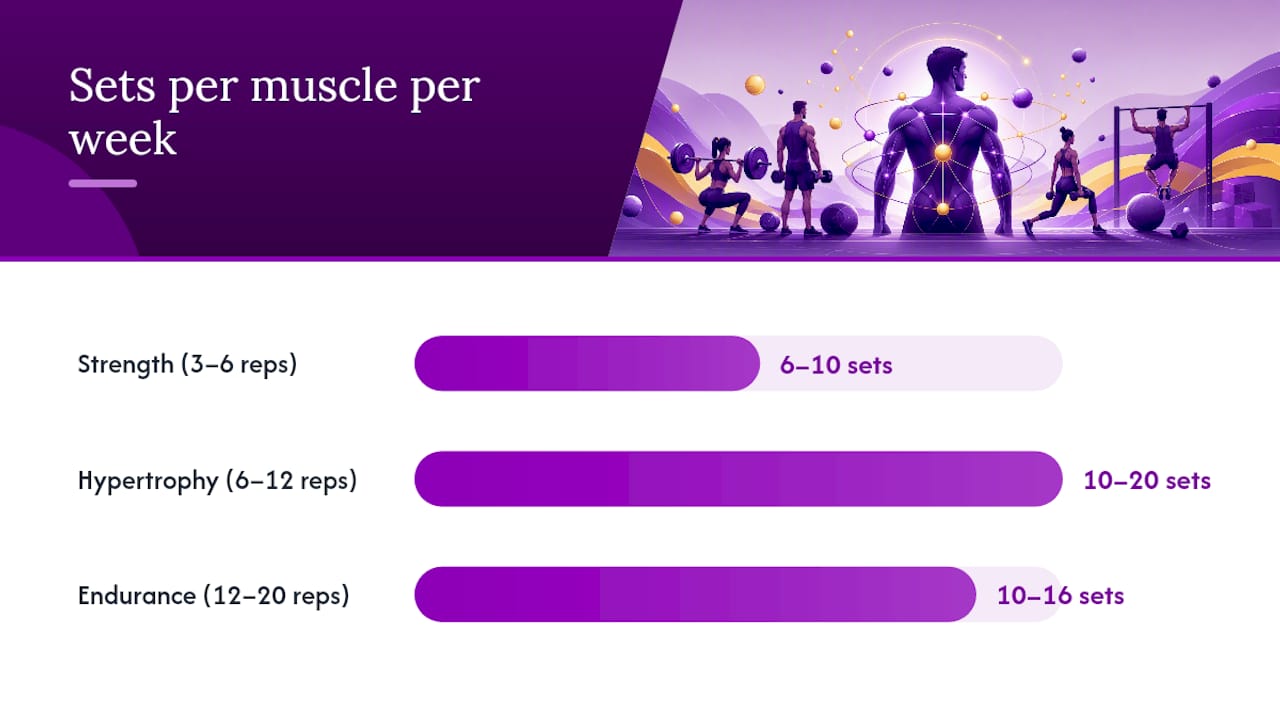
Aim for 10–16 working sets per muscle group per week, spread across your training days. You can build a workout routine from scratch using this framework if you prefer a fully customized approach.
Progression strategies
Log every session. Add weight when you can complete all prescribed reps with 1–2 reps left in reserve (RPE 7–8). If you cannot add weight, add one rep per set. If neither is possible, that is a recovery signal, not a programming failure.
Pro Tip: On your heaviest compound sets, keep 1–2 reps in reserve rather than training to failure. In a calorie deficit, failure sets spike fatigue without proportionally increasing the growth signal, and recovery is already slower than in a surplus.
Two ready-to-use multi-week recomposition programs
How to choose between the 6-week and 8-week templates
Choose the 6-week plan if you are newer to structured training, want a clear endpoint to evaluate before adjusting, or have a specific event in 6 weeks. Choose the 8-week plan if you have 6–18 months of consistent training history and want more time to accumulate volume and see meaningful strength progress. Both use the same phase logic; the 8-week version simply extends the build phase.
6-week recomposition template (3-day full-body)
Phase 1: Ramp (Weeks 1–2) Focus: learn movement patterns, establish baseline loads, keep RPE at 6–7.
- Day 1: Squat 3×8, Romanian deadlift 3×10, bench press 3×8, seated row 3×10, plank 3×30 sec
- Day 2: Rest or 20–30 min low-intensity cardio (walk, bike)
- Day 3: Deadlift 3×6, overhead press 3×8, pull-up or lat pulldown 3×8, dumbbell lunge 3×10 each
- Day 4: Rest
- Day 5: Goblet squat 3×10, dumbbell row 3×10 each, push-up variation 3×12, hip thrust 3×12, farmer carry 3×30 m
- Days 6–7: Rest or light activity
Phase 2: Build (Weeks 3–4) Add one set to each main lift. Increase load by 5 lbs (upper body) or 10 lbs (lower body) where possible. RPE target: 7–8.
Phase 3: Consolidate (Weeks 5–6) Hold volume steady. Push intensity: aim for the top of each rep range before adding weight.
8-week recomposition template (4-day upper/lower)
Phase 1: Ramp (Weeks 1–2): Same structure as above, split across upper and lower days. Phase 2: Build (Weeks 3–5): Add sets and load progressively; introduce one optional accessory day. Phase 3: Peak (Weeks 6–7): Highest volume block; track personal records on main lifts. Assess progress before deciding next steps.
Scaling notes:
- If you miss more than two sessions in a week, repeat that week rather than advancing.
- If a lift stalls for two consecutive weeks, drop the load 10% and rebuild.
- For home training, beginner-friendly home workout routines offer solid regressions for every movement pattern above.
For sport-specific scaling or athlete-focused modifications, the body recomposition guide for athletes covers additional programming considerations.
Nutrition that actually supports fat loss and muscle gain
The short version: eat 200–300 calories below TDEE, get 0.7–1.0 g of protein per pound of bodyweight, and hit 30–38 g of fiber daily. Everything else is detail.
Calculating your calorie target
Find your TDEE using a calculator that accounts for your activity level, then subtract 200–300 calories. That is your daily target. A 500-calorie deficit, standard for pure fat loss, is too aggressive for recomposition because it compromises the energy available for muscle-protein synthesis. When fat loss stalls for two consecutive weeks despite adherence, return to maintenance for 1–2 weeks before resuming the deficit.
Protein targets and meal distribution
Men’s Health nutrition guidance recommends 1.6–2.2 g of protein per kilogram of bodyweight (roughly 0.7–1.0 g per pound) spread across meals. Distributing protein across 3–5 meals rather than concentrating it in one or two sittings supports more consistent muscle-protein synthesis throughout the day.
Good protein sources: chicken breast, Greek yogurt, eggs, cottage cheese, canned tuna, lean beef, tofu, and protein powder to fill gaps.
Fiber: the underrated adherence tool
Fiber target: Mayo Clinic guidance recommends 30–38 g of fiber daily for men and around 25 g for women. Hitting that range in a calorie-restricted plan helps control appetite, slows digestion, and supports gut health, all of which improve long-term adherence. Beans, lentils, oats, berries, and vegetables are the fastest routes there.
For between-meal hunger, high-protein snack ideas that also hit fiber targets make adherence significantly easier.
Supplements worth considering
- Creatine monohydrate (3–5 g/day): well-supported for strength and lean mass retention; safe and inexpensive.
- Protein powder: a practical tool when whole-food protein is inconvenient, not a replacement for it.
- Caffeine: useful pre-workout for performance, but not a fat-loss shortcut.
Skip fat burners, testosterone boosters, and any compound marketed as “recomposition-specific.” The evidence does not support the cost.
How to track progress without obsessing over the scale
Prioritize these four signals in order: strength on key lifts, weekly rolling average bodyweight, waist circumference, and progress photos. Use DEXA or a reliable body-composition tool periodically for a deeper read.
Measurement schedule:
- Baseline (Day 1): photos (front, side, back), waist and hip circumference, bodyweight (morning, fasted), and key lift maxes.
- 4-week check: repeat all measurements. Expect small changes. Strength up 5–10% and waist down 0.5–1 inch is a solid 4-week result.
- 8-week evaluation: full reassessment. This is your decision point: continue recomposition, shift to a cut, or shift to a lean bulk based on where you are.
DEXA scans give the most accurate body-composition data available outside a research lab, typically costing $50–$150 per scan at imaging centers across the United States. The CDC’s physical activity measurement guidance is also useful for tracking daily movement and NEAT alongside training data. One scan at baseline and one at 8–12 weeks is enough to see meaningful change without overspending.
Pro Tip: Creatine loading and high-carb days cause water retention that can add 2–4 lbs to the scale overnight. Never judge a week’s progress from a single morning weigh-in. Use a 7-day rolling average instead, and you will see the actual trend clearly.
Recovery and lifestyle factors that move the needle
Recovery is not optional in a calorie deficit. Training breaks muscle down; sleep and rest days build it back up. Shortchange recovery and you lose the muscle you are working to build.

Sleep: aim for 7–9 hours per night. Sleep is when growth hormone peaks and muscle-protein synthesis runs at its highest rate. Dropping below 6 hours consistently blunts both fat loss and muscle retention.
NEAT (non-exercise activity thermogenesis): the calories you burn walking, fidgeting, and moving through daily life often exceed your gym calories. Keeping daily steps at 7,000–10,000 meaningfully increases total energy expenditure without adding training stress. A simple pedometer or phone step counter is enough to track it.
Stress management: chronically elevated cortisol promotes fat storage (particularly around the abdomen) and suppresses muscle-protein synthesis. Short daily practices like a 10-minute walk, breathing exercises, or consistent sleep timing reduce cortisol more reliably than occasional long recovery sessions.
Deload weeks: schedule a lighter week every 4–6 weeks, or whenever you notice two or more of these signs:
- Strength dropping on lifts you were previously progressing
- Persistent soreness that does not resolve between sessions
- Poor sleep despite low training volume
- Motivation to train dropping sharply
Keep the movement patterns. You come back stronger.
Common mistakes that stall a recomposition plan
Most recomposition plans fail for one of four reasons, and all four are fixable.
- Deficit too large: cutting 500-plus calories daily while training hard leads to muscle loss, not just fat loss. Pull back to 200–300 calories below TDEE.
- Protein too low: anything below 0.7 g per pound of bodyweight leaves muscle protein synthesis underfueled. Audit your actual intake for three days before assuming you are hitting your target.
- No progressive overload: doing the same weights for the same reps week after week gives your body no reason to adapt. Log every session and add load or reps consistently.
- Ignoring recovery: training 6–7 days per week in a deficit without deload weeks accumulates fatigue faster than the body can clear it.
Red flags that warrant a plan change or professional input:
- Losing more than 1.5 lbs per week consistently (likely losing muscle, not just fat)
- Strength dropping on all main lifts for 3-plus consecutive weeks
- Persistent fatigue, mood disruption, or hormonal symptoms (irregular cycles, libido changes, hair loss)
- Any clinical symptom that does not resolve with a maintenance week
Quick corrections to try first: add 200 calories back for one week, run a 3-day protein audit, or take a full maintenance week before escalating to a coach or physician.
Practical resources and next steps
Getting the plan on paper is step one. Having the tools to execute it consistently is what separates people who see results from people who restart every few weeks.
Ready-to-use assets to set up today:
- A simple training log (notebook or spreadsheet) with columns for date, exercise, sets, reps, and load
- A weekly meal template with your protein and calorie targets pre-filled for each meal slot
- A measurement checklist (bodyweight, waist, hips, key lift numbers) for your 4-week and 8-week check-ins
Expand your knowledge with Dietexerciseshop resources:
- Beginner diet and workout plan — solid foundation for anyone new to structured training
- Best exercises for beginners — technique primers for the compound movements in the sample plans
- Best home gym equipment for beginners — gear guide for readers training at home
- Dietexerciseshop eBooks and digital guides — structured plans and templates you can download and use immediately
When to hire a coach: if you have been following a recomposition plan for 12-plus weeks with good adherence and progress has stalled completely, a qualified coach can identify the specific bottleneck faster than trial and error. The same applies if you have a medical condition that affects metabolism or body composition.
The part most people get wrong about recomposition
Most fitness content frames recomposition as a hack, a shortcut, or a secret protocol for people who cannot commit to a real cut or bulk. That framing is wrong, and it sets people up to quit.
Recomposition is actually the harder path in one specific way: the feedback loop is slow. The scale barely moves. Progress photos look similar week to week. Strength goes up, but not dramatically. For someone used to seeing rapid scale drops on a crash diet, this feels like failure. It is not.
The people who succeed at recomposition are not the ones with the best program. They are the ones who trust a slow process long enough to see it work. Six weeks of consistent training, adequate protein, and a modest deficit will change your body composition measurably, even if the scale says otherwise. Eight weeks will change it more. The program matters less than the consistency.
One thing worth saying plainly: the protein target is not negotiable. Every other variable in a recomposition plan has some flexibility. Protein does not. If you hit nothing else from this article, hit your daily protein target. The rest follows from there.
Dietexerciseshop has the tools to make this plan stick
Knowing what to do is one thing. Having the right resources at hand when motivation dips is another. Dietexerciseshop’s structured eBooks and digital guides give you printable templates, phased programs, and nutrition frameworks you can follow without building everything from scratch. If you want a guided course format, the online courses walk you through the process step by step.

And if you want to show up to the gym with the right mindset already on, the MEAL PREP & MUSCLE REPS Hoodie and the TRUST THE PROCESS T-Shirt are built for people who take both their training and their nutrition seriously. Browse the full eBook library and pick the plan that fits your timeline.
Sources
- Examine research feed
- Mayo Clinic — High-fiber foods: Helps manage hunger and gut health
- Men’s Health — Body recomposition nutrition guide
- Cleveland Clinic — What to know about body recomposition
- CDC — Measuring physical activity
- Pubmed
FAQ
What does a body recomposition plan actually involve?
A body recomposition plan combines a modest calorie deficit (200–300 calories below TDEE), high protein intake (0.7–1.0 g per pound of bodyweight), and 3–4 days of progressive resistance training per week to lose fat and build or preserve muscle simultaneously.

How long does body recomposition take to show results?
Most people see visible shape changes by weeks 4–6, with meaningful strength gains appearing earlier. Scale weight often stays flat for the first 4–8 weeks, which is normal; waist circumference and strength are better early indicators.
Who benefits most from a recomposition approach?
Beginners, returning lifters, and people with moderate excess body fat get the strongest results, according to Examine’s research synthesis. Lean, highly trained lifters typically do better with a dedicated cut or bulk.
How much protein do you need for recomposition?
Target 1.6–2.2 g of protein per kilogram of bodyweight (0.7–1.0 g per pound) daily, distributed across 3–5 meals. This range supports muscle-protein synthesis while in a calorie deficit.
Can you do body recomposition at home without a gym?
Yes. The 3-day full-body template works with dumbbells, resistance bands, and bodyweight movements. Dietexerciseshop’s home gym equipment guide covers the minimal gear needed to run the full program at home.