

About a Week Off? Caffeine Tolerance Reset for Athletes
Most people need about a week or more off caffeine to meaningfully lower their tolerance, though light users may see results in a few days and heavy daily drinkers often need longer. A gradual taper of around 10% to 25% every few days is often preferable to quitting cold-turkey because it blunts withdrawal without prolonging the process for too long. The details on symptoms, timing, and tracking below will tell you exactly what to expect and how to get through it.
TL;DR:
- A caffeine tolerance reset generally takes at least one to two weeks, with heavy users needing longer to fully restore sensitivity and performance benefits.
- Peak withdrawal symptoms occur between 20 and 51 hours, with cerebral recovery possibly exceeding 36 hours even before tolerance resets.
- Tapered reductions of 10% to 25% every few days are safer and more sustainable than cold-turkey, especially for heavy or long-term drinkers.
- Fully tracking caffeine sources, including hidden ones like chocolate and medications, is essential to avoid unintended intake that prolongs the reset.
- Reintroducing caffeine after a reset should be slow, starting at half previous doses, with monitoring of sleep quality and performance to prevent tolerance from quickly rebuilding.
Table of Contents
- How Long Does a Caffeine Tolerance Reset Take, Really?
- Building a Practical Caffeine Tolerance Reset Protocol
- Managing Withdrawal Symptoms Without Losing Your Whole Week
- Tracking Your Real Caffeine Intake
- How to Reintroduce Caffeine Without Losing Your New Sensitivity
- Who’s Behind This Guide, and What Else Can Help
- What Actually Matters When You Reset Your Caffeine Tolerance
- Keep Momentum Going With Diet & Exercise
- Sources
- FAQ
How Long Does a Caffeine Tolerance Reset Take, Really?
Caffeine withdrawal follows a fairly predictable clock. Symptoms typically start 12 to 24 hours after your last dose, peak somewhere between 20 and 51 hours, and usually fade out within 2 to 9 days, according to the clinical review in StatPearls’ caffeine withdrawal summary. That timeline explains the headache that shows up right on schedule the morning after you skip your usual coffee, and it explains why day two or three often feels like the worst of it.
But “withdrawal symptoms ending” and “tolerance actually reset” are two different finish lines, and this is where a lot of advice gets sloppy. Caffeine’s average half-life is about 5 hours, though it ranges from 1.5 to 9.5 hours depending on the person, according to NCBI’s chapter on caffeine pharmacology. That means a single evening cup can still leave detectable amounts of caffeine, plus its metabolite paraxanthine, circulating in your system well into the next day.
Research on daily caffeine users backs this up in a way that surprised even the researchers involved. One study found that caffeine and paraxanthine residues were still measurable overnight in habitual drinkers, and cerebral function had not fully recovered even after 36.5 hours off caffeine, according to PMC’s research on caffeine recovery kinetics. If your brain hasn’t fully reset after a day and a half, a 24 hour “detox” is really just the warmup lap.
Athletes chasing a caffeine tolerance reset for performance reasons face an even longer runway. A review of caffeine’s ergogenic effects in exercise found that short withdrawals, around four days, were generally not enough to fully restore the performance boost caffeine gives trained athletes, per PMC’s review on caffeine and exercise performance. The exact number of days needed to fully restore every effect isn’t nailed down in the literature. Its guidance is built on the best available data, not a fixed formula.
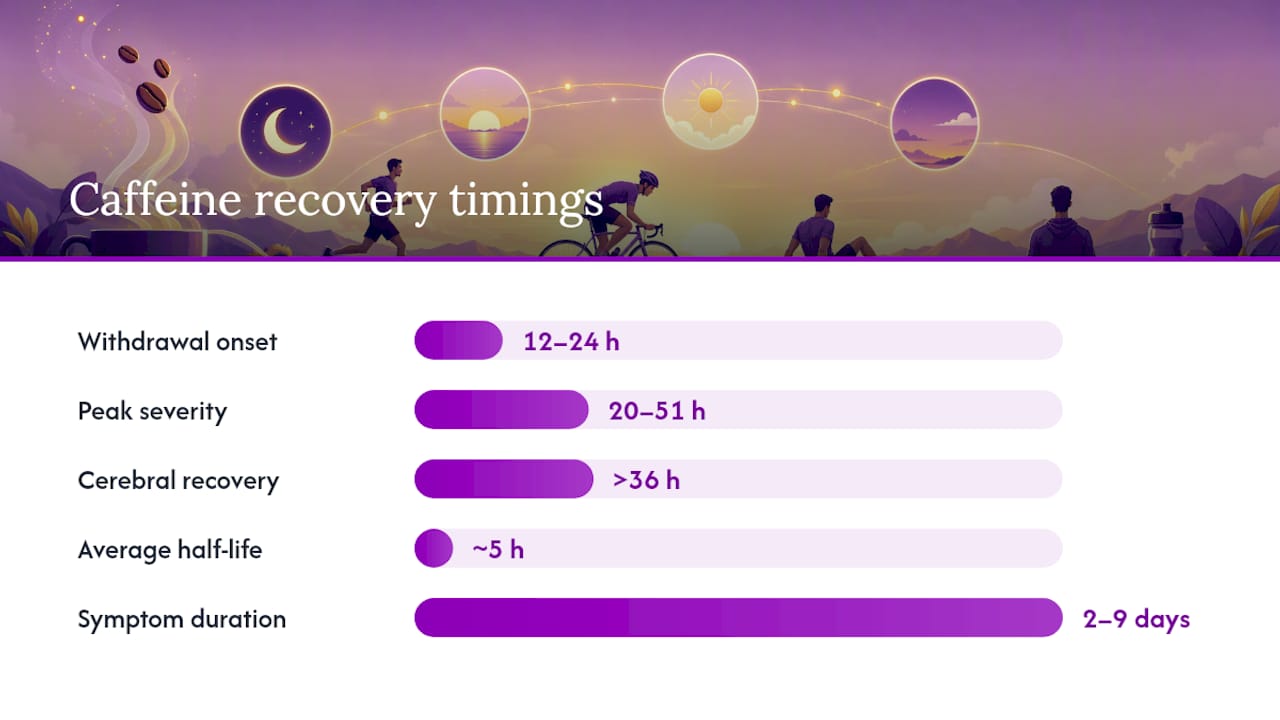
By the numbers: withdrawal onset 12 to 24 hours, peak severity 20 to 51 hours, symptom duration 2 to 9 days, and cerebral recovery potentially exceeding 36 hours even before tolerance itself resets.
A handful of personal factors stretch or shrink that window:
- Habitual dose. Someone drinking 600 mg a day has a longer road back than someone at 150 mg.
- Body weight and metabolism. Faster metabolizers clear caffeine and its byproducts quicker.
- Smoking status. Smoking speeds up caffeine metabolism, which can shorten withdrawal but also masks how tolerant you’ve actually become.
- Pregnancy. Caffeine clearance slows dramatically during pregnancy, altering the whole timeline.
- Medications. Certain drugs, including some oral contraceptives, interact with the liver enzymes that break down caffeine.
Building a Practical Caffeine Tolerance Reset Protocol
The fastest way to sabotage a reset is guessing at your intake. Add up every source across a normal day, coffee, tea, energy drinks, pre-workout, even chocolate, and get a real number in milligrams before you touch your schedule. Once you know your baseline, you have two real paths: taper down gradually or stop cold.

The taper approach
Tapering by 10% to 25% every 3 to 7 days is the approach most clinical guidance points to for reducing withdrawal severity, according to StatPearls’ caffeine withdrawal guidance. A slower cut suits people who’ve had rough withdrawal before or who can’t afford a foggy week at work. A faster cut gets you to zero sooner but with sharper symptoms along the way.
- Calculate your baseline. Say you’re at 400 mg a day, roughly four cups of coffee.
- Cut 10% every week for a gentle taper. Week one: 360 mg. Week two: 320 mg. You reach near zero in about eight weeks, which suits heavy, long-term users who want minimal disruption.
- Cut 25% every 3 to 7 days for a faster taper. Day one: 300 mg. Day four: 225 mg. Day seven: 170 mg. You’re near zero within three weeks, a better fit for moderate users on a deadline.
- Light users (under 200 mg a day) can often skip straight to a 25% cut every three days and finish in under two weeks.
- Heavy users (over 500 mg a day) usually do better starting with 10% cuts to avoid a withdrawal crash that derails work or training.
The cold-turkey approach
Stopping outright gets your adenosine receptors back to a lower-tolerance baseline faster, since you’re not feeding the dependency during a drawn-out taper. The trade-off is a rougher few days, often with a more intense headache, fatigue, and irritability hitting right in that 20 to 51 hour peak window. If you go this route, it’s wise to allow yourself a few days to recover and avoid scheduling demanding tasks or intense workouts immediately afterward.
Pro Tip: Before choosing cold-turkey, ask yourself three questions: Have I had bad withdrawal headaches before? Do I have anything demanding coming up in the next 72 hours? Am I on any medication that could interact with sudden caffeine changes? Two or more “yes” answers point you toward a taper instead.
Managing Withdrawal Symptoms Without Losing Your Whole Week
The headache is the headline symptom, but withdrawal usually brings a package deal: fatigue, irritability, difficulty concentrating, and sometimes flu-like muscle aches, all clustering in that 2 to 9 day window clinical reviewers describe. Knowing that ceiling matters. If you’re still miserable on day twelve, something else is going on, and it’s worth checking with a clinician.
For the headache and body aches, standard over-the-counter analgesics like acetaminophen or ibuprofen typically help, and hydration alone often takes the edge off, per StatPearls’ withdrawal management notes. Check with a doctor first if you have liver issues, take other medications, or have any condition where these are contraindicated.
A few things worth stacking into your week:
- Hydrate more than usual. Caffeine is a mild diuretic, and dehydration amplifies headache severity.
- Add magnesium and B-vitamin-rich foods. Leafy greens, nuts, and whole grains support energy metabolism while you’re running low on your usual stimulant.
- Protect your sleep window. Withdrawal fatigue often collides with withdrawal insomnia; a consistent bedtime helps more than it sounds like it would.
- Move, but keep it light. A walk or an easy resistance band session beats a hard training day when your energy is already down.
- Use a rescue dose only as a last resort. A small dose of 50 to 100 mg of caffeine can quickly relieve severe withdrawal symptoms, but using this without a structured plan may prolong dependence and reset tolerance timing.
Seek medical advice if symptoms include a severe migraine unresponsive to standard pain relief, chest tightness, or anything lasting well past the nine-day mark. Those aren’t typical withdrawal, and they deserve a real diagnosis, not another day of waiting it out.
Tracking Your Real Caffeine Intake
Most resets fail quietly, not because the taper plan was wrong but because people miss caffeine hiding in places they didn’t check. A cup of drip coffee runs roughly 95 to 165 mg, an espresso shot around 60 to 75 mg, black tea around 40 to 70 mg, and energy drinks and pre-workout supplements can range anywhere from 100 mg to well over 300 mg per serving.
Common blind spots worth auditing:
- Pre-workout powders, many of which pack more caffeine per scoop than a large coffee.
- Over-the-counter medications, including some pain relievers and cold remedies.
- Dark chocolate, which contains meaningful caffeine in larger servings.
- “Decaf” coffee, which isn’t zero, just lower, typically 2 to 15 mg per cup.
Keep it dead simple: a daily log with four columns, time consumed, milligram estimate, symptoms felt, and sleep quality that night. Reviewing patterns after a week tells you more than any single day ever will.
How to Reintroduce Caffeine Without Losing Your New Sensitivity
The whole point of a caffeine tolerance reset evaporates fast if you jump straight back to your old dose. Start at roughly half your previous daily amount and hold there for a few days before adding more; your receptors have downregulated, and a full dose now will hit harder and rebuild tolerance faster than you’d expect.
Selective-use strategies protect that sensitivity longer than daily habit ever will. Reserve caffeine for training days, big deadlines, or mornings you genuinely need the edge, rather than defaulting to it every single day. A structured cycle, something like five days on and two days off, or a full one to two week break every three to four months, is a workable pattern practitioners use to slow tolerance from creeping back.
A few rules keep the gains from slipping away:
- Cap your daily total and write it down instead of estimating.
- Avoid caffeine after early afternoon so it doesn’t chip away at sleep quality, which quietly drives you back toward needing more caffeine the next day.
- Log intake for at least a month post-reset to catch the moment your tolerance starts inching back up.
Pro Tip: Anchor your reintroduction decisions to objective signals, sleep quality, resting heart rate, workout performance, rather than the calendar. If two weeks have passed but your sleep is still rough, hold off another few days before adding caffeine back.
Who’s Behind This Guide, and What Else Can Help
This guide was written by Mark, who also covers how caffeine interacts with training and supplementation in Timing Your Creatine With Coffee, a useful companion read if you’re stacking creatine alongside your usual caffeine habit. For readers pairing performance nutrition with a reset, Training Load Carb Cycling for Trainees covers a similar cycling logic applied to carbohydrate timing.
A caffeine tolerance reset goes smoother when your routine has something to hold onto besides your morning cup. A few categories worth having on hand:
- A dedicated mug for a caffeine-free tea or warm lemon water ritual that replaces the habit without the stimulant.
- Low-caffeine or caffeine-free pre-workout alternatives, audited using the guidance in Master Pre Workout Supplement Timing.
- Resistance bands for light movement on low-energy withdrawal days.
- eBooks on habit-building to fill the mental space a caffeine ritual used to occupy.
Faster recovery habits, covered in How to Recover Faster and Boost Your Fitness Goals, also apply directly to withdrawal days when your body needs extra support.
What Actually Matters When You Reset Your Caffeine Tolerance
The conventional advice treats a caffeine tolerance reset like a light switch: stop for a few days, flip back to normal, done. The research doesn’t support that. Recovery kinetics studies show your brain can still be adjusting past the 36 hour mark, and performance studies show four days isn’t enough to restore an athlete’s full ergogenic edge. Anyone promising a fast, clean reset in under a week is oversimplifying a process that’s genuinely individual.
What’s overrated is the specific number of days. What’s underrated is tracking. Most people who fail a reset don’t fail because they picked cold-turkey over tapering, they fail because they didn’t know a pre-workout scoop was quietly adding 200 mg they never counted. Get your baseline right, pick a taper speed that matches your history with withdrawal, and use your sleep and training performance, not the calendar, to decide when you’re actually ready to drink caffeine again. That’s the part nobody puts in the headline, and it’s the part that actually determines whether the reset sticks.
— Mark
Keep Momentum Going With Diet & Exercise
Diet & Exercise gives you a way to stay consistent through a reset without relying on caffeine to power your motivation. A NEVER SETTLE ALWAYS STRIVE T-Shirt or a TRUST THE PROCESS T-Shirt works as a small daily reminder on the days your energy dips before your sensitivity comes back. For training days when you want to move without leaning on stimulants, the Ab Roller and resistance bands keep sessions productive at a lower intensity that suits withdrawal fatigue.

If you’d rather explore a caffeine-free ritual entirely, Tri Crow Coffee’s list of caffeine alternatives is worth a look for morning options that skip the stimulant altogether. For readers who want structured support beyond apparel and accessories, the ENERGY++ eBook walks through non-caffeinated ways to manage energy levels during the exact window a reset gets hardest. Browse the full T-shirt collection or check out the eBooks collection to find the pieces that fit your reset best, then place your order and get moving before your next taper step.
Sources
- Caffeine Withdrawal - StatPearls - NCBI Bookshelf
- Time to Recover From Daily Caffeine Intake - PMC - NIH
FAQ
Is 4 days enough to reset caffeine tolerance?
For light users, four days can noticeably lower sensitivity, but research on athletes found four-day breaks generally weren’t enough to fully restore caffeine’s performance benefits, according to PMC’s review on caffeine and exercise. Moderate to heavy users typically need about a week or more off to meaningfully lower their tolerance.
What is the 90 minute rule for coffee?
The 90 minute rule refers to delaying your first coffee of the day after waking, giving your body’s natural cortisol wake-up response time to peak before caffeine takes over. It’s a habit tweak for daily energy management, not part of a formal tolerance reset protocol, though it can help once you reintroduce caffeine after a reset.
Is 400 mg of caffeine at once bad?
400 mg is the upper daily limit many health guidelines cite for healthy adults, so consuming it all at once rather than spread across a day increases the chance of jitteriness, a racing heart, or disrupted sleep. During a reset, hitting that amount in one sitting after a break is especially risky since your lowered tolerance means the same dose hits much harder than it used to.
Are caffeine resets good for you?
A caffeine tolerance reset can restore the stimulant and performance effects caffeine used to give you at lower doses, which is genuinely useful if your usual cup has stopped doing much of anything. The temporary withdrawal symptoms, typically resolving within 2 to 9 days per StatPearls, are the main trade-off, and a gradual taper minimizes how rough that stretch feels.