

3 Ready Dumbbell Only Workouts for 30, 45–60 Min and a 12 Week Plan
Pick a 3-day full-body dumbbell program if you have 28 to 35 minutes, three days a week, and want the fastest strength return for beginner-to-intermediate effort. Choose a 5-day split if you can train five days and want more per-muscle volume, or run a 12-week progressive plan if your goal is measurable size and strength over a full mesocycle cycle. All three work with nothing but dumbbells, a floor, and a little space to move.
TL;DR:
- The 3-day full-body dumbbell program is ideal for beginners or those short on time, offering full muscle coverage in about 28 to 35 minutes per session.
- The 5-day split provides more volume for experienced lifters, focusing on specific muscle groups with sessions lasting 45 to 60 minutes, suitable after reaching a plateau with full-body routines.
- The 12-week progressive plan builds strength and size through structured loading, deload weeks, and tracking progress, making it best for those pursuing measurable results over time.
- Mastering key movements like goblet squats, Romanian deadlifts, and floor presses is crucial, with emphasis on controlled reps, unilateral work, and proper warm-up to prevent injury.
- Progress depends on adding reps, increasing weight, or reducing rest, with weekly adjustments and deloads every four to six weeks to prevent stagnation and promote consistent gains.
Table of Contents
- Which Dumbbell-Only Program Should You Choose?
- Three Ready-to-Use Dumbbell Workout Templates
- Essential Dumbbell Moves and How to Perform Them
- Warm Up and Cool Down the Right Way
- How to Structure Progression, Sets, and Rest
- Choosing Weights and Making Small Spaces Work
- Nutrition and Recovery to Support Your Training
- Why Trust These Dumbbell Workout Plans?
- Gear That Makes a Dumbbell-Only Routine Easier to Stick With
- A Practical Note From the Author
- Sources
- FAQ
Which Dumbbell-Only Program Should You Choose?
Every reader lands in one of three buckets: short on time, hungry for volume, or chasing a specific strength number by a specific date. Match the bucket, not the hype.
The 3-day full-body split is the default for anyone new to dumbbell training or juggling a packed week. Sessions run 28 to 32 minutes including warm-up, according to Healthline’s beginner dumbbell routine, because you’re hitting every major muscle group with five to seven compound lifts rather than isolating body parts. This frequency (three total-body sessions per week) tends to build strength faster in beginners than a split routine does, simply because each muscle gets stimulated three times instead of once.
The 5-day split suits lifters who already have a base and want more sets per muscle group without cramming everything into one session. Expect 45 to 60 minutes per day, with each session narrowing focus: upper push, lower body, upper pull, legs and core, then a conditioning or arms day. This is the route for someone who has plateaued on full-body training and wants the extra volume a split allows.
The 12-week progressive plan is for anyone training toward a real number, whether that’s a bodyweight goblet squat for 15 reps or visible shoulder definition by spring. It’s built on three-week loading blocks followed by a lighter deload week, a structure borrowed from how Men’s Health’s full-body dumbbell plan sequences progression to avoid stalling out.
Here’s the quick decision guide:
- Short on time, new to training: 3-day full-body, 28 to 35 minutes per session.
- Want more volume, already comfortable with basics: 5-day split, 45 to 60 minutes per session.
- Chasing a specific strength or physique goal: 12-week progressive plan with built-in deloads.
- Need a quick sweat with minimal planning: dumbbell circuits or AMRAP formats, which double as your strength and conditioning work in one shot, per Nourish Move Love’s dumbbell circuit format.
Whichever you pick, give it eight to 12 weeks before judging results. That’s the window Healthline recommends for evaluating whether a program is actually working, and it’s long enough to see real changes in strength and body composition without bailing early out of impatience.
Three Ready-to-Use Dumbbell Workout Templates
Copy one of these directly. No bench, no rack, no excuses.
1. The 3-day full-body plan (beginner or time-crunched)
Run this Monday, Wednesday, Friday. Rest 60 to 90 seconds between sets on strength moves, less on the finisher.
- Goblet squat: 3 sets of 8 to 12 reps
- Floor press: 3 sets of 8 to 12 reps
- Bent-over row: 3 sets of 8 to 12 reps
- Romanian deadlift: 3 sets of 8 to 12 reps
- Standing overhead press: 3 sets of 8 to 12 reps
- Suitcase carry or plank: 2 sets, 30 to 45 seconds per side
Total time lands around 28 to 32 minutes once you add a five-minute warm-up, matching the Healthline benchmark for a full-body dumbbell session.
2. The 5-day split (more volume, per-muscle focus)
- Day 1, upper push: floor press, overhead press, lateral raise, close-grip floor press. 3 to 4 sets of 8 to 15 reps each.
- Day 2, lower body: goblet squat, walking lunge, Romanian deadlift, calf raise. 3 to 4 sets of 8 to 15 reps each.
- Day 3, upper pull: bent-over row, single-arm row, rear-delt fly, biceps curl. 3 to 4 sets of 8 to 15 reps each.
- Day 4, legs and core: Bulgarian split squat, single-leg RDL, weighted crunch, side plank with reach. 3 sets of 10 to 15 reps.
- Day 5, upper and conditioning: shoulder press, triceps extension, curl, then a 10-minute circuit finisher (squat to press, renegade row, high pull).
Each session runs 45 to 60 minutes. This is more total volume than the full-body plan delivers, which matters once your body has adapted past the beginner stage.
3. The 12-week progressive plan (structured build)
The plan is broken into four mesocycles: three weeks of progressive loading followed by one deload week, repeated four times. That deload structure follows the loading pattern outlined in Men’s Health’s dumbbell training plan, which reduces injury risk from accumulated fatigue while still moving the needle on strength.
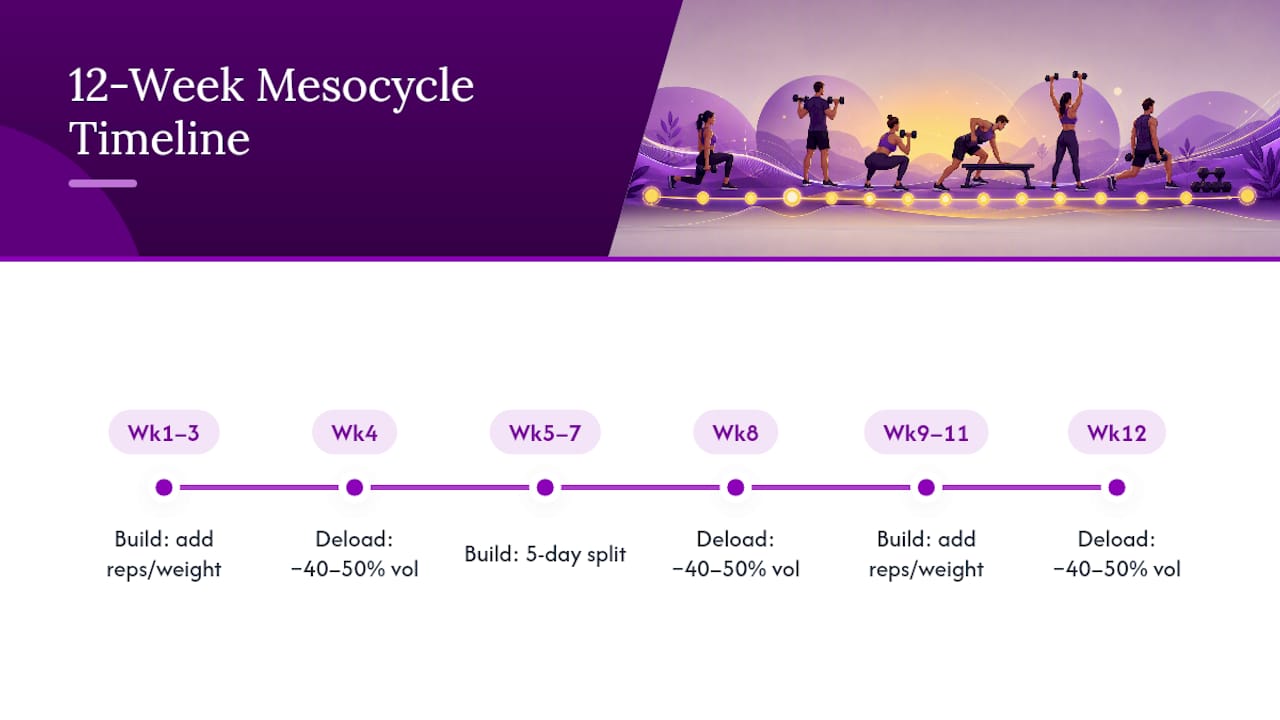
Sample week from mesocycle 1 (weeks 1 to 3, building): Follow the 3-day full-body template above, adding either one rep or 2.5 to 5 pounds per exercise each week.
Sample week from mesocycle 2 (weeks 4 to 6): Shift to the 5-day split as volume tolerance improves, keeping loads at the top of your rep range.
Deload week (weeks 4, 8, 12 if you extend): Cut volume by 40 to 50 percent. Same exercises, roughly half the sets, moderate weight. This is not an off week. It’s active recovery that lets you come back stronger.
Log every session in a notebook or your phone: exercise, weight, reps, and how it felt (easy, moderate, hard). When you complete every prescribed rep at the top of a range for two sessions in a row, add weight or a rep next time. That single rule drives almost all the progress in a dumbbell-only program.
Essential Dumbbell Moves and How to Perform Them
A handful of exercises do most of the work in any dumbbell-only program. Master these and everything else is a variation.
Goblet squat. Hold one dumbbell vertically against your chest, feet shoulder-width apart. Sit back and down like you’re reaching for a low chair, keeping your chest up. Feel it in your quads and glutes, not your lower back. This move alone teaches squat mechanics better than almost anything else in a home setup, which is part of why it anchors so many beginner routines, including the seven-exercise beginner circuit from FED Fitness.
Romanian deadlift. Hold dumbbells in front of your thighs, soft knees, and hinge at the hips while pushing your hips back. Stop when you feel a stretch in your hamstrings, not when your back rounds. This is a hip hinge, not a squat.
Floor press. Lie on your back, knees bent, dumbbells at chest level. Press up until your arms are extended, then lower until your triceps touch the floor. The floor limits your range of motion just enough to protect your shoulders if you don’t own a bench.
Single-arm row. Hinge forward, one hand on a chair or your knee for support, and row the dumbbell to your hip. Keep your torso still. This move exposes and fixes side-to-side strength imbalances that bilateral rows hide.
Overhead press. Standing, press dumbbells from shoulder height straight overhead without arching your lower back. If your back arches, the weight is too heavy.
Unilateral moves matter more than people think. Split squats, single-leg RDLs, and single-arm presses train one side of the body at a time, which builds core stability and evens out strength between your dominant and non-dominant sides. Anyone who has favored one leg for years without noticing will feel this immediately in a Bulgarian split squat.
Accessory work and substitutions:
- Biceps curl or hammer curl for arm accessory volume.
- Lateral raise or front raise if shoulders feel undertrained.
- No room to swing a dumbbell overhead? Swap overhead press for a seated version against a wall.
- Limited weight selection? Slow the tempo (three seconds down, one second up) to increase difficulty without adding plates.
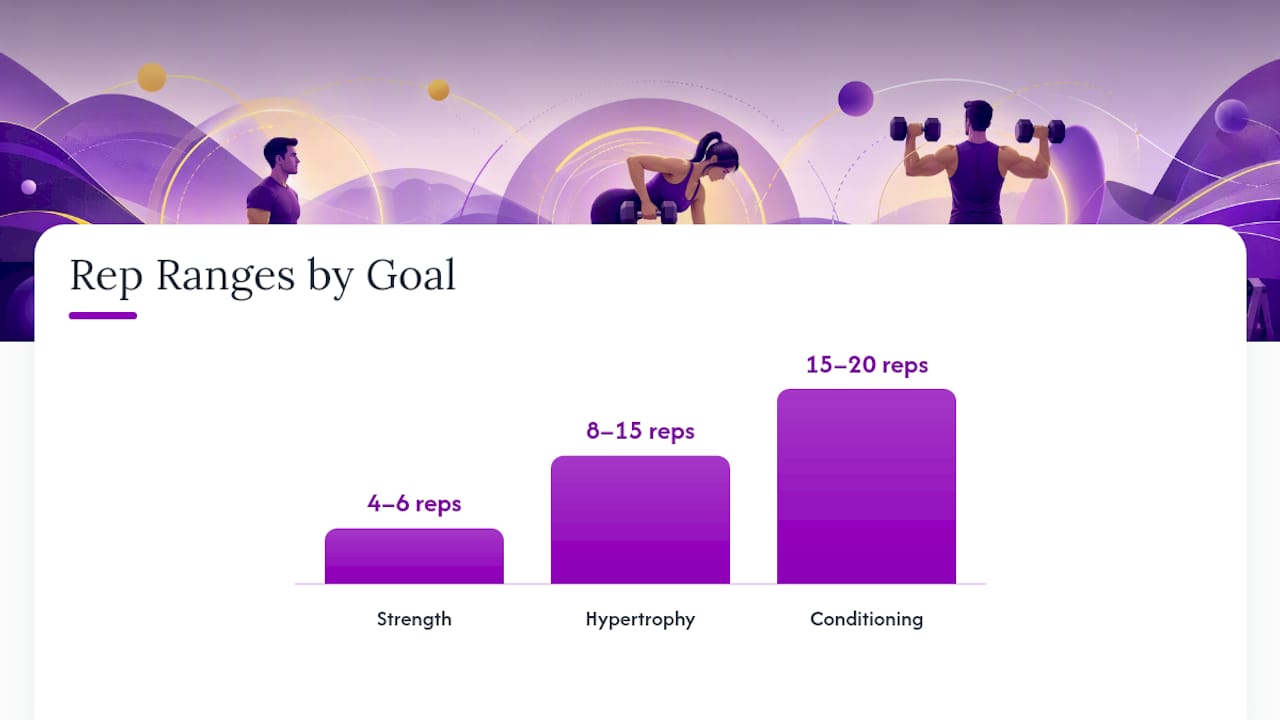
Rep ranges shift with your goal: 4 to 6 reps for strength, 8 to 15 for hypertrophy, 15 to 20 or timed circuits for conditioning.
Pro Tip: Control the lowering phase of every lift. A slow, controlled descent (three to four seconds) builds more muscle per rep than rushing through it, and it’s the easiest form fix that costs you nothing but patience.
Warm Up and Cool Down the Right Way
Skipping the warm-up is the fastest way to turn a good program into a nagging shoulder problem.
- Joint circles and hip hinges (60 seconds each): Loosen ankles, hips, and shoulders before loading anything.
- Band pull-aparts or light dumbbell rows (10 to 15 reps): Wake up the upper back, especially if your day includes pressing.
- Glute bridges (10 to 15 reps): Activate the posterior chain before squats or deadlifts.
- Ramping sets on your first main lift (2 to 3 sets): Start with an empty-feeling weight, add load each set until you reach your working weight for the day.
This dynamic sequence, paired with ramping sets, is the exact structure recommended for a dumbbell-only session by PureGym’s full-body dumbbell guide, and it takes five to eight minutes total.
After training, spend three to five minutes on static stretches for whatever you just worked: hamstring stretch after RDLs, chest-opener stretch after pressing, hip-flexor stretch after squats. A quick pass with a foam roller on your quads or upper back helps with next-day soreness, though it’s optional, not mandatory.
On rest days, a 20-minute walk or light mobility flow counts as active recovery. It keeps blood moving without adding fatigue you’ll need to recover from before your next session.
How to Structure Progression, Sets, and Rest
Progress comes from one of three levers: more reps, more weight, or less rest. Pick one at a time.
- Linear progression: Add one rep per set until you hit the top of your range, then add weight and drop back to the bottom of the range.
- Weekly load increases: Add 2.5 to 5 pounds per exercise each week regardless of reps, common in the early weeks of a 12-week plan.
- RPE-based adjustment: Rate each set’s difficulty from 1 to 10. If your top set feels like a 6 or 7, add weight next session; if it’s a 9 or 10, hold steady.
Rep ranges by goal: strength sits at 4 to 6 reps with 2 to 3 minutes rest; hypertrophy sits at 8 to 15 reps with 60 to 90 seconds rest; conditioning sits at 15-plus reps or timed rounds with 15 to 30 seconds rest.
Circuits versus straight sets comes down to your goal and your clock. Straight sets (complete all sets of one exercise before moving on) suit strength and hypertrophy work when you have time to rest fully. Circuits and AMRAP formats, cycling through three or four exercises with minimal rest, suit anyone short on time or chasing a conditioning effect alongside strength, which is exactly the appeal of the circuit-based dumbbell workout format Nourish Move Love built around one pair of dumbbells.
Deload every four to six weeks, or sooner if your lifts stall for two straight sessions or your joints feel cranky. Cut volume roughly in half, keep the movements the same, and reassess after the deload. If your lifts jump back up, you needed the rest. If they don’t, look at sleep and food before blaming the program.
Choosing Weights and Making Small Spaces Work
Adjustable dumbbells save space and money if you’re building a home setup from scratch. One pair that adjusts from 5 to 50 pounds replaces what would otherwise be ten sets of fixed dumbbells. Fixed dumbbells load faster between sets, which matters for circuits, but they take up more floor and shelf space. Dietexerciseshop’s dumbbell buying guide breaks down both options if you’re deciding what to buy first, and the adjustable versus fixed comparison goes deeper on which setup fits a smaller apartment versus a dedicated garage gym.
Estimating starting weight: pick a load where your last two reps of a 10-rep set feel genuinely hard but your form stays clean. Too light and you’re just moving weight around; too heavy and your first rep already looks ugly.
When to move up: if you complete every set at the top of your rep range with a rep or two left in the tank, add weight next session.
Hacks when your dumbbells top out too low:
- Slow the tempo to three or four seconds per rep to add difficulty without adding plates.
- Switch to unilateral versions (single-arm press, single-leg RDL) since one limb working alone needs less absolute load to feel challenging.
- Add pause reps, holding two seconds at the hardest point of the lift.
- Increase reps into the 15 to 20 range rather than stopping at 12, a workaround backed by Nourish Move Love’s approach to weight-limited progression.
For storage, a simple rack or even a sturdy shelf keeps dumbbells off the floor and out of walking paths. If you’re setting up a corner of a bedroom or garage, Dietexerciseshop’s beginner home gym equipment guide covers layout ideas that don’t require a dedicated room.
Nutrition and Recovery to Support Your Training
Training only gets you halfway. What you eat and how you sleep decides whether the work shows up on the scale or the mirror.
- Protein target: aim for 1.6 to 2.2 grams per kilogram of body weight daily, spread across three or four meals so your body has a steady supply for repair.
- Calorie context: eat at maintenance to hold steady while building strength, or a modest surplus of 200 to 300 calories if visible muscle gain is the goal. Track intake for two weeks with a simple app to know your actual baseline before adjusting.
- Sleep: seven to nine hours is the range that supports muscle repair and hormone regulation; skimping here undercuts even a well-built program.
- Hydration and active recovery: drink water consistently through the day, not just around workouts, and use light walks or mobility work on rest days instead of full inactivity.
If you want programming and nutrition guidance bundled together rather than piecing it together yourself, an eBook built around structured movement patterns, like Dietexerciseshop’s Functional Fitness eBook, gives you both in one place.
Why Trust These Dumbbell Workout Plans?
These templates aren’t guesswork. The 3-day full-body structure, the session-length estimates, and the deload cadence all draw from the same principles used in established dumbbell programs from Healthline, The New York Times, and Men’s Health, cross-checked against how Dietexerciseshop builds its own training resources.
Mark, who writes the training content for Dietexerciseshop, has spent years testing what actually gets followed through, not just what looks good on paper… The plans above reflect that same bias toward simplicity: fewer moving parts, clearer instructions, less room to quit in week two.
Dietexerciseshop’s blog carries deeper dives on dumbbell workout plans and dumbbell chest training if you want to build out any single day further.
Gear That Makes a Dumbbell-Only Routine Easier to Stick With
Following any of these templates for 12 weeks comes down to friction, not motivation. The fewer excuses your setup gives you, the more sessions you actually finish.
Dietexerciseshop’s Functional Fitness eBook lays out programming logic you can adapt past the templates here, and the Energy++ eBook pairs well with it for readers who want nutrition timing dialed in around training days. If your recovery routine needs a boost between sessions, the Abs Stimulator is a low-effort accessory for core activation on rest days.
For the training days themselves, comfort matters more than people admit. The Meal Prep & Muscle Reps Hoodie and Running on Coffee and Protein Shakes Hoodie work for cooler sessions, while the Squats? I Thought You Said Squash? T-Shirt and Turnip the Gains T-Shirt keep leg day a little lighter on mood, even when the weights aren’t.
Start with the Functional Fitness eBook if you want a structured next step beyond these templates, it’s built to carry you past the 12-week mark once you’ve outgrown the beginner phase.
A Practical Note From the Author
Three things separate people who see results from people who quit in week three: consistency, progressive overload, and a bias toward compound moves over isolation exercises. Miss any one of those and the rest of the program stops mattering.
The most common mistake I see in dumbbell-only training is treating every session like a max-effort test. You don’t need to grind out a brutal set every time you train. Most sessions should feel like solid, controlled work, not a fight for survival. Save the genuine grind for maybe one set per session, not every set.
The second mistake is abandoning a program after two weeks because the scale hasn’t moved. Give any of the templates above the full eight to 12 weeks before deciding whether it’s working. Strength shows up faster than visible muscle change, and it’s usually the first honest signal that your program is doing its job.
Pick one template, run it as written for a month, and adjust from there. Don’t chase a new plan every time you get bored. Boredom is not the same as a plateau.
— Mark
Sources
- Full-Body Dumbbell Workout: 30-Minute Routine — Healthline
- 30-Minute Beginner Full-Body Dumbbell Workout at Home — FED Fitness
- 30-Minute Dumbbell Only Workout (Full Body) | Nourish Move Love
FAQ
Is It Okay to Only Work Out With Dumbbells?
Yes. Dumbbells train every major muscle group through compound and unilateral movements, and a well-structured dumbbell-only program builds strength and stability as effectively as a mixed-equipment routine for most training goals.
Can I Build Muscle With Dumbbells Only?
Yes, provided you apply progressive overload (more weight, more reps, or slower tempo over time) and eat enough protein, roughly 1.6 to 2.2 grams per kilogram of body weight daily, to support muscle repair.
Can You Do a Full Workout With Just Dumbbells?
Yes. A 30-minute session using five to seven compound exercises, such as goblet squats, floor presses, and bent-over rows, can train legs, chest, back, shoulders, arms, and core in one sitting.
What Workouts Can I Do With Only Dumbbells?
You can run full-body strength sessions, upper/lower splits, or timed circuits and AMRAPs that blend strength with conditioning, all using a single pair of dumbbells and floor space.
How Often Should I Do a Dumbbell-Only Workout?
Beginners get the most benefit from three full-body sessions per week with rest days between, while more experienced lifters can train five days using a split routine that targets different muscle groups each day.