

Two Short Strength Sessions and One Band to Stay Fit While Traveling
Keep two short strength sessions a week, add daily walking or active sightseeing, and pack one resistance band. That single combination covers the WHO weekly movement targets even on a chaotic trip. The sections below cover packing, hotel-room workouts, nutrition on the road, transit circulation, jet lag, and sample routines you can start today.
TL;DR:
- Short strength sessions and daily walking easily meet WHO guidelines, even with minimal equipment, by combining resistance bands, bodyweight moves, and active sightseeing.
- Packing lightweight gear like resistance bands, a jump rope, and a towel ensures versatility for workouts without taking up much space or risking lost luggage.
- Maintaining muscle on trips requires two brief full-body sessions weekly, with adjustable routines using bodyweight or resistance bands for effective preservation.
- Moving legs regularly during long flights and road trips reduces blood clot risks, with ankle pumps and walking being simple, effective circulation aids.
- Combining light exposure, meal timing, and gentle mobility after arrival helps reset circadian rhythms and recover from jet lag faster.
Table of Contents
- How Do You Stay Fit While Traveling on a Tight Schedule?
- Pack Smart: What Fitness Gear Actually Earns Its Space
- What Should You Eat to Avoid Gaining Weight on Vacation?
- Can You Keep Muscle and Strength on a Short or Long Trip?
- How Do You Stay Healthy on Long Flights and Road Trips?
- How Do You Beat Jet Lag and Recover Fast After Travel?
- Ready-to-Use Hotel Room Workouts You Can Start Today
- Prepping Before You Leave Makes the Whole Trip Easier
- Managing Stress and Mental Health While You Travel
- Keeping Your Heart Healthy Beyond the Hotel Room Circuit
- Adjusting Your Workout for Heat, Cold, and Altitude
- Using Apps and Online Tools to Stay on Track
- Exercising Safely in an Unfamiliar Environment
- A Practical Take on Travel Fitness
- Two eBooks and a Circuit That Actually Fit in a Suitcase
- Sources
- FAQ
How Do You Stay Fit While Traveling on a Tight Schedule?
The World Health Organization recommends 150 to 300 minutes of moderate aerobic activity or 75 to 150 minutes of vigorous activity weekly, plus muscle-strengthening work on two or more days. You don’t need a gym to hit that on the road. You need a plan that survives a delayed flight, a packed itinerary, and a hotel room with no equipment.
Translate the WHO target into three moving parts: two short strength sessions, daily walking or active sightseeing to bank aerobic minutes, and a fallback rule for the days nothing else works. Walking tours, hiking a trail, renting a bike, or swimming at the hotel pool all count toward the aerobic side. The strength sessions are the part travelers skip first, which is exactly why they need a fixed slot on the calendar.
Match the workout to the time you actually have, not the time you wish you had:
- 10 minutes: a bodyweight or band micro circuit before breakfast.
- 20 to 30 minutes: a full hotel-room circuit combining strength and short cardio bursts.
- 45 minutes or more: a longer session on a rest day, or a hike, run, or swim.
Scheduling beats motivation on every trip longer than a weekend. Block workout time in your phone calendar the same way you block a dinner reservation, and treat it with the same seriousness. A few tactics that consistently work:
- Set the workout as the first calendar event of the day, before meetings or excursions get added.
- Tell a travel companion your plan so someone else expects you to show up.
- Define a minimum session (one circuit, 10 minutes) so a busy day doesn’t turn into a missed week.
- Attach the workout to an existing habit, like right after you brush your teeth.
That minimum-session rule matters more than any specific exercise choice. REI’s travel fitness guidance points out that the workout with the fewest failure points is the one that actually gets done, and a single fallback circuit removes most of the excuses that derail a travel routine.
Pack Smart: What Fitness Gear Actually Earns Its Space
Four items cover almost every travel workout scenario: a flat resistance band, a lightweight travel jump rope, a foldable travel mat or a hotel towel, and a small mobility ball or lacrosse ball for tight hips and shoulders. None of these weigh more than a paperback book combined.
Band resistance matters more than people expect. Bring a medium band as your default and a light one as backup for shoulder and rotator cuff work. Test both at home before your trip, not in a hotel room where you find out mid-set that the band is too stiff for a row.
- Roll the band around the jump rope handle to save space and stop tangling.
- Use the mat for floor work and stretching, and skip it entirely if you’re comfortable using a towel.
- Keep the kit in a carry-on, never checked luggage. Lost bags happen, and you don’t want your workout gear stuck at a different airport than you are.
- Store the whole kit in one packing cube so it’s the same grab-and-go item every trip.
Pro Tip: Leave the band clipped to the outside of your suitcase or gym bag as a visual cue. You’re far more likely to use it if you see it every time you unpack, instead of burying it under clothes.
A 7-move bodyweight workout built for hotel rooms proves you don’t need much gear at all, but the band adds resistance options that bodyweight alone can’t replicate for rows and shoulder work.
What Should You Eat to Avoid Gaining Weight on Vacation?
Prioritize protein and fiber at meals, and keep a portable protein snack within reach at all times. That single habit does more to control travel weight gain than any calorie-counting app, because protein and fiber both extend satiety longer than refined carbs, which dominate airport food courts and hotel breakfast buffets.
ACE Fitness’s travel nutrition guidance recommends choosing water regularly, building walking into the day, and packing snacks rather than relying on whatever is closest at hand when hunger hits. A few habits that hold up across time zones:
- Order protein first at any meal, then fill the rest with the plate.
- Carry nuts, jerky, or a protein bar for the gap between “hungry” and “next meal available.”
- Drink water on a schedule during flights and hot-weather days, since thirst cues get unreliable in dry cabin air or heat.
- Eat close to your usual meal times when possible, even if the food itself is different.
Hydration keeps you comfortable, but it isn’t a clot-prevention tool. The CDC is explicit that staying hydrated does not specifically prevent deep vein thrombosis on long flights. Moving your legs does far more for circulation than a bigger water bottle, a distinction worth knowing before you assume drinking enough is your main defense on a long-haul flight.
None of this requires strict dieting. Cedric Bryant of ACE frames travel eating as a balance between enjoying the trip and staying functional, not forcing home-level discipline onto a schedule that was never built for it. If you’re managing diabetes, pregnancy, or another condition where food timing genuinely matters, get individualized guidance from a dietitian before you travel rather than improvising from general advice.
Can You Keep Muscle and Strength on a Short or Long Trip?
Two short full-body sessions a week are enough to maintain most of the strength you built at home, matching the WHO’s muscle-strengthening frequency recommendation. You will likely lose a small amount of peak output on a two-week trip. You will not lose meaningful muscle if you keep those two sessions on the calendar.
Two templates cover most travelers:
- Bodyweight full-body (20 minutes): squats, push-ups, walking lunges, glute bridges, and a plank, done as 3 rounds of 12 to 15 reps with 45 seconds of rest between exercises.
- Band full-body (20 to 25 minutes): band squats, band rows, band chest press, band deadlifts, and band lateral raises, done as 3 rounds of 12 to 15 reps, adjusting band tension for resistance instead of adding weight.
Accept reduced volume without treating it as failure. A rep range of 12 to 15 with a lighter band or fewer sets still triggers the muscle-preserving signal your body needs; it just won’t build new strength the way a loaded barbell session would. Form matters more than load here, since hotel-room space and unfamiliar surfaces raise injury risk if you rush through a squat or lunge pattern you’d normally do slower with weight.
Pro Tip: If a hotel gym is available, use it for one of your two sessions and save the band workout for the day you’re stuck in a room or an Airbnb with no equipment at all.
How Do You Stay Healthy on Long Flights and Road Trips?
Move your legs at least once every hour on any flight, train ride, or drive longer than four hours. The CDC identifies prolonged immobility as the primary driver of travel-related blood clot risk, and simple ankle pumps done seated can meaningfully improve circulation without leaving your seat.
- Do 10 to 15 ankle pumps and calf raises every hour while seated.
- Get up and walk the aisle or rest stop every one to two hours on longer trips.
- Rotate your ankles and flex your calves during long security lines or layovers instead of just standing still.
- Choose an aisle seat on flights specifically so getting up doesn’t require asking two strangers to move.
Reported VTE incidence during air travel is low overall, but the CDC still recommends ambulation for most travelers and clinician consultation for those at elevated risk (a history of clots, recent surgery, certain medications, or pregnancy). If you notice one-sided leg swelling, warmth, or pain after a long trip, that’s a signal to see a doctor promptly rather than waiting it out.
How Do You Beat Jet Lag and Recover Fast After Travel?
Coordinate light exposure, meal timing, and moderate exercise together rather than relying on any single fix. A consensus review on travel fatigue and jet lag found the evidence for any one intervention alone is limited, but combining timed light, consistent meals, and appropriately timed movement helps travelers re-entrain to a new time zone faster.
- Get outside in daylight as soon as possible after landing, especially in the morning at your destination.
- Eat your first meal on destination time, even if your body says it’s the wrong hour.
- Skip the intense workout on arrival day and do an easy walk or light mobility session instead.
- Set a consistent bedtime for your destination starting the first night, resisting the urge to nap for hours.
Arrival day is for restoring circulation and mobility, not testing your one-rep max. A short outdoor walk does more for jet lag recovery than a hard gym session on legs that just spent nine hours folded into an economy seat.
Ready-to-Use Hotel Room Workouts You Can Start Today
Two circuits cover almost every travel scenario: a 10-minute version for brutal schedules, and a 25-minute version for days with more breathing room.
The 10-minute micro circuit (no rest between exercises, one full round, repeat if time allows):
- Bodyweight squats, 15 reps
- Push-ups, 12 reps (knees down if needed)
- Band rows, 15 reps
- Reverse lunges, 10 per leg
- Plank hold, 30 seconds
The 25-minute full circuit (3 rounds, 45 seconds rest between rounds):
- Band squats, 15 reps
- Push-ups, 12 to 15 reps
- Band rows, 15 reps
- Walking lunges, 12 per leg
- Band chest press, 12 reps
- Bicycle crunches, 20 reps
- Plank hold, 45 seconds
Warm up for two to three minutes with arm circles, leg swings, and bodyweight squats before either circuit, and close with a short stretch targeting hips, hamstrings, and shoulders since those tighten the most from sitting during travel. This kind of hotel-room resistance band workout fits into almost any schedule, whether you’re squeezing it in before a conference or after a full day of sightseeing.
On rest days, skip the structured circuit entirely and let walking do the work. A day spent exploring a city on foot, hiking, or renting a bike easily banks 45 minutes or more of aerobic activity, which is exactly the kind of substitution the WHO framework anticipates. If you want more format options for quiet hotel room workouts that don’t require jumping around and disturbing the room below you, low-impact versions of both circuits above work just as well with slower tempo and no rope work.
Prepping Before You Leave Makes the Whole Trip Easier
Spend 15 minutes before departure researching what’s actually available at your destination. Check whether the hotel has a gym, look up a running route or park near where you’re staying, and search for a drop-in yoga or fitness class if that’s your preference.
- Book any class or gym pass in advance if it requires a reservation.
- Download two or three workouts to your phone in case you lose signal.
- Set a realistic goal for the trip (two sessions a week, not five) so you don’t quit after missing day one.
- Put workout blocks directly on your itinerary alongside flights and dinner reservations.
A clear travel itinerary reduces the stress of fitting everything in, and that applies to workouts just as much as sightseeing. Treating movement as a scheduled stop instead of an afterthought is what separates travelers who stay consistent from those who mean to work out and never quite get to it.
Managing Stress and Mental Health While You Travel
Travel stress, from missed connections to unfamiliar surroundings, undercuts fitness goals just as much as a skipped workout does. Poor sleep and high stress both raise cortisol, which affects appetite, recovery, and motivation to move, so managing stress isn’t separate from staying fit. It’s part of the same system.
Build in small resets throughout the day. A 10 minute walk outside, even without any structured exercise, lowers stress hormones and clears the kind of mental fog that comes from a long travel day. Breathing exercises work well in transit spaces where a walk isn’t possible, like a cramped airport gate or a middle airplane seat.
Protect sleep as aggressively as you protect your workout schedule. Travelers who sacrifice sleep for one more excursion or a late dinner tend to see stress and appetite regulation suffer together, which then makes the next day’s workout feel harder than it should.
Give yourself permission to skip a planned session when a trip gets genuinely overwhelming. Rigid adherence to a fitness plan during a stressful trip can add pressure rather than relieve it, and one missed session rarely undoes weeks of consistency. The goal is staying functional and reasonably active, not hitting a perfect record.
Keeping Your Heart Healthy Beyond the Hotel Room Circuit
Cardiovascular fitness on the road doesn’t have to come from a structured workout at all. Stairs are everywhere on a trip: hotel stairwells, subway stations, historic sites without elevators. Taking them instead of the elevator adds up to meaningful cardio minutes across a multi-day trip without ever feeling like “exercise.”
Local running routes are easier to find than most travelers assume. A quick search for a nearby park, riverside path, or popular running loop usually turns up a route with reviews from other travelers. Running a new city at sunrise also doubles as a way to see neighborhoods most tourists skip entirely.
Active sightseeing counts, too. Walking tours, hiking trails, and rental bikes all bank aerobic minutes toward the WHO weekly target while doing double duty as actual tourism. For travelers who enjoy cycling, joining a local group ride or checking a cycling community for route recommendations turns a solo activity into a social one and often surfaces routes that don’t show up in a basic map search.
The key difference from a home routine is intensity variability. You might not hit your usual pace on a hike at altitude or a run through unfamiliar heat, and that’s fine. Consistency in showing up matters more than matching your home performance numbers.
Adjusting Your Workout for Heat, Cold, and Altitude
Heat and altitude both demand you lower expectations for the first few days, not push through at home intensity.
Cold climates bring a different problem: shortened outdoor windows and stiffer joints. A longer warm-up, five minutes instead of two or three, reduces injury risk in cold weather, and indoor bodyweight or band circuits become the more reliable option when it’s too cold or icy to move safely outside.
Altitude changes the math entirely. Above roughly 8,000 feet, your body is working with less oxygen per breath, so the same pace that felt easy at home will feel noticeably harder. Cut intensity for the first two to three days at altitude, focus on lower-impact movement like walking and mobility work, and let your body adjust before attempting anything close to your normal effort level. Pushing hard on day one at altitude is one of the more common ways travelers end up sidelined for the rest of a trip.
Using Apps and Online Tools to Stay on Track
A downloaded workout app removes the biggest failure point in travel fitness: not knowing what to do when you only have 15 minutes and a hotel room. Look for apps with an offline mode, since hotel Wi-Fi and international data plans are unreliable enough to derail a workout that depends on streaming video.
Filter for apps that let you select equipment on hand, band, bodyweight, or none, so the workout matches your actual travel kit instead of assuming a full gym. Apps built specifically around short circuits and minimal equipment tend to translate better to travel than programs designed for a home gym setup.
Beyond apps, a downloaded playlist and a couple of saved workout PDFs cover you completely if you lose signal mid-trip. The goal isn’t finding the single best app. It’s having something ready before you need it, so a bad Wi-Fi day doesn’t turn into a skipped week.
Exercising Safely in an Unfamiliar Environment
Scout any outdoor route before you commit to it, especially for a run or hike in a place you don’t know well. Uneven sidewalks, unfamiliar traffic patterns, and unlit streets all raise injury and safety risk in ways a familiar home route never does.
Warm up longer than usual, particularly on unfamiliar hotel-room flooring, cobblestone streets, or a hiking trail with different footing than you’re used to. A rushed warm-up on unfamiliar terrain is a common way ankle and knee tweaks happen mid-trip.
Tell someone your route and expected return time before heading out alone, and carry your phone and ID. Choose well-lit, populated areas over shortcuts through quiet streets, particularly if you’re running early morning or after dark in an unfamiliar city.
Respect the limits of local conditions instead of forcing your home routine onto them. A trail that looks easy on a map can be steeper, hotter, or more technical in person, and pulling back on intensity when conditions are unclear is a safety decision, not a fitness compromise.
A Practical Take on Travel Fitness
Most travel fitness advice fails for one reason: it assumes a level of control over your schedule that travel simply doesn’t allow. The programs that actually survive a real trip are boring by design. Two sessions. One band. A ten-minute fallback. That’s not a lack of ambition. It’s an acknowledgment that consistency beats intensity when your environment keeps changing every 48 hours.
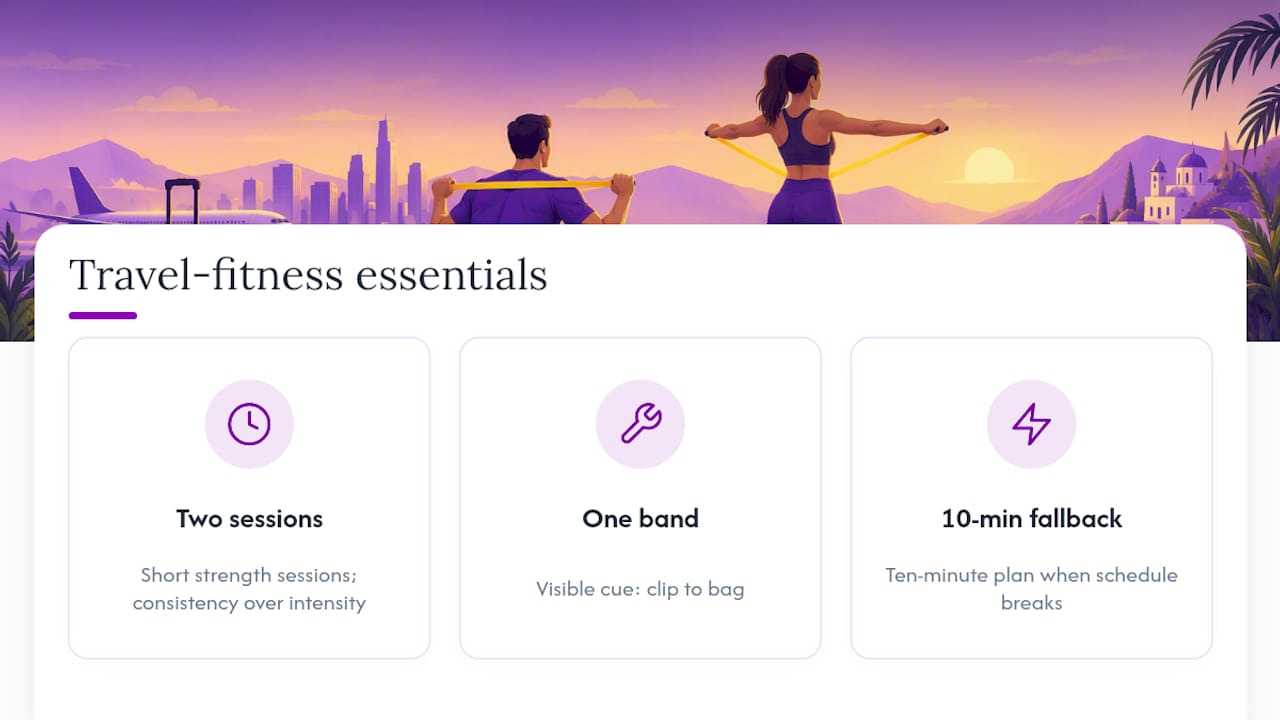
What gets underestimated is how much a single visible cue, a band clipped to your bag, a workout saved on your phone, changes whether you actually train. The gap between people who stay active on trips and people who don’t usually isn’t fitness knowledge. It’s friction. Remove the friction and the workout happens more often than not.
If you want structured programming that’s already built for these constraints, the 7-move bodyweight hotel workout is a solid starting reference, and Dietexerciseshop’s own hotel room workout guides cover formats built specifically for tight spaces and tighter schedules. Neither replaces judgment. Both remove the guesswork of designing a session from scratch when you’re jet lagged and short on time.
— Mark
Two eBooks and a Circuit That Actually Fit in a Suitcase
Dietexerciseshop built its eBook library around exactly the constraints this article covers: little time, little space, and no gym guarantee. Instead of a full commercial program you’ll never finish before your flight, these three digital guides give you a ready structure the moment you land.

The Functional Fitness eBook is built around compact, full-body movement patterns, the same kind that translate directly into a hotel-room circuit with a band and nothing else. If your trips are short on time but long on stairs, layovers, and unpredictable schedules, the HIIT 2 FIT eBook gives you micro-sessions built for exactly that kind of window. And for longer stints away from home, the Real Life Fitness eBook focuses on adapting training to irregular days rather than forcing a home routine onto a life that doesn’t have one right now.
Pair either guide with a resistance band from the Dietexerciseshop store and you’ve got a complete travel kit for less effort than researching a hotel gym from scratch.
Sources
- WHO physical activity guidelines (summary) / PMC7719906
- How to maintain fitness on vacation - REI expert advice
- A 7-move bodyweight workout you can do in any hotel room - Outside Online
- CDC: Deep vein thrombosis and pulmonary embolism - Travel guidance
FAQ
What Is the 3-3-3 Rule for the Gym?
The “3-3-3 rule” isn’t an official public health guideline; different gyms and coaches define it differently. Treat any 3-3-3 program as a local convention rather than a substitute for the WHO’s weekly targets of 150 to 300 minutes of aerobic activity plus two strength sessions.
How Do You Lose Weight or Avoid Gaining It While Traveling?
Prioritize protein and fiber at meals, keep portable snacks on hand, and build walking into every day rather than relying on scheduled workouts alone. ACE’s travel nutrition guidance points out there’s no universal calorie target, so the goal is consistent habits over strict tracking.
What Travel Hacks Actually Work for Staying Fit?
Pack a resistance band, set a minimum session rule (one circuit, ten minutes), and put workout blocks directly on your travel itinerary before you leave. Booking a hotel with a gym, downloading offline workouts, and choosing an aisle seat for easier movement on flights round out the habits that hold up trip after trip.
How Do You Avoid Losing Muscle on Vacation?
Keep two short full-body strength sessions a week, using bodyweight moves or a resistance band if a gym isn’t available. This matches the WHO’s strength-training frequency recommendation and preserves nearly all the muscle you’d maintain with a home routine, even with reduced volume.
Do I Need Special Equipment to Stay Fit While Traveling?
No. A single resistance band, a travel jump rope, and a mat or towel cover almost every scenario, and bodyweight circuits work with no equipment at all. The Dietexerciseshop eBooks are built around exactly this minimal-equipment approach for travelers who want a structured plan without packing a gym bag’s worth of gear.