

Three Level Dumbbell Leg Workout for Home: Barbell Free Progressions
Yes, dumbbells build strong, defined legs. Hit the squat, hinge, lunge, and hip-bridge patterns with rep ranges between 6 and 20, then push progressive overload week to week, and your quads, hamstrings, and glutes respond the same way they would to a barbell. Start with the movement selection below, pick a rep range that matches your goal, and let load and tempo do the rest.
TL;DR:
- Dumbbell workouts effectively target all major lower-body muscles, including quads, hamstrings, glutes, calves, and stabilizers, with proper progression.
- Key movements such as goblet squats, Romanian deadlifts, lunges, step-ups, and hip bridges cover essential patterns and can be scaled for beginners to advanced levels.
- Use a simple re-test to select appropriate dumbbell weights, aiming for 12 to 15 reps, and progressively overload by increasing reps, sets, tempo, or frequency.
- Incorporate unilateral exercises like Bulgarian split squats to reveal and correct strength imbalances between legs.
- Prioritize good form, suitable equipment, and balanced programming across workout levels, avoiding common mistakes like knees caving inward or shallow hinges.
Table of Contents
- What Muscles Does a Dumbbell Leg Workout Target?
- Core Dumbbell Exercises: What to Do, Why, and How to Cue Them
- Beginner, Intermediate, and Advanced Dumbbell Leg Workouts
- How to Choose the Right Dumbbell Weight and Keep Progressing
- Programming Tips, Variations, and Common Mistakes
- Equipment, Setup, and Safety for Home or Gym Training
- Why Trust This Guide
- A Training Philosophy Worth Adopting
- Build Your Program With the Right Resources
- Sources
- FAQ
What Muscles Does a Dumbbell Leg Workout Target?
Your lower body runs on five major players, and a smart dumbbell leg workout hits every one of them instead of just chasing quad burn. The quads extend the knee and dominate squats and step-ups. The hamstrings and glutes drive hip extension, which is why hinge movements like the Romanian deadlift feel like a different exercise entirely from a squat. Calves get overlooked constantly, yet they stabilize every single-leg movement you do. Hip abductors and the smaller stabilizers around the hip and ankle rarely get named, but they’re what keep your knee from buckling inward on a lunge.
A balanced dumbbell lower body workout should cover four movement patterns, not just “leg day exercises” picked at random. SELF’s training guidance backs this exact structure: squat, hinge, hip bridge, and abduction work together to train quads, hamstrings, and glutes without leaving gaps.
- Squat pattern: knee and hip bend together, quad and glute dominant. Think goblet squats or front-rack squats.
- Hinge pattern: hips fold back while knees stay soft, hamstring and glute dominant. The dumbbell Romanian deadlift is the standard here.
- Lunge/split pattern: one leg loaded at a time, builds unilateral strength and exposes weak sides. Bulgarian split squats and walking lunges live here.
- Hip bridge/abduction pattern: isolates glute extension and the outer hip, often underused but critical for hip stability.
Unilateral (single-leg) training deserves its own callout. PowerBlock’s coaching research notes that dumbbell-based single-leg work exposes strength differences between your left and right sides that a barbell often hides, because the bar lets your stronger leg quietly do more work. Training one leg at a time forces both sides to earn their share.
Form cues worth memorizing: keep your chest tall on squats, push your hips back (not down) on hinges, and track your front knee over your ankle, not past your toes, on every lunge variation.
Core Dumbbell Exercises: What to Do, Why, and How to Cue Them
Every dumbbell leg workout routine boils down to picking the right tool for the pattern you’re training. Here’s the working list, in the order most programs use them, from the heaviest compound lift to smaller finishing moves.
-
Goblet squat. Hold one dumbbell vertically against your chest, elbows tucked, and squat between your knees. This is the best entry point for beginners because the front-loaded position naturally keeps your torso upright and teaches proper depth. Once your single dumbbell gets too light to challenge you, switch to a front-rack double-dumbbell squat, which lets you load heavier without your grip becoming the limiting factor. Men’s Health’s exercise-library guidance on holding positions confirms that front-rack and goblet holds shift torso angle and balance demand differently, which is exactly why swapping holds keeps a plateaued lift moving again.
-
Dumbbell Romanian deadlift (RDL). Hold a dumbbell in each hand, soften your knees slightly, and hinge at the hips until you feel a stretch through your hamstrings, then drive back up by squeezing your glutes. The bar path should stay close to your shins the entire way down. This is the single best dumbbell hamstring exercise you can do without a barbell, and it teaches the hip-hinge pattern that protects your lower back in every other lift.
-
Bulgarian split squat. Rest your rear foot on a bench behind you, hold dumbbells at your sides, and drop straight down until your front thigh is roughly parallel to the floor. Foot placement matters more than people think: a shorter stance biases quads, while stepping your front foot farther forward shifts more work into the glute. This move humbles almost everyone the first time they try it, and that’s the point. It exposes weak legs fast.
-
Walking, reverse, and forward lunges. Walking lunges build hip stability through continuous motion, reverse lunges are gentler on the front knee and easier to learn, and forward lunges add a deceleration challenge that trains control, not just strength. Keep your stride long enough that your front knee stacks over your ankle at the bottom, never drifting past your toes.
-
Step-ups. Choose a box or bench roughly knee height, place your whole foot flat on top, and drive up through your heel rather than pushing off your trailing leg. Step-ups double as a hip-bridge alternative when you don’t have room for a barbell hip thrust. A weighted hip bridge on the floor, dumbbell resting on your hips, works just as well if you’d rather stay grounded.
-
Calf raises, plus lateral and curtsy variations. Standing calf raises with dumbbells in hand hit the plane most programs ignore entirely: vertical loading straight up through the ankle. Lateral lunges and curtsy lunges train the frontal plane, the sideways and rotational movement your knees and hips need but rarely get in a gym built around forward and backward motion.
Rotate through these six categories and you’ve covered every essential pattern a dumbbell lower body workout needs, without a single barbell in sight.
Beginner, Intermediate, and Advanced Dumbbell Leg Workouts
A dumbbell leg workout routine should follow the same shape at every level: warm up, hit your main compound lift, layer in accessory work, then cool down. What changes across levels is volume, exercise complexity, and how hard you push each set.
Beginner session (technique first)
Four to six moves, kept simple, aiming for a 6 or 7 out of 10 on perceived effort (RPE) so your nervous system learns the patterns before you load them heavily.
- Goblet squat: 3 sets of 10 to 12 reps, 90 seconds rest
- Dumbbell RDL: 3 sets of 10 to 12 reps, 90 seconds rest
- Reverse lunge: 2 sets of 10 reps per leg, 60 seconds rest
- Standing calf raise: 2 sets of 15 reps, 45 seconds rest
Most beginners do fine starting around 10 to 20 pounds per dumbbell for squats and lunges, and lighter for calf raises, then adjusting up once 12 reps feel too easy for two sessions in a row.
Intermediate session (more volume, more unilateral work)
Bump total sets, add supersets to save time, and lean harder into single-leg training. Rep ranges of 6 to 12 work well here, balancing strength and muscle growth. Rest 60 to 90 seconds between straight sets, 30 to 45 seconds between superset pairs.
- Front-rack squat: 4 sets of 8 to 10 reps
- Bulgarian split squat: 3 sets of 8 to 10 reps per leg
- Walking lunge superset with lateral lunge: 3 rounds of 10 reps each side
- Step-up: 3 sets of 10 reps per leg
- Calf raise (paused at top): 3 sets of 12 to 15 reps
Advanced session (intensity techniques)
Heavier loads, longer time under tension, and single-leg overload replace simply adding more sets. Paused eccentrics (a two to three second lowering phase) and tempo work push muscles harder without needing a heavier dumbbell than you own. The Ohio State University Wellness Center notes that slowing the eccentric phase increases time under tension and is a legitimate way to build muscle definition when you’ve maxed out your available weight.
- Front-rack squat with 3 second eccentric: 4 sets of 6 to 8 reps
- Single-leg RDL: 4 sets of 8 reps per leg
- Bulgarian split squat, paused at the bottom: 4 sets of 8 per leg
- Curtsy lunge: 3 sets of 10 per leg
- Weighted hip bridge, 2 second pause at top: 3 sets of 12
Pro Tip: Before you touch a heavier dumbbell, try slowing your existing weight down. A 4 second lowering phase on a Bulgarian split squat you’ve been doing for months will make it feel brand new.
A simple 4-week progression
Week 1 sets your baseline reps and weight. Week 2, add 1 to 2 reps per set across the board. Week 3, add one extra set to your two main compound lifts. For structured 12-week versions of this approach, the dumbbell-only workout plan walks through longer progression blocks in more detail.
How to Choose the Right Dumbbell Weight and Keep Progressing
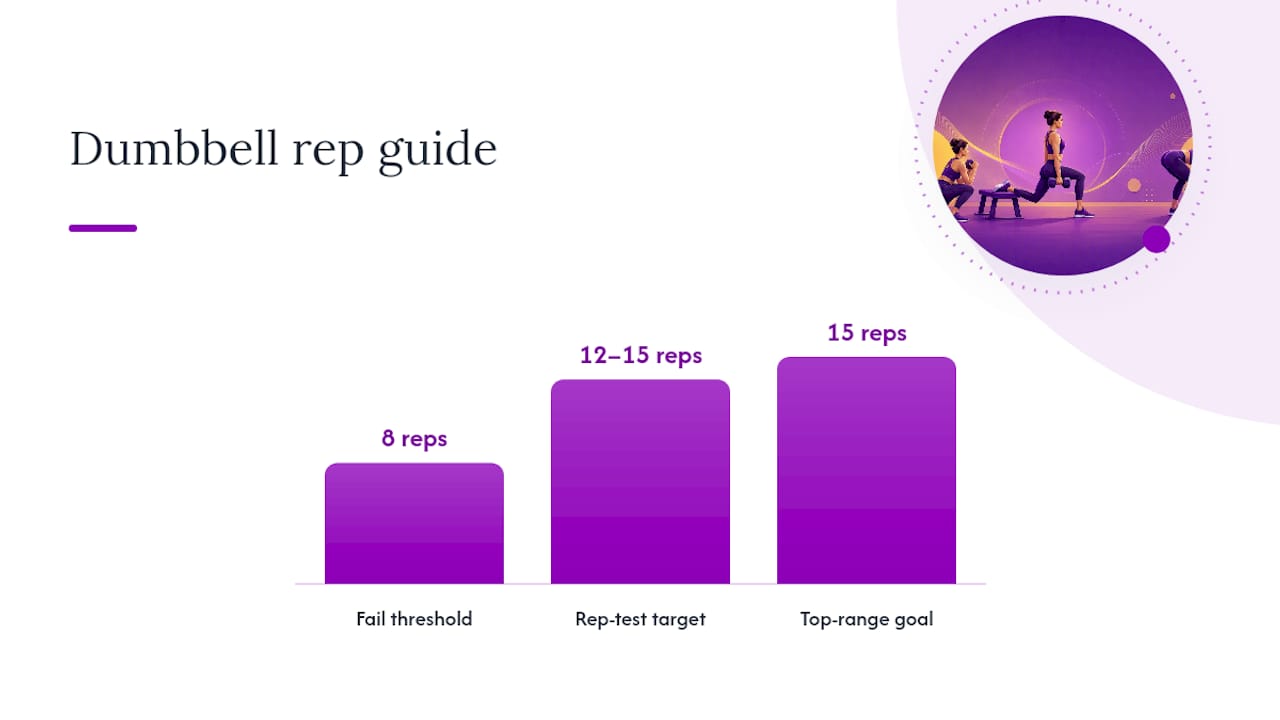
Pick a weight using a simple rep test: load a dumbbell you can lift for 12 to 15 clean reps with 2 to 3 reps left in the tank (a Reps in Reserve, or RIR, of 2 to 3). If you can’t hit 8 reps with decent form, drop the weight. If 15 reps feels easy, go up. This one test replaces guesswork for almost every lift in this article, and the rep-tested weight guide breaks down starting ranges by exercise and experience level.
These ranges are illustrative starting points, not a script. Your actual numbers depend on training history, leg length, and how much you’ve trained unilateral moves specifically.
Once you’ve found a working weight, Heala’s progressive overload framework is worth knowing by name, because most people only think in terms of “add more weight.” There are five real dials:
- Weight: the obvious one, but not the only one.
- Reps: squeeze one or two more out of the same weight before upgrading.
- Sets: add volume without touching load.
- Tempo (time under tension): slow the eccentric phase to make a lighter weight feel heavier.
- Frequency: train legs one more day per week if recovery allows.
Tempo changes matter most when you’ve hit a wall with your available dumbbells, which happens to almost everyone training at home eventually. A 4 to 5 second eccentric on a squat you’ve plateaued on can restart progress without buying a single new plate.
A practical weekly rule: when you hit the top of your rep range for two sessions running, add 1 to 2 reps first. Take a deload week, lighter weight and fewer sets, roughly every 6 to 8 weeks or whenever your joints start feeling cranky rather than just tired.
Programming Tips, Variations, and Common Mistakes
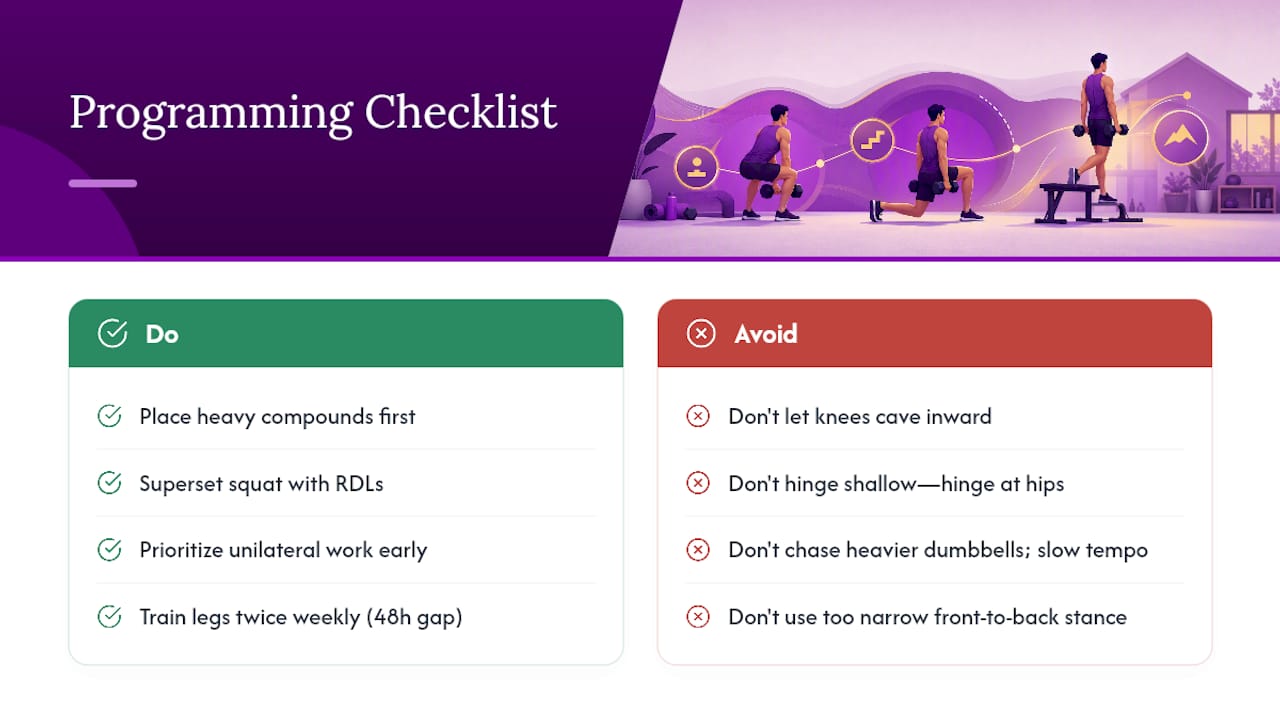
Order your exercises heaviest-compound-first: squats and hinges before lunges and step-ups, isolation calf work last. Supersetting a push pattern (squat) with a pull pattern (RDL) keeps rest efficient without compromising either lift. Prioritize unilateral work early in a session when you’re fresh, since single-leg balance demands more focus than a bilateral squat.
No bench for step-ups or Bulgarian split squats? A sturdy chair, a stair, or a low wall works. No dumbbell heavy enough for RDLs? Slow the tempo down instead of chasing more weight, or switch to single-leg RDLs, which double the per-leg demand instantly.
The two mistakes that show up constantly: knees caving inward (valgus) on squats and lunges, usually fixed by actively pushing the knees outward and strengthening hip abductors with lateral lunges. And a shallow hinge on RDLs, where lifters bend the knees instead of the hips, which turns a hamstring exercise into a mediocre squat. Watch yourself in a mirror or on video until the hip-hinge feels automatic.
Train legs twice a week if you’re intermediate or beyond, with 48 hours minimum between sessions. Pair a dumbbell leg day with upper-body work or a dumbbell chest workout on alternating days for a simple, sustainable split.
Pro Tip: If your knees ache after lunges, check your foot placement before blaming the exercise. A stance that’s too narrow front-to-back often forces excess forward knee travel.
Equipment, Setup, and Safety for Home or Gym Training
You need less gear than you think. An adjustable dumbbell pair, or a small rack of fixed weights, plus a stable bench or box, covers nearly everything in this article. The best dumbbells for home gym guide and the adjustable versus fixed comparison both help you decide what actually fits your space and budget.
- Train on a non-slip surface, especially for step-ups and split squats where a shifting foot is dangerous.
- Wear flat, stable shoes. Cushioned running shoes compress unevenly under a loaded lunge.
- Clear enough floor space for a full walking lunge stride in both directions.
Warm up for 5 minutes with bodyweight squats, leg swings, and glute bridges before your first loaded set, a sequence Gymnasetips recommends to prime mobility and neural readiness before heavier work. Stop and get a professional opinion if you feel sharp joint pain rather than normal muscle fatigue, or if one side consistently feels weaker or less stable than the other.
Why Trust This Guide
This guide is written by Mark for Dietexerciseshop, drawing on movement-pattern research and progressive overload principles used across serious strength coaching resources. Mark has covered dumbbell programming extensively, including the full dumbbell workout plan for building muscle at home.
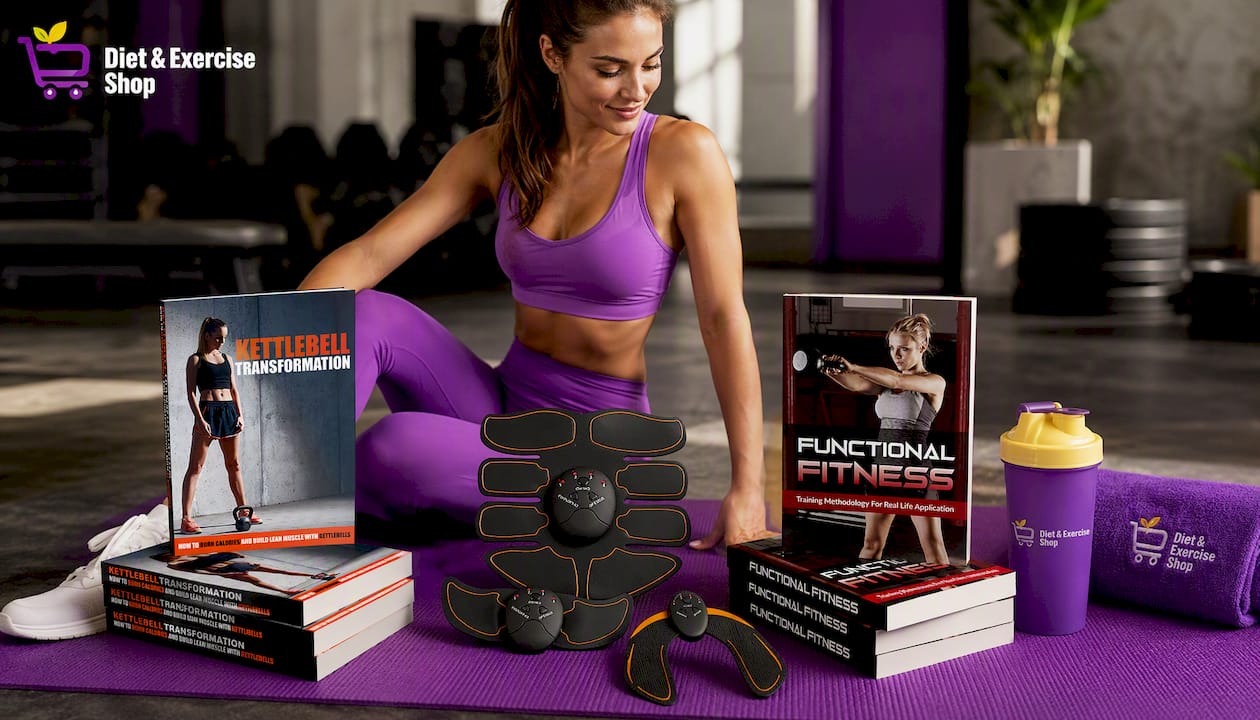
Three Dietexerciseshop resources extend what’s covered here. The KETTLEBELL TRANSFORMATION eBook offers a structured alternative for readers who want to mix implements. The FUNCTIONAL FITNESS eBook dives deeper into the stability and unilateral work this article touches on. The Abs Stimulator | Abdominal Toning Workout for Abdomen/Arm/Leg, Workout Equipment for Men Women supports the core bracing that loaded single-leg movements demand.
A Training Philosophy Worth Adopting
Dumbbells reward attention. A barbell lets your stronger leg cheat; a pair of dumbbells won’t let you hide an imbalance for long, which is exactly why I think they build more durable strength over time, not just bigger numbers on paper.
The one tip worth trying next session: add a 3 second pause at the bottom of your next Bulgarian split squat. It exposes weaknesses a normal tempo lets you rush past.
— Mark
Build Your Program With the Right Resources
You can find equipment and structured programs online to take this routine further without guessing your way through it. If you’re ready to add a proven training resource to your rotation, the KETTLEBELL TRANSFORMATION eBook and FUNCTIONAL FITNESS eBook both build directly on the patterns covered here, giving you week-by-week structure instead of piecing together random workouts.
If you’re still working out what equipment to buy, start with the best dumbbells for a home gym buying guide, then grab the FUNCTIONAL FITNESS eBook to turn today’s workout into a real program you can follow for months.
Sources
- Gold’s Gym — 2026 workout plan
- SELF — A dumbbell leg workout that targets your quads, hamstrings, and glutes
- Gymnasetips — Leg day with dumbbells: full strength routine
- Men’s Health — The dumbbell leg workout to build lower body strength and size
FAQ
Can You Build Legs With Just Dumbbells?
Yes. Research on dumbbell training shows dumbbells produce comparable hypertrophy to barbells when you apply progressive overload through weight, reps, sets, or tempo consistently over time.
What Are the Top 5 Dumbbell Leg Exercises?
The goblet squat, dumbbell Romanian deadlift, Bulgarian split squat, walking lunge, and weighted step-up cover the squat, hinge, and unilateral patterns most lower-body programs need.
What Is the Most Effective Dumbbell Leg Exercise?
The goblet squat is usually the best starting point because its front-loaded position teaches proper depth and posture, but the Bulgarian split squat often delivers the most muscle growth per set once you’ve built a base level of strength.
Is 7 Exercises Enough for Leg Day?
Yes, 6 to 8 exercises totaling roughly 18 to 24 working sets is a well-supported range for building strength and size without overtraining, especially for beginners and intermediates.