

Athletes: Test Your Omega 3 Index Before Taking 1 to 3 g/day
Yes, EPA and DHA can help athletes, mainly for recovery and cardiovascular support, but supplementing blindly isn’t the move. The ISSN position stand treats omega-3 status as a real gap in athlete nutrition, and the omega-3 index (O3i) is the marker that tells you if you actually have one. Step one is checking your fish intake or testing your O3i; if it’s low, 1 to 3 grams a day of combined EPA+DHA for 6 to 12 weeks is a reasonable, evidence-backed starting point.
TL;DR:
- Athletes should test their omega-3 index and aim for 1 to 3 grams of EPA+DHA daily if their levels are low, with 8% O3i as a target for health benefits.
- Supplementation is most effective over 6 to 12 weeks, with tissue incorporation of omega-3s being a slow process that varies based on dose and starting diet.
- EPA and DHA from fish or algae sources directly influence cell membranes and inflammation, which impact recovery, cardiovascular health, brain function, and joint resilience.
- Many studies show omega-3s improve mood, reaction time, and recovery markers, but have limited evidence for enhancing endurance or strength directly.
- For optimal absorption and safety, take omega-3 supplements with meals, verify EPA+DHA content on labels, and choose third-party tested, sport-certified products, especially for tested athletes.
Table of Contents
- What Omega 3s Are and How They Affect Athletic Physiology
- What Trials and Reviews Show for Performance and Recovery
- Dosing, the Omega-3 Index, and When You’ll Actually Notice Something
- Choosing a Sport-Safe Omega-3 Supplement
- Safety, Interactions, and Special Situations
- Omega-3s, Injury Prevention, and Joint Health
- Mental Focus, Cognition, and Mood
- How Omega 3 Interacts With Other Supplements Athletes Use
- Monitoring Your Omega-3 Intake and Adjusting Based on Biomarkers
- Where Omega 3 Fits in an Athlete’s Priority List
- Fuel Your Training With Dietexerciseshop’s Recovery Lineup
- Sources
- FAQ
What Omega 3s Are and How They Affect Athletic Physiology
Omega-3 fatty acids come in three forms that matter here: EPA (eicosapentaenoic acid), DHA (docosahexaenoic acid), and ALA (alpha-linolenic acid). EPA and DHA are long-chain omega-3s found mainly in fish, algae, and marine sources. ALA is a shorter-chain plant version found in flaxseed, walnuts, and chia. They are not interchangeable, despite what a lot of supplement marketing implies.
The distinction matters because your body has to convert ALA into EPA and DHA to use it the way it uses marine-sourced fats, and that conversion is inefficient. The NIH Office of Dietary Supplements notes that conversion rates commonly fall under 15%, which means a diet built around flax oil and walnuts won’t raise your tissue EPA+DHA levels the way a serving of salmon or an algae-based supplement will.
Once EPA and DHA get into your system, they do a few things that matter specifically for training and competing:
- Cell membrane incorporation. EPA and DHA get built directly into the phospholipid membranes of your cells, including muscle and immune cells, changing how those membranes function and signal.
- Inflammation modulation. They shift the balance of inflammatory signaling molecules your body produces after hard training, which is the mechanistic basis for recovery claims.
- Endothelial and nitric oxide effects. Omega-3s influence how well your blood vessels dilate, which has implications for oxygen delivery during endurance work.
- Neuroprotection and immune modulation. DHA in particular is a major structural component of neural tissue, and there’s a plausible link to cognitive and mood effects during heavy training blocks.
Here’s the part most athletes don’t know: training itself can push you toward omega-3 insufficiency. High training volumes increase inflammatory turnover and metabolic demand, and if your diet doesn’t compensate with enough EPA+DHA, your tissue levels can run low even if you eat what feels like a “healthy” diet. That’s exactly why the ISSN frames athletes as a population at elevated risk for insufficiency rather than assuming their higher calorie intake automatically covers it.
The omega-3 index captures this directly. O3i measures the percentage of EPA+DHA in red blood cell membranes, and it’s a far more useful number than “I eat fish sometimes.” Two athletes with similar diets can have meaningfully different O3i values depending on genetics, fish quality, and how much omega-6 is crowding out omega-3 in their overall fat intake. Without testing, you’re guessing.
What Trials and Reviews Show for Performance and Recovery
The evidence splits cleanly into two buckets: consistent findings and mixed findings, and conflating them is where most fitness content goes wrong.
On the consistent side, the 2024 ISSN position stand concludes that EPA+DHA supplementation can support endurance capacity, cardiovascular function, and recovery markers like muscle soreness in athletes who are insufficient to begin with. That’s a meaningful endorsement from the field’s leading professional body, but notice the qualifier: it applies most clearly to athletes starting from a deficit, not universally.
A 2020 systematic review of athlete-specific randomized trials backs this up with more nuance. It found consistent signals for:
- Reaction time
- Mood
- Cardiovascular dynamics (heart rate variability, blood pressure responses)
- Some recovery and soreness markers
But the same review found no clear overall effect on endurance performance, lung function, or muscle force output when you pool the trials together. That’s an important distinction. Omega-3s look genuinely useful for how you feel and recover, and considerably less reliable for making you objectively faster or stronger on a given day.
Why the evidence is this messy: four variables drive almost all the disagreement between studies.
Dose varies wildly across trials, from under a gram to over 4 grams a day of combined EPA+DHA. The EPA-to-DHA ratio differs by product, and EPA-heavy versus DHA-heavy formulations may not do the same job. Study duration ranges from a few weeks to several months, and omega-3 incorporation into tissue is a slow process, so short trials may simply not run long enough to show an effect. Athlete training level also matters, since already-optimized elite athletes have less room to improve than recreational lifters with poor baseline diets.
One trial illustrates how a study can look impressive on paper while still being limited. A 2022 collegiate-athlete trial using roughly 3 grams a day (1.75 g EPA plus 1.1 g DHA) for eight weeks raised participants’ omega-3 index by about 73% and improved handgrip strength. That’s a real, measurable effect, but it came from a small sample in one sport, and a single strength measure doesn’t generalize to sprinting, cycling, or team sport agility. Treat it as a proof of concept, not a universal prescription.
Dosing, the Omega-3 Index, and When You’ll Actually Notice Something
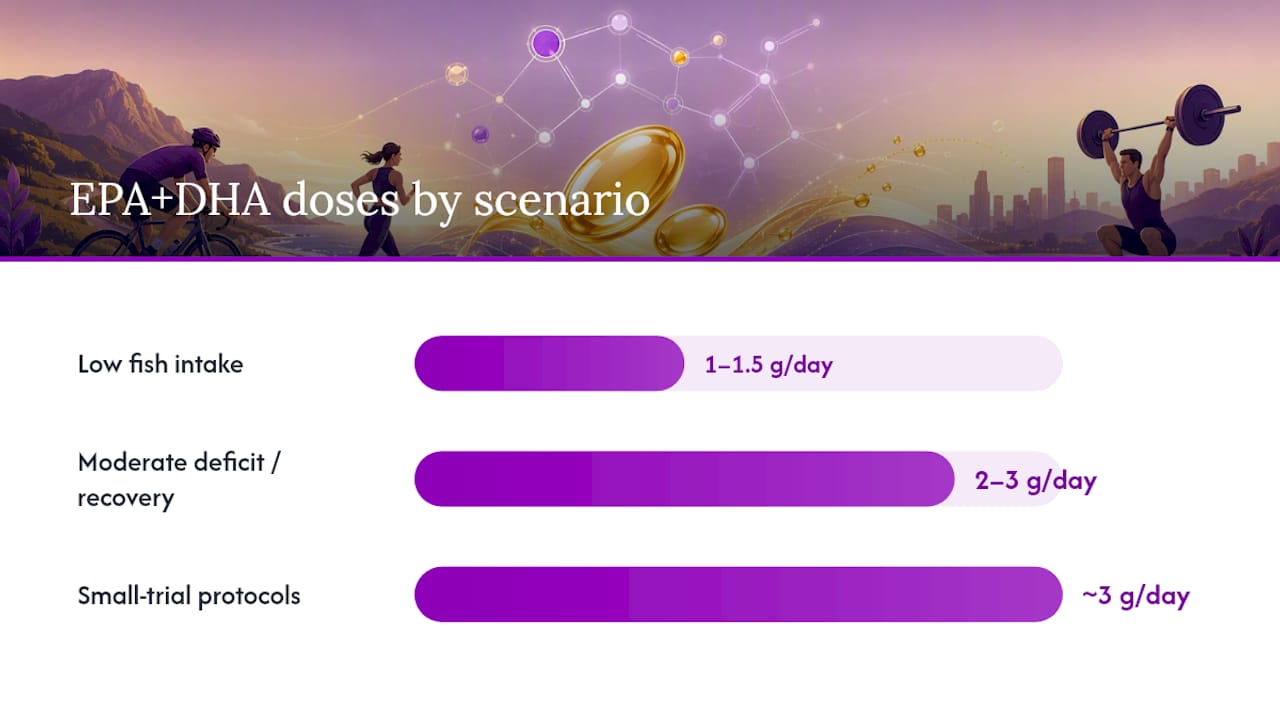
Most practical guidance converges on the same range: 1 to 3 grams a day of combined EPA+DHA, with many clinical trials using doses toward the higher end of 2 to 4 grams a day to produce measurable changes. The GSSI practitioner review settles on roughly 1 to 3 grams a day as the workable individualized range for most athletes, factoring in bioavailability and product form.
The omega-3 index is what tells you whether that dose is actually doing anything. An O3i above 8% is generally considered the target range associated with better cardiovascular and inflammatory outcomes, yet a nutrients review notes that athletes commonly sit below that target, often needing 1 to 1.5 grams a day of EPA+DHA sustained over 12 weeks or more just to close the gap.
| Starting point | Typical dose used | Timeline to reassess |
|---|---|---|
| Low fish intake, no supplement | 1–1.5 g/day EPA+DHA | 12 weeks, then retest O3i |
| Moderate deficit or recovery focus | 2–3 g/day EPA+DHA | 8–12 weeks |
| Small-trial performance protocols | ~3 g/day (specific EPA:DHA ratios) | 8 weeks, athlete-monitored |
That collegiate trial mentioned earlier used close to 3 grams a day for eight weeks and produced a 73% jump in O3i alongside a strength improvement, which gives you a real reference point for how fast incorporation can move under a structured dose. But it’s one small trial in one sport, and your own response will depend on your starting diet, body size, and how consistently you take it.
Realistically, plan on 6 to 12 weeks before drawing conclusions. Omega-3s work by slowly replacing existing fatty acids in your cell membranes, not by acting like a pre-workout stimulant. If you retest your O3i at 12 weeks and it hasn’t moved meaningfully, the dose, the product’s actual EPA+DHA content, or your consistency is the likely culprit, not the strategy itself.
Choosing a Sport-Safe Omega-3 Supplement
Label reading is where most athletes get fooled. A bottle that says “1,000 mg fish oil” per capsule can contain as little as 300 mg of actual EPA+DHA, with the rest being other fats and filler. Always calculate your daily EPA+DHA total from the supplement facts panel, not the headline fish oil number on the front of the bottle.
A few other things worth knowing before you buy:
- Molecular form affects absorption. Triglyceride-form fish oil tends to absorb better than ethyl ester form, particularly when taken without food, though both improve with a fat-containing meal.
- Take it with meals, not on an empty stomach. Pairing your dose with a meal that contains some fat improves absorption and meaningfully cuts down on the fishy aftertaste and mild GI upset some people get.
- Split large doses across the day. If you’re taking 2 to 3 grams a day, splitting it into two servings reduces stomach discomfort compared to one large dose.
- Third-party testing isn’t optional for competitive athletes. Fish oil products can carry contamination risk, and for athletes in tested sports, product-level certification matters more than it does for a casual gym-goer.
Pro Tip: Keep a photo of the batch number and certificate of analysis for any supplement you use in-season. If you’re ever subject to a doping control question, having that documentation on hand can save you a serious headache.
Your practical checklist before buying: does the label state clear EPA and DHA milligram amounts (not just “fish oil” totals)? Does the brand publish independent batch testing? Does it carry a recognized sport-safe certification if you compete in a tested sport? If any of those are missing, look elsewhere. A multivitamin and supplement safety guide covers similar due diligence steps that apply just as well here.
Safety, Interactions, and Special Situations
The most common side effects are gastrointestinal: mild nausea, loose stools, or a fishy aftertaste. Splitting doses and taking omega-3 with meals resolves most of this without needing to lower the dose.
The bleeding question comes up constantly, and it’s worth being precise about it. A secondary analysis of the OPERA trial, a large randomized perioperative study, found that fish oil supplementation did not increase perioperative bleeding and was actually associated with fewer transfusions in that sample. That’s reassuring, but it doesn’t mean the theoretical interaction disappears for everyone.
- If you’re on anticoagulant or antiplatelet medication, talk to your prescriber before adding a gram-level omega-3 dose.
- If you have a planned surgery, mention your supplement use to your surgical team ahead of time.
- If you have a known fish or shellfish allergy, use an algae-derived source instead of fish oil.
- If you’re pregnant, DHA is generally considered beneficial, but dosing should go through your obstetric provider rather than generic athlete guidance.
Athletes in drug-tested sports should route any supplement question through their sports medicine or anti-doping staff, keeping product batch information on hand as a matter of routine rather than only when asked.
Omega-3s, Injury Prevention, and Joint Health
The connective tissue angle is where omega-3’s anti-inflammatory mechanism has the most intuitive fit, even though direct injury-prevention trials in athletes are still limited. Chronic low-grade inflammation from repetitive training stress plays a role in tendinopathy and joint discomfort, and EPA+DHA’s effect on inflammatory signaling is the same mechanism behind the soreness reduction the ISSN position stand references.
That doesn’t mean omega-3 supplementation prevents injuries outright. What the evidence supports is a more modest, useful claim: adequate omega-3 status supports the inflammatory environment your joints and tendons are recovering in, which may make a difference on the margins for athletes carrying a heavy training load in contact or repetitive-impact sports. If you’re managing recurring joint stiffness or soreness, omega-3 status is a reasonable variable to check alongside training load, sleep, and total protein intake rather than a standalone fix. Pairing it with a broader muscle soreness recovery routine makes more sense than expecting a fish oil capsule to do all the work.
Mental Focus, Cognition, and Mood
DHA makes up a large share of the structural fat in neural tissue, which is the biological reason omega-3 research keeps circling back to cognition and mood. The 2020 systematic review found one of its more consistent signals here: improved reaction time and mood outcomes across several athlete trials, even in studies where endurance or strength measures showed nothing.
For athletes, that’s a genuinely practical benefit, arguably more consistently supported than some of the performance claims that get more marketing attention. Faster reaction time matters in reactive sports like tennis, boxing, or field sports, and mood stability matters across a demanding training cycle where overreaching and mental fatigue are real risks. This isn’t a nootropic-level effect, and nobody should expect a dramatic cognitive shift. But if you’re already supplementing for recovery, better focus and steadier mood during heavy training blocks are a reasonable secondary benefit to expect, not a headline claim to chase on their own.
How Omega 3 Interacts With Other Supplements Athletes Use
Omega-3s don’t operate in isolation, and a few interactions are worth knowing if you’re stacking supplements the way a lot of competitive athletes do.
Fish oil and blood-thinning supplements like high-dose vitamin E or ginkgo can theoretically compound bleeding risk, though as noted above, the clinical data on fish oil itself is more reassuring than the theory suggests. Omega-3s pair naturally with vitamin D, since both are fat-soluble and often included together in athlete protocols targeting immune function and bone health. Taking your omega-3 alongside a fat-containing source, whether that’s a meal or another fat-soluble supplement, improves absorption of both.
One interaction worth flagging: excessive omega-6 intake from processed oils can blunt the anti-inflammatory benefit you’re trying to get from omega-3, since the two compete for the same enzymatic pathways. An athlete taking 2 grams of fish oil a day while also eating a diet heavy in fried food and seed oils is working against their own supplementation. If you’re also using creatine, protein powder, or a recovery-focused amino acid like glutamine, there’s no known negative interaction with omega-3, and combining them in a post-workout recovery stack is common practice.
Monitoring Your Omega-3 Intake and Adjusting Based on Biomarkers
Guessing is the default approach for most athletes, and it’s the reason so many people either underdose or waste money overdosing. The fix is straightforward: test, adjust, retest.
Start with a baseline omega-3 index test if it’s accessible to you, or at minimum, an honest audit of your weekly fish intake. If your O3i comes back below the 8% target range, that’s your signal to start a structured 1 to 3 gram daily EPA+DHA protocol rather than a vague “I should probably eat more fish” intention. Retest at the 12 week mark, since that’s roughly how long tissue incorporation takes to stabilize.
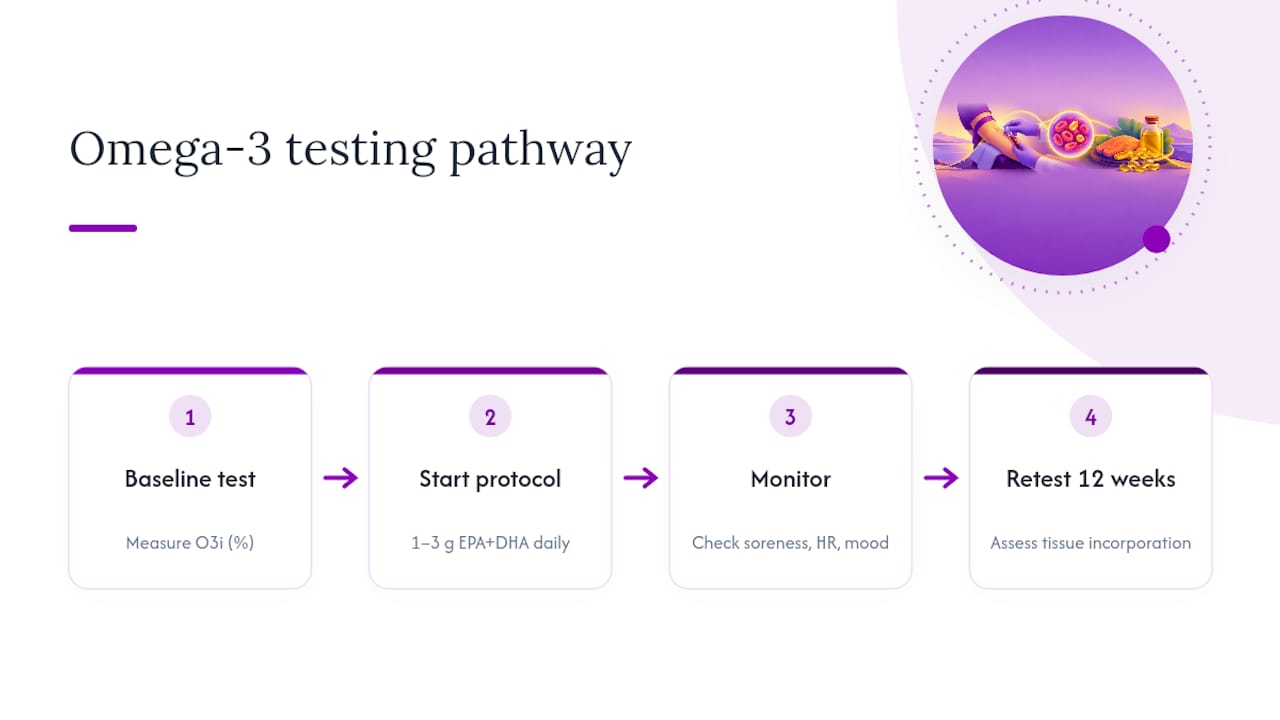
Watch for practical response markers between tests too: are you noticing less next-day soreness after hard sessions, is your resting heart rate trending in a better direction, has your mood or focus during high-volume training blocks improved? None of these are as precise as a blood test, but they’re useful real-world signals. If nothing has changed after 12 weeks at a reasonable dose, the issue is likely product quality, actual EPA+DHA content versus what the label claims, or consistency, not the underlying strategy.
Where Omega 3 Fits in an Athlete’s Priority List
Omega-3 status is a real, testable variable, not a wellness trend, and that’s exactly why I think it deserves a spot in serious athlete nutrition planning. But I’d push back on how it’s often marketed: as some kind of missing performance unlock. The systematic review evidence is honest about this. Reaction time, mood, and recovery markers respond more reliably than raw endurance or strength output does.
Here’s where I land after going through the trial data: omega-3 supplementation moves from optional to genuinely worth prioritizing when one of a few things is true. Your O3i tests low. You’re in a contact or high-impact sport where the anti-inflammatory mechanism has the clearest practical upside. Your fish intake is realistically under twice a week. Or recovery, not raw output, is your current limiting factor.
Outside those situations, I wouldn’t put omega-3 ahead of getting your total energy intake, protein, sleep, and training load right first. It’s a support piece, not a foundation. The athletes who get the most out of it are the ones who test their status, dose deliberately, and treat it as one piece of a broader plan rather than a fish oil capsule doing the job that food, sleep, and smart programming should be doing.
— Mark
Fuel Your Training With Dietexerciseshop’s Recovery Lineup
A supplement and apparel lineup based on status-first, food-first thinking is available to help support recovery without the guesswork of typical marketing. Products including sport-friendly supplements, training accessories, and workout apparel are offered with the goal of providing effective support.

If recovery and energy management are where you’re focused right now, the ENERGY++ eBook breaks down practical nutrition strategy beyond just omega-3, and the VEGAN WARRIOR eBook is built specifically for athletes navigating plant-based training without sacrificing recovery quality. Training days call for the right gear too. The MEAL PREP & MUSCLE REPS Hoodie, CARDIO AND CARBS, THE PERFECT PAIRING Hoodie, and RUNNING ON COFFEE AND PROTEIN SHAKES Hoodie are built for the athletes who live this lifestyle daily, and the TRUST THE PROCESS T-Shirt and NEVER SETTLE ALWAYS STRIVE T-Shirt fit that same mindset of testing, tracking, and adjusting rather than chasing shortcuts.
For strength and core work that pairs naturally with a recovery-focused nutrition plan, check out the Ab Roller or Resistance Bands for home or travel training. Browse the full T-Shirts collection or head to the Dietexerciseshop homepage to see the complete catalog and find your next addition to a smarter training routine.
This article is general information, not a substitute for advice from a qualified doctor. Consult a qualified healthcare professional about your own circumstances before acting on anything here.
Sources
Food should be your first lever, and it’s a simpler fix than most athletes assume.
- International Society of Sports Nutrition Position Stand: Long-Chain Omega-3 Polyunsaturated Fatty Acids
- Promoting Optimal Omega-3 Fatty Acid Status in Athletes
- Omega-3 Fatty Acids - Health Professional Fact Sheet (NIH ODS)
- Omega-3s and athletic performance: systematic review (2020)
Vegan and vegetarian athletes deserve a specific note here: algae-derived EPA/DHA isn’t a fallback option, it’s the correct option. ALA sources don’t reliably raise tissue EPA+DHA at the levels most athletes need to hit meaningful O3i targets, so an algae oil supplement belongs in the plan from day one rather than as a last resort. If you’re building a broader vegan performance nutrition plan, a resource like the VEGAN WARRIOR eBook can help you structure the rest of your intake around that gap.
For athletes eating a standard omnivorous diet, pairing fish or supplement intake with your regular meals rather than treating it as a separate protocol makes it far more sustainable. A post-workout nutrition plan that already accounts for fat intake is a natural place to build this in.
FAQ
What’s the typical omega-3 dose for athletes?
Most practical guidance points to 1 to 3 grams a day of combined EPA+DHA, with many clinical trials using 2 to 4 grams a day to see measurable changes according to the GSSI review. The right dose depends on your current O3i status and dietary fish intake.
Should I take fish oil in the morning or after training?
Timing relative to workouts matters less than taking it with a meal that contains fat, which improves absorption and reduces stomach upset. Splitting a larger dose into two servings across the day is more important than picking a specific hour.
Is algae oil as effective as fish oil for athletes?
Yes, algae-derived EPA and DHA deliver the same long-chain fatty acids as fish oil, since algae are the original marine source of omega-3s. It’s the standard recommendation for vegan and vegetarian athletes who can’t rely on ALA conversion to raise their omega-3 index.
How do I know if my omega-3 supplement is safe for competition?
Look for a product with clearly listed EPA and DHA milligram amounts, independent batch testing, and a recognized sport-safe certification if you compete in a tested sport. Keep the batch number and certificate of analysis on file in case anti-doping questions ever come up.
How soon will I notice a difference from omega-3 supplementation?
Give it 6 to 12 weeks before judging results, since EPA and DHA work by gradually incorporating into cell membranes rather than acting immediately. Retesting your omega-3 index at the 12 week mark is the most reliable way to confirm the dose is working.