

Three Day Microcycle for Progressive Overload With Dumbbells at Home
You build muscle and strength with dumbbells by changing one measurable variable at a time: weight, reps, sets, tempo, rest, or exercise difficulty. For home lifters, the biggest wins usually come from double progression, slower tempo, and unilateral variations rather than buying heavier plates. The rest of this guide shows you exactly how to apply each lever, track it, and avoid the mistakes that stall results.
TL;DR:
- Using slower tempos, unilateral exercises, and reducing rest can drive muscle growth effectively with limited weight progression.
- Tracking reps, sets, tempo, rest, and reps in reserve over several weeks ensures genuine progress rather than plateaus.
- Variations in leverage and exercise difficulty are practical substitutes for increasing weight when working with only one pair of dumbbells.
- Most progress stalls due to inadequate form, poor recovery, or combining multiple variables changes in a single week, which delay results.
- Regular deloads and focusing on form and recovery are essential to maintaining consistent progression over time.
Table of Contents
- What Is Progressive Overload With Dumbbells?
- How Do You Structure Progression With Double Progression?
- What If You Only Have One Set of Dumbbells?
- Sample Microcycle: Applying Progression Week to Week
- How Do You Know Overload Is Actually Happening?
- Why Do Progressions Stall, and How Do You Fix It?
- Who’s Behind This Guide, and What Backs It Up?
- What Actually Moves the Needle Here
- Equipment That Supports Your Progression Work
- Sources
- FAQ
What Is Progressive Overload With Dumbbells?
Progressive overload means giving your muscles a reason to adapt, session after session, by increasing the demand you place on them. With barbells, that demand usually comes from stacking plates. With dumbbells, especially at home, you have more tools than weight alone, and that’s actually an advantage once you know how to use them.
Increase the load when you can still add weight in small increments and your current dumbbells aren’t the ceiling. It’s the most direct lever, but only useful when you actually own the next size up.
Add reps or sets when your dumbbells are fixed. Going from three sets of eight to three sets of twelve is real overload, even with identical weight in your hand.
Slow the tempo, particularly the lowering phase. A scientific review on load and hypertrophy found that muscle growth happens across a wide range of loads when sets are taken close to failure, and that time under tension and tempo play a real role in that response. A four-second eccentric on a dumbbell curl turns a “light” weight into a genuinely hard set.
Cut rest between sets. Shorter rest raises metabolic stress, a known driver of hypertrophy, and it’s free.
Change the exercise’s leverage or difficulty. A goblet squat becomes a Bulgarian split squat. A two-arm row becomes a single-arm row with a longer pause at the top.
- Pressing: dumbbell bench press to dumbbell floor press to single-arm floor press
- Rowing: two-arm row to single-arm row to single-arm row with a two-count pause
- Hinge: Romanian deadlift to single-leg Romanian deadlift
- Squat: goblet squat to Bulgarian split squat
How Do You Structure Progression With Double Progression?
Double progression removes the guesswork. It gives you a clear, repeatable decision rule instead of vague instinct about when to add weight.
- Pick a rep range for the exercise, typically 8 to 12 for hypertrophy or 4 to 6 for strength-focused lifts.
- Start at the bottom of that range across all working sets, for example three sets of eight.
- Add one rep per set each week until every set hits the top of the range, for example three sets of twelve.
- Once you reach the top across all sets, increase the load or move to a harder variation, then reset reps to the bottom of the range.
Train most muscle groups twice a week if recovery allows, since frequency matters as much as the loading scheme itself, according to guidance from Gymaware’s progressive overload framework. Change only one primary variable per training block, usually two to three weeks, so you know exactly what caused your progress. If sleep quality drops, soreness lingers past 48 hours, or your reps fall two or more short of last session’s numbers, that’s your signal to deload for a week rather than push through.
Pro Tip: Keep an “RIR” column in your log, reps in reserve, and aim for 1 to 3 on working sets. If every set feels like 0 RIR for two sessions in a row, your next move is a deload, not heavier weights.
What If You Only Have One Set of Dumbbells?
Plenty of home lifters own a single pair of dumbbells and nothing heavier waiting in the closet. That’s not a dead end. Men’s Health’s guide to progressive overload with adjustable dumbbells points out that tempo changes, shorter rest, and exercise variation are legitimate substitutes for more weight, not lesser options.
Work through these in order, since they stay measurable and easy to compare week to week:
- Add reps or sets first. It’s the simplest change to track and the easiest to reverse if recovery suffers.
- Slow the eccentric to 3 or 4 seconds once reps stall. A Simply Strong breakdown of same-dumbbell progression recommends this as one of the first tools to reach for.
- Add a 1 to 2 second pause at the hardest point of the rep, like the bottom of a goblet squat or the top of a row.
- Switch to unilateral or single-limb variations, which increase demand per side without changing the dumbbell.
- Increase density by trimming rest between sets or supersetting two movements.
Applied practically: bench press progresses through added reps, then a 3-second lowering phase, then a single-arm floor press. Rows progress through added sets, then a paused top position, then single-arm work. Goblet squats progress through reps, then tempo, then a shift to Bulgarian split squats. Romanian deadlifts follow reps first, then a single-leg variation once the two-leg version stops feeling hard.
Sample Microcycle: Applying Progression Week to Week
A three-day full-body split works well for home lifters juggling limited equipment and limited time. Each session hits presses, pulls, and lower-body patterns, and progression happens through the same double-progression rule across the week.
- Day 1: Dumbbell bench press, single-arm row, goblet squat, plank. Start at the bottom of your rep range on all four.
- Day 2: Romanian deadlift, dumbbell overhead press, split squat, side plank. Same rule: add a rep per set weekly.
- Day 3: Single-arm floor press, two-arm row, walking lunge, dead bug. Once any exercise tops out its rep range, add load or move to the harder variation and reset.
For a goblet squat specifically, that looks like this: Week 1, three sets of 8 at a normal tempo. Week 2, three sets of 10. Week 3, three sets of 12. Week 4, add a 3 second lowering phase and reset to three sets of 8, or move up in weight if you have it. Beginners should master the tempo lever before adding pauses. Intermediates can stack tempo and pauses together. Anyone with access to heavier dumbbells should add load once bodyweight variations stop feeling challenging within the rep range. For a full weekly breakdown, a structured dumbbell workout plan can carry you past this starting template.
How Do You Know Overload Is Actually Happening?
You verify progress by logging the same fields every session and reading the trend over two to three weeks, not day to day.
- Exercise, load, sets, reps, tempo, rest, and RIR are the seven fields worth tracking.
- Rising reps at the same RIR means the load is too light. Time to add weight or difficulty.
- Falling reps or rising RIR at the same load two sessions running is your deload signal.
A minimal paper log with those seven columns works just as well as an app, and slower eccentric phases have been linked to greater muscle protein synthesis than fast, uncontrolled lowering, per background research summarized by Trainmate’s home progressive overload guide, which is exactly why tempo shows up as its own tracked field rather than an afterthought.
Why Do Progressions Stall, and How Do You Fix It?
Most plateaus trace back to a handful of repeat offenders: ego loading past your rep range too soon, changing tempo, weight, and exercise all in the same week, skipping the log entirely, or under recovering on sleep and food.
Work through this order when progress stalls:
- Check form first. A shortened range of motion inflates rep counts without real overload.
- Audit volume and intensity. Are you actually hitting your target RIR, or coasting at 4 to 5 reps in reserve?
- Audit recovery. Sleep under six hours and chronic under eating will stall any progression scheme.
- Simplify. Return to one main variable, usually reps within double progression, and drop everything else for a week.
Pro Tip: When in doubt, take a deload week: same exercises, same reps, lighter effort. Re-establish your tempo and RIR baseline before adding anything new.
Who’s Behind This Guide, and What Backs It Up?
This guide draws on peer-reviewed research on load and hypertrophy, along with practical guidance from Men’s Health and Healthline on home training. Related reading includes a dumbbell chest workout, guidance on what weight dumbbells to buy next, and a senior-focused dumbbell workout for lower-impact progression. Always prioritize clean form over added load.
What Actually Moves the Needle Here
Most lifters chase heavier dumbbells before they’ve earned them. The tempo and rest levers get treated like consolation prizes, when they’re often the faster route to real growth, especially once you’re past your first few months of training. Start with one variable next session: pick your hardest dumbbell exercise and add a 3 second eccentric to every rep. Log what happens. That single change tells you more about your recovery and technique than three months of random weight jumps ever will.
— Mark
Equipment That Supports Your Progression Work
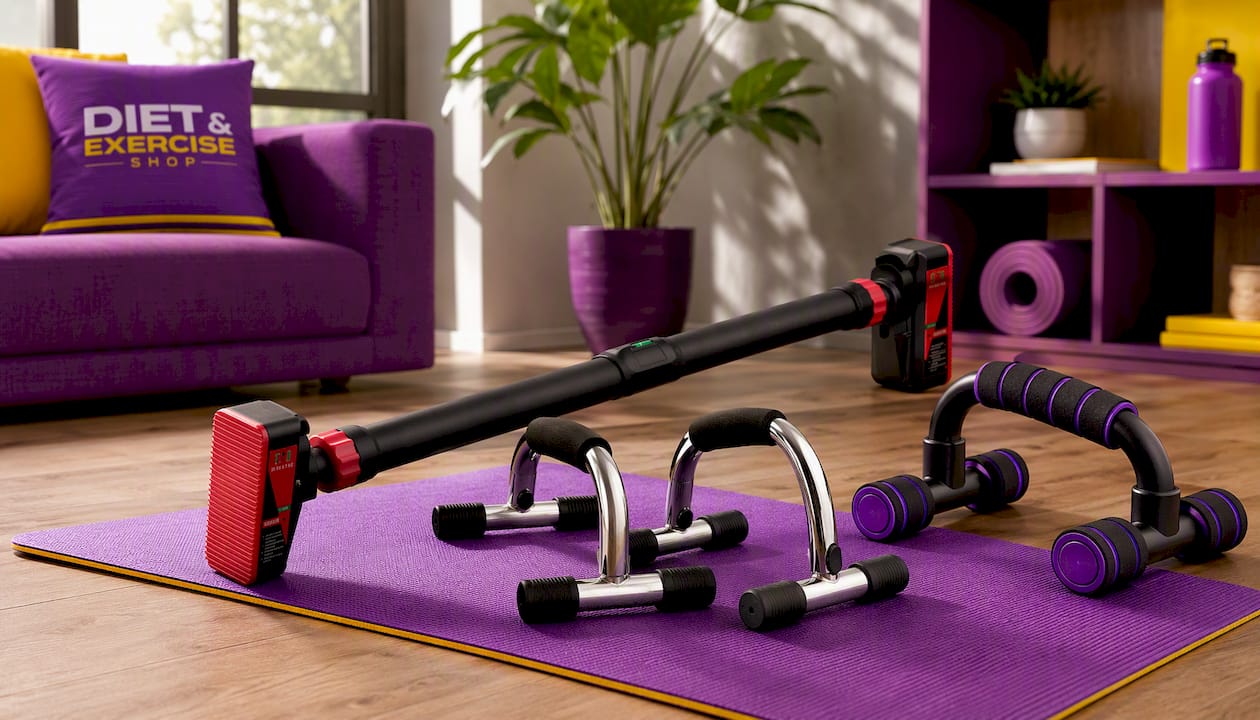
Once tempo, reps, and variation stop being enough, the right equipment extends the same progression logic into new movement patterns. A pull-up bar opens up vertical pulling progressions that dumbbells alone can’t replicate, giving you a natural next step once your rows top out. For pressing work, push-up bar stands extend your range of motion and cut wrist strain, which matters once you’re adding pauses and slow eccentrics to floor presses. If stability is your limiting factor on higher-rep pressing days, non-slip push-up stands keep your base solid through longer sets.
This catalog is built around home-first training: equipment, apparel, and digital guides that support progressive training without requiring a full rack of plates. Browse the full equipment and apparel collection to find the pieces that fit where your current program is stuck, whether that’s a pulling tool, a pressing accessory, or a guide to structure your next block.
Sources
The NCBI review on load and hypertrophy grounds the tempo and RIR guidance in peer-reviewed evidence. Men’s Health and Healthline supply practical home-dumbbell tactics and exercise modifications. Gymaware and Simply Strong offer the programming structure behind double progression and same-dumbbell tactics.
- How to Use Progressive Overload With Adjustable Dumbbells — Men’s Health
- PMC article on load and hypertrophy — NCBI
- How to Apply Progressive Overload With the Same Dumbbells — Simply Strong
FAQ
What Is the 3-2-1 Progressive Overload Method?
The 3-2-1 method typically refers to structuring a set around three tempo phases, often 3 seconds down, 2 seconds paused, 1 second up, to increase time under tension without adding weight. It’s one specific way to apply the tempo lever covered earlier in this guide, useful when your dumbbells are already maxed out for the rep range you’re working.
Is a 35 Pound Dumbbell Considered Heavy?
Whether a given weight counts as heavy depends entirely on the lift and the lifter. It’s a demanding single-arm row or overhead press weight for most intermediate lifters, but a moderate goblet squat load, since your legs handle far more than your shoulders can.
What Is the 3-3-3 Rule in the Gym?
There’s no single, universally agreed definition of a “3-3-3 rule” in strength training, and it isn’t a standard framework referenced in the research behind this guide. If you’ve seen it used to describe three sets of three exercises or three-second tempo phases, treat those as informal shorthand rather than an established method.
Can I Get Strong With a 20 Pound Dumbbell?
Yes, especially through double progression, slower tempo, and single-arm variations that increase the demand without changing the weight in your hand. Dumbbells taken to true near-failure with strict form and a controlled eccentric build real strength, particularly for smaller muscle groups like shoulders and arms.