

Protect Four Sessions a Week: Workout Time Management for Busy People
If you’re short on time, protect a small weekly floor of movement, pick one default time slot you can defend every day, and back it with a two-track plan that includes a short fallback session. That’s it. Do those three things, and workouts stop being the first item cut from a packed week. The American Council on Exercise backs shorter, consistent sessions over sporadic long ones, and Diet & Exercise Shop offers training guides that align with this approach.
TL;DR:
- Scheduling workouts after all other commitments ensures they are consistently protected from daily interruptions.
- Planning four weekly sessions with a mix of full and short workouts creates a reliable habit, even during busy or chaotic weeks.
- Using a two-track plan with pre-decided backup sessions prevents missed workouts from breaking your routine.
- Blocking extended chunks around your workout, including travel and setup, reduces the risk of delays and early termination.
- Rest days should be based on recovery signals like poor sleep and low energy, not just low motivation, to prevent overtraining.
Table of Contents
- How Do You Create a Routine and Pick Your Default Time?
- Why You Need a Two-Track Plan With Fallback Rules
- Time-Blocking, Anchors, and Scheduling Tactics That Actually Work
- How Do You Reduce Friction Before a Workout?
- Short-Session Templates You Can Use Today
- When Should You Rest Instead of Push Through?
- What Mark’s Practical Rules Get Right About Training on a Tight Schedule
- Why Consistent Small Wins Beat Occasional Long Sessions
- Ready to Put the Plan Into Practice?
- Sources
- FAQ
How Do You Create a Routine and Pick Your Default Time?
Most people schedule workouts around whatever’s left over after everything else fills the calendar. That’s backward. The slot you protect first is the one that survives.
Run a three-day audit before you commit to anything. For three consecutive days, jot down what you’re doing every hour, especially the gaps between 6 AM and 9 PM. You’re not looking for a perfect empty hour. You’re looking for the slot that gets interrupted the least, even if it’s imperfect.
- Track your real schedule for 72 hours. Skip the idealized version of your day and write down what actually happens, including the 15 minutes you lose to a slow coffee maker or a kid who won’t find their shoes.
- Circle the window that repeats. A slot that shows up as “available” on Monday and Wednesday but vanishes Tuesday and Thursday isn’t a default. You want something closer to daily.
- Test it against your energy, not just your calendar. A free hour at 9 PM does you no good if you’re mentally checked out by then.
- Name it and defend it like a meeting. Put it on your calendar with a title, not a blank block. “Workout” beats “busy.”
There’s a reason this matters more than most people think: decision fatigue. Every time you have to decide when to work out today, you burn a little willpower before you’ve done a single rep. A fixed default time removes that decision entirely. You’re not asking, “Should I work out now?” You’re asking, “Is it time yet?” That’s a much easier question.
One counterintuitive rule: schedule fewer sessions than you actually want. If your goal is five workouts a week, plan four on the calendar and treat the fifth as a bonus. This isn’t about lowering ambition. It’s about building in slack so one missed session doesn’t collapse the whole week’s plan. Zing Coach’s research on habit consistency backs this up: people who leave breathing room in their schedules stick with training longer than people who plan every single day at full intensity.
Morning slots tend to be more schedule-resistant simply because fewer things compete for your 6 AM than your 6 PM. That said, performance differences between morning and evening training are usually small once sleep and nutrition are dialed in, according to the same Zing Coach research. Pick based on what survives contact with your actual life, not what a fitness influencer swears by.
Block buffer time on both sides of your slot. If your workout is 30 minutes, block 45. That extra 15 minutes absorbs the unexpected phone call, the traffic, the “just one more email” trap that eats every good plan.

Why You Need a Two-Track Plan With Fallback Rules
A single fixed plan breaks the first time life gets messy, and life gets messy roughly every week. The fix is running two versions of your workout plan simultaneously: a full session and a short session, both pre-decided.
Your full session is whatever you’d do on a good day. Full session at 45 to 60 minutes with warm-up, main lifts, and accessory work. Your short session is the stripped-down version of the same movements, compressed into 10 to 20 minutes, hitting the same muscle groups with less volume. The point isn’t that the short version is a lesser workout. It’s a different tool for a different kind of day.
Set a weekly floor before the week starts. That’s the minimum number of sessions you’ll count as a win, regardless of which track you use to get there. A workable floor for most busy adults looks like four sessions a week, split however the week demands.
A sample map, sometimes called a 3-2-1 structure, spreads the floor like this:
- Three full sessions on your most protected days (often Monday, Wednesday, Friday).
- Two short sessions as backup on days you expect disruption.
- One flexible day that becomes either, depending on how the week is actually going by the time you get there.
The rule that makes this work: when a full session isn’t happening, you scale down to the short version. You do not cancel. Canceling breaks the habit chain; scaling down preserves it. This single mental shift, choosing “shorter” over “nothing,” is the core mechanism behind the two-track approach that keeps people training through genuinely chaotic stretches of life.
Here’s how the tracks compare on a typical week:
| Element | Full session | Short session |
|---|---|---|
| Duration | 45–60 minutes | 10–20 minutes |
| Frequency (weekly floor example) | 2–3x per week | 1–2x per week as backup |
| Movements | 5–6 exercises, multiple sets | 2–4 compound movements |
| Best used when | Schedule is clear, energy is good | Travel, meetings run long, low energy |
| Progress driver | Volume and variety | Frequency and consistency |
Pre-commit to your backups before the week starts, not in the moment. Decide now: “If Tuesday’s session gets crushed by a client call, I do the 12-minute version at 7 PM instead of skipping.” Write it down. When Tuesday actually happens and your brain is looking for an excuse, you’ve already removed the decision. You’re just executing a plan you made when you were thinking clearly, not negotiating with yourself.
Time-Blocking, Anchors, and Scheduling Tactics That Actually Work
Calendar blocking a workout is different from calendar blocking a meeting, and most people get the details wrong. A meeting starts when it starts. A workout has hidden costs before and after it that never make it onto the calendar.
Block the whole chain, not just the exercise itself. That means travel time to a gym, changing clothes, water bottle filling, and the five minutes you’ll spend finding your headphones. If your session is 30 minutes but the whole process takes 50, block 50. Underestimating this is the single most common reason people show up late to their own workout and then quit halfway through, annoyed and rushed.
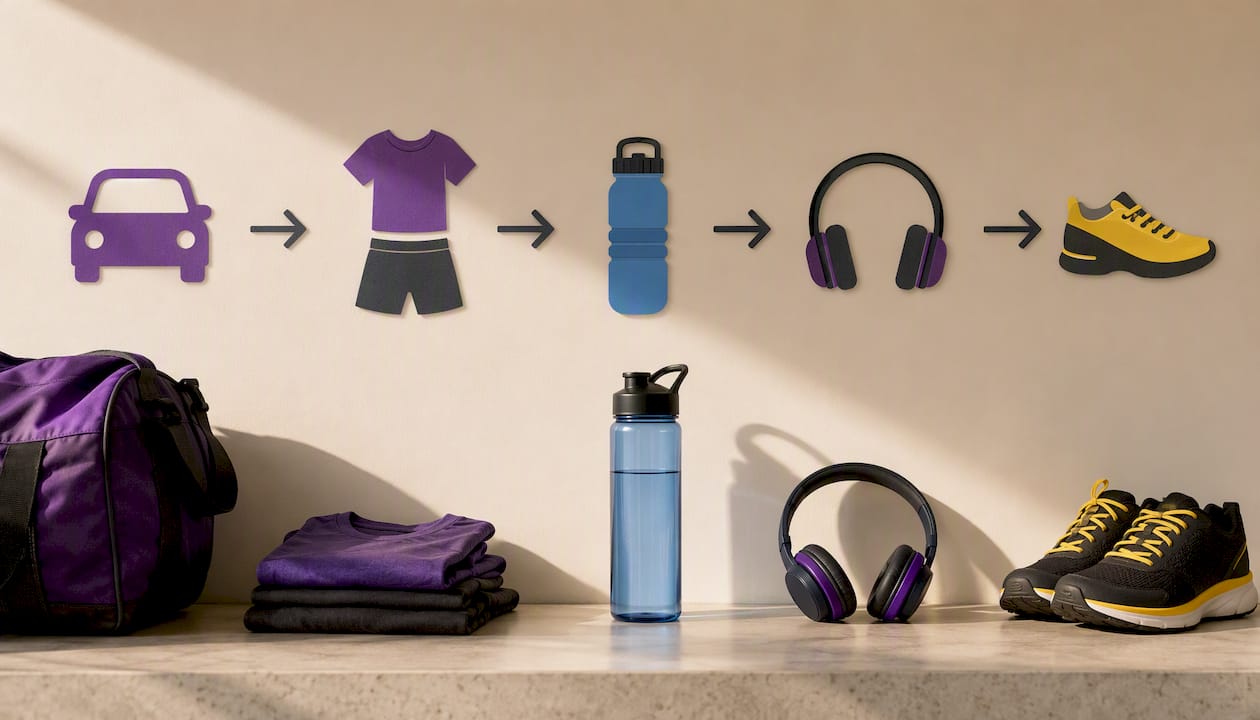
Use an anchor, meaning you tie the workout to something that already happens reliably every day. “Right after I drop the kids off,” “immediately when I close my laptop for lunch,” or “before I check my phone in the morning” all work better than a plain clock time, because your brain follows sequences more reliably than it follows numbers on a screen.
Attention management matters as much as time blocking:
- Decide your workout the night before, not when you’re standing there in workout clothes wondering what to do.
- Set a pre-decision rule like “if I have less than 15 minutes, I default to the short session automatically,” so there’s no negotiation window.
- Tell one other person your plan. A quick text to a friend or partner (“training at 6, checking in after”) creates light social pressure that’s surprisingly effective.
- Silence notifications during the block. A single incoming message can turn a 20 minute session into a 45 minute distraction spiral.
Communication with family or coworkers matters more than most planning guides admit. If your workout window overlaps with when your kids expect you or when colleagues expect a fast reply, say so out loud. “I’m offline from 6:30 to 7 most mornings” prevents the slow erosion where your protected time quietly becomes everyone else’s available time.
Pro Tip: Put your workout block on a shared family or team calendar using the same visual weight as a work meeting. People respect blocks they can see. They ignore blocks they have to guess at.
How Do You Reduce Friction Before a Workout?
The gap between “I planned to work out” and “I actually worked out” is almost always about friction, not motivation. Lower the friction and the motivation problem mostly takes care of itself.
- Lay out your clothes and gear the night before. This sounds small. It isn’t. The decision to dig through a drawer for matching socks at 6 AM is exactly the kind of tiny obstacle that talks people out of showing up.
- Keep equipment visible, not stored. A resistance band hanging on a doorknob gets used. A resistance band in a closet bin gets forgotten. If you’re working with a small apartment or a shared space, compact gear from a resource like this guide to home workout equipment for small spaces solves the storage problem without eating your living room.
- Build a short workout “menu” of three or four go-to options. When you’re tired and short on time, choosing from three known options is fast. Designing a workout from scratch is not.
- Pack a bag once a week, not once a day. If your default time involves leaving the house, pack the bag on Sunday for the whole week so Tuesday morning isn’t a scavenger hunt.
- Pre-load a playlist or a podcast episode. Removing the “what do I listen to” decision saves two minutes that feel like ten when you’re already running late.
Every one of these tactics does the same job: it removes a choice you’d otherwise have to make in the moment, when your resistance is highest. Fewer choices in the moment means a higher chance you actually start, and starting is almost always the hardest part of the whole session.
Short-Session Templates You Can Use Today
You don’t need an hour to get a real training effect. National physical activity guidelines allow activity to count toward weekly totals in chunks as short as 10 minutes, according to ACE Fitness, which means the short session isn’t a consolation prize. It’s a legitimate part of your plan.
The 20-minute full-body circuit:
- 3 minutes of warm-up (light cardio, joint mobility)
- 5-movement circuit, 40 seconds work / 20 seconds rest, repeated 3 rounds (squats, push-ups, rows, lunges, plank)
- 2 minutes of cool-down and stretching
The 12-minute strength finisher:
- 4 rounds of 3 compound movements (deadlift or hip hinge variation, overhead press, and a pulling movement), 10 to 12 reps each, minimal rest between exercises
The 10-to-15-minute micro-workout:
- Two or three exercises stacked back to back, useful stacked twice a day if a single session isn’t possible (a morning stack plus an evening stack still adds up)
The 30-to-40-minute focused session for fuller days:
- Standard warm-up, 2 to 3 main compound lifts with progressive loading, one or two accessory movements, structured cool-down
Compound movements done consistently with a double-progression approach, adding reps first, then weight, drive real strength gains even inside a 20 to 30 minute window, per ACE Fitness guidance on efficient training. Track progress by logging either the reps or the load each session, not by how the workout felt. Feelings are unreliable. Numbers on a page tell you if you’re actually improving.
If you want a done-for-you version of these circuits with the guesswork removed, an easy at-home routine gives you a ready structure to plug into either track without designing anything yourself.
When Should You Rest Instead of Push Through?
Not every skipped workout is a discipline failure. Sometimes it’s your body telling you something your calendar can’t see.
The distinction that matters is true fatigue versus low motivation, and they feel almost identical from the inside. Persistent tiredness, poor sleep, and low appetite point toward recovery needs, not laziness, according to Medical News Today’s guidance on making a routine actually work long term. Run a quick check before deciding:
- How did you sleep the last two nights? Under six hours for multiple nights running is a strong signal to scale down, not push through.
- Have you eaten and hydrated properly today? Skipping meals and then wondering why a workout feels brutal is a common, avoidable mistake.
- How’s your training load been over the past week? Three hard sessions back to back with no easy day in between usually calls for a lighter one, not a harder one.
If two or more of those checks come back negative, that’s your cue to scale down to the short track or take a full rest day rather than grinding through a session your body isn’t ready for. Building a deliberate lighter week, sometimes called a deload, every four to six weeks keeps this from becoming a constant negotiation. A short active session, even just the 10 minute micro-workout, can maintain momentum during a genuinely busy or run-down stretch without adding more fatigue on top of what you’re already carrying. For guidance on eating in a way that actually supports recovery rather than working against it, this breakdown of post-workout nutrition covers timing and food choices worth building into your week. A post-workout fruit pairing guide is also worth a look if you want something quick and simple after a session.
The one-sentence rule to operate by: scale the session down before you consider skipping it entirely, and only skip when the fatigue check clearly says rest, not when motivation is just low.
What Mark’s Practical Rules Get Right About Training on a Tight Schedule
Mark, a contributor at Diet & Exercise Shop, built his approach around three rules that show up throughout this guide because they’re the ones that actually hold up under a busy week: reduce start cost wherever possible, treat the workout slot like an unmovable meeting, and always keep a short menu of go-to sessions ready so there’s never a moment of standing around deciding what to do.
Each rule maps to a specific tool. If your priority is short, intense sessions that fit a tight window without sacrificing intensity, the HIIT IT HARD Training Guide gives you structured interval work built for exactly that. If you want a fuller program that still respects a real schedule rather than assuming you have unlimited gym hours, the REAL LIFE FITNESS eBook is built around that constraint from the ground up. And if your goal leans toward movement quality and everyday strength rather than pure aesthetics, the FUNCTIONAL FITNESS eBook gives you movement templates that slot directly into either the full or short track.
None of these replace judgment. They replace the blank page, which is usually the actual obstacle standing between a busy person and a finished workout.
Why Consistent Small Wins Beat Occasional Long Sessions
The math on this isn’t complicated, but people resist believing it. Four twenty-minute sessions a week beat one heroic ninety-minute session almost every time, because training effect compounds with frequency far more than it compounds with duration. Missing your one big session costs you the entire week. Missing one short session out of four costs you a quarter of your week, and you’ve still got three chances left to recover the loss.
The habit itself is the asset, not any individual workout. Every time you show up, even for twelve minutes, you’re reinforcing the identity of someone who trains. Skip enough sessions and you’re reinforcing the opposite identity, regardless of how good your intentions were.
Pick one thing from this article, just one, and run it for seven days. A default time. A two-track plan. A prepped gym bag. Don’t try to fix everything at once. See what happens.
— Mark
Ready to Put the Plan Into Practice?
Reading a plan and running it are two different things, and the gap between them usually closes fastest with a structure someone else already built. Dietexerciseshop provides workout plans designed to fit within a two-track training system.

Want intensity that fits a short window? The HIIT IT HARD Training Guide gives you interval formats built for the 10 to 20 minute track. Want a full structured program that still respects a packed calendar? The REAL LIFE FITNESS eBook handles that. Want functional movement templates for everyday strength? The FUNCTIONAL FITNESS eBook covers it. And if you’re outfitting your default time slot with gear, apparel, or the small tools that reduce start cost, Dietexerciseshop’s full collection covers the rest, including lightweight training shorts that make packing a gym bag one less decision to make. Pick the guide that matches your track and start this week.
Sources
For deeper detail on the ideas covered here, these three sources are worth reading directly. ACE Fitness covers time-management tactics and the case for short, consistent sessions. Medical News Today breaks down how to tell true fatigue from low motivation. Zing Coach offers practical scheduling tactics for fitting training into an unpredictable week.
- How to make your exercise routine work for you, expert tips — Medical News Today
- How to fit exercise into a busy schedule — Zing Coach
- 8 time management tips to help you achieve your health and fitness goals — ACE Fitness
FAQ
How Much Time Should I Budget for Workouts Each Week?
A workable weekly floor for most busy adults is around four sessions, mixing full and short formats depending on the day. Short sessions of 10 to 20 minutes still count toward activity totals according to ACE Fitness, so the floor doesn’t require large blocks of free time.
What’s the Best Time of Day to Work Out if I’m Busy?
The best time is whichever slot survives your actual schedule most consistently, which tends to be earlier in the day for many people since fewer things compete for that window. Performance differences between morning and evening training are usually minor once sleep and nutrition are solid, per Zing Coach.
How Do I Know if I’m Too Tired to Work Out or Just Unmotivated?
Check your recent sleep, hydration, and training load before deciding; if two or more are off, that points to real fatigue rather than low motivation. Medical News Today recommends addressing those recovery factors directly instead of pushing through a session on willpower alone.
Can Short Workouts Actually Replace Longer Sessions?
Short workouts don’t need to fully replace longer ones, but they can preserve progress on days a full session isn’t possible. Consistent 10 to 20 minute sessions built around compound movements deliver real training effect, according to ACE Fitness, which is the entire premise behind the two-track plan.
Which Dietexerciseshop Product Fits a Tight Schedule Best?
If your main constraint is time and intensity, the HIIT IT HARD Training Guide is built specifically for short, high-effort sessions. Current pricing for all three guides is listed on the Dietexerciseshop site.